
In the rapidly evolving landscape of Natural Language Processing (NLP) and Artificial Intelligence, the fundamental building blocks of human language are being re-examined through a computational lens. For developers, data scientists, and EdTech innovators, understanding linguistic structures is no longer just a humanities pursuit; it is a technical requirement. Among the most critical of these structures in the Romance languages—and specifically in Spanish—is the “infinitive.”
In Spanish, the infinitive is the base, unconjugated form of a verb. While a linguist sees “hablar” (to speak) as a semantic concept, an AI developer sees it as a “lemma”—the canonical form of a word used as a key in database indexing and morphological analysis. As we scale global software solutions and refine machine translation, the Spanish infinitive serves as the anchor for algorithmic accuracy and user experience in language-driven applications.
The Technical Foundation: Why the Infinitive Matters in NLP
To understand the infinitive in a technical context, we must look at how machines “read” Spanish. Unlike English, which has a relatively sparse morphological system, Spanish is highly inflected. A single Spanish verb can take dozens of different forms depending on tense, mood, person, and number. For an AI to function efficiently, it must be able to map all these variations back to a single source: the infinitive.
Lemmatization vs. Stemming in Spanish Software
In the realm of search engine optimization (SEO) algorithms and internal database searches, two processes are vital: stemming and lemmatization. Stemming is a crude heuristic process that chops off the ends of words in the hope of reaching a root. For example, a stemmer might turn “corriendo” (running) into “corr.”
However, lemmatization is a more sophisticated tech approach that uses a vocabulary and morphological analysis of words to return the dictionary form, or the infinitive. In Spanish tech stacks, lemmatization is the gold standard. By identifying the infinitive (e.g., “correr”), the software ensures that a user searching for “corrimos” (we ran) finds relevant results for the entire verb family. This is the backbone of modern Spanish-language search architecture and digital libraries.
Tokenization and the Spanish Morphological Tier
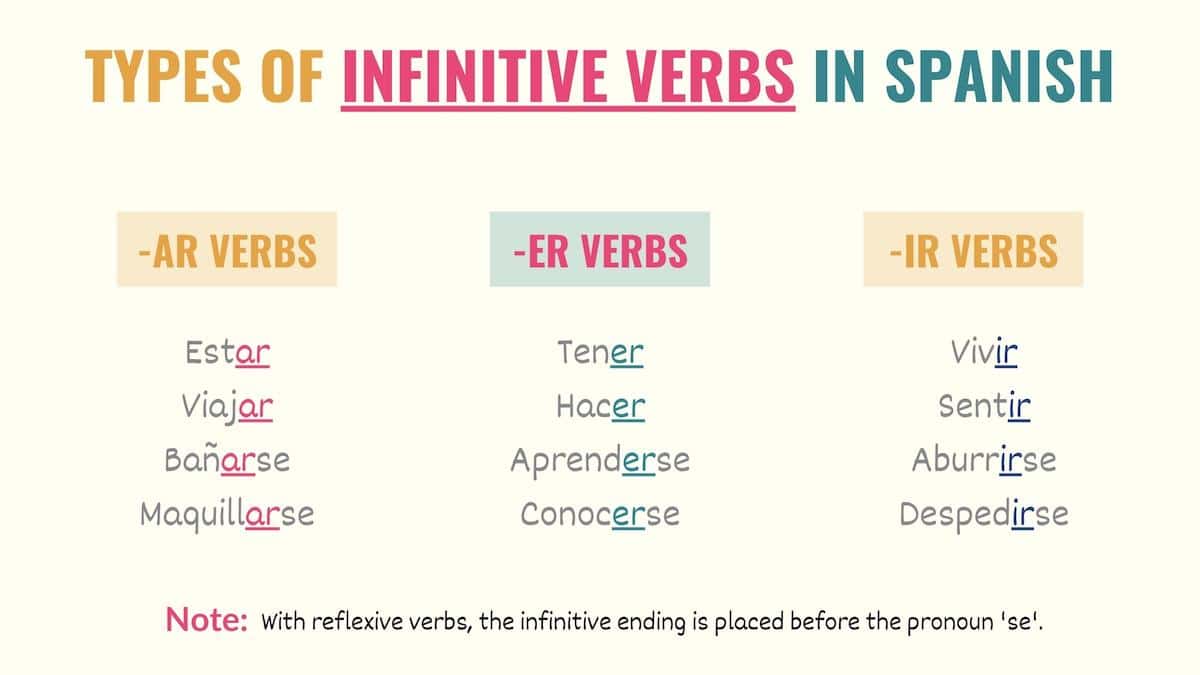
When a Large Language Model (LLM) or a translation tool processes a sentence like “Quiero comer” (I want to eat), it performs tokenization. The infinitive “comer” acts as a stable token. In technical terms, Spanish infinitives are categorized into three distinct classes based on their endings: -ar, -er, and -ir.
From a programming perspective, these endings function as metadata tags. They signal to the translation algorithm which conjugation pattern the verb will follow. If an AI tool identifies a new or “neologism” verb (like “googlear” or “twittear”), it uses the -ar infinitive suffix to predict how that verb should be handled across different temporal data points.
Algorithmic Challenges: Parsing the Infinitive in Complex Syntax
While identifying an infinitive might seem straightforward, the technical implementation becomes complex when dealing with “clitic pronouns” and “periphrastic constructions.” These are the areas where standard translation software often fails and where advanced AI tools must demonstrate superior logic.
Handling Attached Pronouns in Software Logic
One of the unique features of the Spanish infinitive is its ability to host “clitic” pronouns at the end of the word. A word like “decírmelo” (to tell it to me) is a single string of text containing an infinitive (“decir”) and two pronouns (“me” and “lo”).
For a software’s parser, this requires a multi-step deconstruction process. The code must first strip the suffixes, identify the base infinitive, and then assign the pronouns to their respective roles in the data structure. This is a critical step in building sophisticated chatbots and virtual assistants for the Spanish-speaking market. If the parser cannot isolate the infinitive from the string, the entire semantic meaning of the user’s input is lost.
Verbal Periphrasis and Sequence-to-Sequence Models
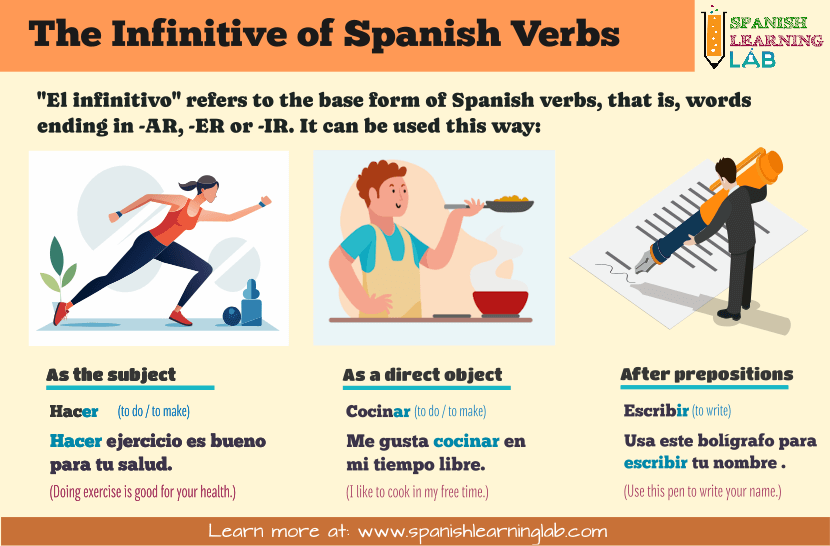
In tech, we often use Sequence-to-Sequence (Seq2Seq) models to handle translation. Spanish relies heavily on “verbal periphrasis,” which involves a conjugated “helper” verb followed by an infinitive (e.g., “Voy a estudiar” – I am going to study).
The technical challenge here is maintaining “long-distance dependencies.” The AI must understand that the infinitive “estudiar” carries the primary semantic weight, while the preceding verb provides the temporal context. Developers must train neural networks to recognize these pairs as a single functional unit rather than isolated words. This ensures that the digital output remains natural and contextually relevant for the end-user.
The Role of the Infinitive in EdTech and Language Learning Apps
The Spanish infinitive isn’t just a backend data point; it is a front-facing component of User Interface (UI) and User Experience (UX) design in the $10 billion EdTech industry. Applications like Duolingo, Babbel, and Rosetta Stone rely on the infinitive as the primary teaching vehicle for their pedagogical algorithms.
Gamification and Verb Conjugation Engines
Modern language apps use “conjugation engines”—software modules specifically designed to generate verb forms on the fly. These engines start with the infinitive as the input variable. For instance, if an app wants to test a user on the “Future Tense” of “vivir” (to live), the algorithm applies a specific transformation rule to the infinitive string.
From a UI/UX standpoint, the infinitive is used to reduce “cognitive load.” By presenting the infinitive in a digital flashcard or a selection menu, the app provides the user with the simplest possible version of a concept before introducing the complexities of tense and mood. This hierarchical data presentation is a cornerstone of effective instructional design in digital products.
Adaptive Learning and Error Pattern Recognition
Advanced EdTech tools use AI to track “error patterns.” When a user consistently struggles with verbs ending in -ir, the software’s underlying logic identifies this by tagging the infinitives in the user’s mistake logs.
By categorizing verbs by their infinitive type, the algorithm can create a personalized “remediation path.” If the data shows a 40% failure rate on -er infinitives in the subjunctive mood, the app will dynamically adjust the user’s daily “streak” challenges to focus on that specific technical morphological cluster. This is big data and machine learning applied directly to the mechanics of the Spanish language.
Future Trends: LLMs, Localization, and the Digital Evolution of Spanish
As we move toward a future dominated by Generative AI, the way technology interacts with the Spanish infinitive continues to evolve. We are moving beyond simple rule-based systems into an era of deep semantic understanding.
Beyond Translation: Contextual Localization
Localization is the process of adapting software for a specific region. In Spanish, this is particularly difficult because the use of the infinitive can vary between Spain and Latin America in certain idiomatic expressions.
The next generation of AI-driven localization tools is being trained on massive datasets to recognize these nuances. Instead of a “one-size-fits-all” translation, these tools use the infinitive as a base to build region-specific variants. This ensures that a corporate app used in Buenos Aires feels as native as one used in Madrid, despite the underlying code sharing the same linguistic foundations.
The Rise of Neural Machine Translation (NMT)
Neural Machine Translation has revolutionized how we handle the Spanish infinitive. Unlike older statistical models, NMT looks at the “vector representation” of words. In a high-dimensional vector space, the Spanish infinitive occupies a central node.
The AI learns that the infinitive represents the “purest” form of the action. When the model encounters a complex or rare conjugated form, it “projects” that word back toward the infinitive’s coordinates to understand its core meaning. This mathematical approach to grammar has led to a 30% increase in translation accuracy for technical Spanish manuals and medical documentation over the last five years.

Conclusion: The Infinitive as a Digital Bridge
The question “what is the infinitive in Spanish” may begin in a classroom, but it ends in the server room. In the tech industry, the infinitive is more than a part of speech; it is a vital data point that enables seamless communication, drives the EdTech revolution, and powers the most sophisticated AI models in existence.
As software continues to eat the world, and as Spanish remains one of the most dominant languages on the internet, the technical mastery of the infinitive remains a priority. Whether you are building a new language learning app, refining a chatbot, or optimizing a global search engine, the Spanish infinitive is the linguistic “source code” that makes digital interaction possible. By treating grammar as a technical asset, developers can build tools that don’t just translate words, but truly understand the mechanics of human thought.
aViewFromTheCave is a participant in the Amazon Services LLC Associates Program, an affiliate advertising program designed to provide a means for sites to earn advertising fees by advertising and linking to Amazon.com. Amazon, the Amazon logo, AmazonSupply, and the AmazonSupply logo are trademarks of Amazon.com, Inc. or its affiliates. As an Amazon Associate we earn affiliate commissions from qualifying purchases.