
In the dynamic world of automotive performance, the term “intercooler” frequently surfaces in discussions about boosting horsepower and optimizing engine efficiency. While often associated with high-performance vehicles and racing, intercoolers are integral components in many modern turbocharged and supercharged engines, contributing significantly to their overall capabilities. This article delves into the fundamental question: what is an intercooler? We will explore its purpose, how it functions, the different types available, and its crucial role in enhancing engine performance, drawing parallels to principles found in technology, brand optimization, and even financial efficiency.
The Science Behind the Boost: Why Intercooling Matters
At its core, the need for an intercooler arises from a fundamental thermodynamic principle: compressing a gas increases its temperature. In the context of internal combustion engines, turbochargers and superchargers are essentially compressors. They force more air into the engine’s cylinders than would be possible under natural aspiration. This increased volume of air allows for more fuel to be injected, leading to a more powerful explosion and, consequently, more horsepower.

However, this process of forced induction comes with a significant drawback: heat. As the turbocharger or supercharger compresses the intake air, its temperature rises dramatically. Hotter air is less dense than cooler air, meaning that for a given volume, it contains fewer oxygen molecules. This directly translates to less fuel being able to burn efficiently, thereby diminishing the potential gains from the boost. Furthermore, excessively high intake air temperatures can lead to engine knocking or detonation, a potentially destructive phenomenon that can severely damage the engine.
This is precisely where the intercooler steps in. Think of it as a sophisticated radiator for the air, designed to cool down the charge air before it enters the engine. By reducing the temperature of the compressed air, the intercooler significantly increases its density. This denser air, rich with oxygen, allows the engine to burn fuel more effectively, leading to a more potent combustion and a tangible increase in power output.
The Analogy of Information Compression and Processing
To understand the impact of intercooling, we can draw an analogy to the technological realm. In computing, we often deal with data compression. While compressing data allows for faster transmission and storage, the decompression process itself generates heat. Similarly, when a turbocharger or supercharger “compresses” air, it’s akin to compressing data – it’s about increasing density and potential. However, this compression generates “heat noise” that degrades the “signal” (the available oxygen).
An intercooler acts like an efficient decompression and cooling system. It takes the “hot, noisy” compressed air and cools it down, effectively “cleaning up the signal” and making it ready for optimal “processing” by the engine. Without this cooling, the increased data (air) would be less useful and potentially damaging, much like attempting to process highly compressed and overheated data without proper cooling.
Brand Perception and Reputation Management
From a brand perspective, the concept of “cooling” or “optimizing” a product or service before it reaches the customer shares similarities with intercooling. Imagine a company launching a new product. If the product is rushed to market with unresolved issues (analogous to hot, uncooled air), it can lead to negative customer experiences, damaging the brand’s reputation.
Effective brand strategy involves thorough testing, refinement, and quality control – essentially, an “intercooling” process. This ensures that what reaches the consumer is a polished, high-performing product that enhances the brand’s image and builds trust. Just as an intercooler delivers denser, more potent air to the engine, a well-prepared product delivers a superior customer experience, strengthening the brand’s identity and fostering loyalty.
How an Intercooler Works: The Mechanism of Cooling
The fundamental principle behind an intercooler’s operation is heat exchange. It’s a process designed to transfer heat from the compressed intake air to another medium. The most common types of intercoolers utilize air or a liquid as the cooling medium.
Air-to-Air Intercoolers
The most prevalent type of intercooler is the air-to-air intercooler. These units consist of a series of finned tubes, often arranged in a dense matrix. The hot compressed air from the turbocharger or supercharger flows through these tubes. Simultaneously, ambient air is directed over the external fins of the intercooler. As the cooler ambient air passes over the fins, it absorbs heat from the tubes, effectively cooling the air inside.
The efficiency of an air-to-air intercooler is influenced by several factors:
- Surface Area: A larger surface area, achieved through more fins and larger intercooler cores, allows for greater heat dissipation.
- Airflow: Sufficient airflow over the intercooler’s fins is critical for efficient cooling. This is why intercoolers are often strategically placed in the front of vehicles where they receive unobstructed airflow.
- Fin Density and Design: The design of the fins plays a role in turbulence and heat transfer.
- Ambient Temperature: Naturally, intercoolers are more effective in cooler ambient conditions.
Air-to-air intercoolers are generally simpler in design, lighter, and more cost-effective to manufacture. They are widely used in a broad range of performance vehicles.
Air-to-Water Intercoolers
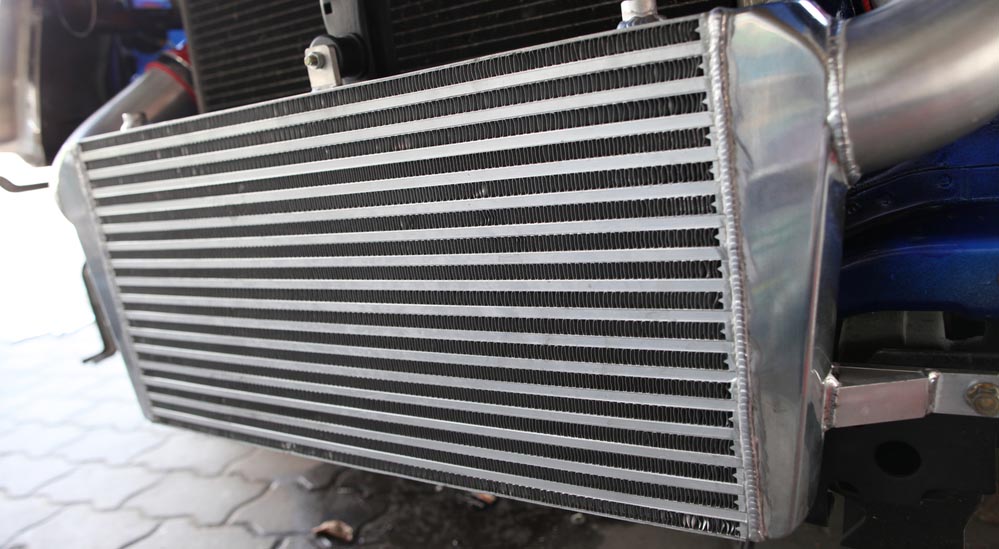
Another effective, though less common, type is the air-to-water intercooler. In this system, the compressed intake air flows through a heat exchanger. This heat exchanger is then cooled by a separate liquid cooling circuit, typically using a dedicated radiator and a water-methanol mixture or pure water.
The hot compressed air passes through a series of channels, and a coolant circulates in adjacent channels, absorbing heat from the air. This cooled air is then fed into the engine. The coolant then flows to a separate radiator, where it is cooled by ambient air, and the cycle repeats.
Air-to-water intercoolers offer several advantages:
- More Consistent Cooling: They are less dependent on ambient air temperature and vehicle speed, providing more consistent charge air cooling.
- Compact Size: They can often be made more compact than air-to-air systems, offering more flexibility in installation.
- Reduced Turbo Lag: In some applications, the more efficient cooling can lead to a slight reduction in turbo lag.
However, air-to-water intercoolers are more complex, heavier, and more expensive to implement due to the additional components and plumbing required. They are often found in high-performance, track-focused vehicles or where space constraints are a significant consideration.
Enhancing Financial Efficiency and Performance
The pursuit of optimal performance through an intercooler can be directly paralleled to managing personal or business finances. Just as an intercooler helps an engine achieve its peak potential by optimizing air intake, sound financial practices enable individuals and businesses to reach their financial goals more effectively.
The “Charge Air” of Income and the “Intercooler” of Financial Planning
Consider your income as the “compressed air” generated by your work or business. Without proper management, this income can be “hot” – meaning it’s quickly spent, loses value due to inflation, or is subjected to inefficient tax strategies. This “hot income” doesn’t perform at its best.
A robust financial plan, akin to an intercooler, cools down and optimizes this income. This involves strategies such as:
- Budgeting and Expense Tracking: This is the equivalent of efficient airflow over the intercooler, ensuring that resources are directed effectively and not wasted.
- Smart Investing: Investing your income allows it to grow and become more “dense” and valuable over time, much like denser air leads to more powerful combustion.
- Tax Optimization: Utilizing tax-efficient strategies (like tax-advantaged retirement accounts) cools down the tax burden, allowing more of your hard-earned money to remain with you.
- Debt Management: Effectively managing and reducing debt is like ensuring the intercooler itself is well-maintained and free from blockages, preventing a drag on your financial performance.
Just as a poorly performing intercooler can hobble an engine, poor financial planning can lead to missed opportunities, financial stress, and a failure to achieve long-term wealth. By implementing effective “intercooling” strategies for your finances, you can maximize the performance and growth potential of your income, leading to greater financial security and the achievement of your financial aspirations.
The “Turbocharger” of Business Growth and “Intercooling” for Sustainability
For businesses, the analogy extends to growth and operational efficiency. A rapidly growing business, akin to a turbocharged engine, experiences increased demand and pressure. Without proper management, this growth can lead to inefficiencies, increased costs, and potentially unsustainable practices – a “hot” business that is burning too brightly and quickly.
The “intercooling” for a business involves implementing strategic operational and financial processes that optimize its performance and ensure long-term sustainability. This can include:
- Streamlining Operations: Identifying and eliminating bottlenecks in production or service delivery is like ensuring efficient airflow through an intercooler.
- Cost Management: Implementing rigorous cost controls and seeking efficiencies in resource allocation is crucial for preventing excessive heat buildup.
- Strategic Pricing: Understanding market dynamics and pricing products or services optimally ensures that revenue is maximized without sacrificing demand.
- Financial Forecasting and Risk Management: Proactively identifying potential financial risks and developing contingency plans is like ensuring the intercooler system is robust and can handle variations in operating conditions.
A business that effectively “cools” its growth by maintaining operational efficiency and financial discipline is better positioned to achieve sustainable success, adapt to market changes, and deliver consistent value to its stakeholders. It’s about achieving peak performance without the detrimental side effects of overheating.

Conclusion: The Unsung Hero of Performance
In conclusion, an intercooler is a vital component in turbocharged and supercharged engines, responsible for cooling the compressed intake air before it enters the combustion chambers. By increasing air density, it directly contributes to enhanced engine power, improved fuel efficiency, and crucial protection against detonation. Whether air-to-air or air-to-water, the intercooler’s role is to optimize the “charge” of air, ensuring it’s at its most effective state for combustion.
The principles behind intercooling resonate across various domains, from the technological pursuit of efficient data processing to the strategic management of brand perception. Furthermore, the concept of optimizing and cooling “hot” elements for better performance and sustainability finds a strong parallel in personal and business finance, where smart planning and efficient practices are essential for achieving long-term goals. So, the next time you hear about an intercooler, remember its fundamental purpose: to take something powerful and make it even better, more efficient, and more reliable – a true unsung hero of performance in the automotive world and beyond.
aViewFromTheCave is a participant in the Amazon Services LLC Associates Program, an affiliate advertising program designed to provide a means for sites to earn advertising fees by advertising and linking to Amazon.com. Amazon, the Amazon logo, AmazonSupply, and the AmazonSupply logo are trademarks of Amazon.com, Inc. or its affiliates. As an Amazon Associate we earn affiliate commissions from qualifying purchases.