
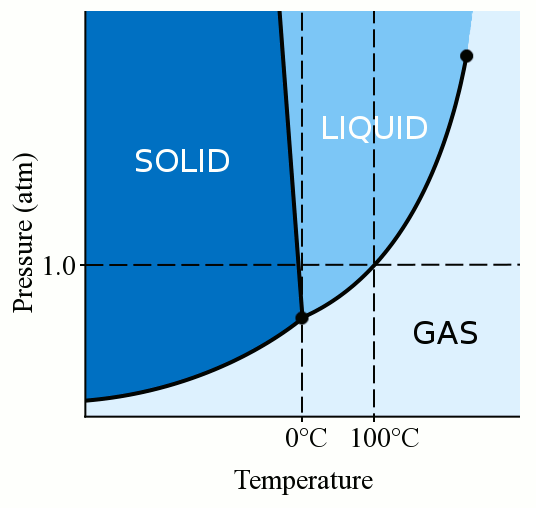
In the natural world, 0 degrees Celsius represents a fundamental phase shift: the moment liquid water transforms into solid ice. However, in the realm of technology, this temperature marks a critical engineering boundary. From the lithium-ion batteries powering our smartphones to the massive liquid-cooling arrays of hyperscale data centers, 0°C is a threshold that demands sophisticated hardware engineering and intelligent software management.
When we ask what happens to “water” at this temperature within a technological context, we are really asking how thermal management, material science, and digital infrastructure respond to the physical challenges of the freezing point. In this deep dive, we explore how the tech industry navigates the 0°C barrier, the innovations born from cold-weather challenges, and the future of hardware resilience.
The Physics of Hardware: What Happens to Circuits at 0°C?
At the microscopic level of a circuit board, 0 degrees Celsius is not merely “cold”—it is a catalyst for physical and electrical change. While semiconductors often perform better at lower temperatures due to reduced thermal noise, the presence of moisture and the physical properties of materials introduce significant risks.
The Condensation Crisis and Humidity Control
The primary threat at 0°C isn’t the cold itself, but the transition of ambient moisture. When hardware components drop to the freezing point, any humidity in the air can condense into liquid water or frost directly onto the PCB (Printed Circuit Board).
In the tech industry, this is known as “reaching the dew point.” If a device is moved from a cold environment (like a car in winter) to a warm room, the sudden temperature shift causes immediate condensation. Modern consumer electronics utilize hydrophobic coatings—microscopic layers of polymers—to prevent these droplets from causing a short circuit. However, for industrial-grade tech, engineers must implement “hermetic sealing” to ensure that the internal atmosphere of the device remains bone-dry, regardless of the external temperature.
Mechanical Stress and Material Contraction
Every material used in technology—copper, silicon, gold, and various plastics—has a different coefficient of thermal expansion. As temperatures drop toward 0°C, these materials contract at different rates. This can lead to “solder joint fatigue,” where the microscopic connections between a chip and the motherboard crack under the mechanical stress of contraction. High-end ruggedized tech, such as that used in aerospace or outdoor telecommunications, uses specialized alloys and flexible substrates designed to maintain integrity even as the mercury hits the freezing mark.
Battery Innovation: The Battle Against the Cold
Perhaps the most visible impact of 0 degrees Celsius is on energy storage. Anyone who has seen their smartphone battery drop from 20% to 1% instantly while standing outside in winter has experienced the “0°C effect” on lithium-ion chemistry.
The Slowdown of Ion Transport
Lithium-ion batteries rely on the movement of ions through a liquid electrolyte. As the temperature approaches 0°C, the viscosity of this electrolyte increases—essentially, the “liquid” becomes more like a thick syrup. This increase in internal resistance makes it much harder for ions to move between the anode and the cathode.
From a software perspective, the Battery Management System (BMS) must intervene. At 0°C, the BMS will often throttle the device’s performance to prevent a “voltage sag,” which would otherwise cause the device to shut down unexpectedly. This is a prime example of how software must be programmed to understand the physical limitations of hardware at the freezing point.
EV Pre-Conditioning and Thermal Management
In the Electric Vehicle (EV) sector, 0°C is a major hurdle for range and charging speeds. Regenerative braking is often disabled or limited at these temperatures because the battery cannot safely accept a high-current charge when the ions are moving so slowly.
To combat this, companies like Tesla and Lucid have pioneered “thermal pre-conditioning” technology. When a driver sets a destination to a charging station in the GPS, the car’s software uses energy to intentionally heat the battery pack to roughly 20°C before arrival. By the time the car reaches the charger, the “water” (electrolyte) inside the battery is no longer behaving like a frozen barrier, allowing for rapid electrons transfer.

Data Center Infrastructure and the Free Cooling Revolution
While consumer devices struggle with the cold, the enterprise tech world—specifically data centers—has learned to view 0 degrees Celsius as a massive opportunity for efficiency.
The Rise of “Free Cooling”
Data centers generate an incredible amount of heat. Traditionally, this required energy-intensive chillers to keep servers at optimal temperatures. However, “Free Cooling” technology allows data centers in cooler climates to use outside air to cool their systems. When the outside temperature is 0°C, it acts as a high-efficiency heat sink.
The engineering challenge here is “Economizer” technology. If the air is exactly 0°C, it is often too cold and too dry to be pumped directly into the server aisles. Instead, data centers use heat exchangers. The “water” in the cooling loops transfers the server heat to the outside air without the two ever mixing. This allows facilities to operate with a Power Usage Effectiveness (PUE) near 1.0, drastically reducing the carbon footprint of AI and cloud computing.
Waste Heat Recovery and District Heating
Innovators are now going a step further by treating the 0°C environment as a canvas for “Circular Tech.” In cities like Stockholm and Helsinki, data centers are integrated into the city’s district heating arrays. The servers heat up water, which is then pumped into the city’s pipes. At the 0°C mark, the temperature differential between the server “waste” and the external environment is at its peak, making the heat transfer incredibly efficient. Tech is no longer just surviving the cold; it is heating the world around it.
Specialized Tech: From Industrial Sensors to Quantum States
Beyond everyday gadgets and cloud servers, 0°C serves as a gateway to more extreme forms of computing and sensing.
The Superconductivity Horizon
While 0°C is the freezing point of water, in the world of Quantum Computing, it is considered “boiling hot.” Quantum processors often operate at near absolute zero. However, the development of “high-temperature” superconductors (which still operate far below 0°C but are “warm” compared to absolute zero) is the holy grail of electrical engineering. Research at the 0°C to -100°C range is vital for developing sensors that can operate in deep space or at the poles without the need for liquid helium cooling.
Edge Computing in Extreme Environments
The growth of the Internet of Things (IoT) means that sensors are being placed in environments where 0°C is the norm. Whether it’s an oil rig in the North Sea or a weather station on a mountain peak, “Edge Tech” must be designed with “Cold Start” capabilities.
A “Cold Start” refers to the ability of a system to boot up from a completely frozen state. This requires specialized oscillators (the “heartbeat” of a computer) that don’t drift in frequency when cold, and flash storage (SSD) that can retain data integrity even when the electrons are “sluggish.” Engineering for 0°C at the “Edge” is what allows for real-time climate monitoring and autonomous navigation in harsh climates.

Conclusion: The Engineering Mastery of 0°C
What happens to water at 0 degrees Celsius is a simple question of physics, but what happens to technology at 0 degrees Celsius is a complex narrative of human ingenuity.
At this temperature, we see the convergence of multiple tech disciplines:
- Chemical Engineering: Solving the electrolyte slowdown in our batteries.
- Software Engineering: Writing algorithms that protect hardware from thermal shock.
- Mechanical Engineering: Designing enclosures that breathe without letting in the “dew point” moisture.
- Environmental Tech: Leveraging the cold to create more sustainable data centers.
As we continue to push the boundaries of where technology can go—from the pockets of arctic explorers to the icy moons of Jupiter—the 0°C threshold remains one of our most significant benchmarks. It is the point where the digital meets the visceral reality of our physical world, forcing us to build tech that is not only smart but incredibly resilient. In the end, the way we handle the freezing point defines the reliability of the modern digital age.
aViewFromTheCave is a participant in the Amazon Services LLC Associates Program, an affiliate advertising program designed to provide a means for sites to earn advertising fees by advertising and linking to Amazon.com. Amazon, the Amazon logo, AmazonSupply, and the AmazonSupply logo are trademarks of Amazon.com, Inc. or its affiliates. As an Amazon Associate we earn affiliate commissions from qualifying purchases.