
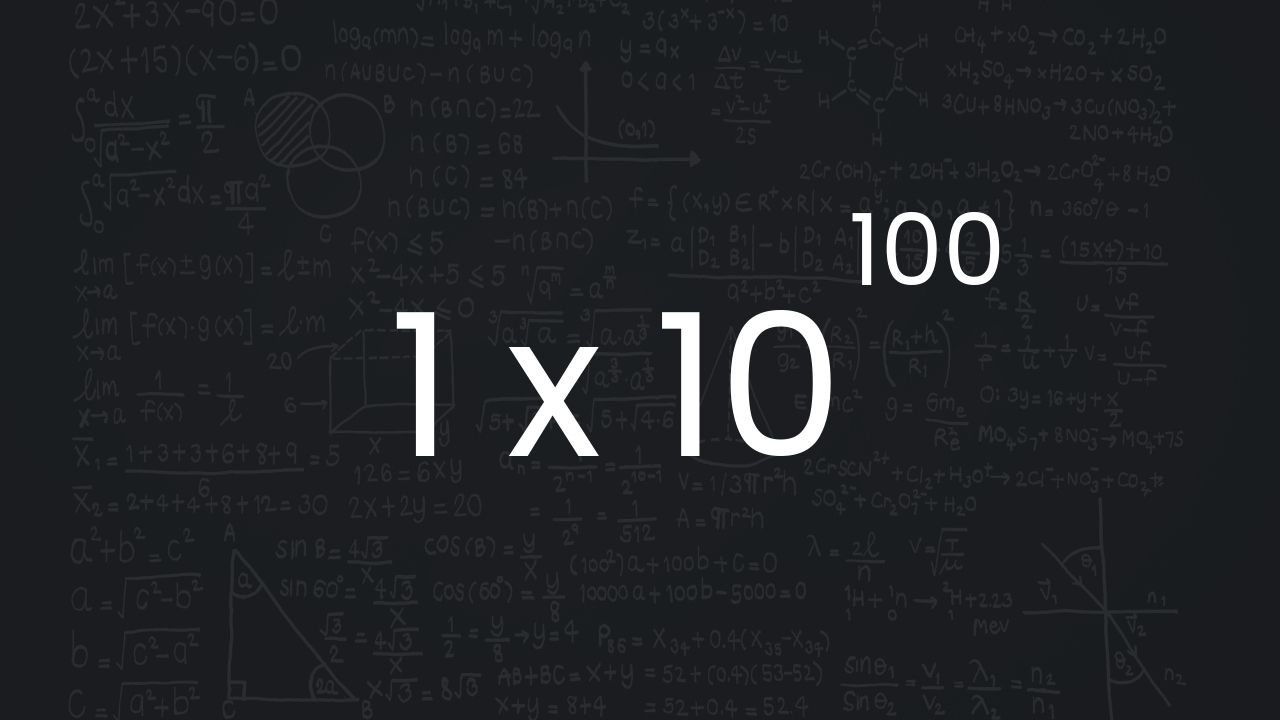
In the realm of mathematics, some numbers are so vast that they cease to be mere measurements and become philosophical provocations. A “googol” is a 1 followed by 100 zeros. While that number is already larger than the number of atoms in the observable universe (estimated at around $10^{80}$), it is a mere microscopic speck compared to a googolplex. A googolplex is defined as $10$ raised to the power of a googol ($10^{10^{100}}$).
To ask what a googolplex “looks like” is to challenge the very foundations of physical reality and digital architecture. In a world increasingly driven by Big Data, quantum computing, and complex AI neural networks, understanding the scale of the googolplex is not just a mathematical exercise—it is a roadmap for the future of technological limits.

The Architecture of Impossibility: Why We Can’t Compute a Googolplex
The first step in visualizing a googolplex through a technological lens is understanding the sheer physical impossibility of its representation. In modern computing, we represent data through bits—binary digits of 0s and 1s. To “write down” or store a googolplex in standard digital format would require more space than the physical universe provides.
The Limits of Physical Storage
Current high-density storage technologies, such as DNA storage or advanced solid-state drives, allow us to pack trillions of bits into small physical areas. However, even if we were to turn every single atom in the observable universe into a microscopic hard drive capable of storing one bit of data, we would still fall catastrophically short. Since there are roughly $10^{80}$ atoms in the universe, and a googolplex requires $10^{100}$ digits, we lack the “hardware” in reality itself to even record the number.
Information Theory and the Bekenstein Bound
In theoretical physics and computer science, the Bekenstein Bound represents the maximum amount of information that can be contained within a limited region of space which has a finite amount of energy. To visualize a googolplex, one would need a volume of space vastly larger than our current universe just to hold the informational “entropy” of such a number. For tech visionaries, this serves as the ultimate “ceiling.” It defines the point where traditional matter-based computing reaches its absolute terminus.
The Data Explosion: From Zettabytes to the Googolplex Scale
While we cannot store a googolplex, the trajectory of global data generation is moving toward scales that were previously unthinkable. We have transitioned from the era of Megabytes and Gigabytes into the era of the Zettabyte ($10^{21}$ bytes). As we look toward the next century of tech evolution, the “visualization” of massive numbers becomes a practical necessity for data scientists and software engineers.
The Rise of Hyperscale Computing
Modern cloud infrastructure—driven by giants like AWS, Google Cloud, and Azure—relies on hyperscale data centers. These facilities manage quintillions of bytes of data daily. When tech leaders discuss the “Global Datasphere,” they are looking at a growth curve that is exponential. While we are not yet operating at a “googol” level of complexity, the interconnectedness of IoT (Internet of Things) devices is creating a digital nervous system that mimics the complexity of high-order mathematical sets.
High-Dimensional Data Spaces
In machine learning and AI development, we often work in “high-dimensional spaces.” When an AI model like GPT-4 processes information, it maps words and concepts into vectors with thousands of dimensions. The number of possible “paths” or connections in a massive neural network doesn’t reach a googolplex, but it reaches a level of “combinatorial explosion” where human intuition fails. Visualizing a googolplex in this context is about understanding the density of connections within a digital ecosystem.
Cryptography and the Security of Large Numbers
If you want to see a googolplex in action, look at the world of digital security. Modern encryption is built entirely on the premise that certain numbers are so large that they are effectively “uncomputable” within a reasonable timeframe. While we don’t use a googolplex for encryption keys (as they would be too large to process), we use the logic of the googolplex to protect global financial and technological assets.

Entropy and Brute Force Resistance
Digital security relies on entropy—the measure of randomness or unpredictability. A 256-bit AES encryption key has $2^{256}$ possible combinations. While $2^{256}$ is significantly smaller than a googolplex, it is still a number so large ($1.1 times 10^{77}$) that all the computing power on Earth working in parallel would take billions of years to crack it.
The Quantum Threat to Scale
The advent of quantum computing changes how we “visualize” these massive numbers. Using Shor’s algorithm, a sufficiently powerful quantum computer could factorize large numbers that are currently the backbone of RSA encryption. This has forced the tech industry to move toward “Post-Quantum Cryptography.” This transition is essentially an arms race of scale—finding mathematical structures and numbers even more complex and harder to navigate than those we use today, inching us closer to the mathematical complexity of a googolplex.
Artificial Intelligence and the Search for Meaning in Infinite Sets
What does a googolplex look like to an AI? For a Large Language Model (LLM) or a generative AI, a googolplex represents the theoretical limit of “all possible outputs.” When we ask an AI to generate an image or a piece of code, it is navigating a “probability space.”
Combinatorial Landscapes
Consider the game of Go, which has $10^{170}$ possible legal positions. This is more than a googol, though less than a googolplex. When Google’s AlphaGo defeated human champions, it did so by efficiently navigating a mathematical landscape that is physically impossible to map entirely. This is the “look” of a googolplex in software: a landscape of infinite branching paths where the goal of the technology is not to see the whole, but to find the most efficient route through the impossible.
Synthetic Data and the Infinite Feedback Loop
As AI begins to generate its own training data—a concept known as synthetic data—we are entering a cycle where the sheer volume of digital information could eventually approach “googol-scale” levels of redundancy. The challenge for future AI developers will be “Data Pruning”—the ability to look at a googolplex of possibilities and discard the $99.9%+1$ that are noise, leaving only the signal.
The Future of Hardware: Reaching for the Unreachable
To even begin to visualize or interact with numbers of this magnitude, our hardware must undergo a fundamental shift. We are currently approaching the end of Moore’s Law, where the number of transistors on a microchip doubles every two years. To move toward “googolplex-level” processing, we must look beyond silicon.
Neuromorphic and Optical Computing
Neuromorphic computing, which mimics the structure of the human brain, and optical computing, which uses light instead of electricity, offer paths toward handling higher orders of complexity. By using photons (light particles), we can achieve higher bandwidth and lower latency, allowing for the simulation of systems that have a “googol-like” number of variables.
The Simulation Hypothesis and Computational Limits
Some tech theorists suggest that if a googolplex can exist as a mathematical reality, it might be possible to simulate an entire universe. However, the “computational cost” of such a simulation brings us back to our initial problem: hardware. To visualize a googolplex, one would essentially have to be the computer that constitutes the universe itself. In the tech industry, this realization drives a focus on efficiency over raw scale. If we cannot build a googolplex-sized computer, we must build smarter algorithms that can approximate those results.
Conclusion: The Googolplex as a North Star for Tech
A googolplex does not “look” like a pile of zeros or a massive hard drive; it looks like the ultimate boundary of information technology. It represents the point where math outpaces matter. For tech professionals, the googolplex serves as a reminder of the infinite potential of digital expansion, but also as a sobering check on the physical constraints of our universe.
As we move deeper into the era of AI, quantum mechanics, and hyperscale data, we will continue to use numbers like the googolplex to test the limits of our algorithms and the strength of our encryption. We may never be able to “see” a googolplex, but by striving to compute the uncomputable, we drive the innovation that defines the modern technological age. The pursuit of the infinite is, ironically, what keeps the tech industry grounded in the necessity of constant evolution.
aViewFromTheCave is a participant in the Amazon Services LLC Associates Program, an affiliate advertising program designed to provide a means for sites to earn advertising fees by advertising and linking to Amazon.com. Amazon, the Amazon logo, AmazonSupply, and the AmazonSupply logo are trademarks of Amazon.com, Inc. or its affiliates. As an Amazon Associate we earn affiliate commissions from qualifying purchases.