
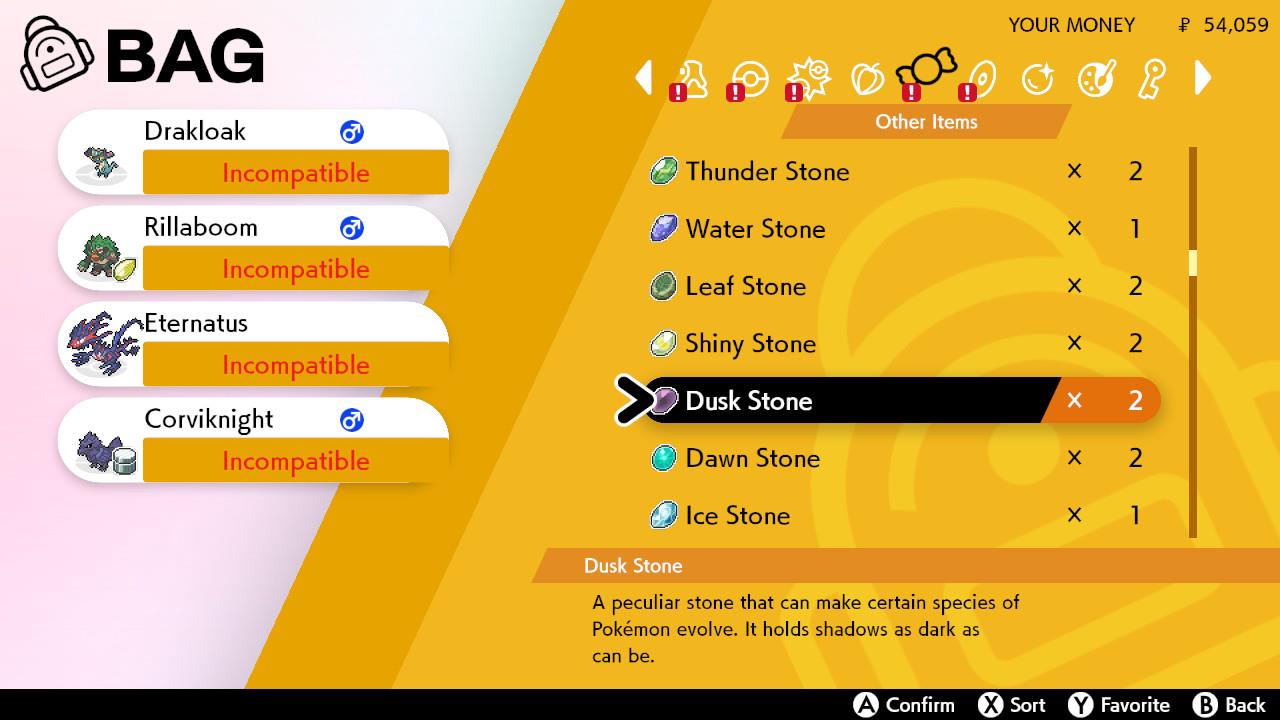
In the landscape of modern gaming technology, the concept of “evolution” serves as a fundamental mechanic that drives player engagement, progression systems, and software longevity. Within the Pokémon franchise—a multi-billion dollar tech ecosystem—evolution is not merely a narrative device but a sophisticated software trigger. One of the most intriguing “keys” within this digital architecture is the Dusk Stone.
To understand what a Dusk Stone evolves, one must look beyond the surface-level aesthetics of the creatures it transforms. We must analyze the game design logic, the conditional programming, and the role of specialized assets in creating a compelling user experience. From the technical implementation of rare item drops to the specific sprite and model transformations of Murkrow, Misdreavus, Lampent, and Doublade, the Dusk Stone represents a pivotal intersection of game balance and digital asset management.
The Logic of Evolution Items in Game Design
In the architecture of Role-Playing Games (RPGs), developers often face the challenge of “power creep”—the tendency for players to become too powerful too quickly. Evolution items like the Dusk Stone act as a form of algorithmic gatekeeping. By decoupling evolution from simple experience-based leveling, developers force players to engage with specific game environments, hidden side-quests, or complex currency systems to unlock a creature’s final form.
Algorithmic Gatekeeping and Player Retention
The Dusk Stone is a “consumable asset.” In terms of game logic, it functions as a boolean check: If Player possesses [Item: Dusk Stone] AND Target [Species: Murkrow/Misdreavus/Lampent/Doublade] THEN initiate [Function: Evolution]. This mechanic ensures that high-tier digital assets (like Honchkrow or Aegislash) are not distributed too early in the game’s lifecycle. By controlling the frequency of these stones through the game’s code—limiting them to specific locations or high-difficulty rewards—the developers maintain the “rarity” value of the evolved forms.
Enhancing Engagement via Asset Scarcity
From a UX (User Experience) perspective, the search for a Dusk Stone creates a secondary gameplay loop. Players are no longer just battling; they are “scavenging.” This utilizes the tech’s underlying RNG (Random Number Generation) systems. Whether it is using a “Dowsing Machine” tool or navigating complex 3D environments to find a hidden item-ball, the Dusk Stone serves as a reward for players who explore the technical boundaries of the game’s map.
Specific Implementations: The Dusk Stone and its Digital Targets
The Dusk Stone is specifically programmed to interact with a select group of Pokémon, primarily those with “dark” or “spectral” themes. Each of these evolutions represents a significant upgrade in the game’s database, affecting base stats, move-pools, and 3D modeling complexity.
Murkrow to Honchkrow: Visual and Data Upgrades
Introduced in the fourth generation of Pokémon software, the evolution of Murkrow into Honchkrow via the Dusk Stone marked a shift in how the game handled “niche” species. From a programming standpoint, Honchkrow is a significantly more complex asset. It features higher base stats (notably in Attack and Special Attack) and a more detailed character model. The transition from the small, simplistic Murkrow sprite to the “boss” aesthetic of Honchkrow demonstrates how evolution items allow developers to reboot older, underpowered digital assets for a modern competitive meta.
Misdreavus to Mismagius: Spectral Logic in Code
Similarly, Misdreavus utilizes the Dusk Stone to become Mismagius. This transformation is a prime example of “stat redistribution” within the game’s engine. Mismagius is coded to be a “Glass Cannon”—a high-speed, high-damage unit. By requiring a Dusk Stone rather than a level-up, the developers ensure that players cannot access this high-tier Special Attacker until the mid-to-late stages of the software’s campaign, maintaining the intended difficulty curve.
Lampent to Chandelure: The Fire/Ghost Binary
The evolution of Lampent into Chandelure is perhaps the most famous use of the Dusk Stone. Chandelure is a fan-favorite due to its massive Special Attack stat. In the game’s backend, this evolution involves a massive jump in the “Special Attack” integer, making it one of the most powerful non-legendary assets in the software. The Dusk Stone acts as the firewall that prevents players from obtaining this overwhelming competitive advantage too early.

Doublade to Aegislash: Mechanical Complexity
The most technically advanced evolution involving a Dusk Stone is the transition from Doublade to Aegislash. Aegislash features a unique ability called “Stance Change.” This is a complex piece of coding that swaps the Pokémon’s Attack and Defense stats in real-time based on the move selected. The Dusk Stone is the key that unlocks this state-machine logic, transforming a relatively simple “double sword” model into one of the most mechanically sophisticated entities in the entire Pokémon ecosystem.
The Technological Evolution of Evolutionary Stones
The way these stones function has changed as the underlying hardware has moved from 2D handhelds to high-definition 3D consoles. The “evolution sequence” is a dedicated piece of software animation that has grown increasingly resource-intensive.
From Static Sprites to 3D Models
In the early days of the Game Boy, an evolution triggered by a stone was a simple palette swap or a sprite replacement. Today, on the Nintendo Switch, using a Dusk Stone triggers a real-time rendering sequence involving particle effects, lighting changes, and high-fidelity model swapping. The “Dusk” element of the stone is represented through shaders that simulate shadows and purple-hued energy, showcasing the capabilities of the game’s modern graphics engine.
Real-time Rendering and Animation Logic
When a player selects “Use” on a Dusk Stone in their inventory, the game must pause its standard environmental rendering and load a specific “Evolution Scene” script. This script handles the transition between two distinct character models. This process involves “interpolation”—the smooth scaling and morphing of the wireframe models—to create the illusion of biological growth. The Dusk Stone is the trigger for this specific graphical subroutine.
Beyond the Game: The Future of Virtual Assets and Digital Evolution
The concept of the Dusk Stone is no longer confined to traditional console RPGs. As the Pokémon franchise expands into mobile tech and the potential metaverse, the way we perceive these “evolutionary keys” is shifting toward the concept of digital ownership and tiered assets.
Integration with Mobile Technology (Pokémon GO)
In Pokémon GO, the Dusk Stone’s logic is adapted for a mobile-first environment. Here, the “Sinnoh Stone” or “Unova Stone” (which often encompass the Dusk Stone’s role) are tied to weekly “Research Breakthroughs.” This is a classic mobile tech retention strategy—using rare digital items to ensure users open the app daily. The “evolution” here is not just a gameplay mechanic; it is a data point in a larger user-engagement matrix.
The Potential for AI-Driven Evolution Logic
As we look toward the future of gaming technology, we can envision a system where items like the Dusk Stone don’t just trigger a pre-determined evolution, but use AI to modify the resulting creature based on the player’s history. Imagine a Dusk Stone that evolves a Lampent into a version of Chandelure with customized stats or unique “AI-generated” visual flares based on how the player utilized Lampent in previous battles. We are moving toward a future where “evolution” is a dynamic, personalized data transformation rather than a static asset swap.
Conclusion: The Significance of the Consumable Trigger
What does a Dusk Stone evolve? On the surface, it evolves a handful of Ghost and Dark-type Pokémon. But through the lens of technology and game design, it evolves the player’s experience. It acts as a bridge between different tiers of digital assets, a gatekeeper for the game’s competitive meta, and a catalyst for high-fidelity graphical sequences.
The Dusk Stone is a testament to the power of “conditional items” in software design. It proves that the most effective way to manage a complex digital ecosystem is not through linear progression, but through the strategic implementation of rare, consumable keys that reward exploration, patience, and tactical planning. Whether you are a competitive player looking to unlock the power of an Aegislash or a developer studying the mechanics of player retention, the Dusk Stone remains a masterclass in the technological implementation of “evolution.”
aViewFromTheCave is a participant in the Amazon Services LLC Associates Program, an affiliate advertising program designed to provide a means for sites to earn advertising fees by advertising and linking to Amazon.com. Amazon, the Amazon logo, AmazonSupply, and the AmazonSupply logo are trademarks of Amazon.com, Inc. or its affiliates. As an Amazon Associate we earn affiliate commissions from qualifying purchases.