
In the realm of sandbox gaming, Minecraft stands as a titan of procedural generation and complex algorithmic behavior. For developers, modders, and technical players, understanding the underlying software logic is crucial for mastering the game’s environment. One of the most persistent and resource-rich entities within this digital ecosystem is the Zombie Piglin. While casual players might simply see them as neutral mobs wandering the Nether, the technical reality is a sophisticated interplay of block data, light levels, and spawning cycles. Understanding what Zombie Piglins spawn on—and the technical conditions required for their manifestation—reveals the intricate “software architecture” of the Minecraft world.

The Algorithmic Foundation: How Minecraft Handles Mob Spawning
To understand the specific requirements for Zombie Piglins, we must first look at the game’s spawning engine. Minecraft operates on a “tick” system, with 20 ticks occurring every second. During these ticks, the game engine runs specific cycles to determine if, where, and how a mob should be generated.
The Spawning Cycle and Mob Caps
Every tick, the game attempts to spawn mobs in a 15×15 chunk area around the player. The software maintains a “mob cap,” a maximum number of entities allowed to exist simultaneously to prevent memory leaks and performance degradation. For Zombie Piglins, which fall under the “hostile” or “ambient” categories depending on the version and state, the engine checks if the current entity count is below the threshold before attempting a spawn.
The Algorithm’s Search Pattern
When the engine initiates a spawn attempt, it selects a random location within the loaded chunks. It then checks for “spawnable” blocks. If the software finds a valid coordinate, it proceeds to check the properties of the block at that location. This is where the technical definition of “what they spawn on” becomes vital. If the block fails the check—perhaps due to being transparent or having a non-full collision box—the attempt is discarded, saving computational resources.
Java vs. Bedrock: Technical Discrepancies
It is worth noting that the spawning algorithm differs between the Java Edition (written in Java) and the Bedrock Edition (written in C++). While the core logic remains similar, the Bedrock engine often prioritizes performance, leading to tighter spawn spheres and different “density caps.” Understanding these software-level differences is essential for anyone designing automated systems or farms.
Technical Specifications: Valid Spawn Blocks for Zombie Piglins
Zombie Piglins are unique in that they are native to the Nether but can exist in the Overworld. Their spawning requirements are dictated by the block’s “material properties” within the game’s code.
Opaque vs. Transparent Blocks
In the technical terminology of the game, a block must be “opaque” and “solid” to support a spawn.
- Netherrack and Soul Sand: These are the primary blocks in the Nether. Technically, these are “full-cube” blocks with specific data values that the spawning algorithm recognizes as valid surfaces.
- Magma Blocks: Interestingly, Zombie Piglins are immune to fire damage, allowing the engine to spawn them on Magma blocks—a property shared with Magma Cubes but few other mobs.
- Non-Spawnable Surfaces: To optimize performance and give players control, the developers programmed certain blocks to return a “false” value for spawn attempts. This includes glass, slabs (in the bottom half position), buttons, and pressure plates. By covering an area in these “transparent” blocks, players can effectively “spawn-proof” a region, manipulating the software’s logic to force spawns elsewhere.
Light Level Requirements and Version Iterations
Historically, Zombie Piglins required a light level of 7 or less to spawn, similar to most hostile mobs. However, with the 1.18 “Caves & Cliffs” update, the software parameters were adjusted. In many biomes, the engine now requires a light level of 0 for hostile spawns.
However, the Nether remains a technical exception. Because the Nether has a baseline “ambient light,” the code for Zombie Piglins allows them to spawn at light level 11 or lower. This higher threshold ensures that the Nether feels consistently populated, despite the presence of lava and glowstone.
Biome-Specific Logic
The Minecraft software uses “biome tags” to determine which mobs are added to the spawn list. Zombie Piglins are technically allowed in:
- Nether Wastes: Their primary “home” biome.
- Crimson Forests: Where they compete with regular Piglins and Hoglins for spawn attempts.
- Basalt Deltas: Though less common here due to the high density of Magma Cubes.
Each of these biomes has a weighted table in the game’s code. The software rolls a “random” number; if that number falls within the range assigned to Zombie Piglins, a spawn is initiated.
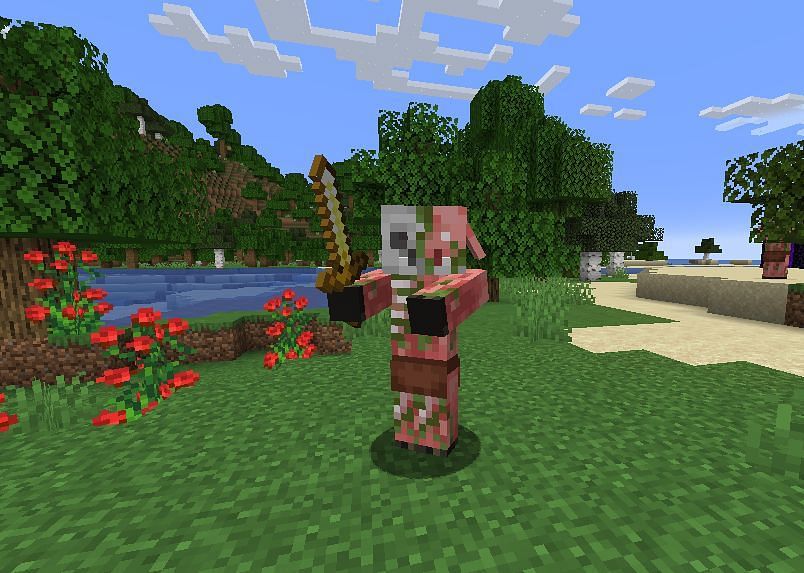
Cross-Dimensional Mechanics: Portals and Lightning Triggers
The most fascinating aspect of Zombie Piglin technology is their ability to spawn outside of the Nether through specific software “triggers.”
Nether Portal “Tick” Spawning
In the Overworld, Zombie Piglins can spawn within Nether Portal frames. This is not a standard spawn cycle but a “random tick” event. Every time a portal block receives a random tick, there is a small percentage chance (0.05% to 0.1% depending on difficulty) that the software will generate a Zombie Piglin at the base of the portal.
This mechanism is a favorite for technical players. By building massive arrays of portals, players can exploit this “random tick” logic to generate thousands of entities per hour, bypassing the standard mob cap constraints of the Nether.
Entity Transformation: The Lightning Strike Function
The Minecraft code includes a specific function for entity transformation. When a lightning bolt strikes within a certain radius of a regular Piglin (in the Overworld) or a Pig (in any dimension), the software triggers an entity_transform event.
- The Pig Logic: The code replaces the
pigentity ID with thezombified_piglinentity ID, preserving some data like health ratios. - The Piglin Logic: If a regular Piglin is in the Overworld for more than 300 ticks (15 seconds), a “zombification” timer reaches its limit. The code then executes a transformation. This is a hard-coded “state change” designed to prevent players from easily keeping regular Piglins in the Overworld.
Optimization and Technical Application: Designing Efficient Systems
For the “Technical Minecraft” community—a niche dedicated to maximizing the game’s software potential—understanding spawn blocks is the first step in building high-efficiency gold and XP farms.
Manipulating the Spawning Algorithm
To build an optimal farm, a player must create a “spawn platform” using valid blocks (like Netherrack) while ensuring all other potential spawn locations within a 128-block radius are invalidated. This process, known as “perimeter clearing,” forces the game engine to use all its successful spawn attempts on the player’s designated platform.
The Donut Design and Pathfinding AI
Technical players often use “Donut” designs in the Nether roof (above the bedrock ceiling). Because the bedrock ceiling is a flat plane at Y=127, it provides a perfect environment for controlled spawning.
- AI Manipulation: Zombie Piglins have a “pack” AI. When one is angered, it alerts all others in a 40-block radius.
- Pathfinding Software: By using “trapdoors” (which the software’s pathfinding AI perceives as solid blocks but entities actually fall through), players can trick the Zombie Piglins into walking off platforms into a central collection point. This exploits the gap between the “collision box” data and the “pathfinding” logic.
Rate Optimization and Data Throughput
In high-level technical play, the goal is “maxing the cap.” This involves removing entities from the spawnable area as quickly as possible. When a Zombie Piglin is moved into the Overworld via a portal or killed instantly, it is removed from the Nether’s mob cap. The software immediately detects this opening and attempts to fill it in the next tick. This creates a high-speed “data loop” of spawning and despawning, resulting in massive resource yields.
Conclusion: The Software Complexity Behind the Mob
What Zombie Piglins spawn on is more than just a question of “Netherrack or Soul Sand.” It is a window into the complex software engineering that powers one of the world’s most popular games. From the binary check of a block’s transparency to the random tick cycles of a portal frame and the entity transformation functions of a lightning strike, the existence of a Zombie Piglin is a testament to sophisticated procedural logic.
For the tech-savvy player, these mechanics are not hurdles but tools. By understanding the underlying “if-then” statements of the Minecraft engine, one can manipulate the digital environment to achieve incredible feats of automation. Whether you are a modder looking at the source code or a player building a gold farm, the technical reality remains the same: every Zombie Piglin is a product of a perfectly executed set of algorithmic rules.
aViewFromTheCave is a participant in the Amazon Services LLC Associates Program, an affiliate advertising program designed to provide a means for sites to earn advertising fees by advertising and linking to Amazon.com. Amazon, the Amazon logo, AmazonSupply, and the AmazonSupply logo are trademarks of Amazon.com, Inc. or its affiliates. As an Amazon Associate we earn affiliate commissions from qualifying purchases.