
In the high-stakes world of cryptocurrency trading, information is the primary currency. For investors navigating the volatile waters of the Binance exchange—the world’s largest platform by trading volume—understanding the tools at your disposal is the difference between a calculated investment and a blind gamble. Among the myriad of technical indicators available, the Moving Average (MA) stands as the fundamental cornerstone of price analysis.
Many newcomers and intermediate traders often ask, “What moving average does Binance use?” The answer is nuanced: while Binance provides a robust suite of customizable indicators, it utilizes specific default settings that shape the perspective of millions of retail traders. Understanding these defaults, and knowing how to manipulate them to fit your financial strategy, is essential for anyone looking to master the art of crypto investing.

The Default Binance Configuration: Decoding the MA(7), MA(25), and MA(99)
When you first open a Pro chart on Binance, you are greeted by three distinct, colorful lines trailing the price action. These are Simple Moving Averages (SMAs). By default, Binance sets these indicators to three specific periods: 7, 25, and 99.
The Significance of the Numbers
These figures are not arbitrary; they are designed to give investors a tiered view of market momentum across different time horizons.
- MA(7) – The Short-Term Pulse: The 7-period moving average tracks the most recent price action. In the crypto market, which operates 24/7, a 7-period average effectively represents one full week of trading data on a daily chart. It is highly sensitive to price fluctuations and is the first indicator to signal a potential change in trend.
- MA(25) – The Intermediate Trend: The 25-period average serves as a proxy for the monthly trend (roughly 30 days, but tuned to 25 for technical balance). It filters out the “noise” of daily volatility, providing a clearer picture of where the market is heading over a several-week period.
- MA(99) – The Long-Term Backbone: The 99-period average represents the long-term sentiment. Often used by institutional investors and “whales,” this line acts as a major psychological level of support or resistance. If the price remains above the MA(99), the macro trend is generally considered bullish.
Why Binance Chooses Simple Over Exponential (By Default)
While Binance allows users to switch to Exponential Moving Averages (EMAs), the default is the Simple Moving Average. The SMA calculates the average price of a security over a specific number of periods by adding the closing prices and dividing by the number of periods. Its primary benefit for investors is its stability. Because it treats every day in the period with equal weight, it is less prone to “fake-outs” caused by sudden, momentary spikes in crypto prices.
Strategic Application: How Investors Use These Averages to Time the Market
Identifying the moving averages Binance uses is only the first step. The real value lies in how an investor applies this data to generate profit and mitigate risk. In the realm of personal finance and active investing, moving averages are primarily used for trend identification and entry/exit signals.
The Power of the Crossover Strategy
One of the most lucrative ways to use the Binance default averages is through “crossover” strategies. When the short-term MA(7) crosses above the medium-term MA(25), it is often interpreted as a “Golden Cross” on a micro-scale, suggesting a buying opportunity. Conversely, when the MA(7) drops below the MA(25), it signals fading momentum, prompting many disciplined investors to take profits or exit positions to avoid a downturn.
Dynamic Support and Resistance
In traditional finance, support and resistance are often viewed as horizontal price levels. However, in the fast-moving crypto market, moving averages act as “dynamic” support and resistance. During a bull market, you will often notice the price of Bitcoin or Ethereum “bouncing” off the MA(25) or MA(99) lines. For an investor, these lines represent “Value Zones”—areas where the asset is historically well-priced relative to its recent trend, offering a safer entry point than buying at a vertical peak.
Gauging Trend Strength
The distance between the moving average lines and the current price is a vital metric for assessing market overextension. If the price is significantly higher than its MA(99), the market may be “overbought,” suggesting a correction is imminent. Smart money often waits for the price to revert to the mean (the moving average) before allocating new capital.
Customizing Your Technical Toolkit for Different Financial Goals
While the default 7/25/99 setting is a great starting point, professional investors often customize their Binance interface to align with their specific financial objectives. Your time horizon—whether you are a “scalper,” a “swing trader,” or a long-term “HODLer”—should dictate which moving averages you prioritize.

Short-Term Income Generation (Day Trading)
For those looking to generate daily or weekly income, the default SMAs might be too slow. Many active traders on Binance switch their settings to Exponential Moving Averages (EMAs). Unlike SMAs, EMAs give more weight to recent price data. Common settings for this niche include the 9-period and 21-period EMAs. This allows the investor to react faster to news-driven price movements, which are frequent in the crypto space.
Medium-Term Wealth Building (Swing Trading)
If your goal is to capture larger market moves over weeks or months, the 50-day and 200-day moving averages are the gold standard. While not the Binance default, these can be easily added in the settings. The “Death Cross” (50-day crossing below the 200-day) is a world-renowned signal of a bear market, while the “Golden Cross” (50-day crossing above the 200-day) often precedes massive bull runs.
Portfolio Protection for Long-Term Investors
For the long-term investor, the MA(99) or the 200-week moving average is the ultimate “floor.” Historically, for major assets like Bitcoin, the 200-week moving average has served as a generational bottom. Using these settings on Binance helps investors keep a cool head during market panics, allowing them to see that while the daily price might be crashing, the long-term moving average remains intact.
Beyond the Lines: Combining MAs with Other Financial Indicators
Relying solely on moving averages is a common mistake that can lead to “lagging” entries. To refine your investment strategy on Binance, it is essential to use moving averages in conjunction with other tools to confirm signals.
Convergence/Divergence (MACD)
Binance also features the MACD (Moving Average Convergence Divergence) as a primary tool. The MACD is essentially a “derivative” of moving averages, showing the relationship between two EMAs. When the MACD histogram turns green and the signal lines cross, it provides a powerful confirmation of the trends you see on your main MA lines.
Volume Analysis
A moving average crossover is much more significant when accompanied by high trading volume. If the price crosses above the MA(25) on Binance but the volume is low, it may be a “bull trap.” An investor looking for high-probability setups will look for the price to break a moving average on high volume, indicating that “big money” is behind the move.
Relative Strength Index (RSI)
To avoid buying at the top, investors pair moving averages with the RSI. If the price is hitting the MA(7) but the RSI is above 70 (overbought), the risk-to-reward ratio for a new investment is poor. The ideal financial setup is often a price bounce off a major moving average (like the MA(99)) combined with an RSI that is just beginning to rise from the oversold (30) territory.
The Investor’s Reality Check: Limitations and Risk Management
No discussion of financial tools is complete without a warning on risk. Moving averages are “lagging indicators,” meaning they are based on past price action. They tell you what has happened, not necessarily what will happen.
Dealing with “Whipsaws”
In a sideways or “ranging” market, moving averages can become flat and tangled. This leads to “whipsaws,” where the price repeatedly crosses the average back and forth, triggering false buy and sell signals. During these periods, disciplined investors often step back and wait for a clear trend to emerge rather than overtrading and losing capital to exchange fees.
The Importance of Stop-Losses
Regardless of which moving average Binance shows you, your primary tool for capital preservation is the stop-loss. A common strategy is to place a stop-loss just below a major moving average. For example, if you enter a trade because the price is holding above the MA(25), your “exit thesis” is invalidated if the price closes below that line. Automated stop-loss orders on Binance allow you to enforce this discipline without emotional interference.
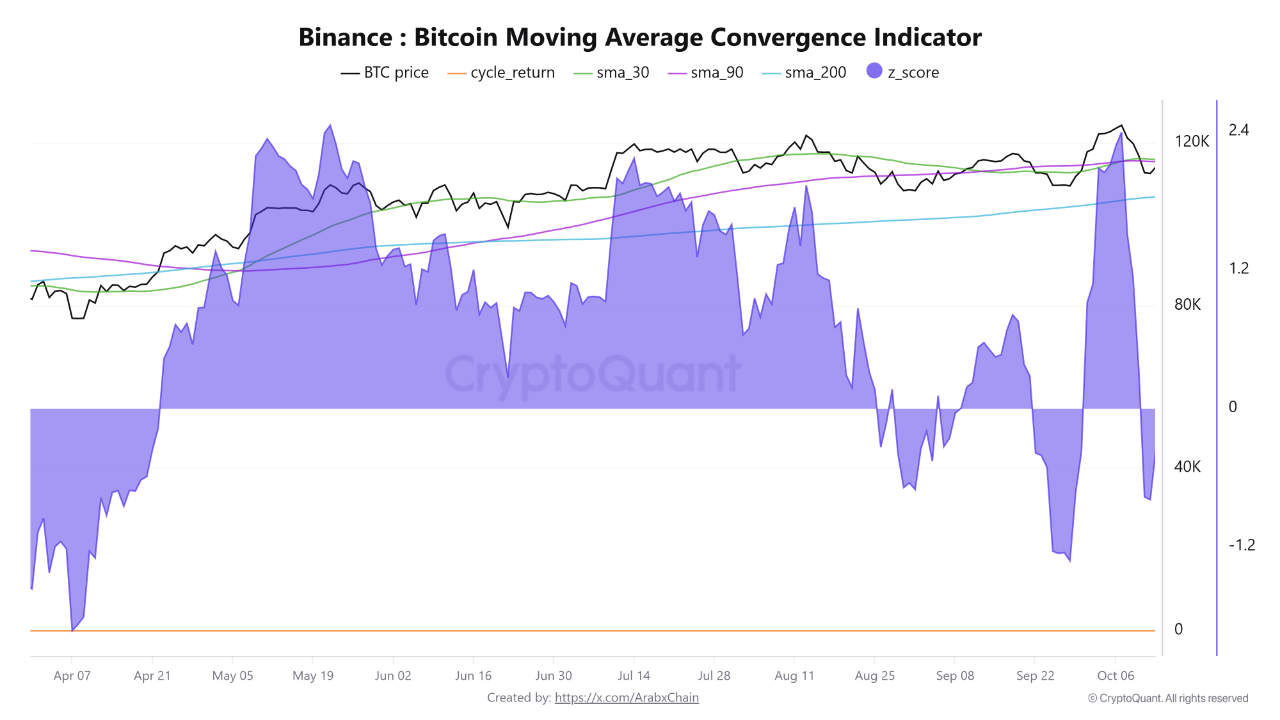
Conclusion: Mastering the Binance Interface
So, what moving average does Binance use? It uses a framework—a default of 7, 25, and 99—that provides a snapshot of short, medium, and long-term market sentiment. However, the exchange’s true power lies in its flexibility.
For the serious investor, these lines are more than just colors on a screen; they are a visual representation of the market’s collective psychology. By understanding these defaults and learning how to customize them to your specific financial goals, you can transform the Binance chart from a chaotic jumble of candles into a clear, actionable roadmap for wealth creation. Whether you are looking for a quick scalp or a decade-long investment, mastering moving averages is your first step toward financial sovereignty in the digital asset age.
aViewFromTheCave is a participant in the Amazon Services LLC Associates Program, an affiliate advertising program designed to provide a means for sites to earn advertising fees by advertising and linking to Amazon.com. Amazon, the Amazon logo, AmazonSupply, and the AmazonSupply logo are trademarks of Amazon.com, Inc. or its affiliates. As an Amazon Associate we earn affiliate commissions from qualifying purchases.