
In the landscape of modern automotive engineering, the quest for efficiency has historically stood at odds with the demand for performance. For decades, the primary solution for more power was simply “more engine”—larger displacements, more cylinders, and higher fuel consumption. However, the emergence and refinement of turbocharger technology have fundamentally shifted this paradigm. Today, a turbocharger is not merely a performance “bolt-on” for sports cars; it is a sophisticated piece of technology that sits at the intersection of thermodynamics, precision fluid dynamics, and digital software integration.
Understanding what a turbo is in a car requires looking past the mechanical hardware and viewing it as a complex system designed to optimize energy recovery. By harnessing waste energy that would otherwise disappear into the atmosphere, turbochargers allow smaller, more efficient engines to punch far above their weight class, defining the current era of technological downsizing.
The Physics of Forced Induction: How Turbochargers Redefine Engine Efficiency
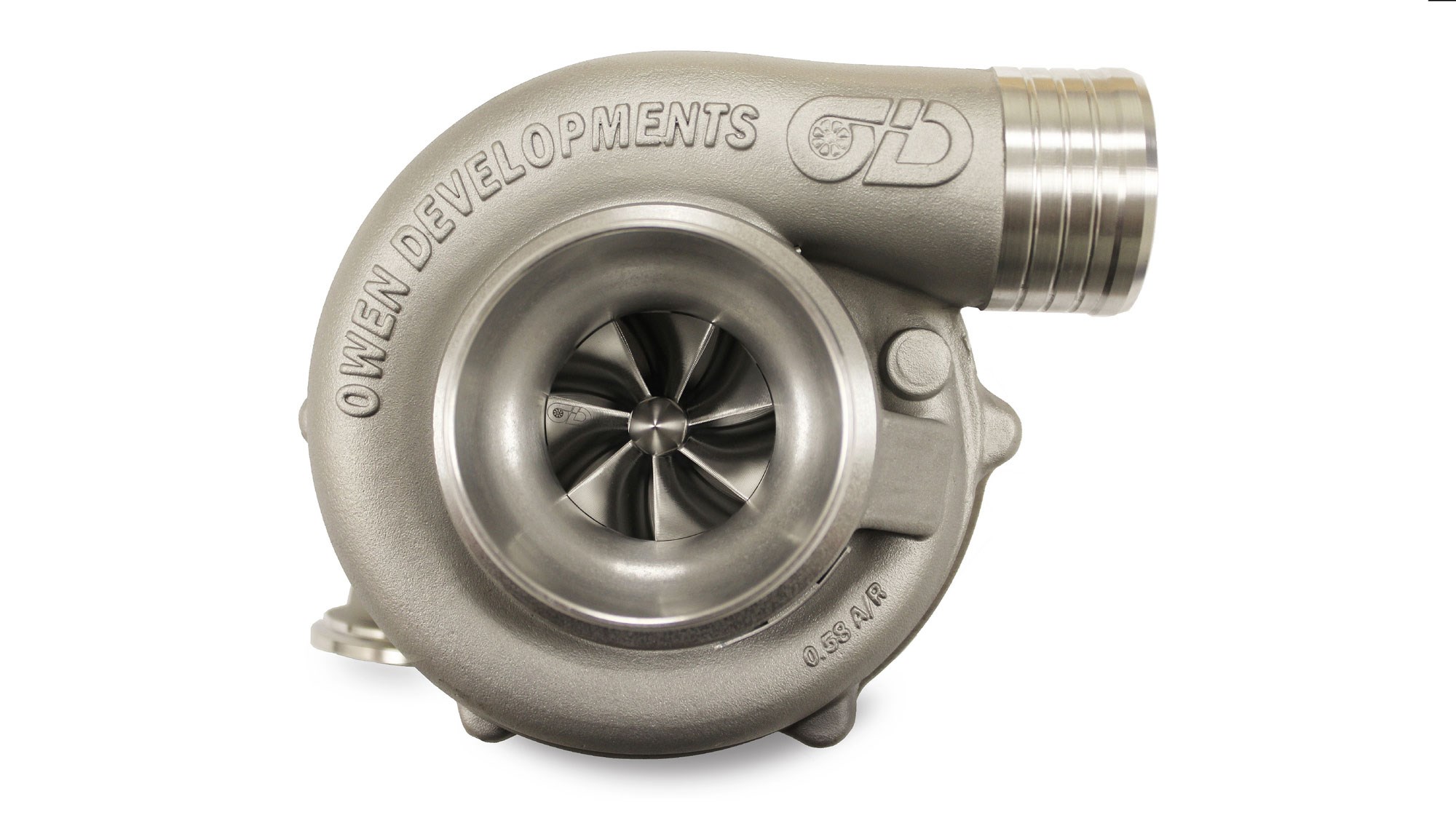
At its core, a turbocharger is a forced induction device. To understand its technical significance, one must understand the basic limitation of an internal combustion engine (ICE): it is essentially an air pump. The more air an engine can process, the more fuel it can burn efficiently, resulting in greater power output.
The Anatomy of a Turbo: Turbine, Compressor, and Housing
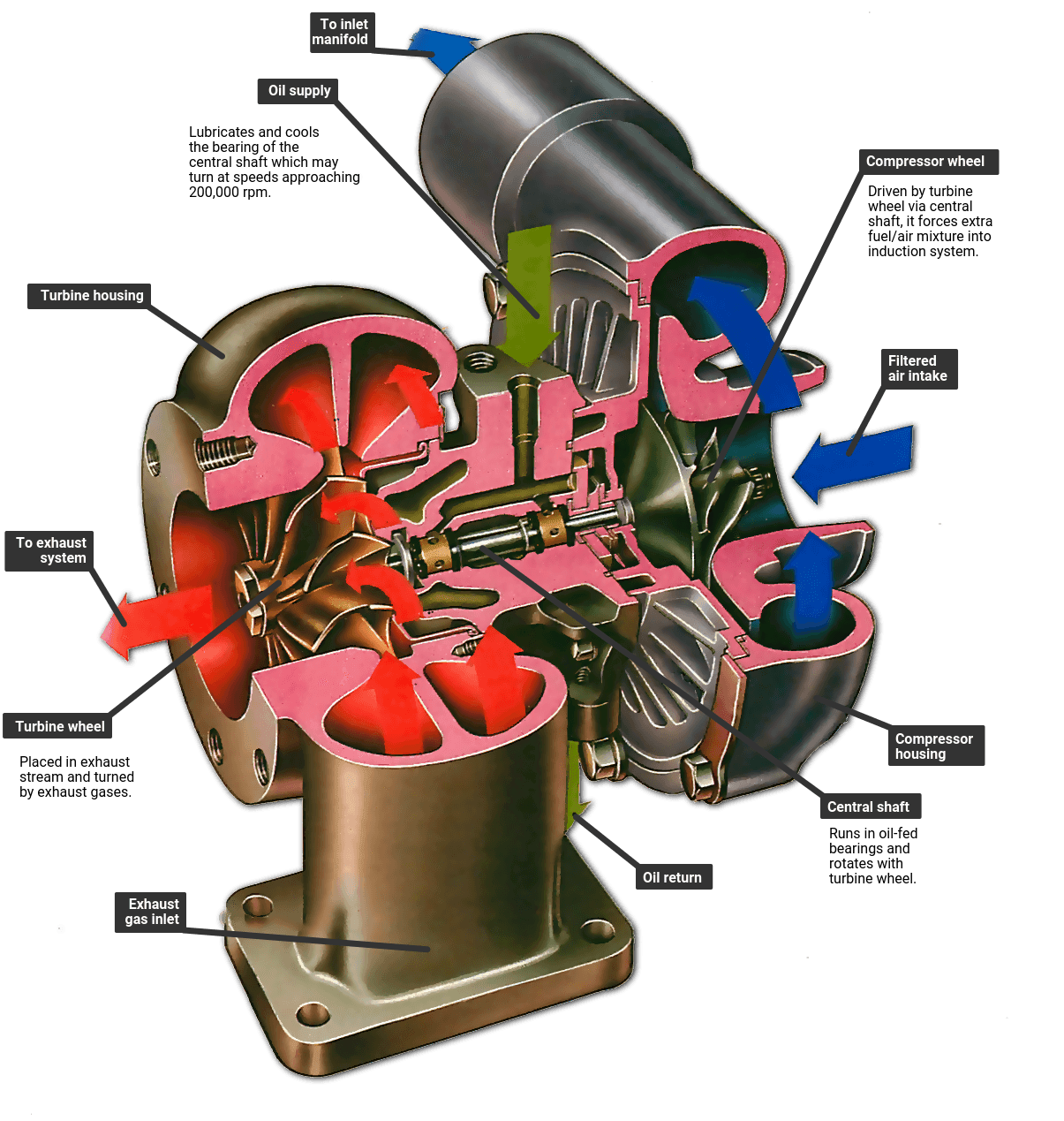
A turbocharger consists of two primary halves joined by a common shaft: the turbine side and the compressor side. The turbine is placed in the path of the exhaust gases exiting the engine. As these hot gases expand and move toward the tailpipe, they spin the turbine wheel at incredibly high speeds—often exceeding 200,000 RPM. Because the turbine is linked to the compressor wheel via a shaft, the compressor spins at the same rate.
The compressor’s job is to draw in ambient air, compress it to a higher density, and force it into the engine’s intake manifold. This technological loop transforms “waste” (exhaust) into “work” (compressed air), effectively increasing the volumetric efficiency of the engine without increasing its physical size.
The Thermodynamics of Power: Converting Exhaust into Energy
The genius of turbo tech lies in energy recovery. In a naturally aspirated engine, nearly one-third of the energy generated by combustion is lost as heat through the exhaust. The turbocharger acts as a recovery unit. However, compressing air generates heat, which is the enemy of combustion stability.
This necessitates a secondary piece of tech: the intercooler. Acting as a heat exchanger, the intercooler sits between the turbo and the engine, cooling the compressed air to make it denser and less prone to “knocking” or pre-detonation. This thermal management system is a critical component of the modern turbocharger suite, ensuring that the technology remains reliable under extreme digital and physical stress.
The Digital Revolution: Software Integration and Electronic Wastegates
While the mechanical components of a turbo are impressive, the true leap in modern automotive tech is how these components are controlled. In the past, turbos were “dumb” mechanical devices governed by simple vacuum lines. Today, they are integrated into a car’s complex digital nervous system.
Precision Tuning: The Role of the Engine Control Unit (ECU)
Modern turbochargers are managed by the Engine Control Unit (ECU), a high-speed processor that monitors hundreds of data points per second. Using sensors for manifold absolute pressure (MAP), air-fuel ratios, and ambient temperature, the ECU decides exactly how much “boost” (compressed air pressure) the engine needs at any given millisecond.
This software integration allows for “overboost” functions, where the computer temporarily allows the turbo to exceed its standard limits for a burst of acceleration, and “component protection” modes, where the software throttles the turbo if it detects overheating or mechanical strain. The turbo is no longer a standalone part; it is a software-defined performance characteristic.
Electronic Actuators and Variable Geometry Turbos (VGT)
One of the most significant technological hurdles in turbocharging is “turbo lag”—the delay between pressing the accelerator and the turbine spinning up to speed. To solve this, engineers developed Variable Geometry Turbochargers (VGT).
In a VGT, the turbine housing contains a series of small aerodynamic vanes that can change their angle. At low speeds, these vanes close to create a narrow passage, accelerating the exhaust flow to spin the turbine faster. At high speeds, they open to prevent overspeeding. These vanes are controlled by precision electronic actuators that receive commands from the ECU, representing a masterpiece of electromechanical synchronization.
Solving the Lag Problem: From Twin-Scroll to Electric Supercharging
The evolution of turbo tech has been a relentless war against latency. Engineers have moved beyond the “one size fits all” approach to create varied architectures that cater to different driving needs, utilizing advanced geometries and even supplementary electric power.
Sequential and Twin-Turbo Architectures
To provide a broad power band, many manufacturers utilize multiple turbos. In a sequential setup, a small, light turbo handles low-RPM response (where exhaust volume is low), and a larger turbo takes over at high RPMs to provide peak power.
Alternatively, “Twin-Scroll” technology utilizes a single turbo with two separate exhaust inlets. By pairing specific engine cylinders together, the pulses of exhaust gas are timed so they don’t interfere with each other, maintaining a constant high-velocity flow to the turbine. This hardware optimization significantly reduces the time it takes for the driver to feel the engine’s power.
The Rise of the E-Turbo: Eliminating Mechanical Limitations
The most cutting-edge development in this space is the Electric Turbocharger (e-turbo). Derived from Formula 1 technology, an e-turbo integrates an electric motor directly onto the shaft between the turbine and the compressor.
Before there is even enough exhaust gas to spin the turbine, the electric motor can spool the compressor to full speed in a fraction of a second. This tech effectively deletes turbo lag from the equation, providing the instantaneous torque of an electric vehicle with the high-end power and range of an internal combustion engine. It represents the ultimate fusion of traditional mechanical engineering and modern high-voltage electronics.
Sustainability Through Tech: Downsizing and the Future of Turbocharged Hybrids
As global regulations push for lower carbon footprints, the turbocharger has transitioned from a tool of speed to a tool of survival. The concept of “engine downsizing” is entirely dependent on the technological capabilities of the turbo.
Efficiency Gains: Extracting Maximum Power from Minimal Displacement
In previous decades, a 2.0-liter four-cylinder engine was considered an economical but sluggish choice. Today, thanks to high-pressure turbocharging and direct injection tech, a 2.0-liter engine can produce 300 to 400 horsepower—figures once reserved for gas-guzzling V8s.
By using a turbo, manufacturers can build lighter, smaller engines that have less internal friction and lower weight, improving the car’s overall efficiency. When the driver is cruising, the turbo stays “off-boost,” allowing the car to sip fuel like a subcompact. When power is needed, the technology engages to provide the performance of a much larger vehicle.
Integrating Turbos with High-Voltage Electric Powertrains
The future of turbocharging lies in the hybrid ecosystem. As we move toward electrification, the “Turbo-Hybrid” has become the gold standard for performance and efficiency. In these systems, the turbocharger works in tandem with an electric drive motor.
The electric motor handles the initial movement and low-speed torque, while the turbocharged engine provides sustained high-speed power and recharges the battery system. Some experimental setups even use the turbine as a generator, capturing excess exhaust energy to feed back into the car’s battery pack. This creates a circular energy economy within the vehicle, where every gram of fuel is utilized to its maximum potential.
The Verdict on Turbo Tech
What is a turbo in a car? It is no longer just a “whirring fan” that makes a car go faster. It is a sophisticated energy-recovery system, a masterpiece of thermal management, and a vital component of the digital engine management suite.
From the precision of Variable Geometry vanes to the lightning-fast response of electric motors, turbocharging represents the peak of automotive tech’s ability to innovate under pressure. As we look toward a future of hybridized and highly efficient transport, the turbocharger remains the critical link that allows us to maintain the thrill of performance while meeting the rigorous demands of modern environmental and technological standards. Whether it’s in a family crossover or a high-end supercar, the turbo is the heartbeat of the modern, optimized machine.
aViewFromTheCave is a participant in the Amazon Services LLC Associates Program, an affiliate advertising program designed to provide a means for sites to earn advertising fees by advertising and linking to Amazon.com. Amazon, the Amazon logo, AmazonSupply, and the AmazonSupply logo are trademarks of Amazon.com, Inc. or its affiliates. As an Amazon Associate we earn affiliate commissions from qualifying purchases.