
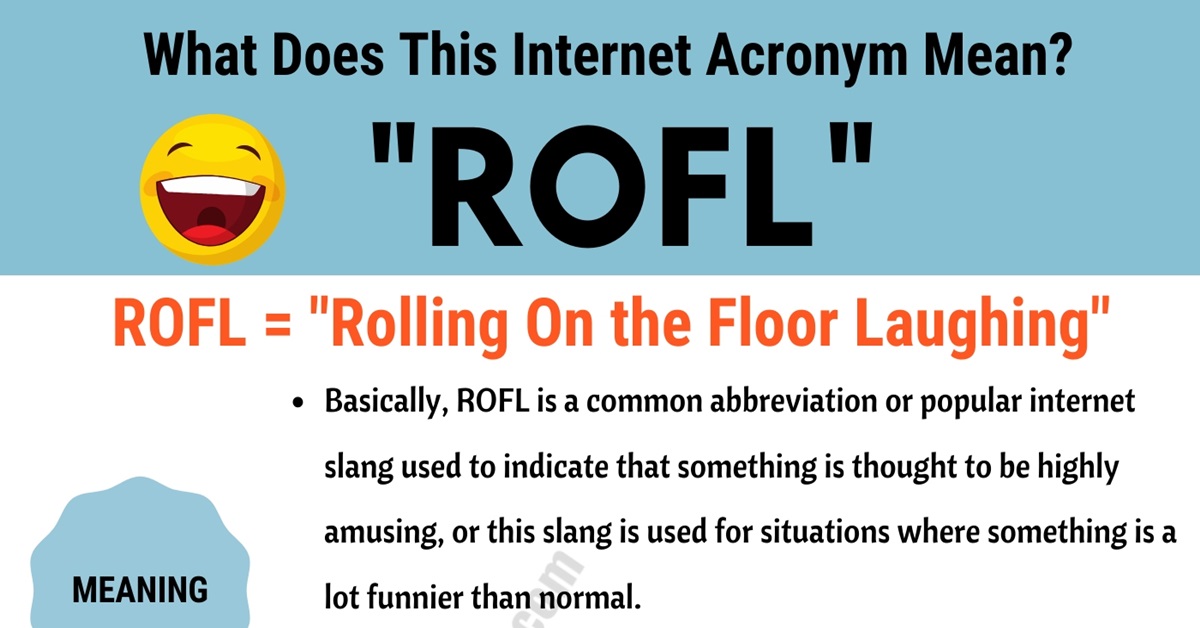
In the rapidly evolving landscape of digital technology, language has undergone a transformation as profound as the hardware that carries it. Among the most enduring artifacts of this linguistic shift is the acronym “ROFL.” Standing for “Rolling On Floor Laughing,” ROFL is more than just a shorthand for amusement; it represents a pivotal moment in the history of internet culture and the technical constraints that shaped how we communicate today.
Understanding what ROFL means requires looking beyond its literal definition. It serves as a window into the evolution of social media platforms, the rise of instant messaging, and the sophisticated way human beings have adapted to the lack of non-verbal cues in text-based digital environments.

The Etymology and Evolution of ROFL in Digital Spaces
The origins of ROFL are deeply rooted in the early days of networked computing. Long before high-speed broadband and high-definition video calls, digital communication was a minimalist affair, constrained by limited bandwidth and text-only interfaces.
Origins in Early IRC and Bulletin Boards
ROFL emerged during the late 1980s and early 1990s, primarily within Internet Relay Chat (IRC) and Bulletin Board Systems (BBS). In these environments, speed was the primary currency. Users interacted in real-time, but typing speeds and connection latencies meant that long-form sentences were often impractical.
Linguists categorize ROFL as an “initialism” that eventually became an “acronym.” Along with its predecessor “LOL” (Laughing Out Loud), ROFL was designed to bridge the emotional gap of text. It provided a way to signal intense amusement that surpassed a simple chuckle. In the tech community of the 90s, using ROFL was a sign of being “online”—a member of an exclusive group that understood the protocols of the web.
The Transition from Desktop to Mobile Messaging
As the internet moved from specialized academic and hobbyist circles into the mainstream, ROFL moved with it. The late 90s and early 2000s saw the rise of Instant Messenger (IM) services like AOL Instant Messenger (AIM), ICQ, and MSN Messenger.
This era was the Golden Age of the internet acronym. The technical limitation of T9 texting on mobile phones further solidified ROFL’s place in the lexicon. When every character required multiple button presses, “ROFL” was a highly efficient way to communicate a complex emotional state. This period marked the shift of internet slang from a niche “techie” dialect to a global standard for digital literacy.
The Mechanics of Internet Slang: How Acronyms Shape Modern UX
From a technical and design perspective, the persistence of terms like ROFL is a testament to the relationship between User Experience (UX) and human psychology. In a digital interface, users are constantly seeking the path of least resistance to convey the highest amount of meaning.
Efficiency in the Age of Micro-communication
Modern software design often prioritizes “frictionless” interaction. ROFL is a linguistic shortcut that reduces friction. In a workplace communication tool like Slack or a social app like Discord, responding with “ROFL” is a low-effort, high-reward interaction. It acknowledges a colleague’s or friend’s input without requiring the cognitive load of constructing a full sentence.
This efficiency is why internet slang hasn’t disappeared despite the advent of voice-to-text and high-speed keyboards. Digital communication is often performative and rapid-fire. In the architecture of modern apps, “micro-communications” like ROFL serve as the connective tissue of social threads, keeping engagement high without slowing down the flow of information.
Visual Cues vs. Textual Representation (Emojis)
In recent years, the tech world has seen a shift from text-based acronyms to visual icons. The “Rolling on the Floor Laughing” emoji ( ) is the direct technological descendant of ROFL. While the emoji provides a visual representation, the acronym remains a staple in communities that value text-heavy interactions, such as Reddit or developer forums.
The choice between using the word “ROFL” and the emoji often depends on the platform’s interface. Desktop-first platforms often see higher rates of acronym use, while mobile-first platforms lean toward emojis. This highlights how the physical hardware—the keyboard vs. the touchscreen—directly influences the language we choose.

The Cultural Impact of ROFL on Social Media Platforms
ROFL is not just a word; it is a tool for social signaling. Within different digital ecosystems, the use of ROFL can indicate a user’s age, their familiarity with internet history, or the specific subculture they belong to.
The Role of ROFL in Meme Culture
Meme culture is the engine of the modern internet, and ROFL was one of its first “meta” components. In the mid-2000s, the “ROFLCOPTER”—a primitive ASCII art animation of a helicopter with “ROFL” as its blades—became one of the internet’s first viral sensations.
This marked a shift where the technology (ASCII art) and the slang (ROFL) combined to create a new form of digital folk art. It demonstrated that users were not just using tools to communicate; they were hacking the tools to create humor. This paved the way for the complex, multi-layered memes we see on TikTok and Instagram today.
Platform-Specific Nuances: Twitter, Reddit, and Discord
Different tech platforms have different “vibes,” and ROFL adapts to each.
- Twitter/X: Here, brevity is king due to character limits. ROFL is often used as a hashtag (#ROFL) to categorize content or join a trending conversation.
- Reddit: On Reddit, ROFL is often used ironically or as part of a deeper “deep-fried” meme culture.
- Discord: In gaming communities, ROFL is a standard part of the fast-paced chat that occurs during live streams.
The way an algorithm treats these terms also matters. Sentiment analysis tools used by social media companies often look for keywords like ROFL to determine if a post is “positive” or “engaging,” which in turn affects how that content is boosted by the platform’s AI.
The Future of Digital Expression: AI and Natural Language Processing
As we move into the era of Artificial Intelligence, the way software interprets terms like ROFL is becoming increasingly sophisticated. Natural Language Processing (NLP) is the branch of AI that helps computers understand, interpret, and generate human language.
How AI Interprets Sentiment and Slang
For an AI, “ROFL” is a vital data point. Modern Large Language Models (LLMs) are trained on vast datasets of internet text. They don’t just see ROFL as a literal instruction to roll on the floor; they understand it as a marker of high-arousal positive affect.
When you interact with a customer service chatbot or an AI assistant, the system is designed to recognize these colloquialisms to provide a more “human” experience. If a user says “ROFL, that’s funny,” a sophisticated AI knows to respond with a lighthearted tone rather than a formal one. This is a crucial frontier in software development: making machines understand the nuance of human emotion as expressed through tech-driven shorthand.
The Next Generation of Expressive Tech
We are already seeing the next phase of this evolution with the rise of Haptic Feedback and Augmented Reality (AR). Imagine a future where typing “ROFL” triggers a physical vibration in your device or an AR overlay that shows a holographic burst of laughter.
As communication technology moves away from 2D screens and toward immersive environments (the “Metaverse”), the acronyms of the 90s will likely be integrated into our physical reality. ROFL transitioned from text to emojis; its next step may be a fully realized digital gesture or a biometric response.
Conclusion: The Enduring Legacy of ROFL
While some may dismiss “ROFL” as a dated relic of the early internet, its continued relevance in the tech world proves otherwise. It is a symbol of human ingenuity—a way we found to inject personality and emotion into a cold, binary system of ones and zeros.
From its birth in the green-text world of IRC to its current status as a fundamental data point for AI sentiment analysis, ROFL has mirrored the trajectory of technology itself. It reminds us that no matter how advanced our gadgets become, the primary goal of tech will always be the same: to help us connect, share a moment, and, of course, laugh together. Whether through a keyboard, a touchscreen, or a neural interface, ROFL remains a cornerstone of our digital identity.
aViewFromTheCave is a participant in the Amazon Services LLC Associates Program, an affiliate advertising program designed to provide a means for sites to earn advertising fees by advertising and linking to Amazon.com. Amazon, the Amazon logo, AmazonSupply, and the AmazonSupply logo are trademarks of Amazon.com, Inc. or its affiliates. As an Amazon Associate we earn affiliate commissions from qualifying purchases.