
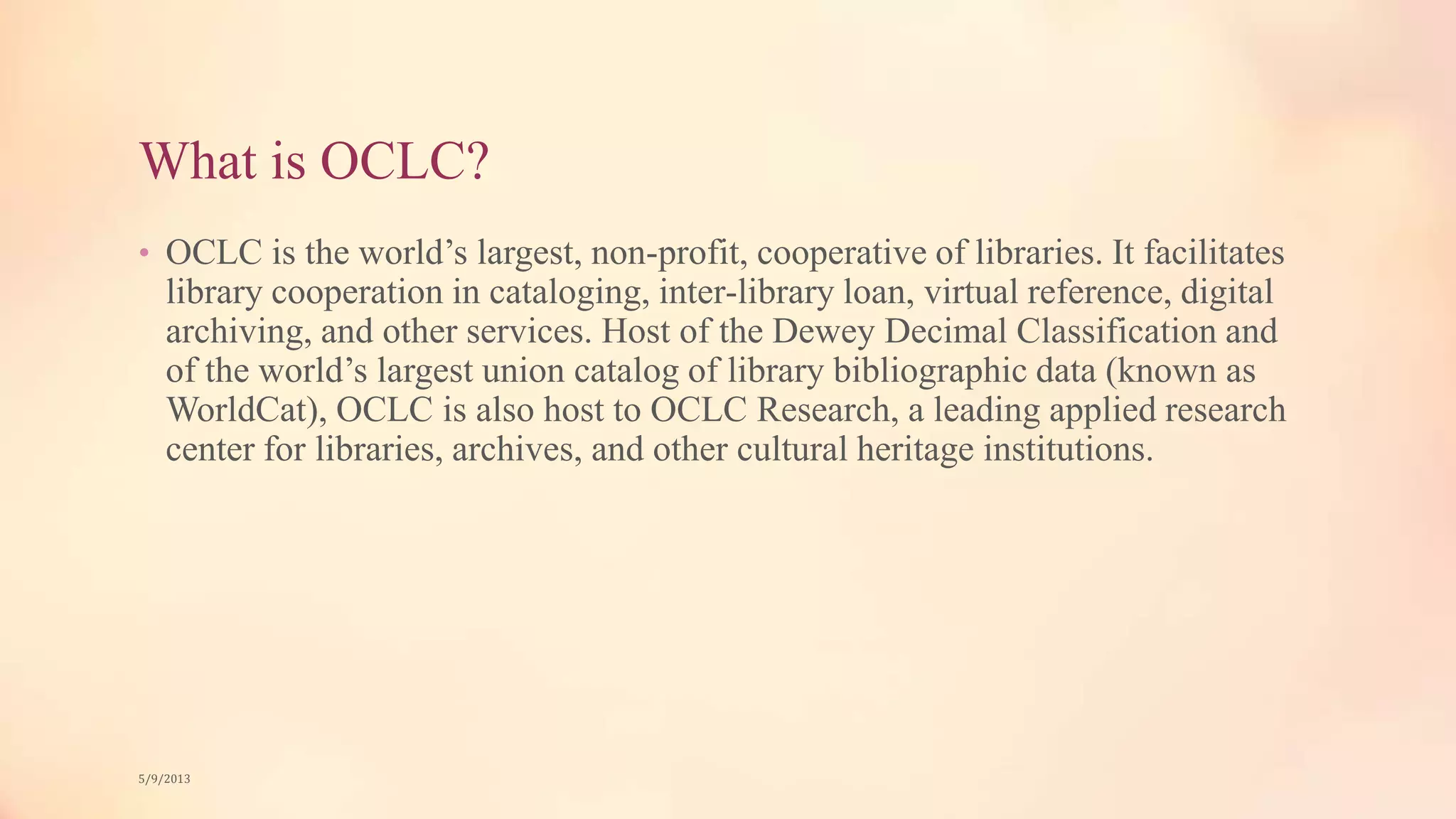
In the modern digital landscape, the seamless flow of information is often taken for granted. Whether you are a student conducting research, a developer building an information retrieval system, or a data scientist analyzing global publication trends, the infrastructure supporting these activities is complex and highly sophisticated. At the heart of this global information ecosystem lies OCLC (Online Computer Library Center).
While often associated with traditional libraries, OCLC is, at its core, one of the world’s most significant technology cooperatives. It functions as a global information technology hub that provides shared services, data management tools, and cloud-based software to thousands of institutions worldwide. To understand OCLC is to understand the history and future of networked information technology and how metadata serves as the “source code” for global knowledge.

The Evolution of OCLC: From Cataloging to Cloud Infrastructure
OCLC began its journey in 1967 as the Ohio College Library Center. Originally designed to help Ohio-based libraries share resources to reduce costs, it quickly became a pioneer in computer networking and database management. Long before the public internet as we know it existed, OCLC was building a distributed network that allowed disparate computer systems to communicate and share data.
The Birth of Collaborative Computing in Libraries
In the late 1960s and early 1970s, the concept of a shared online catalog was revolutionary. OCLC developed a centralized system that allowed libraries to contribute “metadata” (data about data) to a single, shared database. This eliminated the need for thousands of individual libraries to perform the same technical work in isolation. From a tech perspective, this was one of the first successful large-scale implementations of a collaborative, multi-tenant database. It established a framework for shared computing that preceded modern concepts of “crowdsourcing” and “collaborative platforms.”
Transitioning to SaaS and Cloud-Based Library Management
As technology shifted from mainframe computers to local servers and finally to the cloud, OCLC evolved its service model. Today, OCLC operates primarily as a Software-as-a-Service (SaaS) provider. Their flagship product, WorldShare Management Services (WMS), is a cloud-based library services platform. Unlike legacy systems that required extensive on-site server maintenance and manual software updates, WMS allows institutions to manage their entire workflow—from procurement to circulation—within a unified, web-based environment. This transition to the cloud has allowed libraries to scale their operations, integrate with third-party APIs, and focus on digital-first strategies.
WorldCat and the Power of Linked Data
You cannot discuss OCLC without mentioning WorldCat. WorldCat is the world’s largest and most comprehensive bibliographic database. From a data engineering perspective, it is a massive repository of structured data representing billions of physical and digital items held in libraries across the globe.
Metadata Standards and the Architecture of WorldCat
The integrity of WorldCat relies on strict adherence to technical standards. For decades, the backbone of this data has been the MARC (Machine-Readable Cataloging) record. However, as web technologies have advanced, OCLC has led the charge in modernizing how bibliographic data is structured. WorldCat now processes and serves data using sophisticated indexing algorithms that allow for near-instantaneous search results across a dataset that includes books, e-books, journals, maps, and multimedia.
The architecture of WorldCat is designed for high availability and scalability. It serves as a central hub where data from diverse sources is normalized and deduplicated using complex matching algorithms. This ensures that a search for a specific digital asset returns a clean, accurate record regardless of which institution contributed the data.
Moving from MARC to Bibframe: The Future of Linked Data
The tech world is currently moving toward the “Semantic Web,” and OCLC is at the forefront of this shift within the information science niche. While MARC was designed for computer systems of the 20th century, the future lies in Linked Data. OCLC has been instrumental in exploring and implementing “Bibframe” (Bibliographic Framework), which uses Resource Description Framework (RDF) to make library data “machine-understandable” by search engines like Google and Bing.
By converting massive bibliographic databases into Linked Data, OCLC is ensuring that information is not trapped in “siloed” library catalogs. Instead, it becomes part of the global Web of Data. This allows for better discoverability, as search engines can understand the relationships between authors, subjects, and publications in a way that was previously impossible.
Innovative Software Solutions for Global Information Access
Beyond data management, OCLC develops and maintains a suite of software tools that are essential for the modern digital library experience. These tools focus on three primary areas: discovery, resource sharing, and security.
WorldShare Management Services (WMS)
WMS represents the pinnacle of OCLC’s SaaS offerings. It is an integrated library system (ILS) built on a global platform. The technical advantage of WMS is its ability to integrate workflows. For example, when a library acquires a new digital subscription, WMS automatically updates the library’s catalog, ensures the item is discoverable in the user interface, and manages the licensing permissions. This level of automation is driven by robust back-end APIs that connect OCLC’s databases with external content providers and publishers.
EZproxy and the Security of Digital Resource Access
In the realm of digital security and access management, OCLC’s EZproxy is an industry standard. As libraries shifted from physical stacks to digital databases, they faced a significant technical challenge: how to provide secure, remote access to subscription-based content while protecting user privacy.
EZproxy acts as a middleware authentication layer. It allows users to sign in using their institutional credentials and then proxies their connection to the content provider. This ensures that the user’s personal identity is protected while the publisher receives the necessary technical verification that the user belongs to a subscribed institution. In an era of increasing cybersecurity threats and data privacy regulations (like GDPR), EZproxy remains a critical tool for secure information dissemination.
The Intersection of AI and Library Science at OCLC
As we enter the age of Artificial Intelligence, OCLC is leveraging its vast data holdings to innovate in the fields of machine learning and automated metadata generation. The sheer volume of data in WorldCat makes it an ideal training ground for AI models focused on natural language processing (NLP) and information classification.
Machine Learning in Bibliographic Maintenance
One of the most significant challenges in large-scale data management is “data rot” or inconsistency. OCLC uses machine learning algorithms to scan millions of records for errors, inconsistencies, or missing information. These automated systems can identify duplicate records, suggest subject headings, and even translate metadata between different languages with high accuracy. This use of AI significantly reduces the manual labor required by information professionals and ensures that the global database remains clean and usable for both humans and machines.
AI-Driven Search and Discovery Engines
The modern user expects a search experience similar to that of Netflix or Amazon—personalized, intuitive, and highly relevant. OCLC is integrating AI into its discovery layers to provide more sophisticated recommendation engines. By analyzing anonymized usage patterns and the complex relationships between data points in the Linked Data cloud, OCLC’s tools can suggest related research materials, identify trending topics in specific academic fields, and provide users with a more holistic view of the information landscape.
Conclusion: The Technological Future of Information
OCLC is far more than a library organization; it is a global tech cooperative that manages the infrastructure of human knowledge. Through its work in cloud computing, linked data, digital security, and artificial intelligence, OCLC ensures that the world’s information is organized, accessible, and preserved for the future.
As the volume of digital data continues to grow exponentially, the role of a centralized, technologically advanced entity like OCLC becomes even more vital. By providing the tools and standards that allow for the seamless exchange of information, OCLC is not just helping libraries; it is powering the research and development engines of the digital age. Whether it is through the transition to semantic web technologies or the implementation of AI-driven data cleaning, OCLC remains at the cutting edge of how technology can be used to serve the collective intelligence of humanity.
aViewFromTheCave is a participant in the Amazon Services LLC Associates Program, an affiliate advertising program designed to provide a means for sites to earn advertising fees by advertising and linking to Amazon.com. Amazon, the Amazon logo, AmazonSupply, and the AmazonSupply logo are trademarks of Amazon.com, Inc. or its affiliates. As an Amazon Associate we earn affiliate commissions from qualifying purchases.