
The world of business, particularly in fast-paced and innovation-driven sectors, relies heavily on structured and efficient communication. Among the myriad of methodologies and frameworks designed to optimize team performance and strategic alignment, the “L10 meeting” stands out as a powerful tool. Often associated with the entrepreneurial operating system (EOS) developed by Gino Wickman, the L10 meeting is not just another corporate jargon term; it’s a highly structured, time-bound session designed to address the most critical issues facing a business and drive forward momentum. This article will delve into the intricacies of the L10 meeting, exploring its purpose, structure, benefits, and best practices, all within the context of how it serves as a cornerstone for effective business operations.
The Foundation of the L10 Meeting: Purpose and Principles
At its core, the L10 meeting is a weekly tactical meeting designed to help leadership teams identify, discuss, and solve the most pressing issues within their organization. The “L” stands for “Level 10,” signifying the desired level of satisfaction and effectiveness for the meeting. The “10” represents the ideal outcome – a meeting that feels like a perfect 10 on a scale of 1 to 10 for every participant. This aspirational goal drives the rigorous adherence to its structure and purpose.
Identifying and Prioritizing Issues: The Heart of Problem-Solving
The primary objective of the L10 meeting is to tackle challenges head-on rather than letting them fester and impede progress. This is achieved through a systematic approach to issue identification and prioritization.
The “Issues List”: A Dynamic Repository of Challenges
Every L10 meeting begins with a review of the “Issues List.” This is not a static document but a dynamic, living repository of all significant challenges, obstacles, and opportunities that the team needs to address. Issues can be sourced from anywhere within the organization, but during the L10 meeting, the focus narrows to those that require immediate attention from the leadership team. This list is typically managed by a designated “Issues List” owner who ensures that all submitted issues are clear, concise, and have a direct impact on the business.
The “IDS” Process: Issue, Discuss, Solve
Once issues are identified and prioritized, the L10 meeting employs a disciplined process known as “IDS” – Issue, Discuss, Solve. This structured approach ensures that each issue is given the appropriate level of attention and that the meeting doesn’t devolve into unproductive brainstorming or lengthy complaints.
- Issue: The issue is clearly stated, often by the person who brought it to the table. The goal is to present the problem in a factual and objective manner, avoiding emotional language or blame. A well-defined issue is critical for effective resolution.
- Discuss: This is where the team engages in collaborative dialogue. However, discussion in an L10 meeting is not an open-ended debate. It’s focused and time-boxed, aiming to gather sufficient information and different perspectives to arrive at a solution. The facilitator plays a crucial role in keeping the discussion on track and ensuring all voices are heard.
- Solve: The ultimate goal of the “Discuss” phase is to arrive at a concrete solution or a clear next step. This might involve assigning an action item, making a decision, or deferring the issue if more information is needed. The emphasis is on achieving closure and tangible progress.
The Sacred 90-Minute Time Box: Efficiency and Focus
A defining characteristic of the L10 meeting is its strict 90-minute time limit. This constraint is not arbitrary; it’s a deliberate design choice to foster efficiency and prevent meetings from dragging on indefinitely.
Maximizing Productivity Within Constraints
The 90-minute structure forces participants to be concise, focused, and decisive. It encourages a “get to the point” mentality, reducing the likelihood of tangents and unproductive discussions. By limiting the time available, teams are compelled to prioritize effectively and work collaboratively to resolve issues within the allotted window. This can lead to a higher sense of accomplishment and less meeting fatigue.
The Importance of a Strong Facilitator
To effectively manage the 90-minute time box and the IDS process, a strong facilitator is indispensable. The facilitator is responsible for keeping the meeting on schedule, guiding the discussion, ensuring all items on the agenda are addressed, and enforcing the established rules and norms. This role requires impartiality, excellent listening skills, and the ability to gently, yet firmly, steer the conversation back on track when necessary.
The L10 Meeting Structure: A Step-by-Step Breakdown
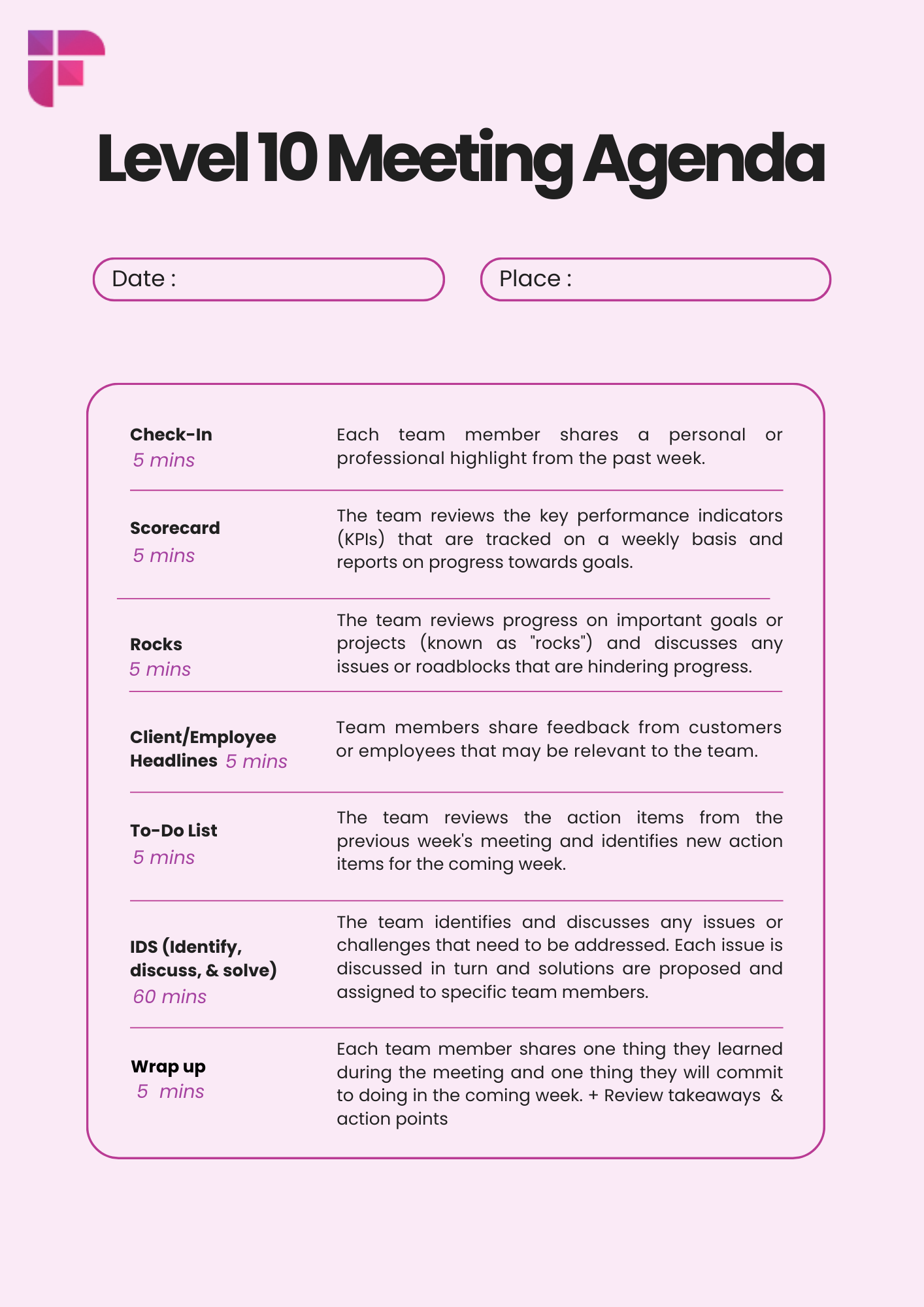
The L10 meeting follows a predictable and consistent agenda, which is crucial for building rhythm and ensuring all essential components are covered each week. This structure provides a framework for both tactical and strategic discussions.
1. The Scorecard Review (10-15 minutes): Tracking Progress and Performance
The meeting begins with a review of the “Scorecard.” This is a concise, one-page document that displays key performance indicators (KPIs) for the business, typically with 5-15 critical metrics. The Scorecard provides a high-level overview of how the business is performing against its stated objectives.
Key Performance Indicators (KPIs) as Barometers of Health
The Scorecard focuses on objective, measurable data. Each KPI is reviewed weekly, and deviations from the target are noted. This allows the leadership team to quickly identify areas that are performing well and those that require immediate attention. For example, if sales figures are down or customer churn is increasing, these would be flagged on the Scorecard, prompting further investigation.
Identifying and Addressing Out-of-Bounds Items
When a KPI on the Scorecard is “out of bounds” (meaning it has not met its target for the week), it becomes an immediate issue to be addressed. This provides a clear trigger for the IDS process, ensuring that performance dips are not overlooked. The team will quickly discuss why the KPI is out of bounds and, if a clear reason and solution can be identified within the allocated time, it will be addressed. Otherwise, it gets added to the Issues List for deeper discussion.
2. The Rock Review (5-10 minutes): Reviewing Progress on Key Initiatives
Next, the team reviews “Rocks.” Rocks are the 3-7 most important priorities for the company that are scheduled to be completed within a 90-day period. These are significant, long-term goals that require focused effort.
Alignment with Long-Term Vision
The Rock Review ensures that the team’s weekly efforts are aligned with the company’s overarching strategic vision. By reviewing progress on these key initiatives, leaders can ensure that the company is consistently moving forward on its most critical objectives.
Accountability and Progress Tracking
For each Rock, the responsible individual or team provides a brief update on their progress. This promotes accountability and allows the rest of the leadership team to understand what is being done to achieve these critical goals. If a Rock is falling behind schedule, it might become an issue to be discussed and resolved in the meeting.
3. The P.A.C.E.™ Review (5-10 minutes): A Focused Accountability Check
P.A.C.E.™ stands for “People, Accountability, Cash, and Events.” This section of the meeting provides a brief update on these foundational elements of the business.
People: Team Health and Dynamics
This segment focuses on the well-being and effectiveness of the team. It’s a quick check-in to see if there are any interpersonal issues, staffing concerns, or potential bottlenecks related to human resources.
Accountability: Action Item Updates
This is where previous action items assigned in prior L10 meetings are reviewed. The person responsible for each action item provides a brief update on its completion status. This ensures that commitments are being met and that no tasks fall through the cracks.
Cash: Financial Health Snapshot
A brief overview of the company’s cash flow and financial health is provided. This isn’t a deep dive into financial statements but a high-level understanding of the company’s financial position.
Events: Upcoming Milestones and Happenings
This segment covers significant upcoming events, such as product launches, marketing campaigns, industry conferences, or important client meetings. It ensures everyone is aware of critical dates and can plan accordingly.
4. The Issues List – IDS (60 minutes): The Core of Problem-Solving
This is the longest and most critical section of the L10 meeting, dedicated to tackling the most pressing issues identified in the Issues List.
Prioritization and Tackling One Issue at a Time
The facilitator guides the team through the prioritized Issues List. The goal is to address as many issues as possible within the 60-minute block, following the IDS process: Issue, Discuss, Solve. The team collaboratively discusses the issue, explores potential solutions, and agrees on actionable steps to resolve it.
Generating Action Items and Assigning Ownership
For each issue that is “solved,” a clear action item is created. Each action item must have a single owner and a specific due date. This ensures accountability and clarity on who is responsible for what and by when.
The “No Issue Too Small, No Issue Too Big” Mentality
While the L10 meeting aims to tackle significant issues, it also embraces the principle that no issue is too small to warrant attention if it’s impacting the business. However, the time constraint forces a pragmatic approach, ensuring that trivial matters don’t consume valuable meeting time.
5. “What’s Next?” and Wrap-Up (5 minutes): Ensuring Continuity
The meeting concludes with a brief “What’s Next?” segment, where any outstanding items or important announcements are reiterated. This ensures that everyone leaves the meeting with a clear understanding of their responsibilities and the overall direction.
Recap of Action Items and Ownership
A quick recap of all new action items assigned during the meeting, along with their owners and due dates, reinforces accountability.
Setting the Stage for the Next Meeting
The facilitator might briefly touch upon what is expected to be on the agenda for the following week’s L10 meeting, further preparing the team.
Benefits and Best Practices of Implementing L10 Meetings
The structured nature of the L10 meeting yields significant benefits for organizations that consistently implement it. However, its success hinges on adhering to certain best practices.
Fostering a Culture of Accountability and Transparency
One of the most profound benefits of the L10 meeting is its ability to cultivate a culture of accountability. By regularly reviewing progress on Rocks, Scorecards, and action items, individuals and teams are held responsible for their commitments. This transparency builds trust and encourages a proactive approach to problem-solving.
Driving Decision-Making and Problem-Solving Efficiency
The time-bound structure and the IDS process are designed to accelerate decision-making. Instead of lengthy deliberations, the L10 meeting encourages focused discussions that lead to tangible solutions. This efficiency is crucial for businesses operating in dynamic environments where quick, informed decisions are vital for staying competitive.
Enhancing Communication and Team Cohesion
Regularly gathering to discuss critical issues and progress fosters better communication among leadership team members. It ensures everyone is on the same page, understands the challenges and priorities, and feels part of a cohesive unit working towards common goals.

Key Best Practices for Success
- Consistency is Paramount: The L10 meeting should be a non-negotiable weekly event. Skipping meetings or deviating from the structure can quickly erode its effectiveness.
- Strict Adherence to Time: Respecting the 90-minute time box is crucial. Use a visible timer and empower the facilitator to keep the meeting on track.
- Well-Defined Roles: Ensure clear understanding of roles, especially the facilitator and the Issues List owner.
- Focus on Issues, Not Personalities: The IDS process should be objective and focused on the problem, not on blaming individuals.
- Action Items with Owners and Due Dates: Every “solved” issue must result in a clearly defined action item with a designated owner and a realistic due date.
- Preparation is Key: Participants should come prepared, having reviewed the Scorecard, Rocks, and any issues they wish to add to the list.
In conclusion, the L10 meeting is a powerful and practical tool for any business looking to improve its operational efficiency, strategic execution, and overall performance. By providing a consistent, structured, and disciplined framework for problem-solving and accountability, it empowers leadership teams to navigate challenges effectively and drive sustainable growth. It’s not just a meeting; it’s a catalyst for a more productive, transparent, and successful organization.
aViewFromTheCave is a participant in the Amazon Services LLC Associates Program, an affiliate advertising program designed to provide a means for sites to earn advertising fees by advertising and linking to Amazon.com. Amazon, the Amazon logo, AmazonSupply, and the AmazonSupply logo are trademarks of Amazon.com, Inc. or its affiliates. As an Amazon Associate we earn affiliate commissions from qualifying purchases.