
In the dynamic world of technology, where motion, speed, and efficiency are paramount, the concept of acceleration is a foundational principle. Whether we’re discussing the sleek acceleration of an electric vehicle, the precise movements of a robotic arm, or the launch trajectory of a satellite, acceleration underpins our understanding of how things change their velocity over time. While instantaneous acceleration is a snapshot of this change at a specific moment, average acceleration provides a broader, more practical perspective for analyzing motion over a defined period. This article delves into the meaning, calculation, and crucial applications of average acceleration within the technological landscape.
Defining Average Acceleration: Beyond the Instantaneous
At its core, acceleration is the rate at which an object’s velocity changes. Velocity itself is a vector quantity, meaning it has both magnitude (speed) and direction. Therefore, acceleration can be a change in speed, a change in direction, or a combination of both.
Velocity vs. Acceleration: A Crucial Distinction
Before diving into average acceleration, it’s vital to distinguish it from velocity. Velocity tells us how fast an object is moving and in what direction. For example, a drone might have a velocity of 10 meters per second north. Acceleration, on the other hand, tells us how that velocity is changing. If the drone is speeding up, it has positive acceleration in the direction of motion. If it’s slowing down, it has negative acceleration (often called deceleration) in the opposite direction of motion. If it’s turning, it also has acceleration, even if its speed remains constant, because its direction of velocity is changing.
The Concept of Average: Smoothing Out the Nuances
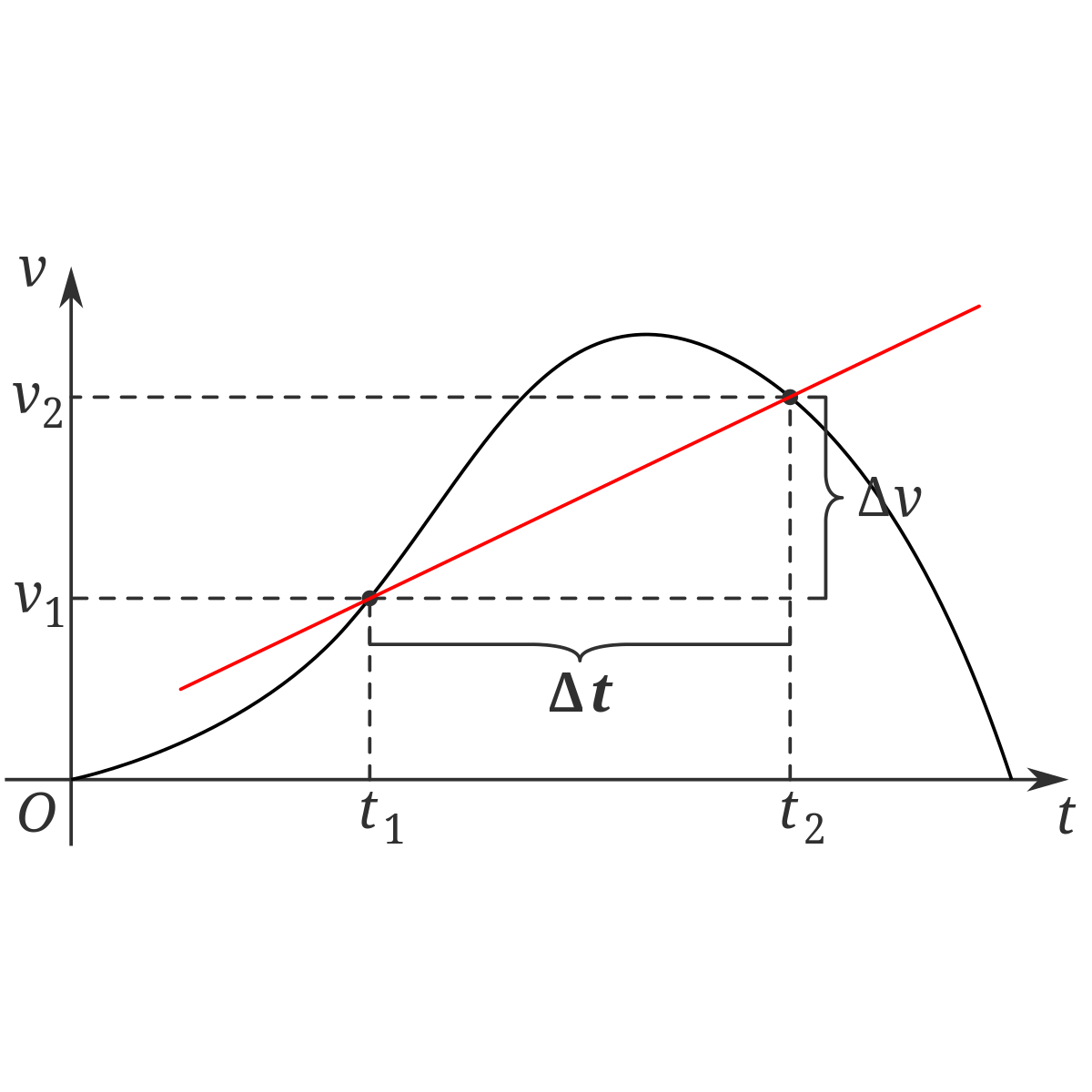
While instantaneous acceleration captures the precise rate of velocity change at a single point in time, it can be complex to measure and analyze, especially in real-world technological systems where changes are rarely perfectly smooth. This is where average acceleration becomes indispensable. Average acceleration provides a simplified yet powerful way to understand the overall change in velocity over a specific interval of time, without needing to know the exact acceleration at every single moment within that interval. It represents the constant acceleration that would produce the same net change in velocity over the same duration.
Mathematical Formulation: Quantifying the Change
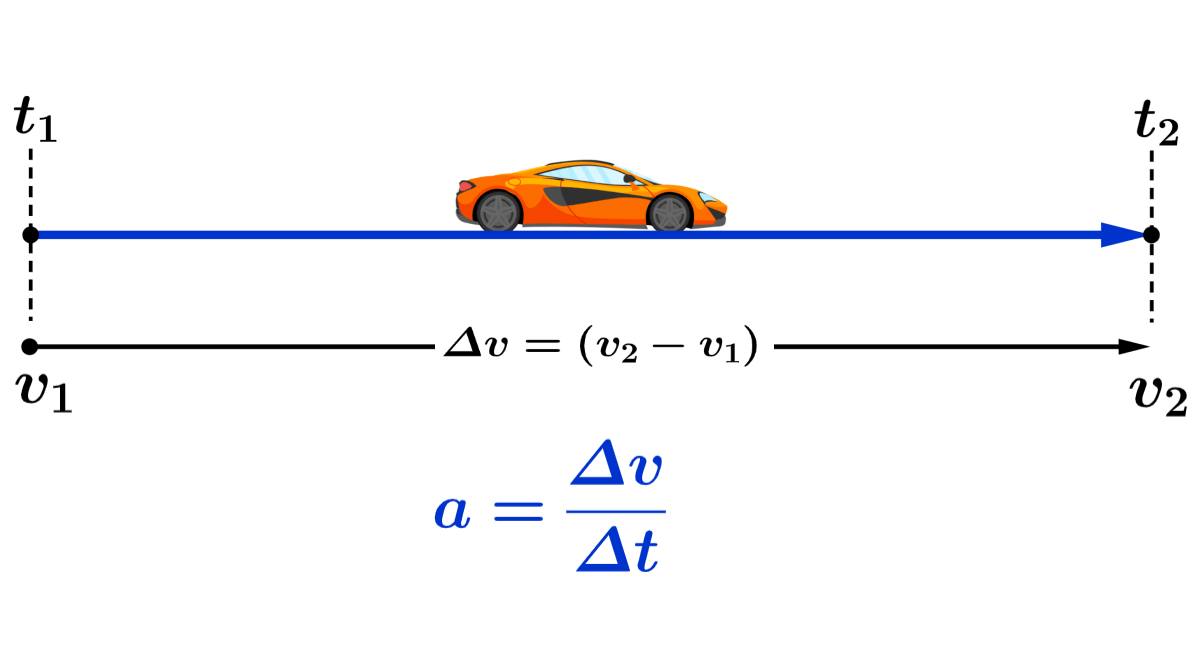
The mathematical definition of average acceleration ($a_{avg}$) is elegantly simple. It is calculated by dividing the total change in velocity ($Delta v$) by the total time interval ($Delta t$) over which that change occurs.
The formula is expressed as:
$a_{avg} = frac{Delta v}{Delta t}$
Where:
- $a_{avg}$ is the average acceleration.
- $Delta v$ is the change in velocity, calculated as $vf – vi$, where $vf$ is the final velocity and $vi$ is the initial velocity.
- $Delta t$ is the time interval, calculated as $tf – ti$, where $tf$ is the final time and $ti$ is the initial time.
The units of average acceleration are typically meters per second squared (m/s²) in the International System of Units (SI). This unit signifies a change in velocity (meters per second) per unit of time (second).
Calculating Average Acceleration: Practical Applications in Tech
The ability to calculate average acceleration is fundamental to many engineering and technological disciplines. It allows engineers to design, predict, and optimize the performance of systems involving motion.
Scenario 1: Vehicle Dynamics and Autonomous Systems
In the automotive industry, understanding average acceleration is critical for designing vehicles with desired performance characteristics and for the development of autonomous driving systems.
Designing for Performance and Safety
When manufacturers aim for a specific 0-to-60 mph acceleration time, they are essentially concerned with the average acceleration of the vehicle over that speed change. This average value informs engine design, transmission ratios, and overall powertrain calibration. Similarly, for safety systems like airbags and anti-lock braking systems (ABS), knowing the expected range of decelerations (negative acceleration) is vital for their effective deployment. An autonomous vehicle needs to be able to calculate its average acceleration to ensure smooth and predictable maneuvers, avoiding sudden jolts that could unnerve passengers or compromise stability.
Trajectory Prediction and Control
For autonomous systems, calculating average acceleration is often a stepping stone to predicting future states. If a vehicle’s current velocity and its average acceleration over a short time interval are known, engineers can estimate its velocity at a future point. This is crucial for path planning, collision avoidance, and maintaining safe following distances. For instance, when an autonomous car needs to merge into traffic, it calculates its average acceleration required to match the speed of the surrounding vehicles safely within a given time.
Scenario 2: Robotics and Automation
Robotics is a field where precise motion control is paramount. Average acceleration plays a significant role in programming robotic arms, mobile robots, and other automated machinery.
Smooth and Efficient Movement
Robotic arms on assembly lines must perform tasks with both speed and precision. When a robot arm moves from one position to another, its trajectory is often designed to achieve a certain average acceleration. This ensures that the movement is smooth, minimizing vibrations and wear on the mechanical components. Rapid, jerky movements would not only be inefficient but could also damage the robot or the products it handles. By calculating the desired average acceleration, programmers can ensure that the robot reaches its target position with the correct velocity at the end of the movement, within a specified time.
Payload Handling and Force Management
When a robot arm picks up or moves a payload, its acceleration will directly influence the forces exerted on the payload and the robot’s structure. Calculating the average acceleration involved in lifting or moving a known mass allows engineers to determine the required motor torque and the structural integrity needed for the robot. Overly high average acceleration could lead to slippage of the payload or even structural failure. Conversely, too low an average acceleration might make the process inefficient.
Scenario 3: Aerospace and Flight Dynamics
The principles of average acceleration are fundamental to the design and operation of aircraft, spacecraft, and their associated systems.
Launch Sequences and Orbital Mechanics
During the launch of a rocket, the vehicle undergoes tremendous acceleration. While instantaneous acceleration can vary wildly due to changing fuel consumption and atmospheric drag, engineers often analyze the average acceleration during specific phases of the launch. This average provides a benchmark for comparing different rocket designs and predicting mission success. For orbital maneuvers, calculating the required average acceleration to change trajectory or speed is essential for precise navigation. For example, an average acceleration applied for a specific duration will result in a predictable change in orbital velocity, allowing spacecraft to enter desired orbits or rendezvous with other objects.
Flight Control Systems
In aircraft, flight control systems constantly adjust control surfaces to maintain desired flight paths. These adjustments involve changes in acceleration. While the pilot or autopilot might not consciously think in terms of average acceleration, the underlying algorithms are designed to achieve specific velocity changes over time, which is precisely what average acceleration describes. For instance, during a turn, the aircraft experiences centripetal acceleration to change its direction, and the control system manages this to maintain a stable and controlled maneuver.
Limitations and Considerations of Average Acceleration
While incredibly useful, it’s important to recognize the inherent limitations of average acceleration and when a deeper analysis might be required.
The Assumption of Uniformity
The primary limitation of average acceleration is that it smooths out all the variations within the time interval. It doesn’t tell us anything about how the velocity changed moment by moment. In many technological applications, the pattern of acceleration is as important as the net change.
Non-Uniform Motion and Pulsed Systems
Consider a device that uses an electric motor with a commutator. The acceleration profile of such a motor might be far from uniform; it could have distinct pulses. If we only consider the average acceleration over a full rotation, we might miss critical information about the vibrations or torque ripple that could affect the performance of the attached system. In these cases, analyzing instantaneous acceleration or using more advanced calculus-based methods (like integration) becomes necessary.
Impact on System Dynamics
In complex systems, like the suspension of a high-speed train or the landing gear of an aircraft, the dynamic response is sensitive to the rate of change of acceleration (known as jerk). While average acceleration gives an overall picture of velocity change, it doesn’t capture the jerk, which can be the dominant factor in system stress and passenger comfort. Engineers often need to consider higher-order derivatives of position (velocity, acceleration, jerk, snap, etc.) for detailed design and simulation.
The Role of Instantaneous Acceleration
In scenarios requiring precise control and real-time adaptation, instantaneous acceleration becomes the focus.
Real-time Control Systems
Modern control systems, particularly in areas like high-frequency trading algorithms, advanced robotics, or active noise cancellation, rely on continuously monitoring and adjusting based on instantaneous values. For these systems, knowing the acceleration at this very moment is crucial for making the immediate next decision. For example, a drone performing an acrobatic maneuver needs its flight controller to react to the instantaneous acceleration to maintain stability and execute the desired movements precisely.
Advanced Simulation and Modeling
In sophisticated simulations used for product development, engineers often model systems with highly detailed physics. These models require the calculation of instantaneous acceleration to accurately represent the behavior of components under various conditions. This level of detail is crucial for predicting stresses, material fatigue, and overall system reliability over long operational periods.
The Interplay Between Average and Instantaneous Acceleration
Despite their differences, average and instantaneous acceleration are deeply interconnected, and understanding one often informs the analysis of the other.
Using Average Acceleration as a Baseline
Average acceleration serves as an excellent starting point for analysis. If initial calculations show an unacceptably high or low average acceleration, it signals a need for further investigation into the instantaneous behavior. It provides a high-level metric that is easy to grasp and compare across different designs or scenarios. For instance, comparing the average acceleration of two different electric vehicle powertrains can quickly identify which one offers superior performance from a standstill.
Calculus: The Bridge Between Them
The fundamental relationship between average and instantaneous acceleration is rooted in calculus. Instantaneous acceleration is the derivative of velocity with respect to time, while average acceleration is the slope of the secant line connecting two points on the velocity-time graph. Conversely, integrating acceleration over a time interval yields the change in velocity. This mathematical connection allows engineers and physicists to move seamlessly between the two concepts when needed.
Practical Measurement and Data Analysis
In the real world, we often measure data over discrete time intervals. Sensors collect data points, and from these points, we can calculate the average velocity change and thus the average acceleration over that interval. By taking data at very small time intervals, the calculated average acceleration closely approximates the instantaneous acceleration during that brief period. This is how modern instrumentation effectively captures the dynamic behavior of technological systems.

Conclusion: The Enduring Importance of Average Acceleration in Tech
In the ever-evolving landscape of technology, where innovation is driven by an understanding of physical principles, average acceleration remains a cornerstone concept. It offers a practical and accessible way to quantify and analyze the change in motion over time, underpinning the design, optimization, and control of a vast array of devices and systems. From the fundamental performance metrics of vehicles to the intricate movements of robots and the complex trajectories of spacecraft, the ability to calculate and interpret average acceleration empowers engineers to build a more efficient, safer, and capable technological future. While instantaneous acceleration provides the granular detail for highly specialized applications, average acceleration offers the broad perspective necessary for initial design, performance benchmarking, and understanding the overall dynamics of technological innovation.
aViewFromTheCave is a participant in the Amazon Services LLC Associates Program, an affiliate advertising program designed to provide a means for sites to earn advertising fees by advertising and linking to Amazon.com. Amazon, the Amazon logo, AmazonSupply, and the AmazonSupply logo are trademarks of Amazon.com, Inc. or its affiliates. As an Amazon Associate we earn affiliate commissions from qualifying purchases.