
Java, a cornerstone of modern software development, thrives on its dual nature: the raw efficiency of primitive data types and the rich expressiveness of its object-oriented paradigm. However, these two fundamental facets don’t always naturally coalesce. This is where wrapper classes step in, acting as crucial bridges that allow us to treat primitive values as objects. Understanding wrapper classes isn’t just about memorizing facts; it’s about grasping a core concept that underpins much of Java’s powerful ecosystem, from data structures to advanced concurrency mechanisms. For any developer aiming for robust, scalable, and professional Java applications—be it for cutting-edge AI tools, enterprise software, or efficient data processing—a firm grasp of wrapper classes is indispensable.

Understanding the Core Concept: Primitives vs. Objects
To truly appreciate the utility of wrapper classes, we must first revisit the two distinct categories of data types in Java: primitives and objects. They represent different ways of storing and manipulating information, each with its own set of advantages and limitations.
The Realm of Primitives
Primitive data types are the most basic building blocks in Java. They represent single, atomic values and are directly stored in memory. Java defines eight primitive types:
- byte: Stores small whole numbers (-128 to 127).
- short: Stores slightly larger whole numbers (-32,768 to 32,767).
- int: The most commonly used integer type (-2^31 to 2^31 – 1).
- long: For very large whole numbers (-2^63 to 2^63 – 1).
- float: Single-precision floating-point numbers (for decimals).
- double: Double-precision floating-point numbers (more precise decimals, default for decimal literals).
- boolean: Represents truth values (
trueorfalse). - char: Stores a single Unicode character.
Characteristics of Primitives:
- Direct Value Storage: They hold the actual value directly in the memory location allocated for them.
- Efficiency: Operations on primitives are generally faster and consume less memory because there’s no object overhead.
- Not Objects: Primitives do not have methods or properties like objects do. You cannot call
.on a primitive variable. - No Null: A primitive variable always has a value; it cannot be
null.
For example:
int score = 100;
double price = 99.99;
boolean isActive = true;
These variables are simple, direct, and efficient.
The Power of Objects in Java
In stark contrast, objects are instances of classes. They are the cornerstone of Java’s object-oriented programming (OOP) paradigm. An object encapsulates both data (fields or attributes) and behavior (methods) related to that data. When you declare an object variable, it doesn’t hold the object itself, but rather a reference (a memory address) to where the object resides in the heap memory.
Characteristics of Objects:
- Encapsulation: Objects group related data and methods together.
- Methods and Fields: Objects have methods that define their behavior and fields that store their state.
- Polymorphism and Inheritance: Objects can leverage these powerful OOP features, allowing for flexible and extensible code.
- Collections Compatibility: Java’s robust Collections Framework (e.g.,
ArrayList,HashMap) is designed exclusively to store objects. - Nullability: Object references can be
null, indicating that they currently do not refer to any object.
For example:
String name = "Java"; // String is an object
Integer count = new Integer(50); // Integer is a wrapper object
The ability to encapsulate, offer methods, and participate in complex data structures makes objects incredibly powerful for building sophisticated software. However, the inherent difference between primitives and objects creates a gap that needs to be bridged for certain operations, and this is precisely where wrapper classes become indispensable.
Why Do We Need Wrapper Classes? Bridging the Gap
The fundamental reason for wrapper classes’ existence lies in Java’s design philosophy: to be object-oriented while still providing the performance benefits of primitive types. When you need to interact with systems or frameworks that demand objects, but your data is primitive, wrapper classes provide the necessary conversion.
Enabling Object-Oriented Operations
One of the most compelling reasons for wrapper classes is their role in enabling operations that strictly require objects.
-
Collections Framework: Java’s Collections Framework (e.g.,
ArrayList,LinkedList,HashSet,HashMap) is a suite of interfaces and classes for storing and manipulating groups of objects. Crucially, these collections cannot directly store primitive types. If you want to store a list of integers, for instance, you cannot declare anArrayList<int>. Instead, you must useArrayList<Integer>, whereIntegeris the wrapper class forint. This ensures consistency within the object-oriented design of the collections. UsingIntegerobjects in collections allows developers to build robust data management systems, which is vital for any tech startup or large enterprise dealing with vast amounts of data, helping streamline development and reduce costly data manipulation errors.import java.util.ArrayList; ArrayList<Integer> scores = new ArrayList<>(); scores.add(95); // Autoboxing automatically converts int 95 to Integer object scores.add(88); // int total = scores.get(0) + scores.get(1); // Unboxing happens here -
Null Values: Primitives cannot hold a
nullvalue. Abooleanis eithertrueorfalse, anintalways has a numeric value, even 0. However, in many real-world scenarios, the absence of a value is a meaningful state. For example, a database field for a user’s age might be optional, or a web form input might be left blank. Wrapper classes can benull, allowing you to represent “no value” or “undefined” states, which is critical for flexible data modeling and preventing premature zero-filling or default values that might be misleading. This precision in data representation can prevent subtle bugs that might otherwise lead to incorrect calculations or financial discrepancies.Integer optionalAge = null; // Represents an unknown or unspecified age // int mandatoryAge = null; // Compile-time error -
Method Arguments and Return Types: Some methods in Java’s standard library or third-party APIs might be designed to accept or return only object types. Wrapper classes facilitate seamless integration in such cases.
Utility and Convenience Methods
Beyond mere object representation, wrapper classes provide a wealth of useful static and instance methods that simplify common data manipulation tasks. These utility methods are a hallmark of well-designed APIs, offering convenience and reducing the need for developers to write boilerplate code.
-
Parsing Strings: A common task is converting a
Stringrepresentation of a number into its numeric equivalent. Wrapper classes likeInteger,Double, andBooleanprovide static methods for this:Integer.parseInt("123")returns anint.Double.parseDouble("3.14")returns adouble.Boolean.parseBoolean("true")returns aboolean.
These methods are invaluable for handling user input, reading configuration files, or processing data streams, ensuring data integrity across various application layers.
-
Value Conversion: Wrapper classes also offer
valueOf()methods, which convert a primitive or aStringinto a wrapper object. For example,Integer.valueOf(10)orInteger.valueOf("20")both returnIntegerobjects. -
Other Utility Methods: They also provide methods for comparing values (
compareTo()), converting to string representations (toString()), and accessing constants likeMAX_VALUEandMIN_VALUE. For example,Character.isDigit('5')andCharacter.toUpperCase('a')demonstrate the powerful character manipulation features available.
Generics and Reflection
Wrapper classes are also fundamental for Java’s generics feature, which provides type-safe collections. Generic types (e.g., List<T>) must be reference types, not primitives. Similarly, Java Reflection, a powerful API for inspecting and manipulating classes, methods, and fields at runtime, exclusively works with objects. These advanced features, critical for building adaptable and dynamic software systems (think plugin architectures or advanced frameworks), rely heavily on the availability of wrapper classes.
The Java Wrapper Classes: A Detailed Look
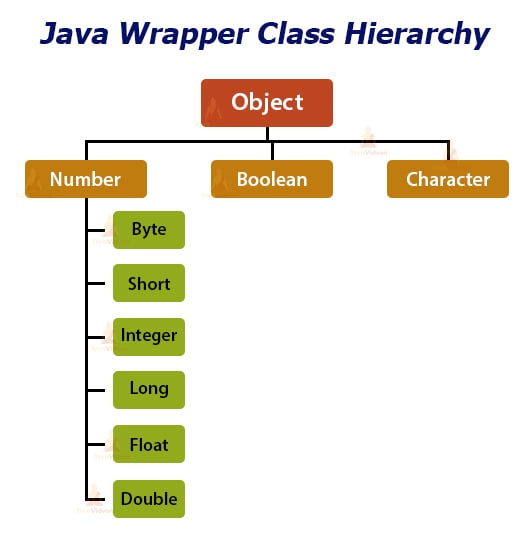
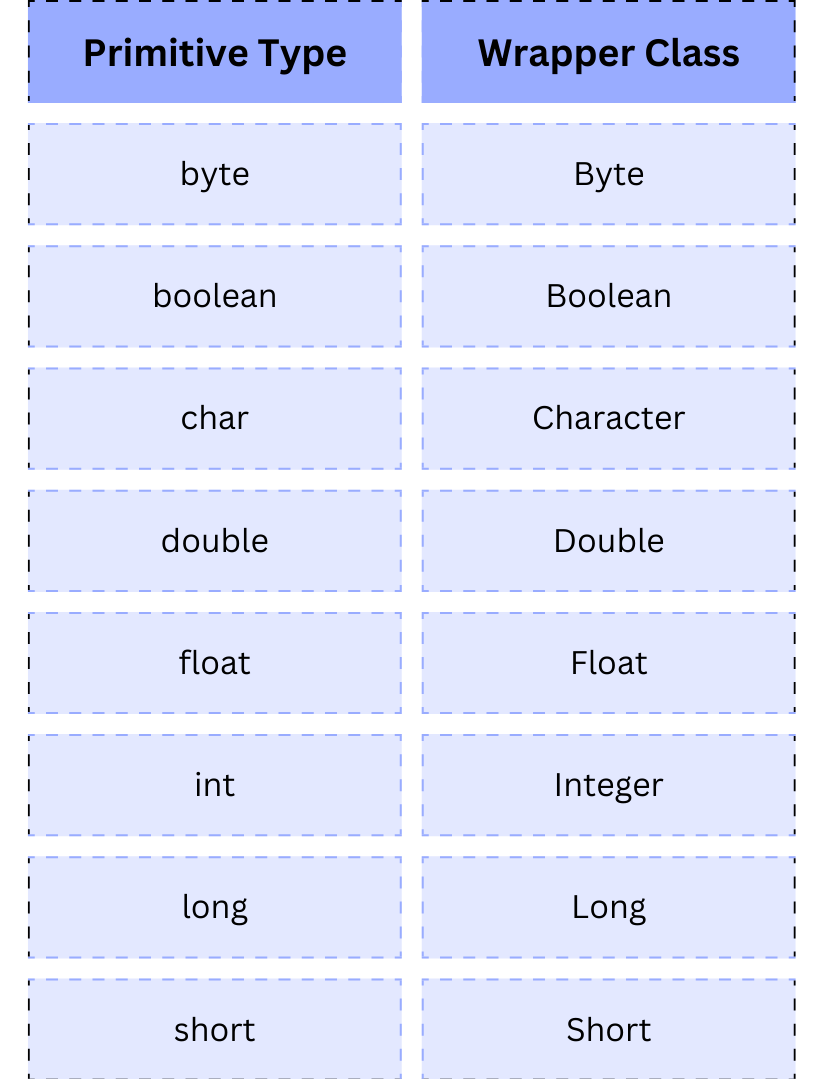
Java provides a specific wrapper class for each of its eight primitive data types. These classes reside in the java.lang package, meaning they are automatically imported and available in every Java program.
| Primitive Type | Wrapper Class |
|---|---|
byte |
Byte |
short |
Short |
int |
Integer |
long |
Long |
float |
Float |
double |
Double |
boolean |
Boolean |
char |
Character |
Notice the naming convention: most wrapper classes are simply the primitive name capitalized. The exceptions are Integer (for int) and Character (for char).
Autoboxing and Unboxing: Streamlining the Process
Before Java 5, converting between primitives and wrapper objects was a manual process, requiring explicit calls to constructors and value methods. This led to verbose and sometimes clunky code. To address this, Java introduced autoboxing and unboxing, two powerful features that automate these conversions, making code cleaner and more readable.
-
Autoboxing: This is the automatic conversion performed by the Java compiler from a primitive type to its corresponding wrapper class object. When you assign a primitive
intto anIntegerobject, the compiler handles the conversion behind the scenes.int primitiveInt = 100; Integer wrapperInt = primitiveInt; // Autoboxing: int to Integer // Equivalent to: Integer wrapperInt = Integer.valueOf(primitiveInt);This allows primitives to be seamlessly used in contexts where objects are expected, such as adding elements to a
List<Integer>. -
Unboxing: This is the automatic conversion performed by the Java compiler from a wrapper class object to its corresponding primitive type. When you assign an
Integerobject to anintvariable, or use anIntegerobject in an arithmetic operation, the compiler automatically extracts the primitive value.Integer wrapperValue = 200; int primitiveValue = wrapperValue; // Unboxing: Integer to int // Equivalent to: int primitiveValue = wrapperValue.intValue(); int sum = wrapperValue + 50; // Unboxing occurs before additionAutoboxing and unboxing significantly improve developer productivity by reducing boilerplate code and making the two worlds of primitives and objects feel more integrated. However, it’s crucial to be aware of potential pitfalls, particularly with
NullPointerExceptionduring unboxing if the wrapper object isnull.Integer nullableInt = null; // int result = nullableInt; // This would throw a NullPointerException at runtime!Understanding this behavior is a mark of a careful developer and helps in preventing runtime issues that could degrade application performance and reliability, ultimately safeguarding a company’s brand reputation.
Practical Applications and Best Practices
Knowing what wrapper classes are is one thing; knowing when and how to use them effectively is another. Strategic application of wrapper classes is a hallmark of good Java programming, balancing performance with functionality.
When to Use Primitives vs. Wrappers
The choice between using a primitive type and its wrapper counterpart is not always straightforward and often depends on the specific context and requirements of your application.
-
Use Primitives When:
- Performance is Critical: Primitives are stored directly in the stack, leading to faster access and less memory overhead compared to objects, which are stored in the heap and involve indirection. For high-performance computations or loops involving millions of operations, primitives generally outperform wrappers.
- Memory Efficiency: Primitives consume less memory than their object counterparts, as they don’t carry the overhead of an object header. In applications dealing with very large arrays or collections of simple numeric data, using primitives can lead to significant memory savings.
- Local Variables and Simple Operations: For temporary variables or straightforward arithmetic, primitives are often the more natural and efficient choice.
- Nullability is Not Needed: If a variable must always have a value and
nullis not a valid state, primitives are appropriate.
-
Use Wrappers When:
- Collections Framework: This is the most common and unavoidable scenario. Any time you need to store values in
ArrayList,HashMap,Set, etc., you must use wrapper classes. - Generics: When working with generic types (e.g.,
List<T>,Optional<T>), the type parameterTmust be a reference type. - Nullability is Required: If a value might genuinely be absent or unknown, wrapper classes allow you to represent this state using
null. This is particularly useful when interacting with databases, APIs, or user input where fields might be optional. - Object-Oriented Features: When you need to call methods on the value (e.g.,
Integer.parseInt(),doubleValue()), or leverage polymorphism. - Serialization: If objects need to be serialized (e.g., for storage or network transmission), primitives are automatically handled, but using wrapper objects can sometimes provide more flexibility in complex data structures.
- Collections Framework: This is the most common and unavoidable scenario. Any time you need to store values in
Making informed decisions here relates directly to “Tech” (optimizing performance, managing memory) and “Money” (efficient code often translates to lower infrastructure costs and better user experience, indirectly affecting revenue).
Immutability and Thread Safety
All wrapper class objects in Java are immutable. This means that once a wrapper object is created, its internal primitive value cannot be changed. For example, if you create Integer i = 10; and then perform an operation like i++;, a new Integer object with the value 11 is created, and i is made to refer to this new object. The original Integer object representing 10 remains unchanged.
Implications:
- Predictability: Immutability makes wrapper objects highly predictable. You don’t have to worry about their values changing unexpectedly from other parts of your code.
- Thread Safety: Because they are immutable, wrapper objects are inherently thread-safe. Multiple threads can access and share wrapper objects without needing external synchronization mechanisms. This simplifies concurrent programming, reduces the likelihood of complex bugs in multi-threaded environments, and is crucial for building reliable “Tech” platforms. For a brand, reliable and bug-free software builds trust and enhances its reputation.
Performance Considerations
While autoboxing and unboxing make code cleaner, they do introduce a slight performance overhead. Each autoboxing operation involves creating a new object on the heap, and each unboxing operation involves retrieving the primitive value. For casual use, this overhead is negligible. However, in performance-critical loops that execute millions of times, or in scenarios where memory footprints are extremely constrained, excessive autoboxing/unboxing can accumulate and impact performance.
For instance, in a loop adding numbers:
// Potentially less efficient due to repeated autoboxing
List<Integer> numbers = new ArrayList<>();
for (int i = 0; i < 1000000; i++) {
    numbers.add(i); // Autoboxing
}

// More efficient if only a sum is needed
long sum = 0;
for (int i = 0; i < 1000000; i++) {
    sum += i; // No autoboxing if sum is primitive
}
Awareness of this trade-off is important for optimizing Java applications, especially in areas like data processing or gaming where milliseconds matter. This consideration ties into “Money” because faster applications often mean better user experience, reduced server costs, and higher conversion rates.
Beyond the Basics: Advanced Insights and Future Trends
Mastering wrapper classes isn’t just about coding; it’s about understanding how they fit into the broader landscape of Java development and how that knowledge can advance your career and even impact financial outcomes.
Leveraging Wrapper Classes for Robust Software Design
Thoughtful use of wrapper classes contributes significantly to writing robust, maintainable, and flexible software. By understanding when to use int versus Integer, developers can design APIs that are more precise about their intent. For example, a method signature accepting Integer explicitly communicates that the input might be null, prompting the caller to handle that scenario, leading to more resilient applications. This attention to detail in design elevates the “Brand” of a software product, signifying quality and reliability.
Furthermore, wrapper classes, particularly Boolean, can be used to model more complex truth states than a simple boolean allows, such as true, false, and undefined (null). This is powerful for state management in complex applications.
The Role in Modern Java Development and AI/Data Science Contexts
In the evolving landscape of “Tech”, particularly within AI, machine learning, and big data processing, Java continues to play a significant role. Frameworks like Apache Spark (written in Scala, which runs on the JVM) and various machine learning libraries often rely on object-oriented structures for data representation. Wrapper classes facilitate the manipulation of numerical and boolean data within these object-centric environments. When data scientists or backend engineers are working with datasets that require nullable values or complex transformations, the flexibility provided by wrapper classes becomes invaluable, allowing for richer data models and more sophisticated algorithms. This direct application underscores their relevance in high-growth areas of technology.
Interview Preparation and Career Growth
For aspiring and experienced Java developers alike, a solid understanding of wrapper classes, including autoboxing, unboxing, immutability, and their performance implications, is a frequent topic in technical interviews. Being able to articulate these concepts clearly and provide practical examples demonstrates not just theoretical knowledge but also an understanding of practical software engineering principles. This mastery of fundamentals is a key component of “Personal Branding” for developers, signifying competence and attention to detail. Strong interview performance can directly translate to better job opportunities, higher salaries, and faster “Career Growth”, thereby impacting the “Money” aspect of one’s professional life. Building a strong foundation in core Java concepts is an investment that pays dividends throughout a tech career.
Conclusion
Wrapper classes in Java are far more than mere syntactic sugar; they are fundamental components that harmoniously bridge the gap between Java’s primitive data types and its object-oriented paradigm. From enabling the powerful Collections Framework to providing utility methods, facilitating nullability, and ensuring thread safety through immutability, their role is pervasive and critical.
By understanding when to leverage the efficiency of primitives versus the flexibility and object-oriented capabilities of wrapper classes, developers can write more robust, efficient, and maintainable code. While autoboxing and unboxing simplify their usage, a keen awareness of their underlying mechanisms and potential performance implications is essential for crafting high-quality software. For anyone building modern applications, navigating complex data, or aspiring to advance in the tech industry, a comprehensive grasp of wrapper classes is not just beneficial—it’s absolutely essential for building resilient systems and thriving professionally.
aViewFromTheCave is a participant in the Amazon Services LLC Associates Program, an affiliate advertising program designed to provide a means for sites to earn advertising fees by advertising and linking to Amazon.com. Amazon, the Amazon logo, AmazonSupply, and the AmazonSupply logo are trademarks of Amazon.com, Inc. or its affiliates. As an Amazon Associate we earn affiliate commissions from qualifying purchases.