
The automotive world, particularly in the realm of performance and efficiency, often throws around technical terms that can leave the uninitiated scratching their heads. One such term, frequently encountered when discussing turbocharged engines, is the “wastegate.” While its name might conjure images of discarding unwanted materials, its function is far more sophisticated and critical to the optimal operation of a modern engine. Fundamentally, a wastegate is a valve that controls the amount of exhaust gas that is allowed to spin the turbine of a turbocharger. This seemingly simple mechanism is the linchpin of turbocharger performance, directly impacting boost pressure, engine power, and longevity.
The Core Function: Regulating Boost Pressure
At its heart, the wastegate’s primary responsibility is to prevent the turbocharger from over-boosting the engine. Turbochargers work by using the engine’s exhaust gases to spin a turbine, which in turn spins a compressor. The compressor then forces more air into the engine’s cylinders than would normally be drawn in, leading to a significant increase in power and torque. However, without regulation, the exhaust gases could spin the turbine at increasingly higher speeds, generating excessive boost pressure. This uncontrolled boost can overwhelm the engine’s components, leading to severe damage, including blown head gaskets, damaged pistons, and even catastrophic engine failure. The wastegate acts as a safety valve, ensuring that the boost pressure stays within safe and optimal limits.
How Exhaust Gases Drive the Turbocharger
To understand how the wastegate intervenes, it’s essential to grasp the basic operation of a turbocharger. When an engine combusts fuel and air, it produces hot exhaust gases. These gases are directed through the exhaust manifold and then into the turbine housing of the turbocharger. The high-velocity exhaust gas impinges upon the blades of the turbine wheel, causing it to spin. The turbine wheel is directly connected to a compressor wheel via a shaft. As the turbine spins, so does the compressor. The spinning compressor draws in ambient air, compresses it, and then forces it into the engine’s intake manifold. This compressed air, also known as “boost,” contains more oxygen than naturally aspirated air. With more oxygen available, the engine can burn more fuel, resulting in a more powerful combustion event and ultimately, increased horsepower and torque. The speed at which the turbine spins is directly proportional to the volume and velocity of the exhaust gases flowing through it.
The Threat of Over-Boosting
The challenge with turbochargers is that as engine RPM and load increase, the volume and velocity of exhaust gases also rise. This increased flow can cause the turbine to spin faster and faster, leading to a rapid and uncontrolled increase in boost pressure. If left unchecked, this can exceed the design limits of the engine’s internal components, the turbocharger itself, and other associated systems. For instance, excessively high boost can force the piston rings out of their grooves, cause the cylinder head to lift off the engine block, or even lead to the destruction of the turbocharger’s bearings. The wastegate is the crucial component that prevents this runaway scenario.
The Mechanics of a Wastegate: Internal vs. External
Wastegates come in two primary configurations: internal and external. Each has its own design and operational characteristics, but both serve the same fundamental purpose of boost control. The choice between internal and external wastegates often depends on the specific application, the desired performance characteristics, and cost considerations.
Internal Wastegates: Integrated Simplicity
Internal wastegates are integrated directly into the turbocharger housing, typically within the turbine housing itself. They consist of a movable flap or valve that is controlled by a spring-loaded diaphragm actuator. When the exhaust gas pressure within the turbine housing reaches a predetermined level (determined by the spring tension), it pushes against the diaphragm. This force overcomes the spring pressure, causing the valve to open. When the valve opens, a portion of the exhaust gas is diverted away from the turbine wheel and is instead allowed to bypass it, typically flowing directly into the exhaust system downstream. This diversion reduces the amount of exhaust gas hitting the turbine, slowing its rotation and thus controlling the boost pressure. The beauty of internal wastegates lies in their compact design and simplicity, making them a common choice for many OEM (Original Equipment Manufacturer) turbocharged applications where a balance of cost and performance is desired.
External Wastegates: Precision Control and Flexibility
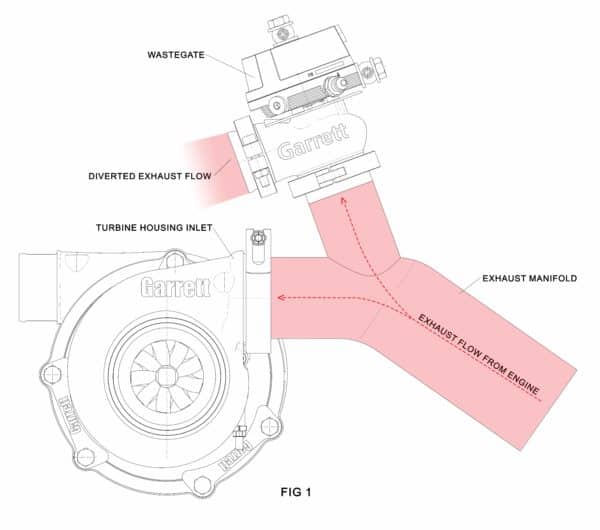
External wastegates, as their name suggests, are separate units that are mounted externally to the turbocharger. They typically bolt onto a specially designed manifold or exhaust housing. Like internal wastegates, they feature a valve and an actuator. However, external wastegates often offer greater precision and flexibility in boost control. They are generally considered more robust and capable of handling higher exhaust gas flow rates, making them popular in high-performance and racing applications.
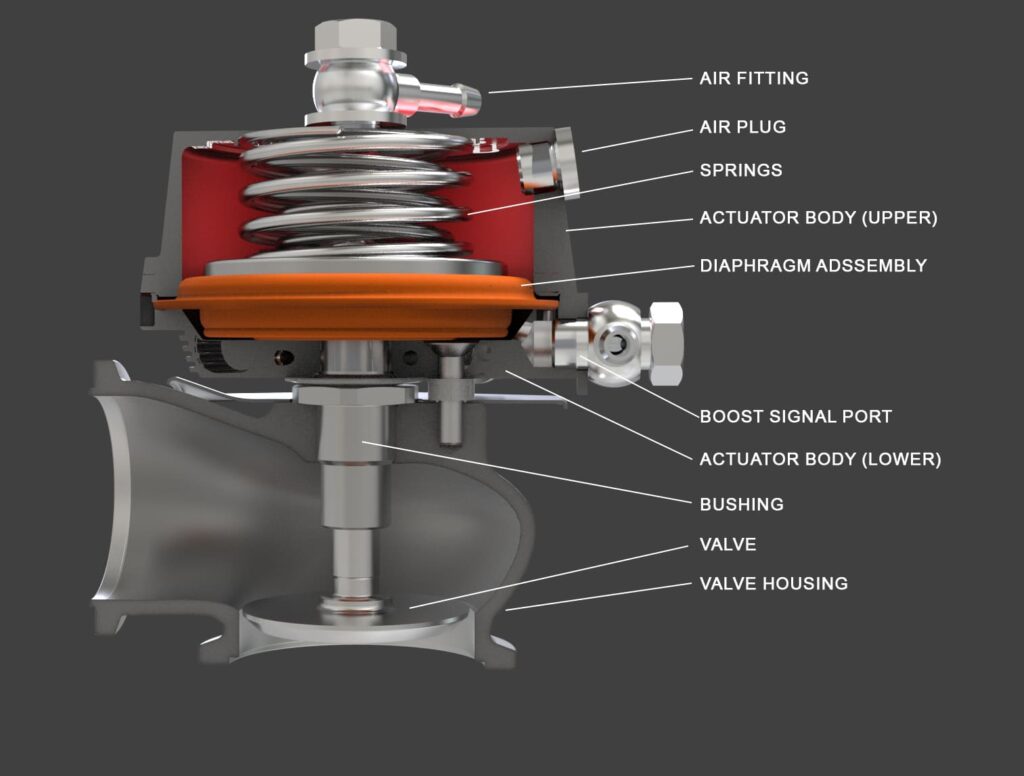
An external wastegate consists of a housing that contains a diaphragm and a spring, similar to an internal unit. However, instead of being integrated into the turbine housing, it connects to the exhaust manifold via a “header pipe” or “dump tube.” When boost pressure, controlled by the engine’s management system (or an aftermarket boost controller), reaches a specific threshold, it is sent to the wastegate’s actuator. This pressure acts on the diaphragm, forcing it to move and open a valve. This valve then directs exhaust gas from the manifold away from the turbocharger’s turbine and either vents it to the atmosphere (creating a distinctive “whoosh” sound, often referred to as a “blow-off” sound in this context, though technically different from a blow-off valve’s function) or recirculates it back into the exhaust system downstream of the turbine. The advantage of external wastegates is their ability to manage higher boost levels and their often finer tuning capabilities due to their separate nature and the ability to use different spring rates for precise boost control.
The Actuation Mechanism: How Control is Achieved
The precise operation of a wastegate, whether internal or external, relies on a sophisticated actuation mechanism that responds to pressure changes within the exhaust and intake systems. This mechanism ensures that the wastegate opens and closes at the opportune moment to maintain the desired boost level.
Actuator Pressure and Spring Tension
The core of the wastegate’s actuation is the diaphragm and spring assembly. The diaphragm is a flexible membrane that separates two chambers. One chamber is exposed to the boost pressure (or a controlled signal representing boost pressure), while the other is typically exposed to atmospheric pressure or a vacuum. A spring is placed in opposition to the boost pressure, resisting its movement. The wastegate valve is connected to this diaphragm.
In a typical setup, the spring is calibrated to hold the wastegate valve closed up to a certain pressure. As the turbocharger spools up and the exhaust gas pressure increases, it exerts force on the diaphragm. When this force, acting on the area of the diaphragm, exceeds the force exerted by the spring, the diaphragm begins to move. This movement opens the wastegate valve, allowing some exhaust gas to bypass the turbine. The higher the boost pressure, the more the diaphragm is pushed, and the more the wastegate opens, diverting more exhaust gas and thus limiting further increases in turbine speed and boost.
Role of Boost Controllers and Engine Management Systems
While the spring tension sets a baseline for when the wastegate will start to open, modern turbocharged vehicles utilize sophisticated engine management systems (ECUs) and often employ electronic boost controllers to achieve more precise and dynamic boost control.
An ECU monitors various engine parameters, including throttle position, engine RPM, air-fuel ratio, and importantly, manifold absolute pressure (MAP) or boost pressure. Based on these inputs, the ECU can send a signal to an electronic boost control solenoid. This solenoid, in turn, modulates the pressure signal that is sent to the wastegate actuator. Instead of the raw manifold pressure directly acting on the wastegate actuator, the solenoid can either vent some of this pressure or restrict its flow. This allows the ECU to finely tune the boost pressure throughout the entire engine operating range, optimizing performance and efficiency while ensuring component safety. For example, the ECU might command lower boost at low RPMs to improve drivability and then progressively increase boost as the engine revs higher and can handle more power. In racing applications, manual or electronic boost controllers achieve a similar effect, allowing the driver or tuner to set specific boost targets.
Beyond Boost: Additional Roles and Benefits of a Wastegate
While its primary role is boost regulation, the wastegate also contributes to the overall efficiency, longevity, and even the sound characteristics of a turbocharged engine. Understanding these secondary benefits provides a more complete picture of this vital component.
Protecting the Turbocharger from Excessive Speed
As mentioned earlier, the wastegate is crucial for preventing the turbocharger itself from spinning beyond its mechanical limits. Turbochargers have a maximum safe rotational speed. Exceeding this speed can lead to bearing failure, impeller damage, or even turbine wheel disintegration. By diverting excess exhaust gas, the wastegate ensures that the turbine speed remains within acceptable parameters, thereby extending the life of the turbocharger. This protection is particularly important during transient conditions, such as rapid throttle changes, where boost can spike quickly.
Improving Throttle Response and Reducing Turbo Lag
While it might seem counterintuitive, a properly functioning wastegate can actually contribute to improved throttle response and reduced turbo lag. Turbo lag is the delay between when the throttle is opened and when the turbocharger produces significant boost. By controlling boost pressure and preventing the turbo from over-spinning at lower RPMs, the wastegate can help keep the turbine spinning at a more consistent speed. This means that when the driver demands more power, the turbo is already closer to its optimal operating range, spooling up more quickly and delivering boost with less delay. Some advanced tuning strategies even use the wastegate to deliberately bleed off some boost at very low RPMs to prevent compressor surge, a condition where airflow reverses direction within the compressor, which can be damaging and reduce efficiency.
The Sound of Performance: Wastegate Bypass and Atmos Dump
The operation of a wastegate can also influence the audible characteristics of a turbocharged engine, particularly in the case of external wastegates that vent bypass air directly to the atmosphere. When an external wastegate opens, the excess exhaust gas is channeled away from the turbine. If this bypassed gas is vented to the atmosphere through a dump tube, it creates a distinct “whoosh” or “chatter” sound, often associated with performance vehicles. This sound is a direct audible indicator that the wastegate is functioning to regulate boost pressure. While some enthusiasts enjoy this sound, it’s important to note that it is a byproduct of the boost control system and not its primary function. In many OEM applications, the wastegate bypass air is recirculated back into the intake system upstream of the turbocharger or directly into the exhaust system downstream of the turbine, making it virtually silent.

Optimizing Efficiency and Fuel Economy
By precisely controlling boost pressure, the wastegate contributes to the overall efficiency of the engine. When boost is kept within optimal levels, the engine can operate more efficiently, achieving the desired power output without wasting excessive fuel. The ability to modulate boost allows the engine management system to deliver the right amount of power for the given driving conditions, potentially leading to improved fuel economy compared to an engine with uncontrolled or poorly regulated boost. This precise control ensures that the engine is not generating more power than is needed, thus avoiding unnecessary fuel consumption.
In conclusion, the wastegate is a sophisticated yet crucial component of any turbocharged engine. Far from being a mere outlet for excess exhaust, it is a precisely engineered valve that acts as the guardian of boost pressure. Its ability to regulate the flow of exhaust gases directly impacts engine performance, longevity, and even efficiency. Whether internal or external, integrated or standalone, the wastegate plays an indispensable role in harnessing the power of turbocharging safely and effectively. Understanding its function demystifies a key aspect of modern automotive technology and highlights the intricate engineering that goes into optimizing engine performance.
aViewFromTheCave is a participant in the Amazon Services LLC Associates Program, an affiliate advertising program designed to provide a means for sites to earn advertising fees by advertising and linking to Amazon.com. Amazon, the Amazon logo, AmazonSupply, and the AmazonSupply logo are trademarks of Amazon.com, Inc. or its affiliates. As an Amazon Associate we earn affiliate commissions from qualifying purchases.