
In the intricate tapestry of modern networking, where data flows at the speed of light and connectivity is king, certain components operate as unsung heroes, silently enabling the digital world we inhabit. Among these crucial elements are SFP ports, a ubiquitous feature in network switches, routers, and other communication devices. Far more than just a simple opening, SFP ports represent a gateway to flexible, high-speed, and scalable network connectivity, acting as the interface through which specialized modules can be inserted to tailor a network’s capabilities. Understanding what SFP ports are, how they function, and why they are so vital is fundamental for anyone looking to grasp the essence of contemporary network infrastructure, from the smallest home office setup to the largest enterprise data centers. This article will delve into the technical nuances of SFP technology, explore its diverse applications, discuss practical implementation considerations, and shed light on its broader impact on the tech landscape, business operations, and financial efficiency.

Deconstructing SFP: What It Is and How It Works
At its core, an SFP port is a slot on a network device designed to accept a Small Form-Factor Pluggable (SFP) transceiver module. It’s crucial to understand that the “port” itself is the physical opening, while the “SFP” refers to the module that plugs into it. This distinction is vital because the intelligence and versatility come from the interchangeable SFP module, not the port alone.
The Acronym Explained: Small Form-Factor Pluggable
SFP stands for Small Form-Factor Pluggable. The “Small Form-Factor” aspect highlights its compact size, allowing for high port density on network equipment, which is critical in space-constrained data centers and wiring closets. “Pluggable” emphasizes its ability to be easily inserted and removed, often while the device is still operating (hot-pluggable), offering immense flexibility and ease of maintenance. This modular design was a significant innovation over fixed-port configurations, where the interface type was permanently etched into the hardware.
Beyond the Port: Understanding the Transceiver
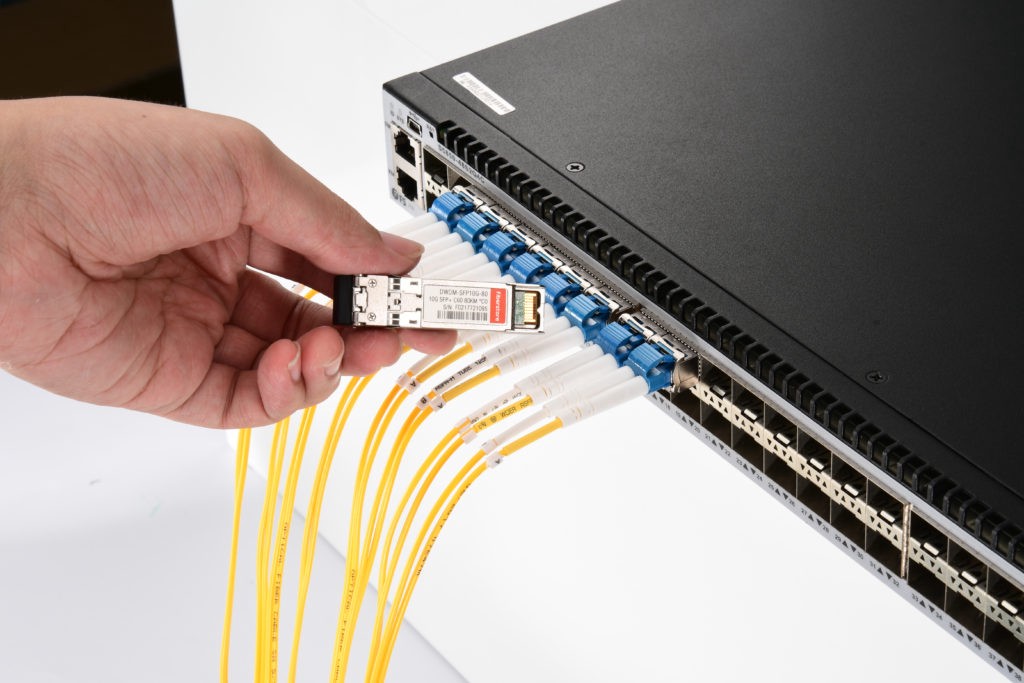
The SFP module, often referred to as an “SFP transceiver,” is a hot-pluggable optical or electrical transducer. It connects a network device (like a switch, router, or media converter) to a fiber optic cable or, less commonly, a copper network cable. Its primary function is to convert electrical signals from the host device into optical signals (for fiber) or specific electrical signals (for copper) for transmission, and vice-versa, for reception. This conversion process is what enables data to travel over different media types and distances. Each SFP module contains the necessary electronics, including a laser diode for transmitting data and a photodiode for receiving data, along with control circuitry to manage these operations. The type of SFP module determines the transmission speed, the type of cable it uses (e.g., single-mode fiber, multimode fiber, copper), and the maximum distance over which it can transmit data reliably.
Hot-Pluggable Design: A Game Changer
The hot-pluggable nature of SFP modules is one of their most significant advantages. It means that an SFP module can be inserted into or removed from an active network device without powering down the device or disrupting other ports. This capability offers several benefits:
- Reduced Downtime: Network administrators can upgrade, replace, or troubleshoot modules without bringing down the entire switch or router, significantly minimizing service interruptions.
- Simplified Maintenance: Faulty modules can be quickly swapped out, streamlining maintenance procedures.
- Enhanced Flexibility: Network configurations can be altered on the fly, adapting to changing requirements without the need for extensive downtime or hardware replacement.
Key Components of an SFP Module
Despite their small size, SFP modules are sophisticated pieces of engineering. They typically consist of:
- Transmitter (Laser Diode): Generates the optical signal for fiber optic transmission. Different types of lasers are used depending on the wavelength and distance requirements.
- Receiver (Photodiode): Detects the incoming optical signal and converts it back into an electrical signal.
- Control Circuitry: Manages the module’s operations, including signal processing, monitoring diagnostic information (like temperature, voltage, optical power levels through DDM/DOM – Digital Diagnostics Monitoring/Digital Optical Monitoring), and interfacing with the host device.
- Connector: The interface that plugs into the SFP port on the host device and the specific cable type (e.g., LC connector for fiber, RJ45 for copper).
Why SFP Ports Are Indispensable in Modern Networks
SFP ports and their accompanying transceiver modules have become foundational to contemporary network design, primarily due to their unparalleled versatility, scalability, and cost-efficiency. They address several critical challenges faced by network architects and IT professionals, making them a cornerstone of robust, high-performance infrastructure.
Versatility and Flexibility
One of the greatest strengths of SFP technology lies in its remarkable versatility. A single SFP port on a network switch can support a multitude of different media types and transmission characteristics simply by swapping out the SFP module.
- Media Agnostic: SFP modules can transmit data over various types of fiber optic cables (multimode for shorter distances, single-mode for longer distances) or even standard copper Ethernet cables (RJ45). This allows network designers to mix and match connectivity options within the same device, optimizing for specific link requirements.
- Speed Adaptability: While early SFPs primarily supported Gigabit Ethernet (1 Gbps), the technology has evolved to SFP+ (10 Gbps), SFP28 (25 Gbps), and the higher-density QSFP variants (40 Gbps, 100 Gbps, 200 Gbps, 400 Gbps). This progression ensures that SFP ports remain relevant even as network speeds continue to accelerate.
- Distance Variation: From short-reach fiber links within a data center to extended-reach connections spanning tens or even hundreds of kilometers, SFP modules are available for an extensive range of distances, catering to diverse network topologies.
Scalability and Future-Proofing
In the rapidly evolving world of technology, future-proofing infrastructure is a constant challenge. SFP technology significantly contributes to a network’s scalability and longevity.
- Modular Upgrades: Instead of replacing an entire network switch when a higher speed or different media type is required, network administrators can simply upgrade the SFP modules. For instance, a switch designed with SFP+ ports can initially be populated with 1 Gbps SFP modules and later upgraded to 10 Gbps SFP+ modules as bandwidth demands increase, all without replacing the core hardware.
- Adaptive Growth: As a business expands or new technologies emerge, SFP ports allow the network infrastructure to adapt gracefully. New servers requiring faster connections or additional fiber links can be integrated by simply installing the appropriate SFP modules, avoiding costly and disruptive forklift upgrades.
Cost-Effectiveness: A Smart Investment
From a financial perspective, SFP ports offer substantial long-term savings, aligning well with the “Money” aspect of modern IT management.
- Reduced Capital Expenditure (CAPEX): By enabling modular upgrades, SFP technology defers the need for frequent full hardware replacements. Companies can invest in core networking equipment with SFP ports, confident that they can adapt to future needs by only purchasing new, relatively inexpensive modules, rather than entire switches or routers.
- Lower Operational Expenditure (OPEX): The hot-pluggable nature reduces downtime during maintenance or upgrades, minimizing productivity losses. Additionally, standardized SFP modules from various manufacturers can often be used, fostering competition and potentially lowering component costs. The ability to quickly diagnose and replace faulty modules also reduces technician time and associated labor costs.
- Optimized Resource Utilization: By allowing devices to support various media and speeds, SFP ports ensure that network hardware is utilized to its fullest potential, avoiding situations where devices become obsolete prematurely due to a lack of flexible connectivity options.
Performance and Reliability
In an age where latency and bandwidth are critical performance indicators, SFP modules play a pivotal role in ensuring high-performance and reliable network links.
- High Bandwidth Support: SFP, SFP+, SFP28, and QSFP modules are engineered to support the demanding bandwidth requirements of modern applications, including cloud computing, virtualization, big data analytics, and real-time streaming services.
- Error Reduction: Optical fiber, particularly with quality SFP transceivers, is highly resistant to electromagnetic interference (EMI), leading to cleaner signal transmission and fewer errors compared to traditional copper cabling over longer distances. This inherent reliability is crucial for mission-critical applications and data integrity.
- Digital Diagnostics Monitoring (DDM): Many SFP modules incorporate DDM (also known as DOM, Digital Optical Monitoring) features. This allows network administrators to monitor real-time parameters such as optical output power, optical input power, temperature, laser bias current, and transceiver supply voltage. DDM is invaluable for proactive network health monitoring, troubleshooting, and predicting potential failures, thereby enhancing overall network reliability.
Types of SFP Transceivers and Their Applications
The SFP ecosystem is rich with a variety of transceiver types, each designed for specific network requirements. Understanding these different modules is key to designing and maintaining an efficient network.
SFP (1G): The Gigabit Standard
The original SFP modules primarily support Gigabit Ethernet (1 Gbps) or Fiber Channel speeds. They are widely used for connecting switches to servers, storage devices, and other network equipment over both fiber and copper.
- Fiber Optic SFPs (1G):
- 1000BASE-SX: Designed for multimode fiber (MMF) over shorter distances, typically up to 550 meters. SX modules use an 850 nm wavelength laser. They are common for intra-building or data center connections.
- 1000BASE-LX: Used for both multimode and single-mode fiber (SMF). On MMF, it can reach up to 550 meters, similar to SX. On SMF, it supports much longer distances, typically up to 10 km, using a 1310 nm wavelength laser. Ideal for campus networks or connections between buildings.
- 1000BASE-EX: An extended-reach single-mode fiber module, often supporting distances up to 40 km with a 1310 nm wavelength.
- 1000BASE-ZX: Designed for very long-reach single-mode fiber, capable of transmitting data up to 70 km or even 80 km, typically using a 1550 nm wavelength. These are used for metropolitan area networks (MANs) or connections between distant sites.
- Copper SFPs (1G):
- 1000BASE-T: These modules have an RJ45 connector and allow a Gigabit SFP port to connect to standard copper Ethernet cabling (Cat5e, Cat6, Cat6a) up to 100 meters. They are useful for integrating legacy copper infrastructure with fiber-centric switches.
SFP+ (10G): Stepping Up to Ten Gigabit
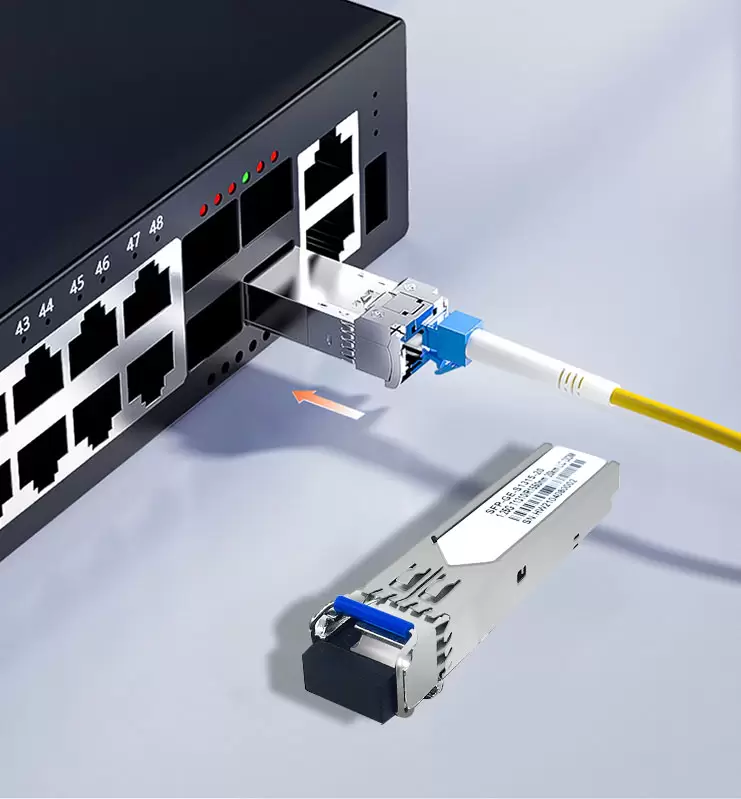
SFP+ (Small Form-Factor Pluggable Plus) is the next evolution, supporting 10 Gigabit Ethernet (10 Gbps) and 8 Gbps Fiber Channel. SFP+ modules are nearly identical in size to SFP modules, allowing for high 10 Gigabit port density.
- 10GBASE-SR (Short Range): The most common 10G SFP+ module, used with multimode fiber for distances up to 300 meters (on OM3 fiber) or 400 meters (on OM4 fiber). Uses an 850 nm wavelength. Essential for high-speed links within data centers.
- 10GBASE-LR (Long Range): Designed for single-mode fiber, supporting distances up to 10 km. Uses a 1310 nm wavelength. Ideal for longer-distance 10G connections.
- 10GBASE-ER (Extended Reach): Single-mode fiber module for distances up to 40 km, typically using a 1550 nm wavelength.
- 10GBASE-ZR (Longest Reach): Single-mode fiber module for distances up to 80 km, also typically using a 1550 nm wavelength.
- 10GBASE-T: Copper SFP+ module for 10 Gigabit Ethernet over Cat6a/Cat7 cables up to 30 meters. Less common than fiber SFP+ due to power consumption and distance limitations for copper at 10G.
- Direct Attach Cable (DAC) / Active Optical Cable (AOC): These are not technically SFP+ modules but cables with integrated SFP+ connectors at both ends. DACs are passive copper cables for very short distances (up to 7 meters), common for server-to-switch connections within a rack. AOCs are fiber optic cables with integrated transceivers, offering longer reaches (up to 100 meters) and better performance than DACs for short-distance inter-rack connectivity.
SFP28 (25G): The 25 Gigabit Evolution
SFP28 modules support 25 Gigabit Ethernet (25 Gbps). They are also the same form factor as SFP+ but are optimized for higher speeds. SFP28 is a key component in 25G Ethernet deployments, which are gaining traction as a cost-effective and efficient upgrade path from 10G for data center server connectivity.
QSFP, QSFP+, QSFP28, QSFP-DD: Higher Density and Speeds
As network speeds continue to accelerate, higher-density SFP variants have emerged, known as Quad Small Form-Factor Pluggable (QSFP). These modules leverage four lanes of data transmission, effectively multiplying the speed capabilities.
- QSFP (40G): Supports 4×10 Gbps lanes for a total of 40 Gbps.
- QSFP+ (40G): An enhancement of QSFP, primarily for 40 Gigabit Ethernet.
- QSFP28 (100G): Supports 4×25 Gbps lanes for a total of 100 Gbps. This is the dominant form factor for 100G in data centers.
- QSFP-DD (200G, 400G): QSFP Double Density, designed to support even higher speeds by doubling the number of lanes to eight, enabling 200 Gbps (8x25G) and 400 Gbps (8x50G) connectivity. These are at the forefront of ultra-high-speed networking.
DWDM and CWDM SFPs: Wavelength Division Multiplexing
For even greater capacity over existing fiber infrastructure, Wavelength Division Multiplexing (WDM) SFPs are used.
- CWDM (Coarse Wavelength Division Multiplexing): Allows multiple optical signals (channels) to be transmitted simultaneously over a single fiber strand using different wavelengths. CWDM SFPs are ideal for increasing bandwidth capacity over relatively shorter distances (up to 80-120 km) without deploying new fiber.
- DWDM (Dense Wavelength Division Multiplexing): Similar to CWDM but uses a much denser packing of wavelengths, allowing for significantly more channels and thus vastly higher capacities over very long distances (hundreds or thousands of kilometers). DWDM SFPs are critical for high-capacity backbone networks and internet service providers.
Implementing SFP: Practical Considerations and Best Practices
Successfully deploying and managing SFP technology requires attention to several practical aspects, from compatibility to ongoing maintenance and even security. Adhering to best practices ensures optimal performance, reliability, and longevity of your network infrastructure.
Compatibility Matters: A Crucial First Step
One of the most frequent challenges in SFP implementation is ensuring compatibility.
- Vendor Compatibility: While SFP modules are designed to be a standardized form factor, some network equipment vendors (e.g., Cisco, Juniper, HP) implement proprietary coding in their transceivers. This can make it challenging to use third-party SFP modules in their equipment, as the device’s operating system might flag them as incompatible or simply refuse to recognize them. It’s often necessary to purchase modules explicitly coded for your specific networking hardware, or to ensure that third-party vendors guarantee compatibility. Many reputable third-party SFP manufacturers offer modules that are fully compatible with major OEM equipment at a fraction of the cost, making them an attractive “Money” saving option for businesses.
- Module-to-Module Compatibility: When connecting two devices, both ends of the link must use compatible SFP modules. This means matching speed (e.g., SFP+ to SFP+), fiber type (e.g., single-mode to single-mode), wavelength, and distance capabilities. Mismatches in any of these parameters will result in a non-functional link.
Proper Installation and Maintenance
Correct installation and ongoing maintenance are crucial for the performance and lifespan of SFP modules and the network.
- Cleanliness is Key: Fiber optic connections are highly susceptible to contamination. Dust, dirt, or oil on the SFP module’s optical interface or the fiber patch cable connector can significantly degrade performance or even block the signal entirely. Always use lint-free wipes and isopropyl alcohol for cleaning, and keep dust caps on connectors when not in use. Fiber optic inspection tools are recommended to verify cleanliness before connection.
- Gentle Handling: SFP modules, though robust, should be handled with care. Avoid touching the optical interfaces, and always insert and remove them gently. The latching mechanism (often a bail clasp or push-pull tab) should be operated correctly to prevent damage to the module or the port.
- Understanding LED Indicators: Network devices typically have LED indicators next to SFP ports. A solid green light usually indicates a good link, while a flashing light signifies activity. Absence of a link light or a yellow/amber light often points to a problem, which can be an early warning sign for troubleshooting.
Troubleshooting Common Issues
When an SFP-based link fails or performs poorly, a systematic approach to troubleshooting is essential.
- No Link Light:
- Check Compatibility: Reconfirm that both SFP modules and the connected hardware are compatible.
- Verify Fiber Connection: Ensure the fiber cable is securely plugged in at both ends and the transmit (Tx) and receive (Rx) fibers are correctly paired (often called “Tx/Rx flip” or polarity issue).
- Inspect and Clean: Check both SFP module faces and fiber cable connectors for dirt or damage.
- Test Cable: Use a fiber optic light source and power meter to check cable continuity and signal strength.
- Swap Components: Systematically swap the SFP modules and then the fiber cable with known good ones to isolate the faulty component.
- Poor Performance/High Error Rate:
- Check DDM Readings: Utilize the digital diagnostics monitoring features if available. High temperatures, low received optical power, or high bias current can indicate a failing module or a problem with the fiber link.
- Distance/Attenuation: Ensure the link distance does not exceed the SFP module’s specifications, and check for excessive attenuation in the fiber cable, which might require a different SFP module or fiber repair.
- Duplex Mismatch: Though less common with modern auto-negotiation, ensure duplex settings are consistent across the link.
Security Implications: Ensuring Genuine Modules
While primarily a “Tech” concern, there’s an intersection with “Brand” and “Money” when it comes to the authenticity of SFP modules.
- Counterfeit Modules: The market has seen a rise in counterfeit SFP modules. These often offer lower performance, reduced reliability, shorter lifespans, and may lack critical DDM features. Using counterfeit modules can lead to unexpected network outages, difficulty in troubleshooting, and even potential security vulnerabilities if they contain malicious firmware.
- Reputation and Trust: For businesses, relying on genuine, quality SFP modules protects their network integrity and, by extension, their brand reputation for reliability. Investing in certified components, whether from an OEM or a reputable third-party, ensures that the network infrastructure remains robust and secure, avoiding costly disruptions and potential data breaches.
- Supply Chain Security: As digital security extends to hardware, ensuring that SFP modules come from trusted suppliers is a critical aspect of supply chain security, preventing the introduction of compromised components into the network.
The Future of Connectivity: SFP’s Evolving Role and Broader Impact
SFP technology, in its various iterations, is not just a present-day workhorse but a continuous driver of innovation in network infrastructure. Its modularity and adaptability ensure its relevance in shaping the future of connectivity, with profound implications across technology, business, and finance.
Driving Innovation in Data Centers and Cloud Computing
The relentless demand for higher bandwidth, lower latency, and greater efficiency in data centers and cloud computing environments is a primary catalyst for SFP evolution.
- Density and Speed: As data centers aim for increasingly higher densities of servers and storage, the compact form factor of SFP and QSFP modules allows for maximum port count on network switches, crucial for scaling East-West traffic within the data center. The continuous push towards 25G, 100G, 200G, and 400G Ethernet, enabled by SFP28, QSFP28, and QSFP-DD, is directly fueled by the needs of virtualized environments, AI/ML workloads, and high-performance computing.
- Disaggregation and Open Networking: SFP technology perfectly aligns with the trend towards network disaggregation, where hardware and software components are sourced independently. This fosters an open ecosystem where network operators can choose best-of-breed transceivers for their open network switches, promoting innovation and competitive pricing in the “Tech” sector.
- Optical Networking Advances: The ongoing development of coherent optics within QSFP-DD form factors is pushing the boundaries of long-haul and data center interconnect (DCI) capabilities, allowing for unprecedented distances and capacities directly from compact pluggable modules, without relying on bulky dedicated systems.
Economic and “Brand” Implications
The strategic implementation of SFP technology extends beyond purely technical benefits, impacting a company’s financial health and market perception.
- Money: Optimizing IT Budgets: By offering a flexible and upgradeable pathway, SFP technology helps businesses optimize their IT spending. It shifts capital expenditure from expensive, monolithic hardware replacements to more manageable, incremental module upgrades. This allows for better financial planning, spreading costs over time, and ensuring that IT investments deliver maximum long-term value. Furthermore, the ability to use compatible third-party modules can lead to significant cost savings on components without compromising performance, directly impacting the bottom line. Efficient network infrastructure, enabled by reliable SFP links, reduces operational costs associated with downtime and troubleshooting.
- Brand: Enhancing Reputation and Service Delivery: A robust, high-performing network is foundational to a strong corporate identity in the digital age. Companies that leverage advanced networking solutions like those enabled by SFP technology project an image of reliability, innovation, and cutting-edge capability. For service providers, this translates directly into enhanced customer satisfaction and trust. For enterprises, it means seamless internal operations, reliable connectivity for remote workers, and the ability to rapidly deploy new digital services. Conversely, frequent network outages or slow performance, often linked to inadequate or poorly maintained connectivity, can severely damage a brand’s reputation, leading to customer churn and loss of confidence. Therefore, investing in quality SFP components and best practices is an investment in brand equity. The ability to quickly adapt and scale network resources with SFP also positions a brand as agile and responsive to market demands.
The Continued Push for Higher Speeds and Lower Power Consumption
The evolution of SFP will continue to be driven by the twin demands of increasing data rates and reducing power consumption. Future SFP and QSFP variants will aim for even higher speeds (e.g., 800G and beyond) while simultaneously striving for greater energy efficiency per bit. This is crucial for sustainable computing and reducing the carbon footprint of data centers, aligning with broader “Tech” trends towards green IT. Developments in silicon photonics and co-packaged optics are likely to further miniaturize and optimize these modules, ensuring SFP’s foundational role for decades to come.
In conclusion, SFP ports, along with their versatile transceiver modules, are far more than just connection points; they are pivotal enablers of modern network infrastructure. Their modularity, flexibility, and scalability allow organizations to build dynamic, high-performance networks that can adapt to ever-changing technological landscapes and business demands. From the gigabit speeds connecting offices to the multi-terabit backbones powering the global internet, SFP technology underpins the seamless flow of information that drives innovation, commerce, and communication in our increasingly connected world. Understanding their function and strategic importance is key for anyone navigating the complexities of digital transformation and building resilient, future-ready systems that support both technological advancement and sound financial and branding strategies.
aViewFromTheCave is a participant in the Amazon Services LLC Associates Program, an affiliate advertising program designed to provide a means for sites to earn advertising fees by advertising and linking to Amazon.com. Amazon, the Amazon logo, AmazonSupply, and the AmazonSupply logo are trademarks of Amazon.com, Inc. or its affiliates. As an Amazon Associate we earn affiliate commissions from qualifying purchases.