
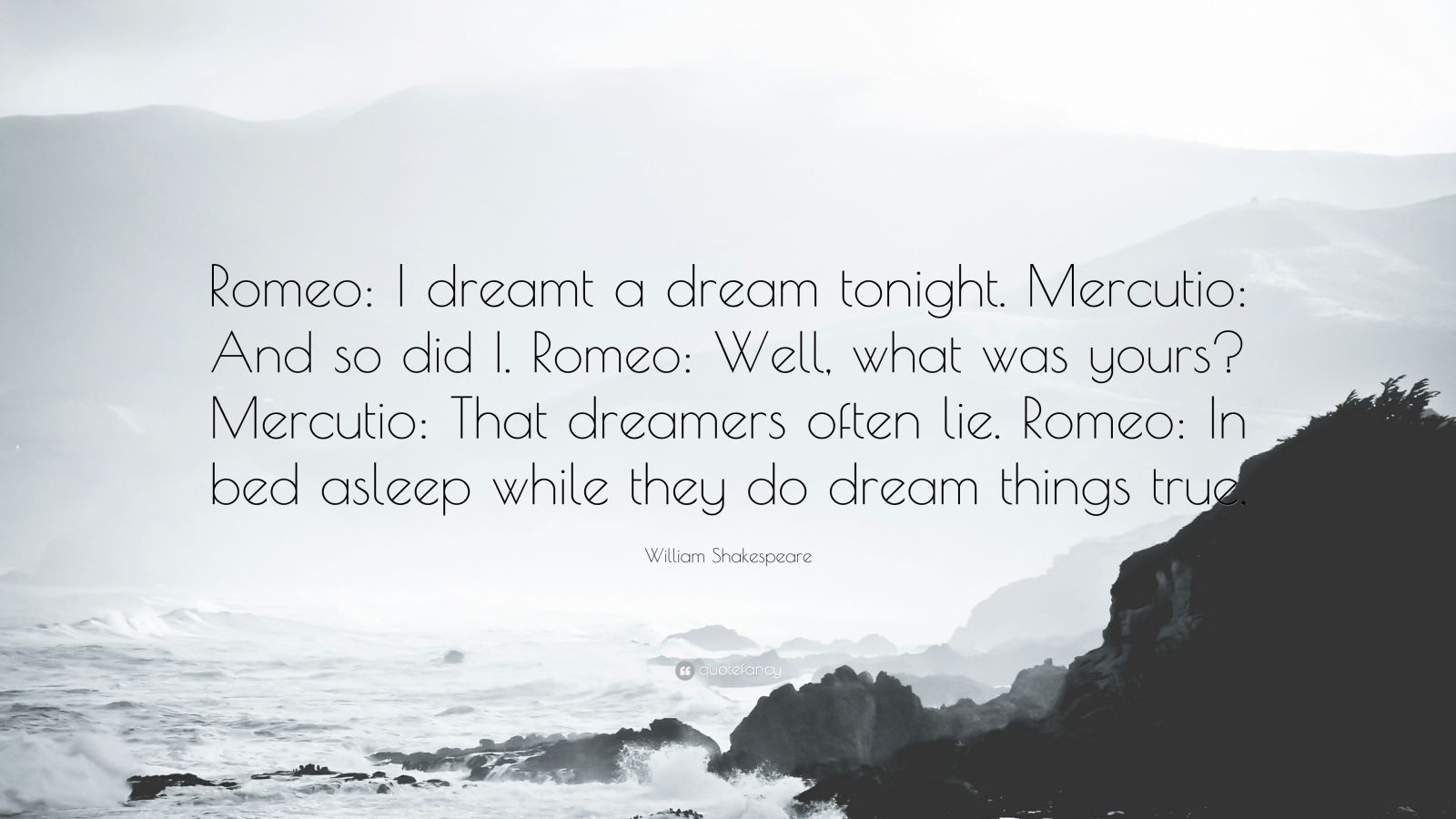
In William Shakespeare’s Romeo and Juliet, Mercutio delivers one of the most famous monologues in theatrical history: the Queen Mab speech. When Romeo claims he had a dream that bodes ill for their evening’s plans, Mercutio scoffs, spinning a wild, psychedelic tale of a “fairy’s midwife” who gallops across the noses of sleepers, delivering dreams tailored specifically to their deepest desires and professional anxieties. While Mercutio intended his speech as a cynical dismissal of dreams—labeling them “the children of an idle brain, begot of nothing but vain fantasy”—his description of how these dreams are constructed bears a striking resemblance to the most sophisticated technologies of the 21st century.
Today, we are no longer visited by a microscopic fairy in a hazelnut chariot. Instead, we are visited by algorithms, predictive analytics, and generative AI. When we ask what Mercutio says about dreams, we find a blueprint for the modern tech landscape: a world where our digital “subconscious” is mined, mirrored, and manipulated by the software we use every day.
The Architecture of Desire: How AI Mirrors Mercutio’s Queen Mab
Mercutio’s core argument is that dreams are not prophetic; rather, they are hyper-personalized reflections of the dreamer’s reality. He describes how Queen Mab makes lawyers dream of fees, ladies dream of kisses, and soldiers dream of “cutting foreign throats.” In the tech sector, this is the fundamental logic of predictive modeling and recommendation engines.
Predictive Analytics as the Modern Fairy Midwife
Just as Queen Mab identifies the specific “niche” of a sleeper to deliver a tailored vision, modern data science uses predictive analytics to anticipate user behavior. When you browse a streaming platform or an e-commerce site, the “Queen Mab” of the platform—the recommendation algorithm—is at work. It analyzes your historical data, your “idle” clicks, and your dwell time to present a curated reality. Mercutio’s insight that dreams are products of our specific circumstances is the bedrock of the Attention Economy. Tech companies do not show us a random world; they show us a world that reinforces our existing inclinations, effectively “dreaming” for us based on our digital footprints.
The Hyper-Personalization of User Experience (UX)
The “midwife” in Mercutio’s speech is a master of UX. She knows exactly which part of the body to touch to trigger a specific response. In modern software development, hyper-personalization has moved beyond simple name-tagging in emails. It now involves dynamic interfaces that change based on user sentiment and real-time behavior. Using machine learning, apps can now adjust their layout, color schemes, and notification frequency to suit the “dream” state of the user. We are moving toward an era of “generative interfaces,” where the software we interact with is as fluid and responsive as the dreamscape Mercutio describes.
Virtual Realities and the “Vain Fantasy” of Digital Worlds
Mercutio concludes his speech by calling dreams “as thin of substance as the air and more inconstant than the wind.” To a tech enthusiast, this sounds remarkably like a description of the Metaverse and Extended Reality (XR). We are increasingly spending our time in environments that are “thin of substance”—made of code and light—yet they feel increasingly real.
Metaverse: Building the Empty Cities of Dreams
The current push toward the Metaverse is an attempt to institutionalize the “vain fantasy” Mercutio spoke of. Companies like Meta and Apple are investing billions in hardware (Quest, Vision Pro) and software to create spaces where we can live out alternate realities. Like Mercutio’s dreams, these spaces are often criticized for being empty or “begot of nothing.” However, the technical challenge lies in making these “thin” environments feel substantial. Through haptic feedback and spatial audio, tech developers are attempting to bridge the gap between Mercutio’s “nothing” and a tangible digital presence.

Latent Space: Understanding AI’s Generative Imagination
In the world of Generative AI, there is a concept known as “latent space.” This is the multi-dimensional space where an AI model stores all the possibilities it has learned from its training data. When a user prompts a tool like Midjourney or DALL-E to create an image, the AI “dreams” by navigating this latent space. Mercutio’s description of dreams as “the children of an idle brain” is a perfect metaphor for these models. They don’t “know” what they are creating; they are simply synthesizing vast amounts of data into a new, often surreal, manifestation. The “vain fantasy” of AI generation is now a multi-billion-dollar industry, proving that there is immense value in the “nothing” that Mercutio dismissed.
Data Sovereignty and the Midwife of Mischief
While Mercutio’s speech starts as a whimsical tale, it takes a dark turn. He mentions how Queen Mab “plats the manes of horses in the night” and “bakes the elf-locks in foul sluttish hairs.” He portrays her as a mischievous, sometimes malevolent force that manipulates the sleeper without their consent. This provides a poignant framework for discussing data privacy and digital security.
The Ethical Dilemma of Algorithmic Manipulation
The “Queen Mab” of modern tech—the algorithm—is not always benevolent. We see this in the “rabbit holes” of social media, where algorithms designed to maximize engagement can lead users toward radicalization or misinformation. Mercutio warns that dreams can become nightmares depending on what the “midwife” brings. In tech, this is the challenge of “alignment.” How do we ensure that the AI systems we build don’t manipulate our “dreams” (our desires and beliefs) in ways that are harmful to society? The mischief Mercutio describes is a precursor to the modern conversation around algorithmic bias and ethical AI.
Protecting the Digital Subconscious
As our “dreams”—our private thoughts, search histories, and biometric data—become more accessible to technology, the need for robust digital security grows. Mercutio’s sleeper is vulnerable, unaware of the fairy riding across their nose. Similarly, many users are unaware of the “shadow profiles” and tracking pixels that follow them across the web. The tech industry is currently grappling with a shift toward “Privacy by Design,” an attempt to give users back control over their digital subconscious. Whether through end-to-end encryption or decentralized identity (Web3), the goal is to prevent the “midwives” of the tech world from entering our private spaces without an invitation.
Future-Proofing Our Dreams: The Intersection of Human Intuition and Machine Learning
Mercutio’s ultimate point is that dreams are unreliable. He urges Romeo to ignore them and focus on reality. However, in the tech world, the line between “dream” (digital) and “reality” (physical) is blurring. To navigate this future, we must find a balance between the precision of machine learning and the unpredictability of human intuition.
Why Pure Logic Still Needs the “Idler’s Brain”
The most innovative tech solutions often come from the kind of “idle brain” Mercutio mentions. While big data provides the patterns, human creativity provides the spark. In the development of software, “hallucination”—a term used when AI makes things up—is usually seen as a bug. But in creative tech, these hallucinations are a feature. They are the “dreams” of the machine that push human creators in new directions. By embracing the “inconstant” nature of creativity, tech developers can build tools that don’t just replicate the past but help us imagine entirely new futures.
Conclusion: The Persistent Relevance of Mercutio’s Vision
What does Mercutio say about dreams? He says they are reflections of our inner lives, delivered by a force we don’t fully control, and often lack substance. As we build the future of technology, these warnings serve as a checklist. We must ensure our algorithms are personalized but not manipulative; our virtual worlds are immersive but not hollow; and our data is used to empower the dreamer rather than exploit them.
In the age of AI and the Metaverse, we are all sleepers in a sense, navigating a world shaped by digital “midwives.” By understanding the mechanics of these modern dreams, we can move beyond “vain fantasy” and use technology to build a reality that is as rich, diverse, and profound as the human imagination itself. The Queen Mab of code is already here; it is our responsibility to ensure she brings us visions of progress rather than the “blisters” of a digital dystopia.
aViewFromTheCave is a participant in the Amazon Services LLC Associates Program, an affiliate advertising program designed to provide a means for sites to earn advertising fees by advertising and linking to Amazon.com. Amazon, the Amazon logo, AmazonSupply, and the AmazonSupply logo are trademarks of Amazon.com, Inc. or its affiliates. As an Amazon Associate we earn affiliate commissions from qualifying purchases.