
A barometer is a scientific instrument that measures atmospheric pressure. While its core function remains consistent, its applications and the underlying technology have evolved significantly over time. Understanding what a barometer does is not just about a single measurement; it’s about comprehending a fundamental aspect of our planet’s atmosphere and how it influences everything from weather patterns to technological advancements. In essence, a barometer is a window into the invisible forces shaping our world.
The Fundamental Principle: Measuring Atmospheric Pressure
At its heart, a barometer’s purpose is to quantify the weight of the air above a given point. This “atmospheric pressure” is the result of the Earth’s gravitational pull on the column of air extending from the surface to the edge of space. While we don’t typically feel this pressure because we are accustomed to it and our bodies are adapted to it, it is a constant and significant force. Changes in this pressure are what drive many of the atmospheric phenomena we experience daily, most notably weather.

Understanding Units of Measurement
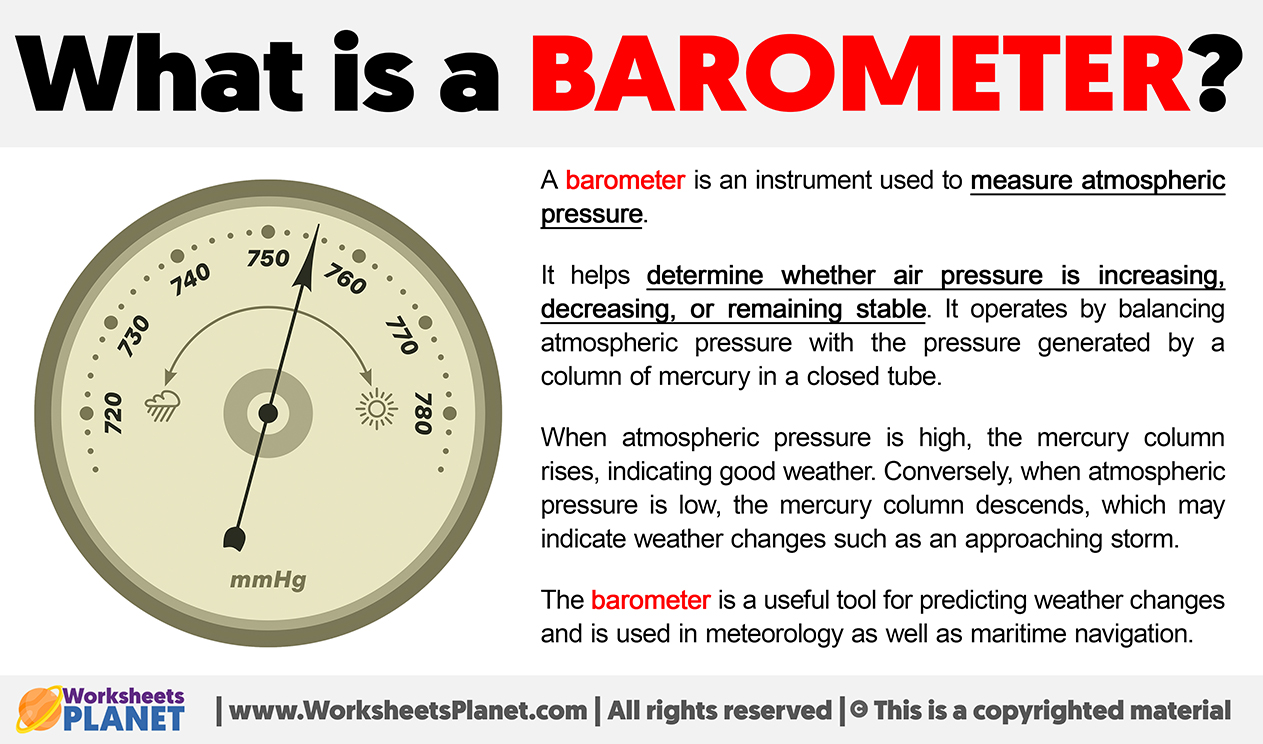
To interpret what a barometer does, it’s crucial to understand the units in which atmospheric pressure is measured. Historically, mercury barometers were the standard, and pressure was often expressed in inches or millimeters of mercury. The height of the mercury column in the barometer tube directly correlated with the atmospheric pressure; a higher column indicated higher pressure, and vice versa.
More modern barometers, particularly aneroid barometers and digital instruments, commonly use hectopascals (hPa) or millibars (mb). These units are more precise and widely adopted in meteorological contexts globally. For reference, standard atmospheric pressure at sea level is approximately 1013.25 hPa or 1013.25 mb. Other units, such as pounds per square inch (psi) or kilopascals (kPa), may also be encountered in specific applications. The conversion between these units is straightforward, allowing for a consistent understanding of pressure readings across different instruments and regions.
The Mercury Barometer: A Historical Perspective
The mercury barometer, invented by Evangelista Torricelli in 1643, was a groundbreaking innovation that fundamentally changed our understanding of the atmosphere. This type of barometer consists of a glass tube sealed at one end, filled with mercury, and then inverted into a dish of mercury. The atmospheric pressure on the surface of the mercury in the dish supports a column of mercury in the tube. The height of this column varies with atmospheric pressure.
- How it Works: As atmospheric pressure increases, it pushes down harder on the mercury in the dish, forcing the mercury column in the tube higher. Conversely, when atmospheric pressure decreases, the mercury column drops.
- Significance: Torricelli’s experiment not only demonstrated the existence of atmospheric pressure but also proved that a vacuum could be created. This discovery laid the foundation for much of future physics and meteorology.
- Limitations: Despite its historical importance, the mercury barometer has several drawbacks. Mercury is a toxic substance, making it hazardous to handle. It is also susceptible to breakage due to its glass construction. Furthermore, mercury barometers are sensitive to temperature fluctuations, requiring corrections for accurate readings.
The Aneroid Barometer: A Mechanical Marvel
The aneroid barometer, developed in the mid-19th century, offers a more practical and portable alternative to the mercury barometer. Instead of using a liquid, it relies on a small, flexible, sealed metal box called an “aneroid cell” or “diaphragm.” This cell is either partially evacuated of air or contains a vacuum.
- Mechanism: The aneroid cell is designed to expand or contract in response to changes in external atmospheric pressure. When pressure increases, the cell is compressed; when pressure decreases, it expands.
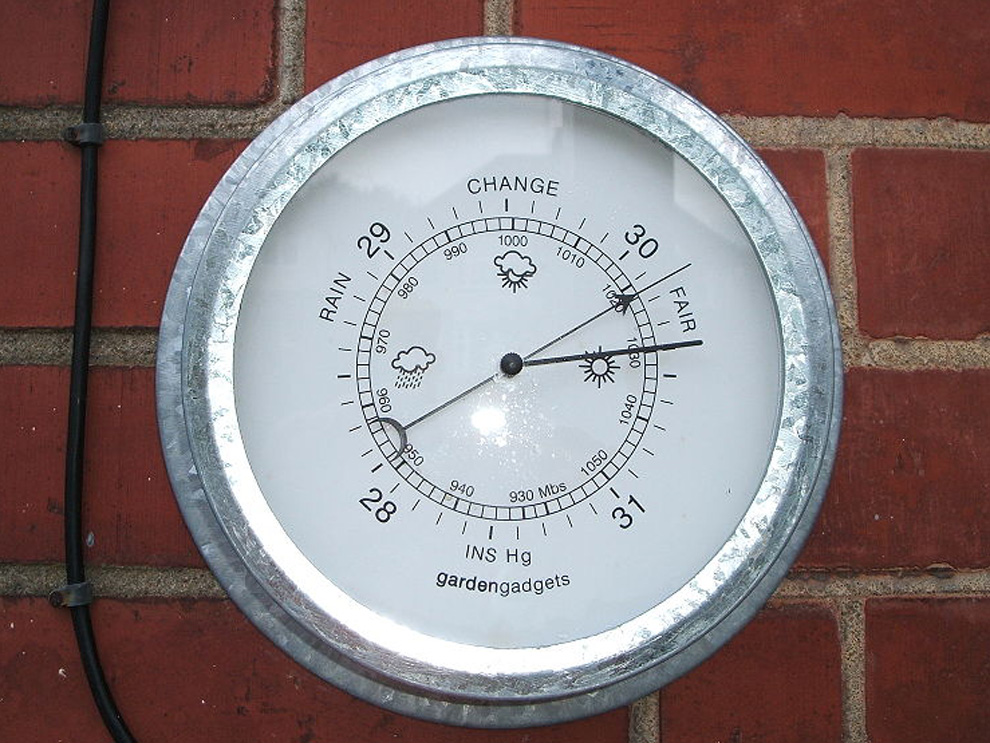
- Linkage System: This expansion and contraction are transmitted through a system of levers and springs to a needle that moves across a calibrated dial. The dial is marked with pressure units, indicating the current atmospheric pressure.
- Advantages: Aneroid barometers are more robust, less prone to damage, and do not contain toxic substances, making them safer for everyday use. They are also generally more compact and easier to read.
- Calibration: Like mercury barometers, aneroid barometers need to be calibrated regularly to ensure accuracy. This calibration often involves comparing their readings to a known standard or adjusting the mechanism against a reliable source of atmospheric pressure data.
The Crucial Role of Barometers in Weather Forecasting
The primary and most historically significant application of barometers lies in their ability to predict weather patterns. The atmosphere is a dynamic system, and changes in pressure are key indicators of upcoming meteorological events. Meteorologists rely heavily on barometric readings, both from ground-based instruments and from weather balloons and satellites, to understand and forecast the weather.
Understanding Pressure Systems: Highs and Lows
The concept of “high-pressure” and “low-pressure” systems is central to weather forecasting.
- High-Pressure Systems: Areas of high atmospheric pressure are typically associated with sinking air. As air sinks, it warms and dries out, inhibiting cloud formation and leading to fair, stable weather. Prolonged periods of high pressure often mean clear skies, sunshine, and calm conditions.
- Low-Pressure Systems: Conversely, low-pressure systems are characterized by rising air. As air rises, it cools and can no longer hold as much moisture, leading to condensation and the formation of clouds. These systems are often associated with unsettled weather, including rain, snow, storms, and strong winds. The stronger the pressure gradient (the difference in pressure between adjacent areas), the more intense the winds tend to be.
Interpreting Barometric Trends for Immediate Forecasting
Observing the trend of barometric pressure over a period of hours is a vital tool for short-term weather prediction.
- Falling Pressure: A consistently falling barometer generally indicates that a low-pressure system is approaching. This suggests a worsening of weather conditions. A rapid drop in pressure is a strong warning sign of an approaching storm.
- Rising Pressure: A consistently rising barometer suggests that a high-pressure system is moving in or strengthening. This usually portends improving weather conditions, with clearer skies and calmer winds.
- Steady Pressure: If the barometer reading remains relatively steady, it suggests that the current weather conditions are likely to persist.
The Barometer’s Contribution to Advanced Meteorology
While simple barometric readings can offer immediate insights, their role in modern meteorology is far more sophisticated.
- Numerical Weather Prediction (NWP): Advanced computer models use vast amounts of data, including precise barometric pressure readings from countless sources, to simulate atmospheric conditions and forecast weather days or even weeks in advance. Barometric pressure is a fundamental input parameter in these complex algorithms.
- Mapping Pressure Systems: Meteorologists create weather maps that display lines of equal atmospheric pressure, known as “isobars.” The spacing and shape of these isobars visually represent the location and intensity of high and low-pressure systems, providing a comprehensive overview of current weather patterns and potential future developments.
- Identifying Fronts: Changes in atmospheric pressure are also critical for identifying weather fronts – the boundaries between different air masses. Warm fronts and cold fronts are often associated with distinct pressure gradients and characteristic weather changes.
Beyond Weather: Diverse Applications of Barometric Measurement
While weather forecasting is the most widely recognized application, barometers have found utility in a surprising range of other fields. The measurement of atmospheric pressure is not solely relevant to meteorology; it plays a role in various scientific, industrial, and even recreational pursuits.
Altitude Measurement and Aviation
One of the most significant non-meteorological uses of barometers is in altitude measurement. Because atmospheric pressure decreases predictably with increasing altitude, a barometer can be calibrated to indicate height above sea level.
- Altimeters: Aircraft are equipped with altimeters, which are essentially specialized barometers. These instruments measure the ambient air pressure and translate it into an altitude reading. Early altimeters were aneroid barometers with specific scales.
- Correction for Weather: It’s important to note that altimeters are affected by changes in atmospheric pressure that are not related to altitude (i.e., weather systems). Therefore, pilots must constantly adjust their altimeters to account for current atmospheric conditions, often by referencing ground-based pressure readings or radio transmissions.
- Hiking and Mountaineering: Portable barometric altimeters are also popular among hikers and mountaineers. These devices provide a way to estimate elevation gain and current altitude, aiding in navigation and route planning in mountainous terrain.
Scientific Research and Experimentation
In laboratory settings and during scientific expeditions, barometers are indispensable tools for a variety of research endeavors.
- Gas Laws and Thermodynamics: Barometers are used in experiments to study the behavior of gases, particularly in relation to pressure and volume changes. They are fundamental in demonstrating and verifying gas laws such as Boyle’s Law and Charles’s Law.
- Calibrating Other Instruments: Barometers themselves can be used to calibrate other pressure-sensitive instruments or to establish reference points in experiments involving pressure.
- Geological and Geophysical Studies: In some geological studies, atmospheric pressure variations can influence subtle ground movements or aid in understanding certain subsurface phenomena.
Industrial and Engineering Applications
While not as ubiquitous as in meteorology or aviation, barometers have niche applications in various industrial and engineering contexts.
- Vacuum Systems: In systems that operate under reduced pressure (vacuum), barometers are used to monitor and control the level of vacuum achieved. This is crucial in manufacturing processes such as semiconductor fabrication, food packaging, and certain chemical reactions.
- Performance Testing: In some specialized testing environments, such as wind tunnels or pressure chambers, barometric pressure is a critical parameter that needs to be precisely measured and controlled to ensure accurate and repeatable test results.
- Submersible Vehicles: For deep-sea exploration, barometric pressure sensors are vital for understanding the immense pressures experienced at different depths and for ensuring the structural integrity of submersibles.
The Evolution of Barometric Technology: From Mercury to Digital
The fundamental principle of measuring atmospheric pressure has remained constant, but the technology used to achieve this measurement has undergone significant transformation. This evolution has made barometers more accurate, accessible, and integrated into our modern technological landscape.
Modern Digital Barometers: Precision and Connectivity
Today, digital barometers are increasingly common, offering a host of advantages over their analog predecessors. These instruments utilize electronic sensors to detect and measure atmospheric pressure.
- Solid-State Sensors: Common sensor types include piezoresistive and capacitive sensors. Piezoresistive sensors change their electrical resistance in response to pressure, while capacitive sensors alter their capacitance. These solid-state components are highly durable and offer excellent precision.
- Digital Readouts: The pressure measurement is displayed digitally, often on an LCD screen, providing clear and unambiguous readings. Many digital barometers also offer features such as trend indicators, alarms for significant pressure changes, and the ability to store historical data.
- Connectivity and Integration: A key advancement in digital barometers is their ability to connect with other devices and systems. They can be integrated into weather stations, smartphones, smart home devices, and complex industrial control systems. This connectivity allows for remote monitoring, data logging, and the automation of processes based on pressure readings.
Smart Devices and Environmental Monitoring
The miniaturization and increasing affordability of digital pressure sensors have led to their integration into a wide array of consumer electronics and specialized environmental monitoring equipment.
- Smartphones and Wearables: Many modern smartphones and smartwatches include integrated barometers. While primarily used to enhance GPS accuracy by helping to determine altitude, they also allow users to track barometric pressure trends directly from their devices.
- Home Weather Stations: For hobbyists and those interested in local weather, digital home weather stations often feature barometers, providing real-time pressure readings and short-term forecasts.
- Internet of Things (IoT) Devices: In the realm of the Internet of Things, barometric sensors are used in various applications for environmental monitoring, such as tracking air pressure changes in confined spaces or monitoring outdoor conditions for data analysis.
The Future of Barometric Measurement
The ongoing advancements in sensor technology and data processing suggest that the role and capabilities of barometers will continue to expand. We can anticipate even greater accuracy, smaller form factors, and more sophisticated integration into our increasingly connected world. From contributing to ever more precise weather forecasts that mitigate the impact of extreme events to enabling new scientific discoveries, the humble barometer, in its various forms, remains a vital tool for understanding and interacting with our environment.
aViewFromTheCave is a participant in the Amazon Services LLC Associates Program, an affiliate advertising program designed to provide a means for sites to earn advertising fees by advertising and linking to Amazon.com. Amazon, the Amazon logo, AmazonSupply, and the AmazonSupply logo are trademarks of Amazon.com, Inc. or its affiliates. As an Amazon Associate we earn affiliate commissions from qualifying purchases.