
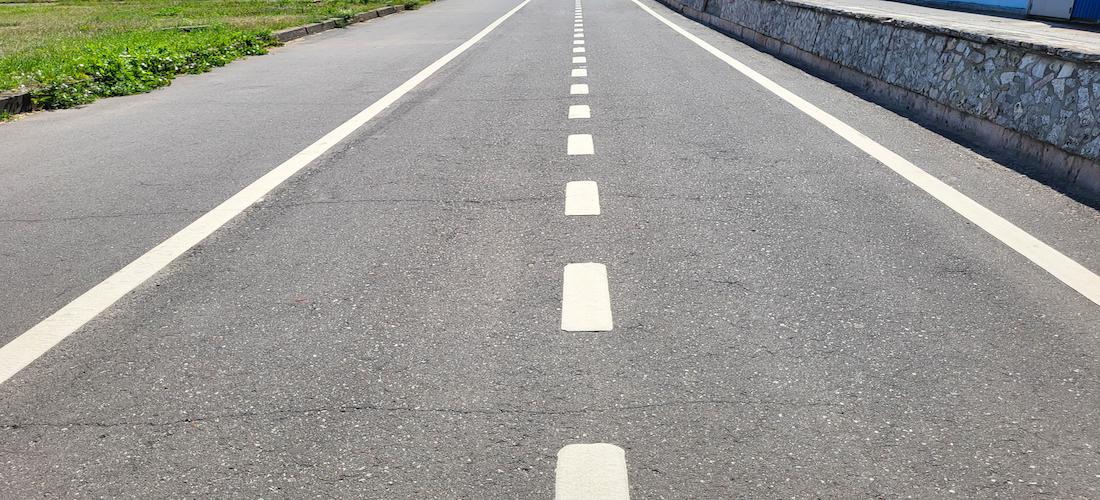
To a human driver, a broken white line is one of the most basic symbols of the road: it signifies that lane changes are permitted and that traffic is flowing in the same direction. However, as we transition into an era defined by Artificial Intelligence (AI), Advanced Driver Assistance Systems (ADAS), and fully autonomous vehicles, this simple strip of paint has been reimagined as a critical data point. In the realm of technology, a broken white line is no longer just a legal permission—it is a complex signal processed by neural networks to maintain vehicle orientation and safety.

Understanding what a broken white line means through the lens of modern tech requires a deep dive into computer vision, machine learning, and the infrastructure of the future. This article explores how technology decodes the physical world to create a safe, automated driving experience.
The Architecture of Perception: How AI Interprets Road Markings
For a machine to “understand” a broken white line, it must first perceive it. Unlike humans, who use biological eyes and intuitive reasoning, autonomous systems rely on a suite of sensors—primarily high-resolution cameras and LiDAR—to capture the environment. The “meaning” of a broken white line is extracted through a process called Computer Vision.
Computer Vision and Semantic Segmentation
At the core of autonomous navigation is semantic segmentation. This is a deep learning process where an AI identifies every pixel in a camera feed and assigns it to a category, such as “road,” “vehicle,” “pedestrian,” or “lane marker.” When a vehicle’s onboard computer encounters a broken white line, it doesn’t just see a shape; it identifies a specific semantic class.
The AI must distinguish between a solid white line (which indicates a boundary not to be crossed) and a broken white line (which indicates a permeable boundary). This requires high-level “feature extraction,” where neural networks analyze the spacing, length, and contrast of the markings. If the system incorrectly identifies a broken line as a solid one, the vehicle might refuse to change lanes during a necessary maneuver, highlighting the high stakes of digital perception.
Neural Networks and Training Data
How does the software learn the difference? The answer lies in massive datasets. Engineers feed millions of images of roads from around the world into neural networks. These images are “labeled” by humans to show exactly what a broken white line looks like in various conditions—sun-drenched highways, rainy city streets, or dimly lit tunnels. Through a process called supervised learning, the AI develops a mathematical model that can predict with near-certainty that a specific pattern of white dashes constitutes a “permissive lane boundary.”
ADAS and the Engineering of Lane Keeping Systems
While fully self-driving cars are the ultimate goal, the most immediate application of road marking technology is found in Advanced Driver Assistance Systems (ADAS). For the millions of drivers currently using Level 2 automation (like Tesla’s Autopilot or GM’s Super Cruise), the broken white line is the foundational guide for two primary features: Lane Departure Warning (LDW) and Lane Centering.
Lane Departure Warning (LDW) and Prevention
The technological meaning of a broken white line in an LDW system is a “monitored threshold.” The system uses a forward-facing camera to track the vehicle’s position relative to these lines. If the vehicle’s trajectory intersects with a broken white line without a turn signal being activated, the software triggers a haptic or audible alert.
In more advanced iterations, known as Lane Keeping Assist (LKA), the computer takes a more active role. If it senses an unintentional drift over a broken white line, it applies corrective steering torque. The “broken” nature of the line is critical here; the system’s logic must be tuned to allow for intentional crossovers (lane changes) while preventing accidental ones.
Automated Lane Centering (ALC) and Path Planning
While LDW is reactive, Automated Lane Centering is proactive. This technology treats broken white lines as the “rails” of a virtual track. By calculating the distance between the lines on either side of the vehicle, the path-planning algorithm determines the mathematical center of the lane.
The tech must account for the “broken” aspect of the line by using predictive modeling. Because there are gaps between the white dashes, the AI cannot “see” the line at every millisecond. Instead, it uses Kalman filters and other estimation algorithms to “fill in the blanks,” maintaining a consistent trajectory even when the physical marking is momentarily absent or obscured.

The Challenge of Variability: Edge Cases in Visual Recognition
In a laboratory, identifying a broken white line is simple. In the real world, it is a significant technological challenge. The “meaning” of the line can be obscured by environmental noise, poor infrastructure, and regional variations, forcing tech companies to develop robust “edge case” solutions.
Environmental Obstacles and Signal Noise
Technology often struggles with what humans find easy. Heavy rain can create reflections on the asphalt that mimic the appearance of white lines. Snow can cover them entirely. Glare from a rising sun can “wash out” the camera’s sensor, making the contrast between the white paint and the grey road disappear.
To solve this, developers use “sensor fusion.” This is the practice of combining data from different sources. For instance, if the camera cannot see the broken white line due to glare, the vehicle may rely on high-definition (HD) maps and GPS to know where the lane should be. This multi-layered approach ensures that the “meaning” of the road remains clear to the computer, even when the visual evidence is degraded.
Global Standardization vs. Local Deviations
A major hurdle for global tech firms is that a “broken white line” does not look the same everywhere. In the United States, the Department of Transportation has specific standards for the length and spacing of these dashes, but these can vary in Europe or Asia.
Furthermore, construction zones often introduce temporary “broken” lines in different colors (like orange or yellow) or use “botts’ dots” instead of paint. Software must be localized. Engineers must write specific code or train specific models for different geographic regions to ensure that the vehicle’s interpretation of road markings aligns with local traffic laws and infrastructure standards.
The Future: V2X Communication and Augmented Reality
As we look toward the future of transportation technology, the broken white line may move from being a physical object that is “seen” to a digital coordinate that is “transmitted.” This shift involves the move from passive infrastructure to “Smart Infrastructure.”
Vehicle-to-Everything (V2X) Communication
The next frontier in tech is V2X, where the road itself communicates with the car. Imagine a “smart” highway where sensors embedded in the pavement or overhead units broadcast the exact location of lane boundaries to passing vehicles. In this scenario, the broken white line becomes a digital heartbeat.
This would eliminate the reliance on visual clarity. Even in a total whiteout blizzard, a vehicle would know exactly where the broken white line is because the infrastructure is “telling” it. This represents a shift from reactive computer vision to proactive data synchronization, significantly increasing the safety and reliability of autonomous systems.
Augmented Reality (AR) and Enhanced Driver Interaction
For the human driver, the way we perceive the broken white line is also changing through Augmented Reality. Modern Head-Up Displays (HUDs) can project digital overlays directly onto the windshield.
If a driver is navigating a complex interchange at night, the AR system can highlight the broken white lines in a glowing blue or green hue, making it easier for the human eye to track the path. This tech bridges the gap between the machine’s digital understanding and the human’s visual perception, creating a “shared reality” between the car’s AI and the person behind the wheel.
Conclusion: The Digital Evolution of a Simple Sign
The broken white line is a testament to how technology transforms the mundane into the extraordinary. What began as a simple tool for traffic management in the early 20th century has become a foundational element of the 21st-century tech stack.
From the complex neural networks that perform semantic segmentation to the ADAS systems that keep us safe in our lanes, the meaning of a broken white line has expanded. It is now a synthesis of computer vision, predictive algorithms, and global data standards. As we move toward a future of fully autonomous transit and V2X communication, these lines will continue to serve as the essential link between the physical world we inhabit and the digital intelligence that increasingly guides our journey.
aViewFromTheCave is a participant in the Amazon Services LLC Associates Program, an affiliate advertising program designed to provide a means for sites to earn advertising fees by advertising and linking to Amazon.com. Amazon, the Amazon logo, AmazonSupply, and the AmazonSupply logo are trademarks of Amazon.com, Inc. or its affiliates. As an Amazon Associate we earn affiliate commissions from qualifying purchases.