
In the competitive landscape of modern business, every touchpoint with your audience, from website copy to marketing emails, is an opportunity to build and reinforce your brand. Precision in language isn’t just about avoiding grammatical errors; it’s about projecting professionalism, clarity, and sophistication. One powerful, yet often underutilized, tool in the writer’s arsenal is the participial phrase. Understanding and effectively employing participial phrases can significantly enhance the clarity, conciseness, and impact of your brand’s messaging, setting you apart from the competition and solidifying your professional image.
The Foundation: Understanding Participles and Their Phrases
Before diving into the nuances of participial phrases, it’s essential to grasp the fundamental building blocks: participles themselves. These are verb forms that function as adjectives, adding descriptive power to nouns and pronouns. They are the lynchpins that allow us to weave richer narratives and present information more dynamically within our brand communications.

Participles: The Versatile Adjectives Derived from Verbs
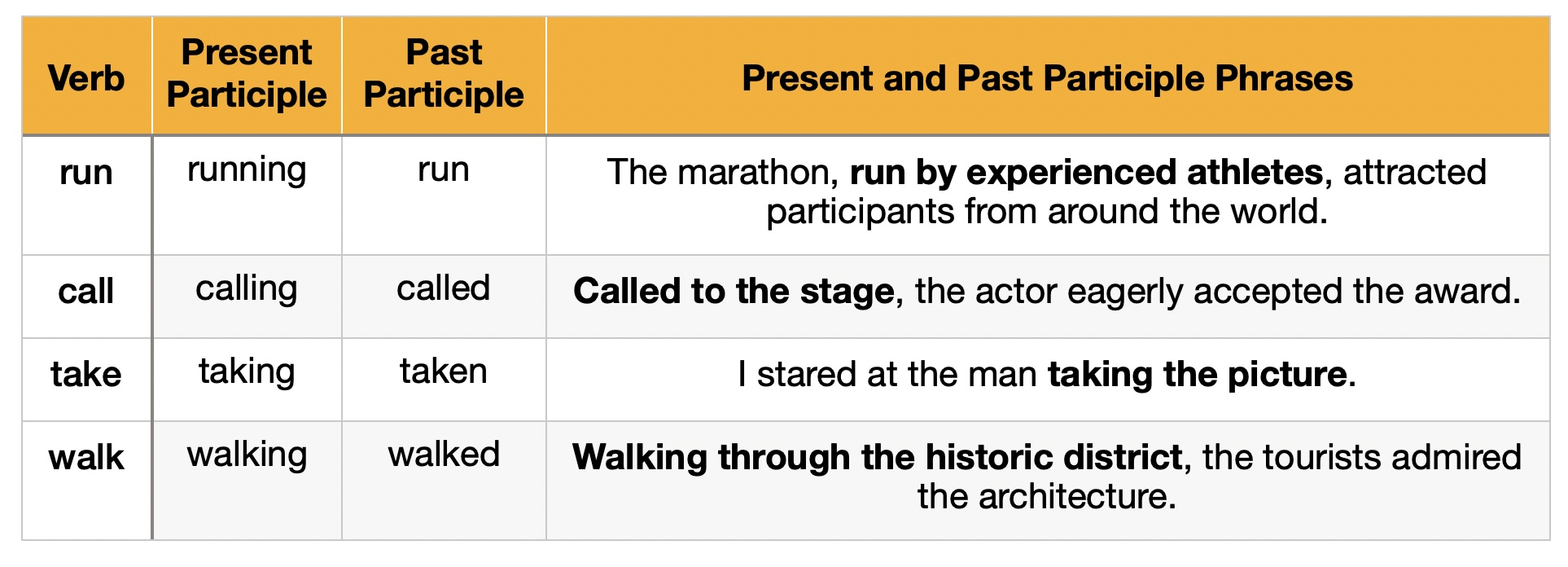
Participles are essentially verbs that have been transformed into adjectives. There are two primary types:
-
Present Participles: These are formed by adding “-ing” to the base form of a verb (e.g., running, speaking, creating). When used as adjectives, they describe an ongoing action or a characteristic.
- Example in Brand Context: “Our innovating team consistently delivers cutting-edge solutions.” Here, “innovating” describes the team’s ongoing nature of innovation, a positive attribute for a brand.
-
Past Participles: These are typically formed by adding “-ed” to the base form of regular verbs (e.g., created, developed, launched). For irregular verbs, the form can vary (e.g., written, built, seen). Past participles often describe a completed action or a state of being.
- Example in Brand Context: “The developed strategy promises significant market growth.” “Developed” tells us the strategy is complete and ready, implying thoroughness and preparedness.
Recognizing these base forms is the first step in mastering the construction and application of participial phrases, allowing for more nuanced and descriptive language in your brand’s voice.
Forming the Phrase: Connecting Modifiers to the Core Verb
A participial phrase consists of a participle (either present or past) and any accompanying modifiers (adverbs, prepositional phrases, or other words that complete its meaning). This entire unit then acts as an adjective, modifying a noun or pronoun. The key is that the phrase, when functioning as an adjective, provides additional descriptive information without requiring a full independent clause. This conciseness is a highly valued trait in effective brand communication.
- Present Participial Phrase Example: “The team, working tirelessly to meet deadlines, achieved remarkable results.” The phrase “working tirelessly to meet deadlines” modifies “team,” providing more detail about their efforts.
- Past Participial Phrase Example: “Our newly launched product, designed with user feedback in mind, has received overwhelmingly positive reviews.” The phrase “designed with user feedback in mind” modifies “product,” highlighting a key feature and the brand’s commitment to its audience.
Understanding how these phrases are constructed allows you to weave more complex ideas and details into your writing seamlessly, enriching your brand’s narrative and demonstrating a sophisticated command of language.
The Power of Participial Phrases in Brand Messaging
The strategic application of participial phrases can transform bland, declarative sentences into engaging and persuasive content. They offer a sophisticated way to add detail, create flow, and emphasize key aspects of your brand’s value proposition, ultimately contributing to a more compelling and memorable brand identity.
Enhancing Conciseness and Readability for a Streamlined Brand Voice
One of the most significant benefits of using participial phrases is their ability to condense information. Instead of using multiple sentences or a subordinate clause, you can express a related idea succinctly within a phrase. This conciseness is paramount in brand communication, where attention spans are short, and the need for clear, digestible information is high.
- Less Concise: “Our software is advanced. It was developed to streamline your workflow.”
- More Concise with Participial Phrase: “Our advanced software, developed to streamline your workflow, offers unparalleled efficiency.”
This streamlined approach makes your brand’s message easier to absorb, digest, and remember. It signals efficiency and clarity, qualities that are highly attractive to potential clients and customers. When your brand speaks in a clear, concise manner, it builds trust and demonstrates respect for your audience’s time.
Adding Descriptive Depth and Vivid Imagery to Your Brand Narrative
Participial phrases are powerful tools for adding rich descriptive detail. They allow you to paint a more vivid picture of your products, services, or brand values, making your message more engaging and emotionally resonant. This is crucial for creating a brand that not only informs but also inspires and connects with its audience on a deeper level.
- Without Participial Phrase: “Our new campaign aims to raise awareness. It focuses on sustainable practices.”
- With Participial Phrase: “Our new campaign, focusing on sustainable practices, aims to raise awareness and inspire action.”
By using phrases like “focusing on sustainable practices,” you immediately provide context and highlight a core brand value. This descriptive power helps audiences understand not just what you do, but why and how you do it, fostering a stronger emotional connection and a more memorable brand image.
Improving Sentence Variety and Flow for a Dynamic Brand Presence
Repetitive sentence structures can lead to monotonous and disengaging content, which can negatively impact how your brand is perceived. Participial phrases offer a simple yet effective way to vary sentence structure, creating a more dynamic and engaging reading experience. This variety keeps your audience interested and signals a sophisticated and adaptable brand voice.
- Monotonous: “We offer excellent customer support. We are available 24/7. We respond quickly to inquiries.”
- Improved Flow with Participial Phrases: “We offer excellent customer support, available 24/7 and responding quickly to inquiries.”
This variation breaks up the rhythm of your text, making it more enjoyable to read. A brand that communicates with a natural, flowing style projects confidence and professionalism, encouraging longer engagement and fostering a more positive perception of your brand.
Common Pitfalls and Best Practices for Employing Participial Phrases
While participial phrases are incredibly beneficial, their misuse can lead to confusion and damage your brand’s credibility. Understanding common errors and adhering to best practices ensures that these powerful tools are wielded effectively.
The Perils of Dangling and Misplaced Modifiers in Brand Communication
The most common error associated with participial phrases is the dangling modifier. This occurs when a participial phrase is placed in a sentence in such a way that it appears to modify a word it was not intended to modify, or when the word it should modify is missing altogether. Similarly, a misplaced modifier is placed too far from the word it is supposed to modify. These errors can lead to unintended, often humorous, meanings and severely undermine the professionalism of your brand.
-
Dangling Modifier Example: “Having completed the extensive market research, the new product was launched with confidence.” (Implies the product completed the research, which is illogical.)
-
Corrected Example: “Having completed the extensive market research, the marketing team launched the new product with confidence.”
-
Misplaced Modifier Example: “We sell premium coffee beans for customers in stylish bags.” (Implies the customers are in stylish bags.)
-
Corrected Example: “We sell premium coffee beans in stylish bags for customers.”
In brand communication, clarity is king. A dangling or misplaced modifier can make your brand seem careless, unprofessional, or even incompetent. Always ensure that your participial phrase clearly and logically modifies the intended noun or pronoun. Proofreading with a critical eye for these errors is crucial for maintaining a polished brand image.
Ensuring Clarity: The Crucial Link Between Phrase and Subject
To effectively use participial phrases and avoid the pitfalls, it is essential to ensure a direct and unambiguous connection between the phrase and the noun or pronoun it modifies. This means placing the participial phrase as close as possible to the word it describes.
- Unclear Placement: “The CEO addressed the team, talking about the company’s future standing on the stage.” (Is the company standing on the stage, or the CEO?)
- Clear Placement: “Standing on the stage, the CEO addressed the team, talking about the company’s future.”
This proximity principle is fundamental. When a participial phrase is immediately next to the word it modifies, the meaning is instantly clear. This clarity reinforces your brand’s ability to communicate complex ideas efficiently and without ambiguity. It demonstrates meticulous attention to detail, a hallmark of a strong brand.
Integrating Participial Phrases for a Coherent Brand Narrative
Think of participial phrases as connecting threads that weave together different elements of your brand’s story. They can be used at the beginning of a sentence to introduce a concept, in the middle to provide additional detail, or at the end for emphasis.
- Beginning: “Understanding the evolving needs of our clients, we continually adapt our service offerings.”
- Middle: “Our flagship software, designed for seamless integration, enhances productivity across all departments.”
- End: “The company’s mission is to empower small businesses, driving growth and fostering innovation.”
By strategically placing these phrases, you can create a more sophisticated and engaging narrative that flows logically from one point to the next. This creates a more cohesive and impactful brand message, leaving a lasting positive impression on your audience and strengthening your brand’s perceived authority and expertise.
Mastering Participial Phrases: A Strategic Investment in Your Brand’s Voice
The ability to articulate your brand’s message with precision and flair is a significant competitive advantage. Participial phrases, when understood and applied correctly, are more than just a grammatical construct; they are a strategic tool for enhancing clarity, building engagement, and projecting a professional and sophisticated brand identity.
From Grammatical Nuance to Brand Excellence
By embracing the power of participial phrases, you elevate your brand’s communication from merely functional to truly impactful. You move beyond simply stating facts to crafting compelling narratives that resonate with your audience. This attention to linguistic detail signals a brand that is thoughtful, precise, and committed to excellence in every aspect of its operation.
- Consider the perception: A brand that uses clear, varied, and descriptive language is perceived as more credible, authoritative, and trustworthy. This directly translates into stronger customer relationships and a more robust market position.

Continuous Refinement for Lasting Brand Impact
Mastering any aspect of language is an ongoing process. Encourage your team to consciously look for opportunities to employ participial phrases in their writing, from website content and social media posts to internal communications and proposals. Regular review and refinement of your brand’s written output will ensure that its voice remains sharp, engaging, and consistent.
- Training and Awareness: Investing in training for your marketing and content teams on grammatical best practices, including the effective use of participial phrases, is an investment in your brand’s long-term success.
In conclusion, understanding and mastering participial phrases is not just about grammar rules; it’s about refining your brand’s voice to be more effective, engaging, and professional. By weaving these powerful descriptive tools into your communication, you create a more compelling brand story, build stronger connections with your audience, and ultimately, achieve greater brand recognition and loyalty.
aViewFromTheCave is a participant in the Amazon Services LLC Associates Program, an affiliate advertising program designed to provide a means for sites to earn advertising fees by advertising and linking to Amazon.com. Amazon, the Amazon logo, AmazonSupply, and the AmazonSupply logo are trademarks of Amazon.com, Inc. or its affiliates. As an Amazon Associate we earn affiliate commissions from qualifying purchases.