
In the realm of geometry and mathematics, understanding fundamental concepts is paramount to grasping more complex principles and their practical applications. Among these foundational ideas, the notion of collinear points stands out as a cornerstone, particularly when delving into fields that rely on spatial relationships and precise data representation. While seemingly simple, the concept of collinearity underpins numerous operations and analyses in technology, from the rendering of graphics on your screen to the sophisticated algorithms that power navigation systems. This article will demystify collinear points, exploring their definition, properties, and their significant impact across various technological domains.
The Geometric Foundation: Defining Collinearity
At its core, collinearity describes a specific spatial relationship between points. It’s a concept rooted in Euclidean geometry, the study of shapes and their properties in a flat, two-dimensional plane or a three-dimensional space. Understanding this basic definition is the first step towards appreciating its broader implications.
What Does “Collinear” Actually Mean?
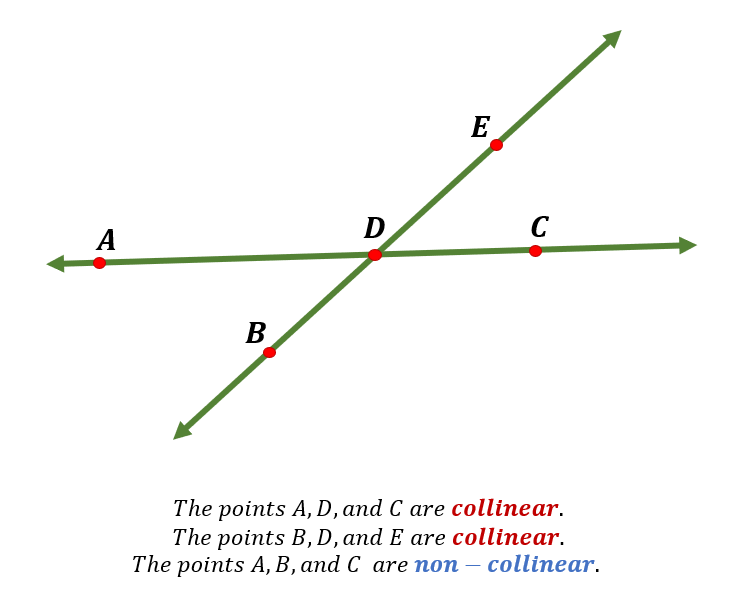
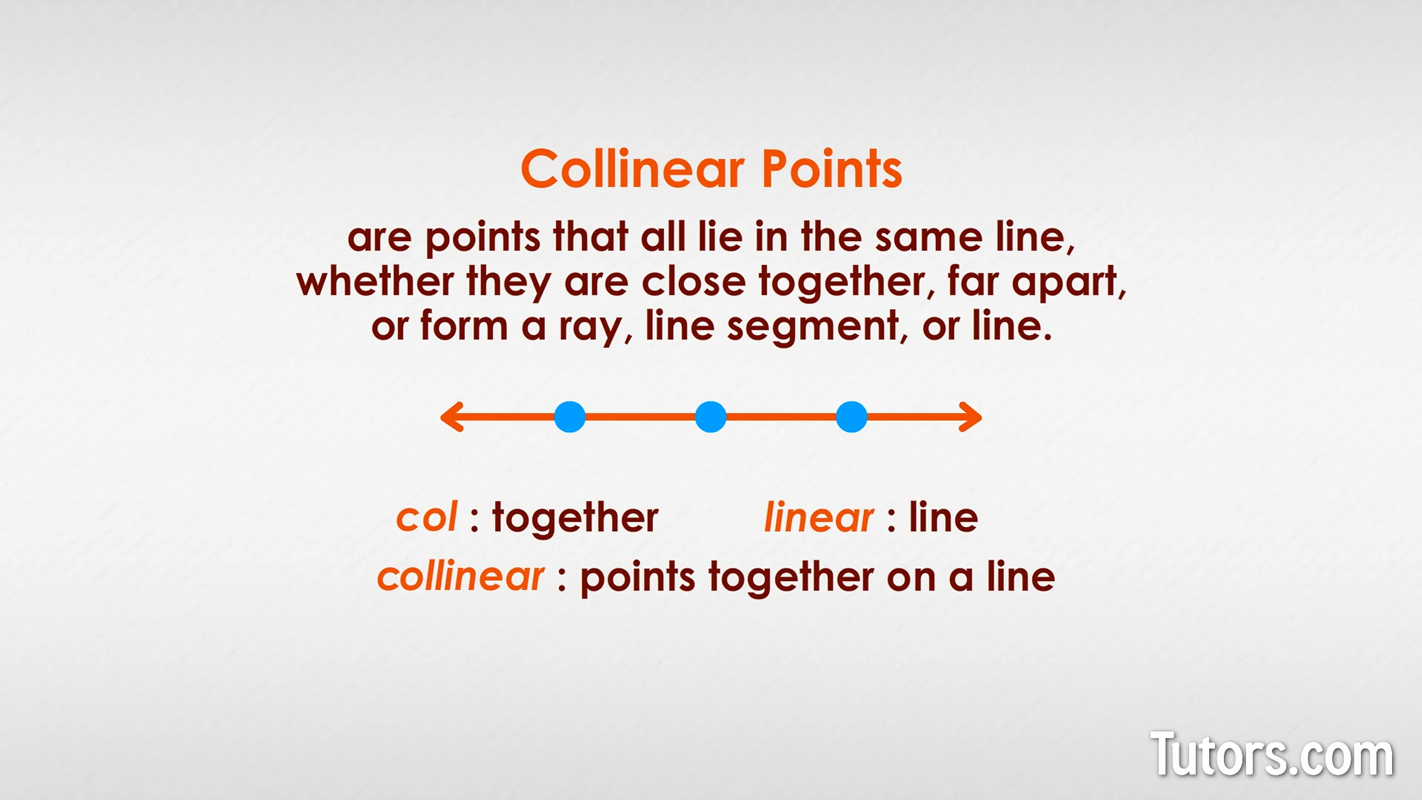
The term “collinear” is derived from Latin, with “co-” meaning “together” and “linear” referring to a line. Therefore, collinear points are simply points that lie on the same straight line. Imagine drawing a perfectly straight line with a ruler; any points you place directly on that line are collinear. Conversely, if a point deviates even the slightest from that line, it is considered non-collinear.
Identifying Collinearity: Mathematical Approaches
Mathematically, identifying whether a set of points is collinear can be approached in several ways, depending on the dimensionality of the space and the information available.
In Two Dimensions (2D)
For two points, they are always collinear by definition, as any two distinct points define a unique straight line. The challenge arises when we consider three or more points in a 2D plane.
-
Slope Method: If points $(x1, y1)$, $(x2, y2)$, and $(x3, y3)$ are collinear, the slope between the first two points must be equal to the slope between the second and third points (or the first and third). The slope ($m$) between two points $(xa, ya)$ and $(xb, yb)$ is calculated as $m = frac{yb – ya}{xb – xa}$. Thus, for collinearity:
$frac{y2 – y1}{x2 – x1} = frac{y3 – y2}{x3 – x2}$
Care must be taken when $x2 – x1 = 0$ or $x3 – x2 = 0$, which indicates a vertical line. In such cases, all x-coordinates must be identical for the points to be collinear. -
Area of a Triangle Method: If three points are collinear, they cannot form a triangle with a non-zero area. The area of a triangle with vertices $(x1, y1)$, $(x2, y2)$, and $(x3, y3)$ can be calculated using the determinant formula:
Area $= frac{1}{2} |x1(y2 – y3) + x2(y3 – y1) + x3(y1 – y_2)|$
If the calculated area is zero, the points are collinear. This method is often preferred as it naturally handles vertical lines without special cases.
In Three Dimensions (3D)
Extending this concept to three dimensions, points are collinear if they lie on the same straight line in space. The mathematical checks become slightly more involved but follow similar principles.
- Vector Method: For three points A, B, and C, they are collinear if the vector AB is parallel to the vector BC. Two vectors are parallel if one is a scalar multiple of the other.
Let A = $(x1, y1, z1)$, B = $(x2, y2, z2)$, and C = $(x3, y3, z3)$.
Vector AB $= (x2 – x1, y2 – y1, z2 – z1)$
Vector BC $= (x3 – x2, y3 – y2, z3 – z_2)$
Points are collinear if there exists a scalar $k$ such that Vector AB $= k times$ Vector BC, or equivalently, if the cross product of AB and BC is the zero vector: AB $times$ BC $= mathbf{0}$.
Key Properties of Collinear Points
Understanding the properties of collinear points helps in their application:
- Uniqueness of the Line: A set of two or more collinear points uniquely defines a single straight line.
- Distance Relationships: If three points A, B, and C are collinear, the distance between the two outer points is equal to the sum of the distances between the two inner segments. For example, if B lies between A and C, then $d(A, C) = d(A, B) + d(B, C)$.
- Order Matters (Sometimes): While the property of lying on the same line is independent of order, when considering distances or segments, the order of points becomes crucial.
Collinearity in Action: Applications in Technology
The abstract concept of collinear points finds surprisingly concrete and vital applications across numerous technological fields. Its importance stems from the fundamental need to define and manipulate spatial relationships, whether in digital environments or physical systems.
Computer Graphics and Visualization
One of the most pervasive applications of collinearity is in computer graphics, the technology behind rendering images on screens, from video games to architectural simulations.
Line Drawing and Interpolation
When software needs to draw a straight line between two points on a screen, it inherently relies on the concept of collinearity. Algorithms like Bresenham’s line algorithm or the Digital Differential Analyzer (DDA) algorithm determine which pixels should be illuminated to best approximate a straight line, ensuring all selected pixels lie “collinearly” in their placement.
Furthermore, interpolation, the process of estimating values between known data points, often involves collinearity. When rendering gradients or smooth transitions in color or texture, the software calculates intermediate values for points that lie on a conceptual line between two defined endpoints. If these intermediate points are not treated as collinear, the rendering would appear jagged or discontinuous.
3D Modeling and Animation
In 3D modeling, objects are constructed from points (vertices) that define their shapes. Understanding collinearity is crucial for maintaining geometric integrity. For instance, when defining a plane or a surface, ensuring that vertices are not unintentionally collinear can prevent degenerate shapes or rendering artifacts. In animation, the movement of objects or characters is often defined along paths. If these paths are intended to be straight lines, the underlying principles of collinearity govern how the object traverses that path.
Geometric Primitives
Fundamental geometric shapes like lines, rays, and line segments are all defined by collinear points. Their manipulation, transformation, and intersection detection within graphics engines directly or indirectly rely on checks for collinearity.
Data Analysis and Machine Learning
In the realm of data science and machine learning, collinearity plays a crucial role, particularly in understanding relationships within datasets and building predictive models.
Feature Engineering and Selection
In multivariate statistical analysis and machine learning, features (variables) can sometimes be highly correlated, a phenomenon known as multicollinearity. While not strictly the same as geometric collinearity, the underlying principle of linear dependence is similar. If two features are perfectly collinear, one is redundant, providing no new information. This can destabilize certain models, like linear regression, by making parameter estimates unreliable. Identifying and addressing multicollinearity is a key step in feature engineering and selection to build more robust and interpretable models.
Spatial Data Analysis
Geographic Information Systems (GIS) and other spatial data analysis tools frequently deal with points on maps. Determining if a series of locations fall along a straight road, a pipeline route, or a migratory path involves checking for collinearity. This can be used for tasks such as identifying straight-line travel routes, detecting illegal construction along specific boundaries, or analyzing the geographical distribution of phenomena.
Clustering and Outlier Detection
In clustering algorithms, the spatial arrangement of data points is fundamental. While not always about strict straight lines, algorithms might look for clusters of points that exhibit linear trends. In outlier detection, identifying points that deviate significantly from established linear patterns or clusters can help pinpoint anomalies in data.
Robotics and Navigation
The precise movement and positioning of robots, as well as the navigation of vehicles, rely heavily on geometric principles, including collinearity.
Path Planning
When a robot or autonomous vehicle needs to move from point A to point B in a straight line, its path planner must ensure that the sequence of movements it executes maintains this linear trajectory. This involves calculating intermediate points that are collinear with the start and end points, while also accounting for obstacles.
Sensor Calibration and Data Fusion
Sensors on robots and vehicles often gather data about their environment. For instance, a robot arm might have multiple joints, and the positions of these joints can be represented as points in a multi-dimensional space. Ensuring that these points align in a specific way (collinearly) during calibration or when fusing data from multiple sensors is critical for accurate operation.
Kinematics and Inverse Kinematics
In robotics, kinematics deals with the motion of rigid bodies. Inverse kinematics, a particularly challenging problem, involves determining the joint parameters required to achieve a desired end-effector position and orientation. The desired position and orientation might be defined by a sequence of collinear points, and solving for the joint movements requires understanding how to place those points and the robot’s components along that line.
Computer Vision
The field of computer vision, which aims to enable computers to “see” and interpret images, also benefits from the understanding of collinearity.
Line Detection and Feature Extraction
Algorithms that detect lines in images, such as those used for recognizing road markings, detecting architectural structures, or tracking objects, inherently work with the concept of collinear points. Identifying a set of pixels that lie along a straight line is a fundamental task in feature extraction for image analysis.
Camera Calibration and 3D Reconstruction
In 3D reconstruction from multiple images, a process known as triangulation is used to determine the 3D position of a point in space. This process relies on the fact that the 3D point, the camera’s optical center, and the corresponding 2D image point are collinear. Understanding this geometric constraint is vital for accurately rebuilding 3D scenes from 2D images.
Advanced Concepts and Related Geometric Ideas
While the definition of collinear points is straightforward, their application often leads to more sophisticated geometric considerations and related concepts that are equally important in technological contexts.
Degeneracy and Robustness
In computational geometry, dealing with degenerate cases is a constant challenge. Degenerate cases are situations where a set of geometric objects collapses into a simpler form, such as three points becoming collinear when they were not intended to be. For instance, in algorithms that construct polygons or meshes, the unintentional collinearity of vertices can lead to errors, resulting in invalid geometries or unexpected behavior in software. Robust algorithms are designed to handle these degenerate cases gracefully, ensuring that the software remains stable and produces correct results even with imperfect or edge-case input data.
Non-Collinearity and Geometric Constraints
The absence of collinearity (non-collinearity) is often as important as collinearity itself. In many applications, specific constraints are imposed to prevent points from becoming collinear. For example, in the design of mechanical structures, ensuring that certain critical points are not collinear is essential for maintaining rigidity and stability. In user interface design, non-collinear arrangements of elements can be used to create visual hierarchy or to prevent visual clutter.
Higher-Dimensional Collinearity
The concept of collinearity extends beyond two and three dimensions. In hyperdimensional spaces (spaces with more than three dimensions), points are collinear if they lie on the same line within that space. This is relevant in fields like theoretical physics, advanced data analysis, and the design of complex multi-variable systems where understanding linear dependencies in high-dimensional data is crucial.
Parametric Equations of Lines
A more formal way to represent a line in any dimension is through parametric equations. For a line passing through a point $P0$ and having a direction vector $mathbf{v}$, any point $P$ on the line can be represented as $P = P0 + tmathbf{v}$, where $t$ is a scalar parameter. For any three points $P1, P2, P3$ on the line corresponding to parameters $t1, t2, t3$, they are collinear. This mathematical framework is fundamental in many areas of science and engineering for describing linear motion or relationships.

Conclusion: The Enduring Significance of Collinear Points
From the fundamental building blocks of computer graphics to the complex algorithms that drive machine learning and robotics, the concept of collinear points is a silent yet indispensable force in the technological landscape. Its apparent simplicity belies its profound impact on how we create, analyze, and interact with the digital and physical worlds. Whether it’s ensuring the smooth rendering of an animation, the accurate calibration of a robot, or the reliable prediction of a machine learning model, the principles of collinearity are consistently at play, ensuring precision, efficiency, and the integrity of geometric relationships. As technology continues to evolve and delve into ever more complex spatial and data-driven problems, a solid understanding of what it means for points to be collinear will remain a critical asset for innovators and practitioners alike.
aViewFromTheCave is a participant in the Amazon Services LLC Associates Program, an affiliate advertising program designed to provide a means for sites to earn advertising fees by advertising and linking to Amazon.com. Amazon, the Amazon logo, AmazonSupply, and the AmazonSupply logo are trademarks of Amazon.com, Inc. or its affiliates. As an Amazon Associate we earn affiliate commissions from qualifying purchases.