
The harrowing conclusion of William Golding’s “Lord of the Flies” is not merely an ending, but a profound and devastating revelation that strips away any remaining pretense of civility, leaving behind the stark reality of humanity’s primal nature. The island, once a canvas for attempted democratic order, devolves into a hunting ground, a stage for savagery, and ultimately, a place of profound loss. The final moments are not about rescue in the traditional sense, but about the arrival of an external force that, ironically, mirrors the very destructive tendencies the boys have so readily embraced. This ending serves as a potent indictment, not of the circumstances, but of the inherent flaws within human beings when societal constraints are removed.

The Unraveling of Reason: From Ralph’s Leadership to Jack’s Tyranny
The descent into savagery is a gradual erosion, spearheaded by Jack Merridew’s increasing influence and the subsequent abandonment of Ralph’s rational leadership. The initial efforts to establish a structured society, symbolized by the conch shell and the dream of a signal fire, are systematically undermined by the allure of immediate gratification and the thrill of the hunt. Ralph’s attempts to maintain order, focusing on shelter, sanitation, and the strategic importance of the fire, are increasingly met with indifference or outright scorn by the majority of the boys, who are drawn to Jack’s charismatic promises of meat and power.
The Erosion of Democratic Ideals and the Rise of the Dictator
The conch, once the ultimate symbol of democratic debate and authority, becomes increasingly impotent. Its power wanes as the boys, particularly the hunters, begin to disregard its presence and the rules it represents. Jack masterfully exploits this shift, appealing to the baser instincts of fear and primal desire. He offers the boys a sense of belonging and purpose within his tribe, a stark contrast to the often frustrating and seemingly futile attempts at rational governance under Ralph. His shamanistic chants, face paint, and aggressive hunting rituals effectively transform the boys into a collective entity driven by instinct rather than intellect. The disintegration of Ralph’s authority is a direct consequence of his inability to satisfy the immediate, visceral needs of the group, a failing that Jack so readily exploits.
The Tyranny of the Hunt and the Dehumanization of the Other
The focus on hunting, initially a means of survival, becomes an end in itself, a ritualistic expression of power and dominance. As the boys become more adept at hunting, they also become more desensitized to violence. The pig hunts escalate from a practical necessity to a bloodthirsty pursuit, culminating in the gruesome act of decapitating a pig and offering its head to the “beast.” This act, in itself, marks a significant turning point, a clear embrace of barbarism and a perversion of any semblance of offering or appeasing a supernatural entity. The hunters begin to see themselves as distinct from the “civilized” boys, their face paint and war cries creating a psychological distance that facilitates further dehumanization. This dehumanization is crucial; it allows them to commit acts of violence, including the murder of Simon and later Piggy, without immediate moral revulsion.
The Tragic Demise of Innocence and Reason
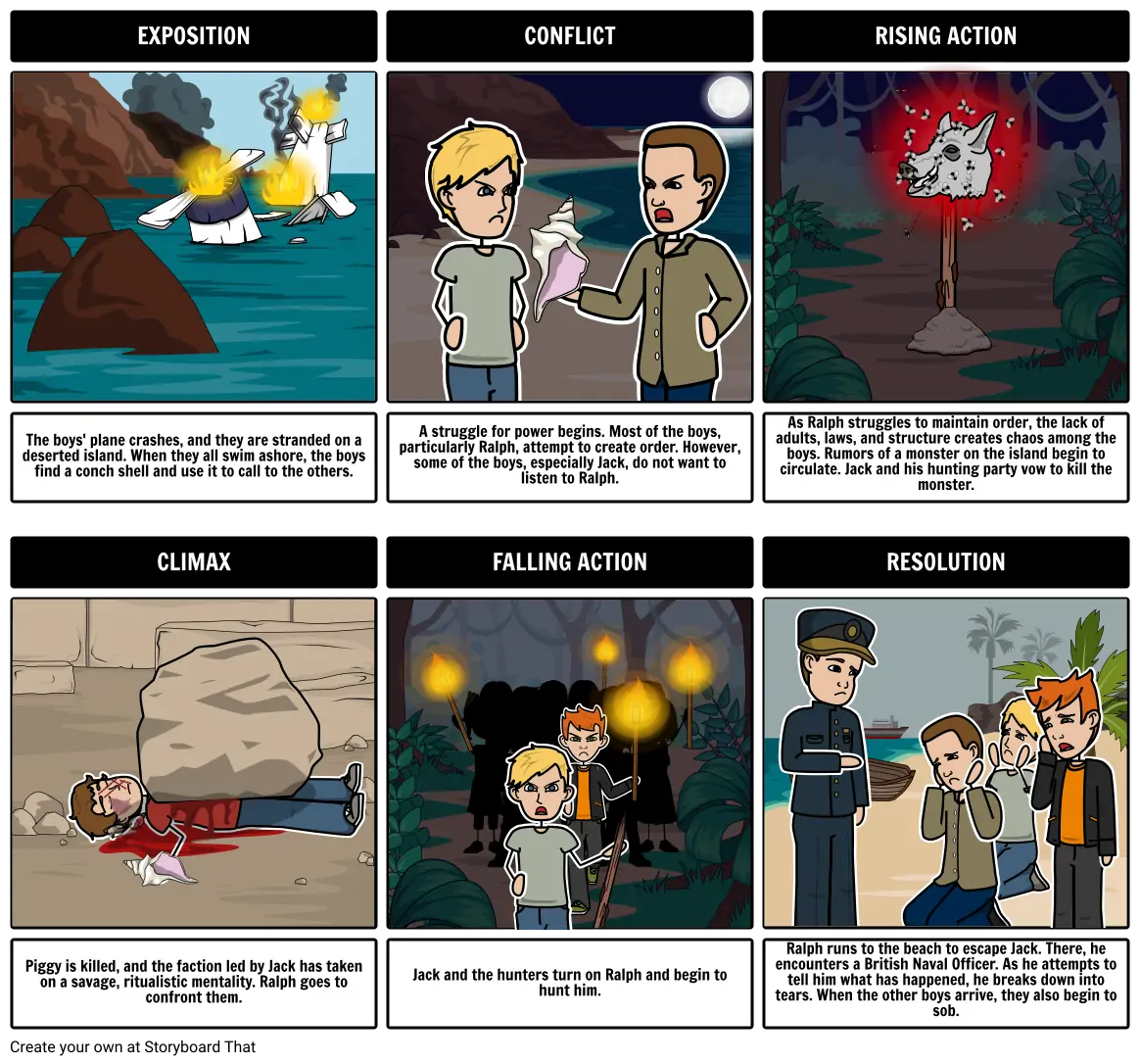
The climax of the story is marked by two devastating deaths, each representing the extinguishment of a vital element of human society: innate goodness and rational thought. The events surrounding Simon’s death and Piggy’s murder are not isolated incidents but the inevitable consequence of the boys’ complete submersion into their savage selves. These deaths signify the irreversible loss of the potential for redemption and the final triumph of brute force over intellect.
Simon’s Prophetic Vision and the Beast Within
Simon, the visionary and the most intuitively aware of the boys, grasps the true nature of the “beast” early on. He realizes that the monster is not an external entity but resides within each of them. His attempt to share this profound, albeit terrifying, revelation with the others is tragically misinterpreted. In their frenzied, ritualistic dance, fueled by fear and the primal urge to hunt, they mistake Simon for the beast and tear him apart. This act is arguably the most profound tragedy in the novel. It signifies the violent suppression of truth and insight, the murder of innocence, and the complete triumph of mob mentality over individual perception. Simon’s death is a grim foreshadowing of what is to come, as the boys are now fully capable of horrific violence against one of their own.
Piggy’s Plea for Reason and the Crushing of Intellect
Piggy, the intellectual and the voice of reason, represents the last bastion of civilized thought on the island. He clings to the hope of rescue and the ideals of law and order. His pleas for logic and his insistence on the importance of the signal fire are consistently ignored by Jack’s tribe. In the final confrontation, as Ralph and Piggy attempt to appeal to the hunters’ sense of reason, Roger, now fully embracing his sadistic nature, deliberately rolls a boulder down the cliff. This boulder crushes Piggy and, with him, shatters the conch shell, symbolizing the complete annihilation of law, order, and rational discourse. Piggy’s death is the definitive end of any possibility of a civilized society being re-established on the island. His demise is a stark representation of how intellect and reasoned argument are brutally extinguished when brute force and primal urges take over.
The Arrival of the Unknowing Rescuer and the Irony of Salvation
The novel concludes with the arrival of a naval officer, a representative of the adult world and its own forms of conflict and violence. This rescue, while seemingly a salvation, is deeply ironic and deeply troubling. The officer, preoccupied with his own ship’s engagement in a war, is oblivious to the depth of savagery the boys have descended into. His presence highlights the hypocrisy of the adult world, which judges the boys for their actions while engaging in far larger-scale violence.
The Naval Officer: A Mirror of Adult Brutality
The officer’s immediate assumption that the island is a place of innocent play, marred only by a fictional “game,” is a profound misjudgment. He sees the smoke from the fire, which Ralph desperately tried to maintain for rescue, as a sign of their “fun.” This oversight is critical. The adult world, with its wars and its complex societal structures, is not as morally superior as it might appear. The officer’s ship is engaged in a battle, a manifestation of the very aggression and tribalism that has consumed the boys. His intervention, therefore, is not a pure rescue from barbarism, but a return to a larger, more complex, and arguably more destructive form of the same primal instincts.

The Tears of the Survivor: Acknowledging the Lost Innocence
Ralph, the last vestige of responsible leadership, weeps at the end of the novel. His tears are not of relief, but of profound grief and remorse. He weeps for the death of Piggy, for the loss of innocence, and for the darkness he has witnessed within himself and his peers. His breakdown signifies the crushing weight of realization – the understanding that the veneer of civilization is fragile and that the capacity for evil is present in all of them. The officer, witnessing this, turns away, perhaps realizing the complexity of the situation and the profound psychological damage inflicted upon the boys. This final image leaves the reader with a chilling sense of despair, questioning whether true rescue is even possible when the very foundations of humanity have been so deeply compromised. The ending of “Lord of the Flies” is a stark, unflinching examination of the human condition, leaving us to ponder the ever-present potential for savagery that lies beneath the surface of even the most seemingly civilized individuals.
aViewFromTheCave is a participant in the Amazon Services LLC Associates Program, an affiliate advertising program designed to provide a means for sites to earn advertising fees by advertising and linking to Amazon.com. Amazon, the Amazon logo, AmazonSupply, and the AmazonSupply logo are trademarks of Amazon.com, Inc. or its affiliates. As an Amazon Associate we earn affiliate commissions from qualifying purchases.