
Hydrophobicity, at its core, describes the physical property of a molecule or substance that repels water. The term itself is derived from Greek, with “hydro” meaning water and “phobos” meaning fear. While it might sound like a simple aversion, hydrophobicity is a fundamental concept with profound implications across numerous scientific and technological fields, particularly within the realm of Tech. In the digital age, where materials science and chemical engineering increasingly intersect with technological innovation, understanding hydrophobicity is crucial for developing advanced materials, optimizing manufacturing processes, and creating sophisticated devices. This article will delve into the technical underpinnings of hydrophobicity, its measurement, its applications in cutting-edge technologies, and its role in shaping the future of technological advancement.

The Molecular Basis of Water Repellency: Understanding Intermolecular Forces
At the microscopic level, hydrophobicity arises from the nature of intermolecular forces, specifically the interactions between water molecules and other substances. Water is a polar molecule, meaning it has a slight positive charge on one end and a slight negative charge on the other. This polarity allows water molecules to form strong hydrogen bonds with each other, creating a cohesive network. Nonpolar molecules, on the other hand, lack this charge separation and therefore do not interact favorably with polar water molecules.
Hydrogen Bonding and the “Like Dissolves Like” Principle
The concept of hydrogen bonding is central to understanding hydrophobicity. Water’s ability to form these strong, attractive forces is responsible for its high surface tension, its solvency for polar and ionic compounds, and its liquid state over a wide temperature range. When a nonpolar substance is introduced into water, it cannot participate in hydrogen bonding. Instead, the water molecules tend to aggregate around themselves, minimizing their contact with the nonpolar molecules. This phenomenon, often summarized by the principle “like dissolves like,” means that polar substances dissolve in polar solvents (like water), and nonpolar substances dissolve in nonpolar solvents.
Van der Waals Forces and Their Role
While hydrogen bonding is the dominant force explaining water’s interaction with polar substances, Van der Waals forces also play a significant role in the interactions between nonpolar molecules themselves, and between nonpolar molecules and water. These forces are weaker attractive forces that arise from temporary fluctuations in electron distribution, creating transient dipoles. In the context of hydrophobicity, water molecules will still preferentially interact with each other via hydrogen bonds rather than engaging in weaker Van der Waals interactions with a nonpolar solute. This energetic favorability of water-water interactions over water-nonpolar solute interactions drives the segregation of nonpolar substances from aqueous environments.
The Hydrophobic Effect and Entropy
The tendency of nonpolar molecules to aggregate in water is often referred to as the “hydrophobic effect.” From a thermodynamic perspective, this effect is primarily driven by entropy. When nonpolar molecules are dispersed in water, they disrupt the highly ordered hydrogen-bonded network of water molecules. To minimize this disruption and maximize the entropy of the system (i.e., increase the disorder), the water molecules tend to form ordered “cages” around the nonpolar molecules. By aggregating, the nonpolar molecules reduce the total surface area exposed to water, thus reducing the number of ordered water cages required and increasing the overall entropy of the water. This entropic gain makes the aggregation of nonpolar molecules in water thermodynamically favorable.
Measuring and Quantifying Hydrophobicity in Materials Science
Accurately assessing the degree of hydrophobicity is crucial for designing and selecting materials for specific technological applications. Various methods have been developed to quantify this property, ranging from simple visual observations to sophisticated instrumental techniques.
Contact Angle Measurement: The Cornerstone of Hydrophobicity Assessment
The most widely used method for quantifying hydrophobicity is the measurement of the static contact angle. When a liquid droplet is placed on a solid surface, it forms a contact angle determined by the interplay of surface tension forces between the liquid and the solid, and the cohesive forces within the liquid itself. For water on a surface:
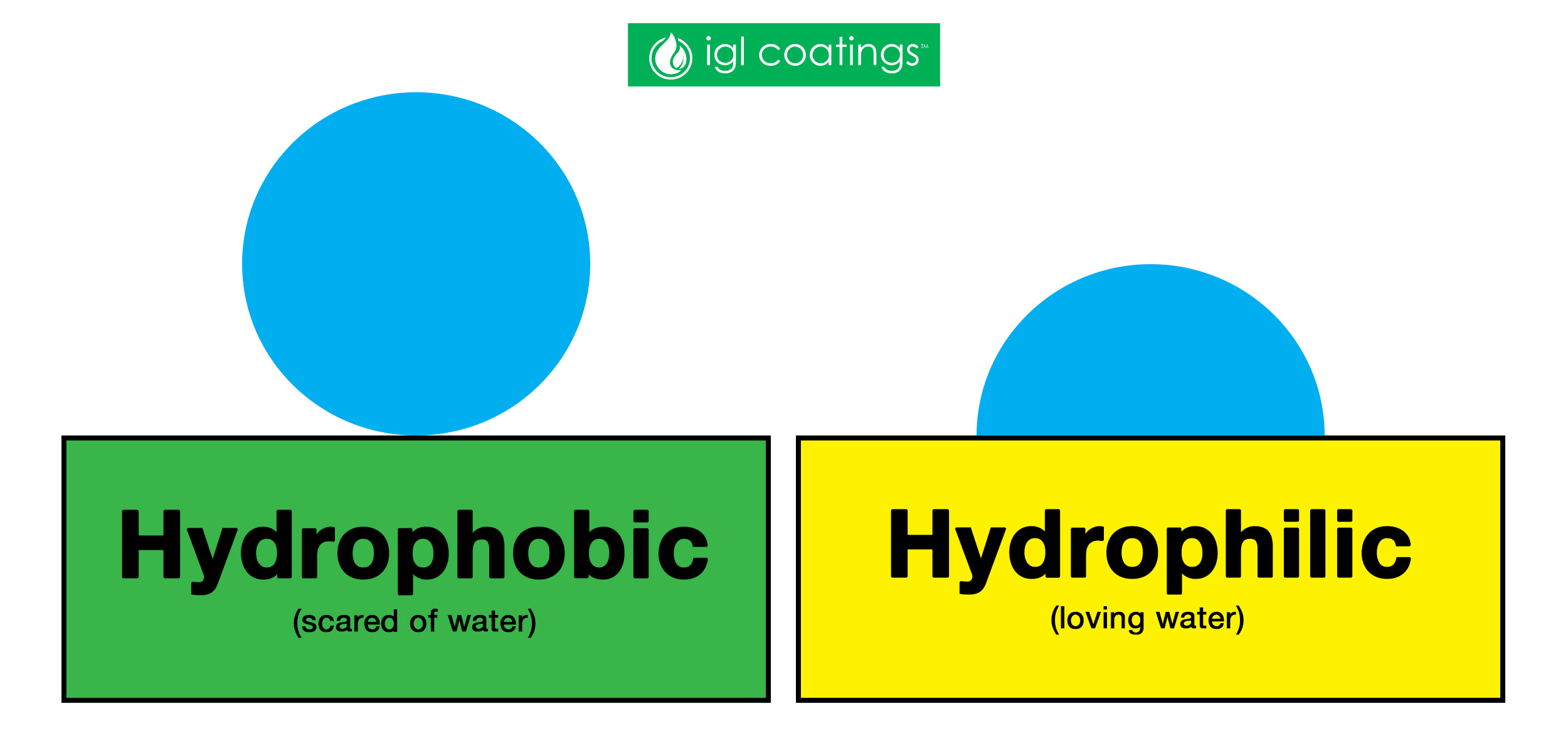
- Hydrophilic surfaces (water-attracting) exhibit low contact angles, typically less than 90 degrees. The water droplet spreads out on the surface.
- Hydrophobic surfaces (water-repelling) exhibit high contact angles, typically greater than 90 degrees. The water droplet beads up, minimizing its contact area with the surface.
- Superhydrophobic surfaces exhibit extremely high contact angles, often exceeding 150 degrees, with very low contact angle hysteresis (the difference between advancing and receding contact angles).
The contact angle is measured using specialized goniometers, which capture images of the droplet and analyze the angle formed at the three-phase contact line (solid-liquid-air).
Surface Energy and its Relationship to Hydrophobicity
Surface energy is a fundamental property of a material that influences its wetting behavior. It represents the excess energy associated with the surface of a material compared to its bulk. Materials with low surface energy tend to be hydrophobic. This is because the attractive forces between the molecules of a low-surface-energy material are weaker, making it energetically unfavorable for water molecules to spread out and interact extensively with such a surface. Conversely, materials with high surface energy are typically hydrophilic.
Other Characterization Techniques: Advancing Contact Angle, Sliding Angle, and Surface Roughness
Beyond static contact angle, other parameters provide a more comprehensive understanding of a surface’s water-repellent properties:

- Advancing and Receding Contact Angles: These measure the contact angle as the droplet edge moves across the surface, first in a spreading motion (advancing) and then in a retracting motion (receding). The difference between these two angles, known as contact angle hysteresis, indicates the degree of surface heterogeneity or adhesion. Low hysteresis is characteristic of highly water-repellent surfaces, where droplets can easily roll off.
- Sliding Angle: This is the angle at which a water droplet begins to roll off an inclined surface. A low sliding angle (ideally close to 0 degrees) signifies excellent water repellency and self-cleaning properties.
- Surface Roughness and Texture: In addition to chemical composition, the physical topography of a surface plays a critical role in achieving superhydrophobicity. Microscopic and nanoscopic structures can trap air pockets, effectively reducing the contact area between water and the solid surface, further enhancing water repellency. Techniques like atomic force microscopy (AFM) and scanning electron microscopy (SEM) are used to analyze surface morphology.
Applications of Hydrophobic Materials in Advanced Technologies
The ability to precisely control the interaction of surfaces with water has opened up a vast array of applications in cutting-edge technologies. From electronics to aerospace, engineered hydrophobicity is a key enabler of innovation.
Microfluidics and Lab-on-a-Chip Devices
In microfluidics, where fluids are manipulated on a microscopic scale, controlling fluid flow and preventing unwanted wetting is paramount. Hydrophobic surfaces are essential for creating channels and chambers that direct the flow of aqueous samples precisely. This is critical for the development of lab-on-a-chip devices, which miniaturize complex biological and chemical analyses into portable platforms. By rendering specific areas of a microfluidic chip hydrophobic, researchers can prevent sample dispersion, ensure accurate reagent mixing, and facilitate efficient separation processes, leading to faster and more sensitive diagnostics and research tools.
Self-Cleaning Surfaces and Anti-Fouling Technologies
The self-cleaning properties of superhydrophobic surfaces are inspired by nature, most notably the lotus leaf. The intricate micro- and nanostructures on the lotus leaf’s surface, combined with a waxy hydrophobic coating, cause water droplets to bead up and roll off, carrying dirt and debris with them. This principle is being applied to develop self-cleaning coatings for windows, solar panels, textiles, and even medical implants. In the realm of anti-fouling, preventing the adhesion of biological organisms (like bacteria or barnacles) to surfaces is crucial. Hydrophobic and superhydrophobic coatings can significantly reduce biofouling in marine applications, medical devices (e.g., catheters, prosthetics), and water treatment systems, thereby improving performance and longevity.
Advanced Coatings and Protective Layers
Hydrophobic coatings are widely used to protect various materials from moisture, corrosion, and staining. In the electronics industry, conformal hydrophobic coatings are applied to printed circuit boards (PCBs) to prevent short circuits caused by moisture ingress. This is particularly important for devices used in humid or outdoor environments. In automotive applications, hydrophobic treatments for windshields and body panels improve visibility and reduce the need for frequent cleaning. Furthermore, hydrophobic barriers are integral in creating durable and weather-resistant materials for construction, apparel, and outdoor gear, extending their lifespan and enhancing their functionality.
Biomedical Applications: Drug Delivery and Biosensors
The controlled interaction with aqueous biological environments makes hydrophobic materials valuable in biomedical technologies. In drug delivery systems, hydrophobic drug molecules can be encapsulated within biodegradable polymers that exhibit controlled release mechanisms. Hydrophobic surfaces can also be used to create selective membranes for separating biological components or to functionalize biosensors, ensuring that specific analytes interact with the sensor surface while unwanted molecules are repelled. This precision is vital for developing effective diagnostics and targeted therapies.
The Future of Hydrophobicity in Technological Innovation
The ongoing research and development in materials science are continuously pushing the boundaries of what is achievable with hydrophobic and superhydrophobic surfaces. As our understanding of molecular interactions and surface engineering deepens, we can anticipate even more sophisticated applications.
Bio-inspired Design and Biomimetics
Nature provides an endless source of inspiration for developing advanced materials. The study of naturally occurring hydrophobic surfaces, such as the wings of insects or the skin of certain animals, continues to reveal new strategies for creating highly effective water-repellent materials. Biomimicry, the imitation of natural designs and processes, is a driving force in developing next-generation hydrophobic technologies that are not only functional but also sustainable and environmentally friendly.
Responsive and Switchable Hydrophobicity
A frontier in hydrophobic technology is the development of “smart” surfaces that can dynamically change their wettability in response to external stimuli. This includes surfaces whose hydrophobicity can be switched on or off by applying electrical fields, light, temperature, or chemical signals. Such responsive materials have immense potential in areas like microfluidic valves, tunable adhesives, and adaptive camouflage. Imagine a surface that can become superhydrophobic to repel water and then switch to hydrophilic to allow for controlled wetting or adhesion when needed.
Integration with Nanotechnology and 3D Printing
The convergence of hydrophobicity with nanotechnology and advanced manufacturing techniques like 3D printing is paving the way for intricate and highly functional hydrophobic structures. Nanoparticles can be engineered to impart superhydrophobicity to surfaces, creating ultra-smooth or textured coatings. 3D printing allows for the precise fabrication of complex three-dimensional hydrophobic architectures, enabling customized microfluidic devices, novel filtration membranes, and advanced catalysts with enhanced surface area and controlled flow properties. The ability to design and manufacture hydrophobic materials at the nanoscale and at complex scales will undoubtedly unlock a new era of technological possibilities.
In conclusion, hydrophobicity is far more than just a simple aversion to water; it is a fundamental physicochemical property that, when harnessed and engineered, becomes a powerful tool in the arsenal of technological innovation. From the fundamental principles of molecular interactions to the sophisticated applications in advanced materials, microfluidics, and biomedical devices, understanding and manipulating hydrophobicity is essential for driving progress in the modern technological landscape. As research continues to unlock new possibilities, the role of this “water-fearing” property will only become more pronounced in shaping the future of our technological world.
aViewFromTheCave is a participant in the Amazon Services LLC Associates Program, an affiliate advertising program designed to provide a means for sites to earn advertising fees by advertising and linking to Amazon.com. Amazon, the Amazon logo, AmazonSupply, and the AmazonSupply logo are trademarks of Amazon.com, Inc. or its affiliates. As an Amazon Associate we earn affiliate commissions from qualifying purchases.