
The humble $50 bill, a staple of American currency, is more than just a medium of exchange; it’s a canvas showcasing historical figures, intricate security features, and a testament to the evolving landscape of our financial system. While its denominations might seem straightforward, understanding the nuances of its appearance can offer a richer appreciation for the craftsmanship and meaning embedded within its design. This exploration delves beyond the surface, dissecting the visual elements, historical context, and the practical implications of the $50 bill in the broader sphere of personal finance, business transactions, and the ongoing evolution of monetary technology.

The Visual Anatomy of the $50 Bill: A Portrait of American Heritage
The $50 bill, officially the United States Note, is immediately recognizable by its distinctive color palette and iconic imagery. Its design is not merely aesthetic; it’s a deliberate arrangement of symbols and portraits intended to convey authority, history, and security.
Ulysses S. Grant: The Face of the Fifty
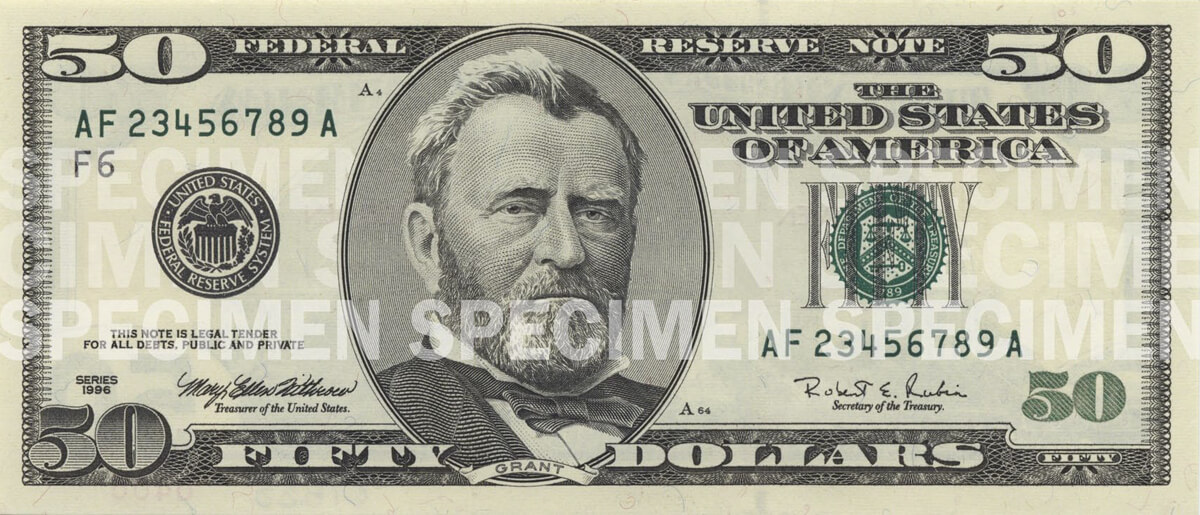
Dominating the obverse (front) of the $50 bill is the portrait of Ulysses S. Grant, the 18th President of the United States and a pivotal figure in American history. Grant, a renowned Union general during the Civil War, is depicted in a dignified pose, his gaze steady and commanding. His inclusion on the $50 bill is a deliberate choice, representing leadership and national achievement.
- Presidential Legacy: Grant’s presidency, though marked by significant challenges, was instrumental in the Reconstruction era following the Civil War. His image on this denomination serves as a constant reminder of this critical period and the enduring impact of his leadership on the nation’s trajectory.
- Artistic Rendition: The portrait itself is a masterpiece of engraving. Subtle details in the shading, the texture of his uniform, and the lines of his face contribute to a sense of realism and gravitas. The engravers meticulously capture the essence of the historical figure, transforming a static image into a powerful representation.
- Placement and Scale: Grant’s portrait occupies a significant portion of the bill’s face, ensuring immediate recognition. Its central placement anchors the design, drawing the viewer’s attention to the historical figure at the heart of the denomination.
The Reverse Side: A Glimpse of American Ingenuity
The reverse (back) of the $50 bill features a more complex and symbolic illustration: the United States Capitol Building. This architectural marvel is a powerful symbol of American democracy and governance.
- Symbol of Governance: The Capitol Building represents the legislative branch of the U.S. government, where laws are debated and enacted. Its inclusion on the $50 bill subtly reinforces the connection between currency and the institutions that regulate it.
- Architectural Detail: The engraving of the Capitol is intricate, capturing the dome, the columns, and the surrounding landscape with remarkable detail. This level of precision in currency design serves not only as an artistic flourish but also as a security feature, making counterfeiting more difficult.
- Historical Context of the Building: The Capitol Building has been a witness to centuries of American history, from its construction to major political events. Its presence on the bill connects the economic value of the $50 to the enduring strength and continuity of American democracy.
Color Palette and Textures: More Than Just Ink
The $50 bill employs a specific color palette and texture that distinguish it from other denominations and contribute to its security. While primarily green, the inks used have subtle variations and undertones that are difficult to replicate precisely.
- The Dominant Green Hue: The characteristic green of U.S. currency, often referred to as “greenback,” has been a hallmark since the Civil War. This color was chosen for its perceived durability and resistance to fading, as well as its psychological association with stability and wealth.
- Subtle Color Variations: While the overall impression is green, a closer examination reveals subtle variations in hue and undertones, particularly in the intricate patterns and borders. These variations are part of the intricate printing process and contribute to the difficulty of counterfeiting.
- Intaglio Printing: U.S. currency is produced using the intaglio printing process, a technique where ink is transferred from a recessed plate to paper. This method creates a raised, tactile feel to the ink, which can be felt by running a fingernail over the printed areas. This tactile element is a significant security feature that is difficult for counterfeiters to replicate.
Security Features: Safeguarding the Value of the Fifty
In an era where digital transactions are increasingly prevalent, the physical security of currency remains paramount. The $50 bill is equipped with a sophisticated array of security features designed to deter counterfeiting and ensure the integrity of the U.S. dollar. These features are not always immediately apparent but are crucial for both individuals and businesses in verifying authenticity.
Watermarks: A Ghostly Image of Franklin
A key security feature embedded within the paper of the $50 bill is a watermark. This subtle image is visible when the bill is held up to a light source.
- The Ulysses S. Grant Watermark: Typically, a watermark on the $50 bill depicts a smaller, fainter image of Ulysses S. Grant, mirroring the portrait on the obverse. This secondary image is created during the papermaking process, meaning it’s an integral part of the paper itself, not printed on top.
- Verification Method: To check for the watermark, hold the bill up to a light. The faint image of Grant should appear on the right side of the portrait. Its clarity and consistency are crucial indicators of authenticity.
Security Thread: A Vertical Guardrail
Another crucial security element is the embedded security thread. This thin strip runs vertically through the paper of the note.
- “USA” and “50” Inscription: The security thread on the $50 bill is printed with microprinting that reads “USA” and “50” repeatedly along its length. These letters are extremely small and can be difficult to read without magnification.
- Fluorescence Under UV Light: When exposed to ultraviolet (UV) light, the security thread glows. The $50 bill’s thread typically glows yellow, a distinct color that helps differentiate it from other denominations and aids in quick verification.
- Placement Varies by Denomination: It’s important to note that the placement and color of the security thread can vary slightly across different denominations, making it a more nuanced security check when comparing various bills.
Color-Shifting Ink: A Dynamic Visual Cue
The $50 bill incorporates advanced security features that utilize color-shifting ink, a dynamic element that further enhances its security.
- The Numeral “50”: The numeral “50” in the lower right-hand corner of the obverse of the bill is printed with color-shifting ink. This ink changes color when the bill is tilted.
- Color Transition: On the $50 bill, this numeral typically shifts from copper to green. This transition is a visually striking and readily observable security feature that is very difficult for counterfeiters to replicate accurately.
- Subtle Variations in Older Notes: While newer notes have a more pronounced color shift, older versions might exhibit a less dramatic transition, making it important to be aware of the general color-shifting property rather than relying on exact shades.
The $50 Bill in Personal Finance and Business Transactions
Beyond its visual appeal and security features, the $50 bill plays a significant role in the everyday financial lives of individuals and the operational dynamics of businesses. Its presence and utility are shaped by economic trends, consumer behavior, and the ongoing evolution of payment methods.
As a Unit of Exchange: Practical Uses
The $50 bill occupies a middle ground in terms of denomination, making it a versatile tool for various transactions.
- Everyday Purchases: It’s commonly used for larger everyday purchases, such as grocery shopping, filling up a car with gas, or paying for services where digital payments might not be preferred or available.
- Cash Transactions and Budgeting: For individuals who prefer a tangible approach to budgeting, larger denominations like the $50 bill can be useful for setting spending limits for specific categories. For instance, allocating a certain number of $50 bills for entertainment or discretionary spending.
- Business Operations: Many small businesses, especially those in retail or service industries, rely on cash transactions. The $50 bill is a frequent component of daily revenue, and managing cash flow, including counting and securing larger bills, is a critical aspect of business finance.
- Tip Distribution and Small Payments: In some sectors, particularly hospitality, the $50 bill can be used for significant tips or for making payments that are too large for a $20 but too small for a $100.
The Evolving Landscape of Cash: Digital vs. Physical
The increasing adoption of digital payment methods presents a complex dynamic for physical currency, including the $50 bill.
- Decline in Cash Usage: In many developed economies, there’s a discernible trend towards a cashless society. Credit cards, debit cards, mobile payment apps, and online transfers are becoming the norm for an ever-wider range of transactions.
- Persistence of Cash: Despite the rise of digital payments, cash, including the $50 bill, continues to hold its ground. Factors contributing to its persistence include:
- Financial Inclusion: Not everyone has access to or is comfortable with digital banking and payment systems. Cash remains a vital tool for unbanked and underbanked populations.
- Privacy and Anonymity: Cash offers a level of privacy that digital transactions cannot match. For individuals who value anonymity, cash remains the preferred method.
- Budgeting Tool: As mentioned, cash can be a powerful psychological tool for budgeting and controlling spending.
- Emergency Situations: In the event of power outages or network failures, cash remains a reliable medium of exchange.
- Impact on $50 Bill Circulation: The reduced reliance on cash for smaller, everyday purchases might lead to a slight decrease in the circulation of smaller denominations. However, the $50 bill, being a larger denomination, often remains relevant for specific types of transactions where larger sums are exchanged.

The Future of the $50 Bill: Adaptation and Innovation
While the physical $50 bill remains a tangible asset, its future, like all physical currency, is intertwined with technological advancements.
- Enhanced Security Features: The Bureau of Engraving and Printing continuously researches and implements new security features to stay ahead of counterfeiters. Future iterations of the $50 bill are likely to incorporate even more sophisticated anti-counterfeiting technologies, potentially including elements that are only verifiable with specialized devices.
- Digital Currencies and Central Bank Digital Currencies (CBDCs): The emergence of cryptocurrencies and the exploration of CBDCs by central banks worldwide signal a significant shift in the concept of money. While not a direct replacement for physical currency in the immediate future, these developments could eventually influence how we perceive and use denominations like the $50 bill.
- Integration with Digital Platforms: It’s conceivable that future innovations might explore ways to bridge the gap between physical currency and the digital realm. This could involve enhanced tracking mechanisms or digital counterparts that provide greater traceability and utility for physical cash.
In conclusion, the $50 bill is far more than just a piece of paper with a monetary value. It’s a meticulously designed artifact embodying American history, a testament to sophisticated security measures, and a practical tool in our financial lives. Understanding its visual intricacies, appreciating its historical significance, and recognizing its evolving role in the face of digital innovation provides a comprehensive perspective on this fundamental element of our monetary system. As the financial landscape continues to transform, the $50 bill, in its current and potentially future forms, will remain a vital component of how we transact, budget, and engage with the economy.
aViewFromTheCave is a participant in the Amazon Services LLC Associates Program, an affiliate advertising program designed to provide a means for sites to earn advertising fees by advertising and linking to Amazon.com. Amazon, the Amazon logo, AmazonSupply, and the AmazonSupply logo are trademarks of Amazon.com, Inc. or its affiliates. As an Amazon Associate we earn affiliate commissions from qualifying purchases.