
The humble torque converter, a crucial component tucked away within the heart of most automatic transmissions, is often an unsung hero of the automotive world. While drivers rarely give it a second thought, this ingenious piece of engineering is responsible for a smooth and seamless driving experience, acting as the vital link between the engine and the drivetrain. Understanding its function is key to appreciating the sophistication of modern vehicles and the technology that makes them tick. At its core, a torque converter’s primary role is to transmit rotational power from the engine to the transmission, but it does so with a remarkable ability to multiply torque and decouple the engine from the wheels when the vehicle is stationary. This article delves into the intricate workings of the torque converter, exploring its fundamental principles, key components, and the essential functions it performs to ensure effortless acceleration and comfortable stopping.

The Fundamental Principles of Fluid Coupling
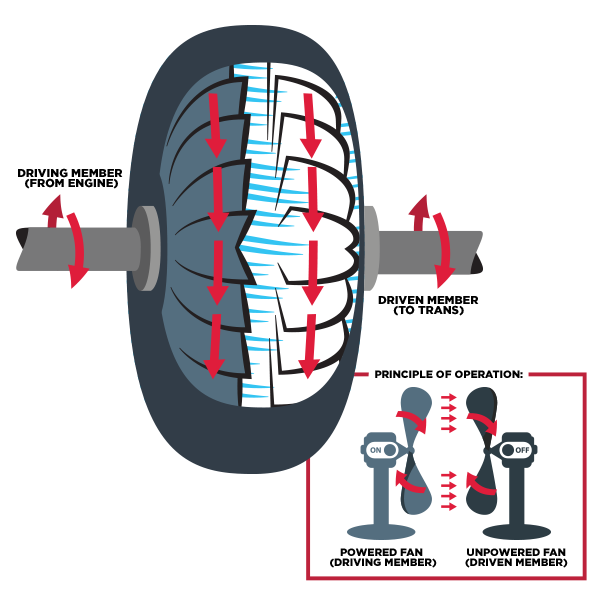
At the heart of every torque converter lies the principle of fluid coupling. Unlike a direct mechanical clutch that rigidly connects or disconnects the engine and transmission, a torque converter utilizes hydraulic fluid – typically automatic transmission fluid (ATF) – to transfer power. This fluid medium allows for a gradual and controlled transfer of energy, eliminating the jarring engagement that would otherwise occur with a manual transmission.
The Role of the Impeller
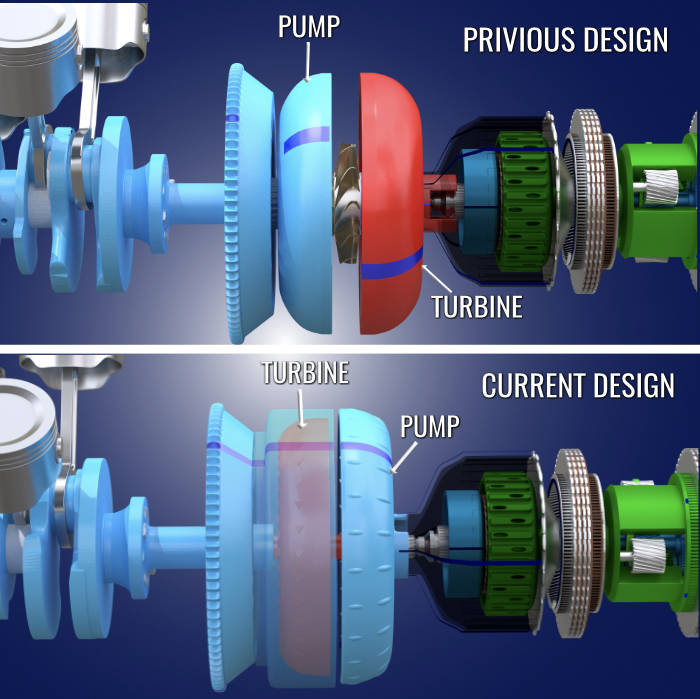
The impeller is the component directly connected to the engine’s crankshaft. As the engine rotates, the impeller spins along with it, acting like a centrifugal pump. It’s designed with curved vanes that fling the ATF outwards into the next component. The faster the engine spins, the greater the centrifugal force exerted on the fluid, and thus, the higher the pressure and velocity of the fluid being ejected. This continuous pumping action is the initial stage of power transmission.
The Turbine: Receiving the Fluid’s Energy
The turbine is the component connected to the transmission’s input shaft. Positioned directly opposite the impeller, it is also equipped with vanes. As the high-velocity ATF from the impeller strikes the turbine vanes, it imparts rotational force. The design of the turbine vanes is crucial; they are angled to efficiently capture the energy of the fluid and convert it into rotary motion. When the engine is running but the vehicle is stationary (e.g., at a red light), the impeller is spinning, but the turbine is not, or is spinning very slowly. This is because the fluid has not yet built up enough momentum to overcome the resistance of the transmission’s gearing and the vehicle’s inertia.
The Stator: The Key to Torque Multiplication
The most critical component that differentiates a torque converter from a simple fluid coupling is the stator. Located between the impeller and the turbine, the stator is a stationary (relative to the impeller and turbine’s relative rotation) element with uniquely shaped vanes. Its purpose is twofold: to redirect the fluid returning from the turbine back to the impeller and to multiply torque.
When the engine speed is significantly higher than the transmission speed – during initial acceleration, for instance – the fluid returning from the turbine is moving in a direction that would oppose the impeller’s rotation if it were simply to flow back. The stator’s vanes are designed to catch this returning fluid and redirect it back towards the impeller in a manner that actually assists the impeller’s rotation. This redirection of fluid effectively increases the force being applied to the impeller, thereby multiplying the engine’s torque. This torque multiplication is most pronounced at low speeds and high engine RPMs, providing the extra “oomph” needed for acceleration from a standstill. As the turbine speed increases and approaches the impeller speed, the fluid flow changes, and the stator begins to pivot or freewheel, minimizing its interference and allowing for more efficient fluid coupling.
The Functionality of Torque Multiplication
Torque multiplication is the defining characteristic of a torque converter and a primary reason for its widespread adoption in automatic transmissions. This ability to artificially increase torque at the transmission input shaft is invaluable for overcoming the inertia of a stationary vehicle and achieving rapid acceleration.
Achieving High Torque at Low Speeds
The torque multiplication effect is most significant when there is a large difference between the engine speed (impeller) and the transmission input shaft speed (turbine). Imagine trying to push a heavy object from rest; it requires a considerable initial force. Similarly, a vehicle from a standstill needs a substantial torque to overcome its inertia. The torque converter achieves this by exploiting the principle of fluid dynamics. As the engine spins rapidly and the transmission is essentially stalled, the fluid is forcefully ejected by the impeller and strikes the turbine. The stator then redirects this fluid back to the impeller in such a way that it effectively pushes the impeller forward, amplifying the torque being transmitted. This multiplication can be as high as 2.5 to 3 times the engine’s output torque.
The Stator’s Crucial Role in Multiplication
The stator’s angled vanes are the key to this torque multiplication. When the speed difference is significant, the returning fluid from the turbine hits the stator vanes at an angle that pushes the stator to rotate in the same direction as the impeller. However, the stator is designed to “lock up” or resist this rotation to a certain degree, depending on its internal mechanism (often a one-way clutch). This resistance forces the fluid to be redirected more effectively back into the impeller, thereby adding its momentum to the impeller’s force. This additive effect is what leads to the multiplication of torque. As the turbine speed increases, the angle of the returning fluid changes. The stator then begins to freewheel, meaning its one-way clutch disengages, and it rotates freely with the fluid. This stops the torque multiplication, preventing excessive slippage and improving efficiency as the vehicle accelerates.
The Advantages of a Lock-Up Clutch
While torque multiplication is a significant advantage, torque converters also have an inherent inefficiency due to fluid slippage, especially at higher speeds. To address this, most modern torque converters incorporate a lock-up clutch. This mechanism provides a direct, mechanical connection between the engine and the transmission, effectively bypassing the fluid coupling and eliminating slippage.
Eliminating Slippage for Improved Efficiency
At cruising speeds, when maximum torque multiplication is no longer needed, the torque converter can operate with considerable slippage. This means that the engine is spinning faster than the transmission input shaft, and some of the engine’s power is being dissipated as heat within the ATF due to fluid friction. This inefficiency leads to reduced fuel economy. The lock-up clutch is a friction clutch that, when engaged, physically locks the impeller to the turbine housing (which is connected to the transmission). This creates a direct 1:1 mechanical link, eliminating slippage and improving fuel efficiency.
When and How the Lock-Up Clutch Engages
The engagement of the lock-up clutch is typically controlled by the vehicle’s Transmission Control Unit (TCU) or Powertrain Control Module (PCM). The TCU monitors various parameters, including vehicle speed, throttle position, and engine load. Once the conditions are favorable – usually at steady cruising speeds and moderate throttle – the TCU commands the lock-up clutch to engage. This engagement is usually a smooth process, often involving a small amount of hydraulic pressure to gradually apply the clutch plates. When the driver demands more power (e.g., by accelerating or going uphill), the TCU will disengage the lock-up clutch, allowing the torque converter to resume its fluid coupling and torque multiplication functions. This seamless transition between lock-up and fluid coupling is crucial for a smooth and responsive driving experience.
The Mechanics of Smooth Operation
Beyond torque multiplication and efficiency gains, torque converters are fundamentally designed to provide a level of operational smoothness that would be difficult to achieve with mechanical clutches alone. Their hydraulic nature allows for a fluid transfer of power that translates into a more comfortable and refined driving experience.
Dampening Engine Vibrations
Engines, especially internal combustion engines, naturally produce vibrations. These vibrations can be transmitted through the drivetrain and felt by the occupants of the vehicle. The fluid in the torque converter acts as a natural damper, absorbing and dissipating a significant portion of these vibrations. The kinetic energy of the fluid and the internal friction within it help to smooth out the rotational pulses from the engine, leading to a quieter and more comfortable ride, particularly at idle and low speeds.
Allowing for Smooth Stops and Starts
The inherent slippage of a torque converter when stationary is what allows the driver to stop the vehicle without stalling the engine. When the brake pedal is applied, the transmission essentially stops the rotation of the turbine, but the engine continues to run, spinning the impeller. The fluid coupling allows for this decoupling, preventing a direct mechanical shock. Similarly, when accelerating from a stop, the gradual engagement of the fluid coupling, combined with the torque multiplication, provides a smooth and progressive initial acceleration, rather than an abrupt lurch. This makes driving in stop-and-go traffic significantly more manageable and comfortable.
In conclusion, the torque converter is a marvel of automotive engineering. Its ability to transfer power hydraulically, multiply torque for improved acceleration, and provide a smooth and vibration-dampened driving experience makes it an indispensable component of modern automatic transmissions. The evolution of the torque converter, particularly with the addition of the lock-up clutch, has further enhanced its efficiency, contributing to better fuel economy without sacrificing the comfort and convenience it provides. Understanding what a torque converter does reveals the intricate interplay of physics and engineering that makes driving an effortless and enjoyable activity.
aViewFromTheCave is a participant in the Amazon Services LLC Associates Program, an affiliate advertising program designed to provide a means for sites to earn advertising fees by advertising and linking to Amazon.com. Amazon, the Amazon logo, AmazonSupply, and the AmazonSupply logo are trademarks of Amazon.com, Inc. or its affiliates. As an Amazon Associate we earn affiliate commissions from qualifying purchases.