
The question “what does a wormhole look like?” immediately plunges us into a realm where theoretical physics meets science fiction, where mathematical elegance battles the limits of human imagination. Unlike a star, a planet, or even a black hole (whose event horizon we can infer through its gravitational effects), a wormhole remains purely hypothetical. Yet, our fascination with these cosmic shortcuts—tunnels through spacetime that could, in theory, connect distant points in the universe or even different moments in time—spurs us to try and visualize them. This isn’t just an exercise in speculative physics; it’s a multidisciplinary endeavor, touching upon advanced technology, the branding of scientific concepts, and the profound economic implications of venturing into the unknown.
This exploration will transcend a mere scientific explanation, weaving in how technology helps us model and imagine the unimaginable, how popular culture has branded these enigmatic structures, and the economic investments required to even pursue such mind-bending possibilities. From the intricate equations of general relativity to the dazzling CGI of Hollywood blockbusters, the ‘look’ of a wormhole is a construct born from both rigorous thought and boundless fantasy, continually shaped by our evolving understanding and the tools we use to comprehend the universe.
The Theoretical Canvas: Visualizing the Unseen
At its heart, understanding what a wormhole ‘looks like’ begins not with an image, but with a concept derived from the complex tapestry of Einstein’s theory of general relativity. This theory describes gravity not as a force, but as the curvature of spacetime caused by mass and energy. Wormholes, formally known as Einstein-Rosen bridges, emerge as peculiar solutions to these equations, suggesting a shortcut through this cosmic fabric.
Einstein’s Bridge: A Conceptual Blueprint
The genesis of the wormhole concept dates back to 1916 when Ludwig Flamm proposed a ‘white hole’ solution to Einstein’s field equations, a theoretical opposite to a black hole, from which matter and light could exit but never enter. Years later, in 1935, Albert Einstein and Nathan Rosen, while attempting to model elementary particles, discovered that general relativity allowed for the existence of bridges connecting two separate regions of spacetime. These ‘Einstein-Rosen bridges’ were mathematically elegant but physically problematic.
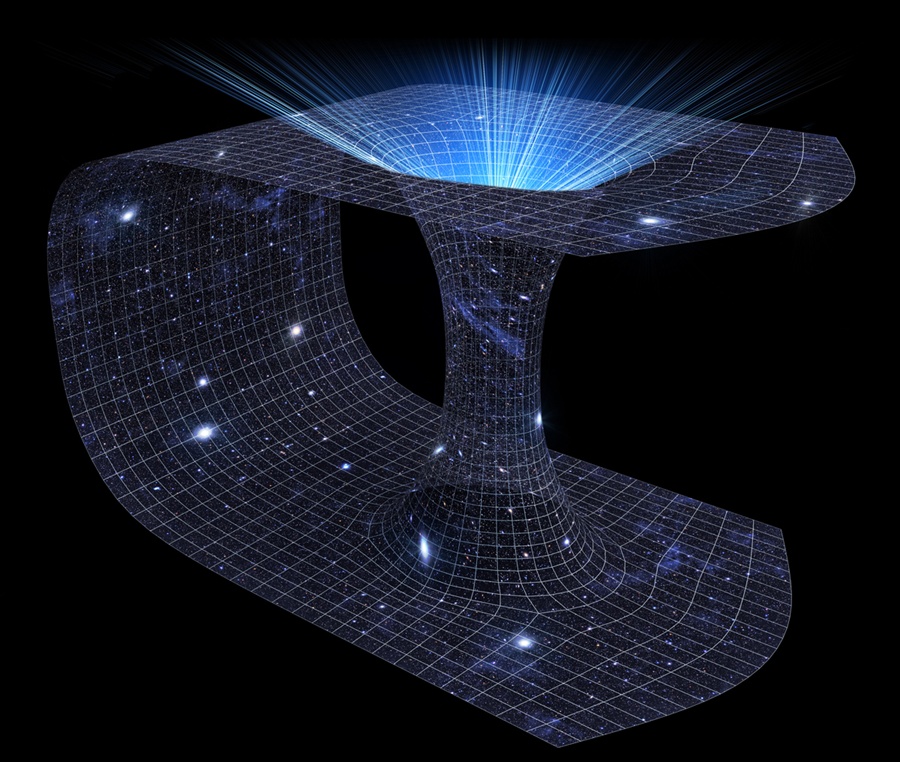
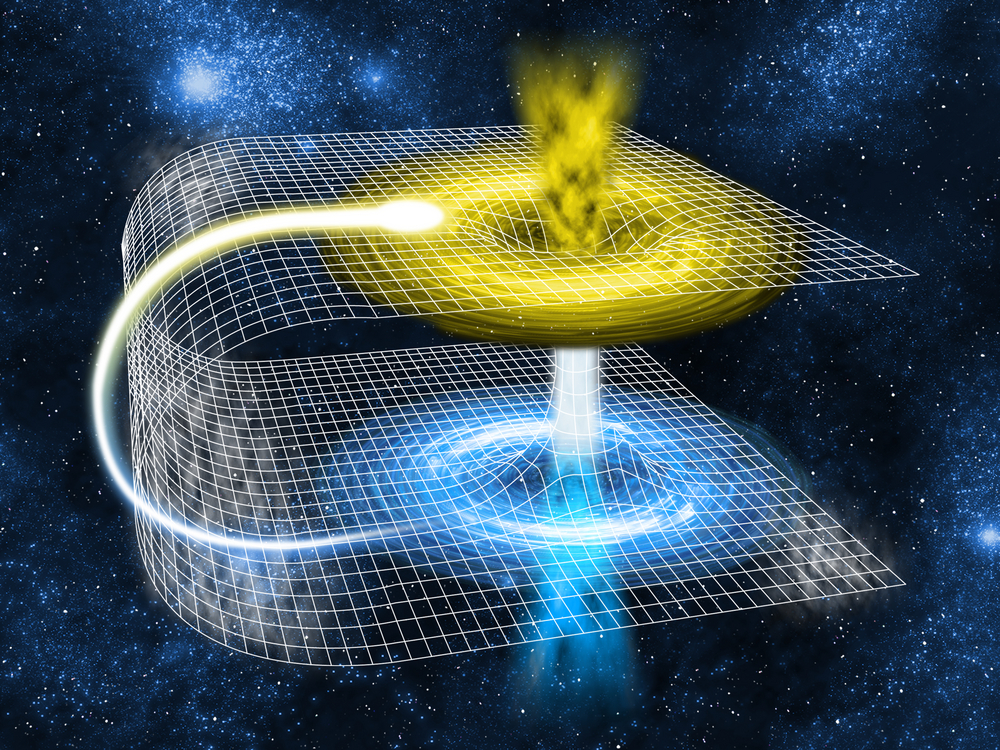
Imagine our three spatial dimensions, plus time, as a stretched rubber sheet. A massive object like a star creates a dip in this sheet. A black hole creates an infinitely deep well. An Einstein-Rosen bridge, in this simplified two-dimensional analogy, would be like folding the sheet and poking a hole through both sides, creating a tunnel that connects two seemingly distant points. If you were an observer approaching one ‘mouth’ of this theoretical wormhole, you wouldn’t necessarily see a dramatic tear in space. Instead, you might observe a highly distorted view of the region around the other mouth, or perhaps a strange lensing effect of stars and galaxies from a distant part of the universe. The mouth itself, if perfectly spherical and uncharged, might appear as a perfectly black disc, much like a black hole, but with a crucial difference: it would be a portal, not an end.
However, these initial theoretical wormholes presented significant issues for physical travel or observation. They were incredibly unstable, collapsing almost instantaneously after formation. Even light would not be able to traverse them before they pinched off. Moreover, they were ‘non-traversable,’ meaning that even if they lasted, their geometry would prevent anything from passing through. The theoretical ‘look’ of such a wormhole, therefore, is primarily one of extreme gravitational distortion rather than a stable, observable tunnel.
Exotic Matter and Traversable Wormholes: A Glimmer of Hope
The instability of Einstein-Rosen bridges led physicists to explore conditions under which a wormhole could remain open and traversable. The groundbreaking work by Kip Thorne and his colleagues in the 1980s, inspired by astronomer Carl Sagan’s need for a scientifically plausible method of interstellar travel in his novel “Contact,” revealed a startling requirement: ‘exotic matter.’
Exotic matter isn’t just unusual; it possesses properties that violate conventional physics. Specifically, it must have negative energy density. While small amounts of negative energy density are allowed by quantum mechanics (like in the Casimir effect), the sheer quantity required to prop open a macroscopic wormhole for even a brief moment is immense, far beyond anything we’ve observed or can currently conceive of creating.
If such exotic matter could exist and be harnessed, a traversable wormhole might present a much more visually compelling prospect. The ‘mouths’ of a traversable wormhole could theoretically be stable, potentially allowing light (and even spaceships) to enter. What would you see if you looked into one?
From the outside, a wormhole mouth might still resemble a black hole – a sphere of perfect blackness or a region of extreme gravitational lensing, where distant stars and galaxies appear warped and stretched around its perimeter. The difference would be what happens when you get closer. Instead of an event horizon beyond which nothing escapes, you might see through the wormhole. Looking into one mouth, you would see the light from the region surrounding the other mouth, no matter how far away it was in normal spacetime. It would be like looking through a telescope at a distant galaxy, but that galaxy is effectively right in front of you, accessed through a portal.
As you approached the mouth, the distortions would become more pronounced. Light rays from the ‘other side’ would be bent and magnified, creating a kaleidoscope of alien stars, nebulae, or even another planet. The ‘throat’ of the wormhole itself, if it were short enough and wide enough to perceive, might appear as a tunnel of swirling colors, reflecting the light from both ends, creating an effect akin to looking down an infinitely long, curving hallway of mirrors. The light from distant objects would be blue-shifted as you fell in (appearing bluer and brighter), and red-shifted as you looked towards the exit (appearing redder and dimmer), due to relativistic effects. The specific appearance would depend heavily on the wormhole’s geometry, its size, and the distribution of matter and energy within and around it.
The Tech Lens: Simulating and Synthesizing Wormhole Aesthetics
Given that wormholes are purely theoretical, our primary means of “seeing” them relies heavily on advanced technology. From complex computational models to future observational strategies, technology plays an indispensable role in translating abstract physics into something visually comprehensible. The Tech section of our website, covering AI tools, software, and gadgets, finds a profound application here.
Computational Physics and AI’s Role in Visualization
The equations of general relativity are notoriously complex, especially when dealing with extreme spacetime curvatures like those associated with black holes and, by extension, wormholes. Analytical solutions are rare, requiring physicists to turn to computational methods. Supercomputers, running sophisticated simulation software, are essential for numerically solving these equations and modeling how light would behave in the vicinity of such exotic objects.
Software tools, often custom-built, allow researchers to trace the paths of light rays (geodesics) through simulated spacetime geometries. By placing a hypothetical observer at different vantage points relative to a wormhole mouth, these simulations can render what that observer would ‘see.’ This involves complex algorithms that account for gravitational lensing, time dilation, and the Doppler effect. AI tools, particularly machine learning algorithms, are increasingly being used to analyze vast datasets generated by these simulations, helping to identify patterns, predict behaviors, and even optimize the parameters for stable wormhole models.
For instance, when depicting a wormhole, software can simulate:
- Gravitational Lensing: How the immense gravity of the wormhole’s mouth bends light from background stars and galaxies, creating distorted arcs, multiple images, or even an “Einstein ring” effect.
- Aberration and Doppler Shift: As an object (or observer) approaches or moves through a wormhole, the relative motion and intense gravitational fields would cause significant shifts in the frequency and direction of light, leading to color changes and apparent distortions in the positions of objects.
- The “Tunnel” Effect: Inside the throat, simulations can model the perspective of looking down a curved tunnel, where light from both entrances mixes, potentially creating a dizzying, kaleidoscopic view depending on the length and curvature of the throat.
These computational visualizations are not just pretty pictures; they are critical scientific tools that allow physicists to test theoretical predictions, refine models, and identify potential observational signatures. They are the closest we can come to actually ‘seeing’ a wormhole with our current technological capabilities, bridging the gap between abstract mathematics and tangible imagery.
Next-Gen Telescopes and Data Interpretation
While we can’t directly image a wormhole today, future technological advancements in observational astronomy might allow us to detect their effects. The development of next-generation telescopes, both ground-based and space-based, equipped with enhanced sensitivity and resolution, could potentially pick up the subtle gravitational signatures of a wormhole.
For example, the Event Horizon Telescope (EHT), which famously captured the first image of a black hole’s shadow, uses a global network of radio observatories to create an Earth-sized virtual telescope. Future iterations of such instruments, or even dedicated gravitational wave observatories (like LIGO and the planned LISA mission), could theoretically detect the distinctive gravitational wave patterns that might be produced by the formation or interaction of wormholes. These aren’t direct visual images, but they are ‘looks’ in a data-driven sense – unique signatures that point to the presence of such an object.
Furthermore, advanced data interpretation techniques, leveraging AI and machine learning, will be crucial. Astronomers are already sifting through vast amounts of data from sky surveys, searching for anomalies that don’t fit standard astrophysical models. A wormhole’s gravitational lensing effects on distant galaxies, for example, might be subtle but distinct from those caused by known dark matter concentrations or black holes. AI algorithms could be trained to identify these unique ‘fingerprints’ in optical, radio, or X-ray data, potentially signaling the presence of a wormhole.
These technological frontiers – from supercomputing to advanced telescopic arrays and AI-driven analytics – represent our best hope for moving wormholes from the realm of pure theory into the domain of observable (or inferable) phenomena. They are the gadgets and software that extend our senses into the most extreme corners of the cosmos.
Branding the Cosmic Enigma: Wormholes in Culture and Communication
While scientists grapple with the theoretical intricacies of wormholes, popular culture has taken the concept and, quite literally, ‘branded’ it with specific visual tropes. This process of branding, where complex scientific ideas are packaged for public consumption, is fascinating and plays a significant role in shaping what the average person thinks a wormhole looks like. This aligns with our ‘Brand’ section, exploring how concepts, even abstract scientific ones, acquire an identity and reputation in the public sphere.
Pop Culture’s Influence: Shaping the Public’s Perception
From Star Trek and Stargate to Interstellar and Contact, science fiction has been instrumental in popularizing the wormhole concept. These portrayals often provide a visually stunning, albeit frequently simplified or exaggerated, interpretation of what it might be like to encounter or traverse one. This repeated visual representation acts as a form of branding, creating a universally recognized “look” for wormholes in the collective imagination.
Common visual elements in pop culture’s wormhole brand include:
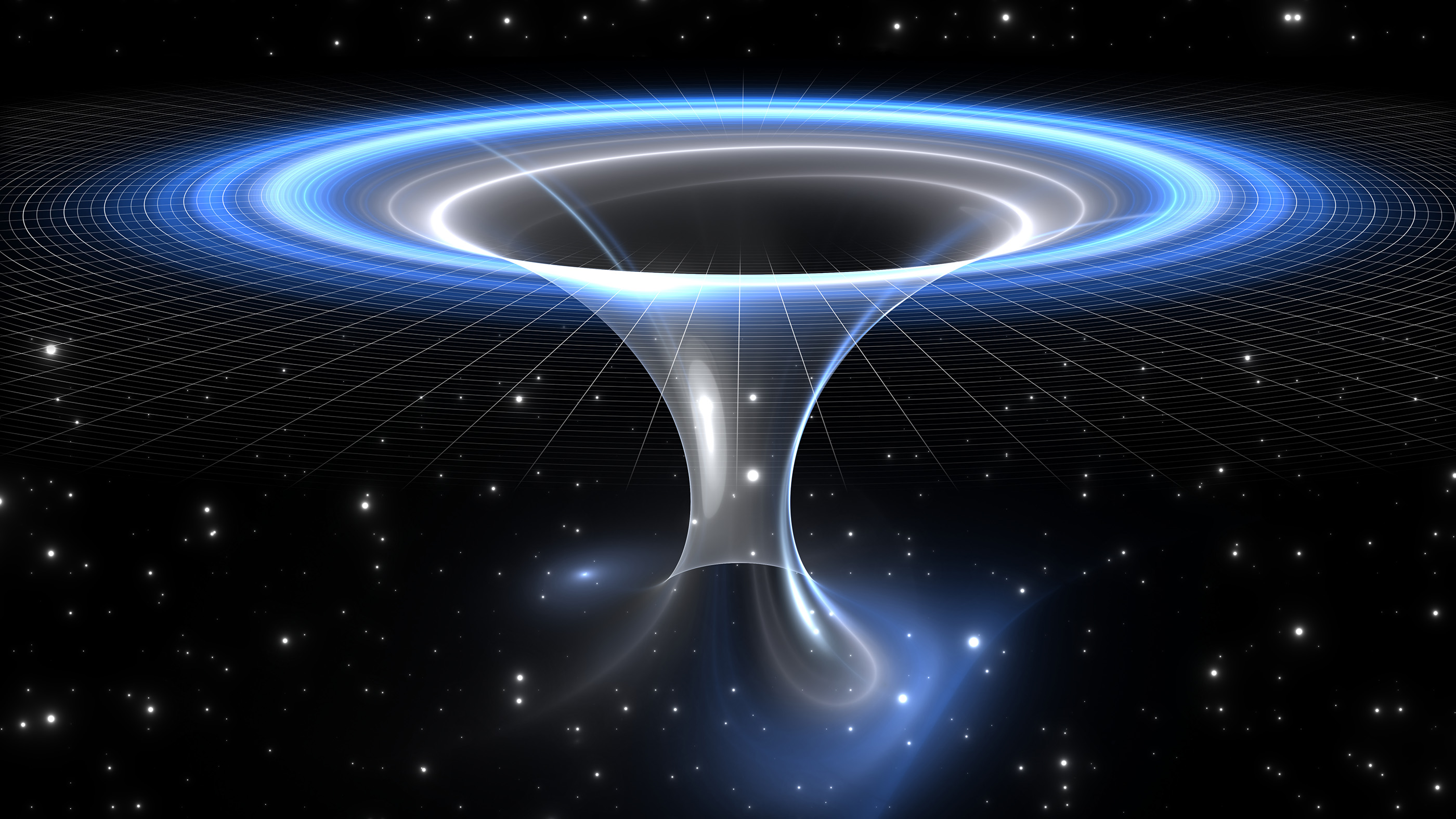
- The Swirling Vortex: Often depicted as a colossal, turbulent funnel of energy, sometimes glowing with blues, purples, or greens. This imagery conveys immense power and instability, a gateway tearing through the fabric of space. Think of the wormhole in Interstellar, which is a brilliantly rendered, scientifically informed visual, but still retains a dramatic, awe-inspiring scale.
- The Hyperspace Tunnel: Many narratives show wormhole travel as a rapid, disorienting journey through a tunnel of light and warped stars. This emphasizes the shortcut aspect and the sensation of incredible speed.
- Distorted Portals: The mouth of a wormhole might be shown as a shimmering, unstable portal, distorting the light of anything behind it, hinting at the different spacetime on the other side.
- The Cosmic Anomaly: Sometimes, a wormhole is simply represented as a bizarre, unexplained phenomenon in space, bending light and causing strange effects, its true nature hidden.
These visual brands serve a dual purpose: they make complex physics accessible and exciting for a broad audience, and they establish a common aesthetic shorthand. While not always scientifically accurate, these cinematic and literary depictions fulfill a crucial role in maintaining public interest in deep space exploration and theoretical physics. They give us something tangible to imagine, a visual anchor for a profoundly abstract concept, thereby effectively branding the wormhole as a symbol of cosmic possibility and mystery.
The Art of Scientific Communication: From Theory to Public Understanding
The challenge for scientific communicators is to bridge the gap between the imaginative branding of pop culture and the rigorous, often counter-intuitive, reality of theoretical physics. How do you ‘sell’ a concept that is mathematically precise but visually elusive? This requires careful strategy, aligning with principles of brand communication that emphasize clarity, accuracy, and engagement.
Scientists and science communicators must often create their own “brand” for wormholes that is both compelling and responsible. This involves:
- Visual Metaphors: Using analogies like the folded sheet of paper (the “rubber sheet” analogy) to explain spacetime curvature and the shortcut concept. These are visual aids, not direct representations, but they brand the wormhole as a spatial bypass.
- CGI & Scientific Visualization: Leveraging the same animation technologies used in Hollywood, but with a strict adherence to physical principles and data from simulations. This creates compelling, scientifically informed visualizations that aim for accuracy rather than just dramatic effect. Renowned astrophysicists like Kip Thorne have worked directly with filmmakers to ensure the wormhole depicted in films like Interstellar was as scientifically plausible as possible, thus creating a powerful, albeit fictional, ‘brand image’ of a wormhole based on cutting-edge theory.
- Simplification without Misrepresentation: The careful art of explaining complex ideas in an understandable way without sacrificing fundamental truths. This might mean admitting “we don’t know what it looks like, but here’s what the math tells us might happen to light.”
Ultimately, the ‘brand’ of a wormhole in both popular culture and scientific communication reflects our collective hopes, fears, and curiosity about the universe. It’s a testament to humanity’s drive to explore, to imagine, and to communicate the awe-inspiring possibilities hidden within the fabric of reality, constantly refining its image as our understanding deepens.
The Economic Frontier: Investing in the Pursuit of the Impossible
The exploration of wormholes, even as a purely theoretical endeavor, is not without its economic implications. The pursuit of such a grand scientific question requires significant financial investment, much like any ambitious technological or branding venture. From funding fundamental research to contemplating speculative future industries, the “Money” aspect of our website topics finds a surprising, yet crucial, link to the abstract physics of wormholes.
Funding Fundamental Research: The Cost of Cosmic Curiosity
Theoretical physics, astrophysics, and cosmology, the fields most directly engaged with wormhole research, are fundamentally curiosity-driven sciences. They don’t typically promise immediate returns on investment in the form of new products or market gains. Yet, they are foundational. Breakthroughs in these areas often pave the way for entirely new technologies and industries decades or centuries later, just as Einstein’s abstract theories of relativity underpinned GPS technology.
The investment in understanding wormholes and other extreme cosmic phenomena comes in several forms:
- Government Grants: Agencies like NASA, the National Science Foundation (NSF) in the US, and their international counterparts allocate billions to fund theoretical physics groups, support observational astronomy, and develop the computational infrastructure needed for complex simulations. This is an investment in human capital (scientists, engineers) and the tools they use.
- University Research: Academic institutions are hubs for this research, funded by a mix of government grants, endowments, and philanthropic donations. Attracting top talent and providing state-of-the-art facilities is a continuous financial commitment.
- Technological Development: The advanced telescopes, detectors, and supercomputers discussed earlier are incredibly expensive to design, build, and operate. These are massive infrastructure projects, often international collaborations, requiring multi-billion dollar budgets. For instance, the James Webb Space Telescope cost over $10 billion, and its observations could indirectly contribute to our understanding of extreme spacetime.
The “return” on this investment is primarily knowledge, intellectual property (in terms of new algorithms or methodologies), and often, unexpected spin-off technologies. The pursuit of fundamental physics pushes the boundaries of computing, materials science, and engineering, which invariably find applications in other sectors. In essence, the global economy collectively invests in the abstract hope that somewhere within these cosmic mysteries lies a key to a deeper understanding of reality, potentially unlocking future technological or economic revolutions.
Future Implications and Speculative Ventures
While wormhole travel remains firmly in the realm of science fiction, its theoretical possibility sparks immense speculation about future economic implications. If traversable wormholes were ever proven to exist or could be engineered, the economic landscape of humanity would be irrevocably altered, creating entirely new markets and disrupting existing ones.
Consider the potential speculative ventures:
- Interstellar Logistics and Trade: The ability to travel instantaneously across vast cosmic distances would revolutionize transportation, enabling rapid interstellar trade and potentially access to unimaginable resources on other planets. This could give rise to multi-trillion dollar spacefaring corporations focused on cosmic logistics, resource extraction, and colonization.
- Tourism and Exploration: Imagine the ultimate travel industry: wormhole tourism to distant exoplanets or nebulae. This would create an entirely new market for luxury travel and scientific expeditions, akin to space tourism today but on a galactic scale.
- New Energy Sources and Materials: The advanced physics required to understand and manipulate spacetime could lead to breakthroughs in energy generation or the creation of novel materials with exotic properties, impacting every industry from manufacturing to defense.
- Geopolitical Shifts: Access to wormholes could dramatically alter geopolitical power structures. Nations or corporations that control wormhole technology would wield immense influence, leading to unprecedented investment in space defense and exploration.
These are, of course, distant dreams. However, the very idea of wormholes serves as a powerful motivator for long-term strategic investment in science and technology. It fuels the imagination of entrepreneurs and policymakers, fostering a climate where high-risk, high-reward research is valued. The pursuit of what a wormhole ‘looks like’ today, through equations and simulations, is a quiet but profound investment in the limitless economic frontiers that could one day define humanity’s place in the cosmos.
In conclusion, “what does a wormhole look like?” is a question that defies simple answers. It is a chameleon, shifting its appearance from the elegant curves of mathematical notation to the awe-inspiring vortexes of cinematic spectacle. It is a concept that demands the cutting edge of technology for its visualization, requiring the powerful computations of AI and the future promise of advanced observatories. It is also a concept that has been carefully branded by both popular culture and scientific communicators, shaping our collective understanding. Finally, it represents an immense, long-term economic investment, a testament to humanity’s insatiable curiosity and the profound belief that even the most abstract scientific quests can yield invaluable returns, both in knowledge and in the potential for a radically transformed future. The ‘look’ of a wormhole is, therefore, a multifaceted reflection of our relentless journey to explore and comprehend the ultimate frontiers of existence.
aViewFromTheCave is a participant in the Amazon Services LLC Associates Program, an affiliate advertising program designed to provide a means for sites to earn advertising fees by advertising and linking to Amazon.com. Amazon, the Amazon logo, AmazonSupply, and the AmazonSupply logo are trademarks of Amazon.com, Inc. or its affiliates. As an Amazon Associate we earn affiliate commissions from qualifying purchases.