
Understanding when the stock market closes is one of the most fundamental requirements for any investor, whether you are a seasoned day trader or a long-term passive investor. While the “closing bell” is a cultural icon of American capitalism, the reality of modern financial markets is far more complex than a simple 4:00 PM ET cutoff. In an era of global connectivity and high-frequency trading, the definition of “market hours” has expanded to include pre-market sessions, after-hours trading, and international time zone overlaps.
Navigating these schedules is essential for managing risk, ensuring liquidity, and executing trades at the most favorable prices. This guide explores the intricacies of the U.S. stock market schedule, the mechanics of the closing auction, and the strategic implications of trading at different times of the day.
The Standard Trading Session: The Core 6.5 Hours
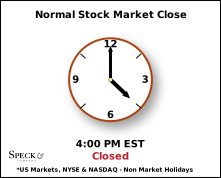
The primary trading session for the two largest stock exchanges in the world—the New York Stock Exchange (NYSE) and the NASDAQ—runs from 9:30 AM to 4:00 PM Eastern Time (ET), Monday through Friday. This 6.5-hour window is when the vast majority of trading volume occurs and when the market is at its most liquid.
The Significance of Eastern Time
Regardless of where an investor is physically located, the U.S. stock market operates strictly on Eastern Time. For an investor in Los Angeles, the market opens at 6:30 AM and closes at 1:00 PM. For an investor in London, the market opens in the mid-afternoon and closes late in the evening. This synchronization ensures that price discovery is centralized and that institutional investors can manage massive portfolios with a unified clock.
The “Power Hour” and the Closing Bell
The final hour of the standard session, from 3:00 PM to 4:00 PM ET, is often referred to as the “Power Hour.” This period frequently sees a surge in volatility and trading volume as institutional investors, mutual funds, and hedge funds rebalance their positions before the day ends. The closing bell at 4:00 PM signals the end of this high-intensity period, providing a definitive “closing price” that is used to calculate mutual fund Net Asset Values (NAVs) and serve as a benchmark for historical data.
The Mechanics of the Closing Auction
The 4:00 PM close is not just a hard stop; it is a sophisticated mathematical process known as the “Closing Auction.” During the final minutes of the day, the exchange computers aggregate “market-on-close” (MOC) and “limit-on-close” (LOC) orders to find the single price that maximizes the number of shares traded. This ensures a stable and fair price for the official daily close, preventing a single small trade from skewing the final valuation of a multi-billion dollar company.
Beyond the Bell: Extended-Hours Trading
While the standard session is the most active, the stock market does not truly “go dark” at 4:00 PM. Electronic Communication Networks (ECNs) allow for extended-hours trading, which caters to investors who need to react to news that breaks outside of the standard window.
Post-Market Trading (4:00 PM – 8:00 PM ET)
Immediately following the closing bell, the “after-hours” session begins. This session typically runs until 8:00 PM ET. This period is crucial because most public companies release their quarterly earnings reports shortly after 4:00 PM. Investors use this time to react to those reports, often causing dramatic price swings. However, because there are fewer participants, the “bid-ask spread” (the difference between what a buyer will pay and what a seller will accept) tends to be much wider, making it more expensive and riskier to trade.
Pre-Market Trading (4:00 AM – 9:30 AM ET)
On the other side of the clock, the pre-market session allows traders to position themselves before the official open. While some brokers allow trading as early as 4:00 AM ET, the bulk of pre-market activity happens between 8:00 AM and 9:30 AM. This session is often driven by international news, overnight developments in Asian or European markets, or early-morning economic data releases from the U.S. government (such as employment or inflation reports).
Risks of Trading Outside Standard Hours
While extended hours offer flexibility, they come with significant warnings from financial regulators. The primary risks include:
- Lower Liquidity: With fewer traders, it is harder to execute large orders without significantly moving the price.
- Increased Volatility: Prices can jump or drop rapidly on very little news.
- Unlinked Prices: Prices in the extended-market session may not reflect the price the stock will eventually trade at once the standard session opens at 9:30 AM.
Market Holidays and Early Closures
The stock market does not operate 365 days a year. It follows a strict schedule of federal holidays and occasional early closures that investors must account for when planning their financial moves.
The Annual Holiday Calendar
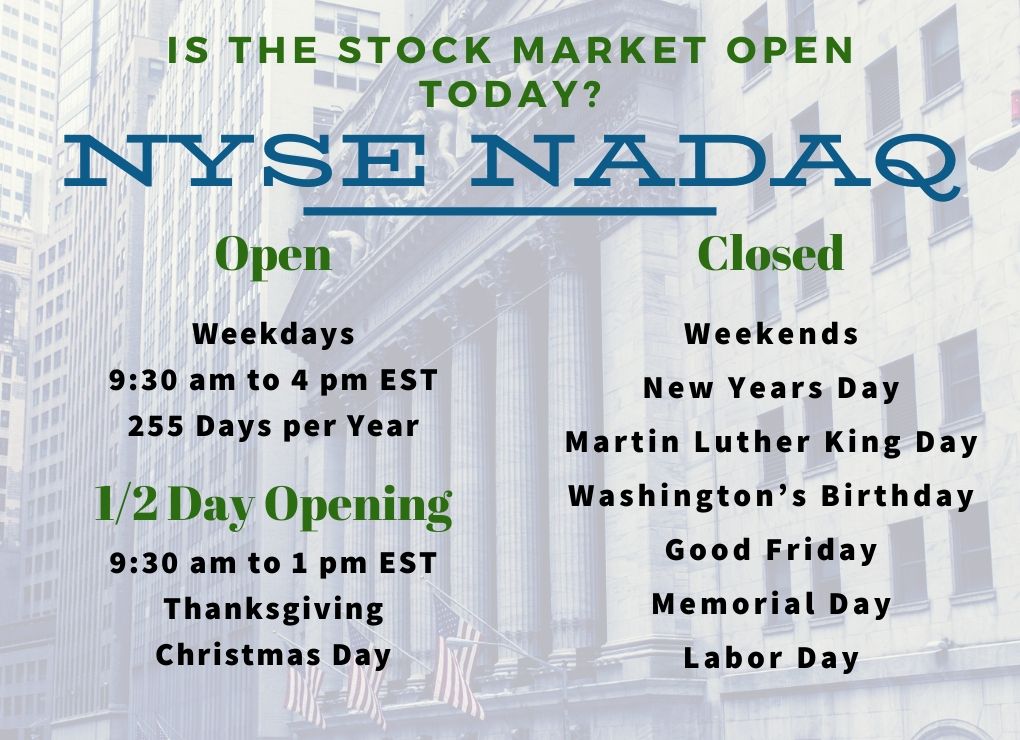
The NYSE and NASDAQ observe nine major holidays per year, during which the markets are completely closed:
- New Year’s Day
- Martin Luther King, Jr. Day (Third Monday in January)
- Presidents’ Day (Third Monday in February)
- Good Friday (The Friday before Easter)
- Memorial Day (Last Monday in May)
- Juneteenth National Independence Day (June 19)
- Independence Day (July 4)
- Labor Day (First Monday in September)
- Thanksgiving Day (Fourth Thursday in November)
- Christmas Day (December 25)
If a holiday falls on a Saturday, the market usually closes on the preceding Friday. If it falls on a Sunday, the market closes on the following Monday.
Early Closure Days
In addition to full holidays, the market occasionally operates on a shortened schedule, closing at 1:00 PM ET. These early closures typically occur on the day after Thanksgiving (Black Friday) and sometimes on Christmas Eve or July 3, depending on where those dates fall in the week. These half-days are often characterized by exceptionally low trading volume, as many institutional traders take the day off.
Unexpected Market Halts
While rare, the stock market can close unexpectedly due to “circuit breakers.” These are regulatory measures intended to curb panic selling. If the S&P 500 drops by 7% (Level 1) or 13% (Level 2) from the previous day’s close, trading is halted for 15 minutes. If it drops by 20% (Level 3), the market closes for the remainder of the day. These mechanisms provide a “cooling-off” period during extreme market stress.
Global Markets and the 24-Hour Cycle
For the modern investor, the closing of the U.S. market is merely one chapter in a 24-hour global financial narrative. Money never truly sleeps; it simply migrates from one time zone to the next.
The European and Asian Overlap
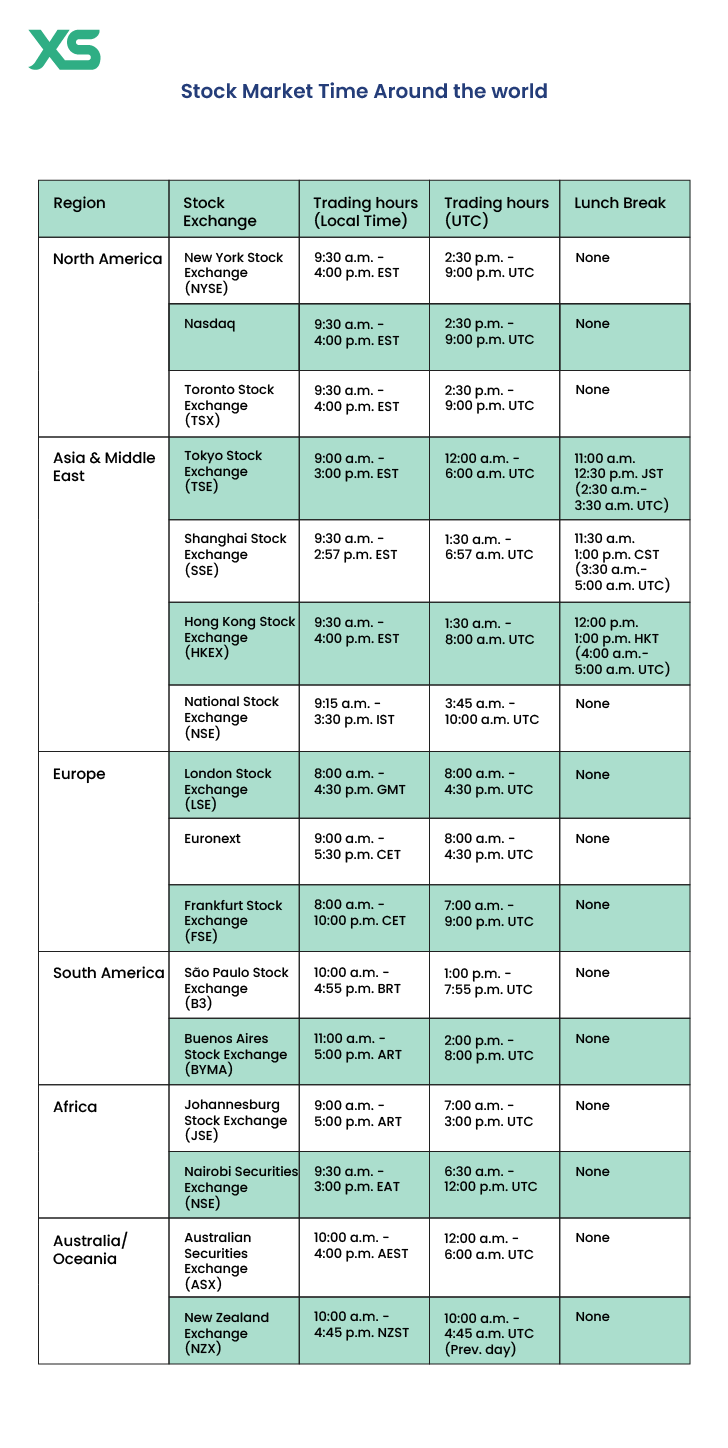
As the U.S. market prepares to open, European markets like the London Stock Exchange (LSE) and the Frankfurt Stock Exchange (DAX) are already in their afternoon sessions. Conversely, when the U.S. market closes, the Asian markets—specifically the Tokyo Stock Exchange (TSE), the Hong Kong Stock Exchange (HKEX), and the Shanghai Stock Exchange—are preparing to begin their trading day.
Global Portfolio Management
Investors with international exposure must be aware of these varying “close” times. For example, a development in the U.S. tech sector at 3:30 PM ET will likely ripple through the Tokyo market a few hours later. Sophisticated investors use this “follow-the-sun” approach to manage risk across different geographic regions.
The Rise of 24/5 Trading
Some brokerage platforms have recently introduced “24/5” trading for a select list of highly liquid ETFs and stocks. This allows retail investors to trade certain assets 24 hours a day, five days a week. While this mimics the 24/7 nature of the cryptocurrency market, it remains a niche offering and does not represent the “official” close of the broader exchange.
Strategic Timing: When Should You Trade?
Knowing when the market closes is practical information, but understanding the implications of that timing is what makes a successful investor. The time of day you choose to buy or sell can have a measurable impact on your returns.
Avoiding the “Open” and “Close” Volatility
Novice investors are often advised to avoid trading in the first 30 minutes and the last 30 minutes of the day. These periods are dominated by institutional rebalancing and reactionary trading, which can lead to “whipsaw” price movements. For long-term investors, executing trades during the “mid-day lull” (between 11:00 AM and 2:00 PM ET) often results in smoother execution and more stable pricing.
Earnings Season Strategy
Because companies report earnings after the 4:00 PM close, the “after-hours” market becomes a battlefield for analysts. If you hold a stock through the close on earnings day, you are essentially committing to whatever volatility occurs overnight. Investors who prefer to minimize risk often sell their positions before the 4:00 PM close if they are uncertain about an upcoming earnings report.
The Importance of Order Types
If you are worried about what happens when the market closes, using the right order types is critical. A “Market Order” placed after the close will execute at whatever the price is when the market opens the next morning—which could be significantly higher or lower than the previous day’s close. Using “Limit Orders” ensures that your trade only executes at a price you are comfortable with, protecting you from the “gap” that often occurs between the close of one day and the open of the next.
In conclusion, while the stock market officially closes at 4:00 PM ET, the ecosystem of modern finance is a continuous loop. By mastering the schedule of standard hours, extended sessions, and holiday closures, you can better protect your capital and navigate the markets with professional precision.
aViewFromTheCave is a participant in the Amazon Services LLC Associates Program, an affiliate advertising program designed to provide a means for sites to earn advertising fees by advertising and linking to Amazon.com. Amazon, the Amazon logo, AmazonSupply, and the AmazonSupply logo are trademarks of Amazon.com, Inc. or its affiliates. As an Amazon Associate we earn affiliate commissions from qualifying purchases.