
In the landscape of big data and artificial intelligence, few names carry as much weight—or as much mystery—as Palantir Technologies. Founded in 2003 by a group of investors and engineers, including Peter Thiel and Alex Karp, Palantir has evolved from a niche tool for the intelligence community into a foundational operating system for the modern enterprise. But to answer the question “What is Palantir?” one must look beyond the buzzwords of “Big Data” and “AI.”
At its core, Palantir is a software company that builds platforms for integrating, managing, and securing data. Unlike traditional business intelligence tools that merely visualize data, Palantir’s software creates a digital twin of an entire organization, allowing users to conduct complex analyses, automate workflows, and make critical decisions in real-time. Whether it is a counter-terrorism unit tracking a threat or a global manufacturer optimizing a supply chain, Palantir provides the digital infrastructure necessary to turn chaotic data into actionable intelligence.
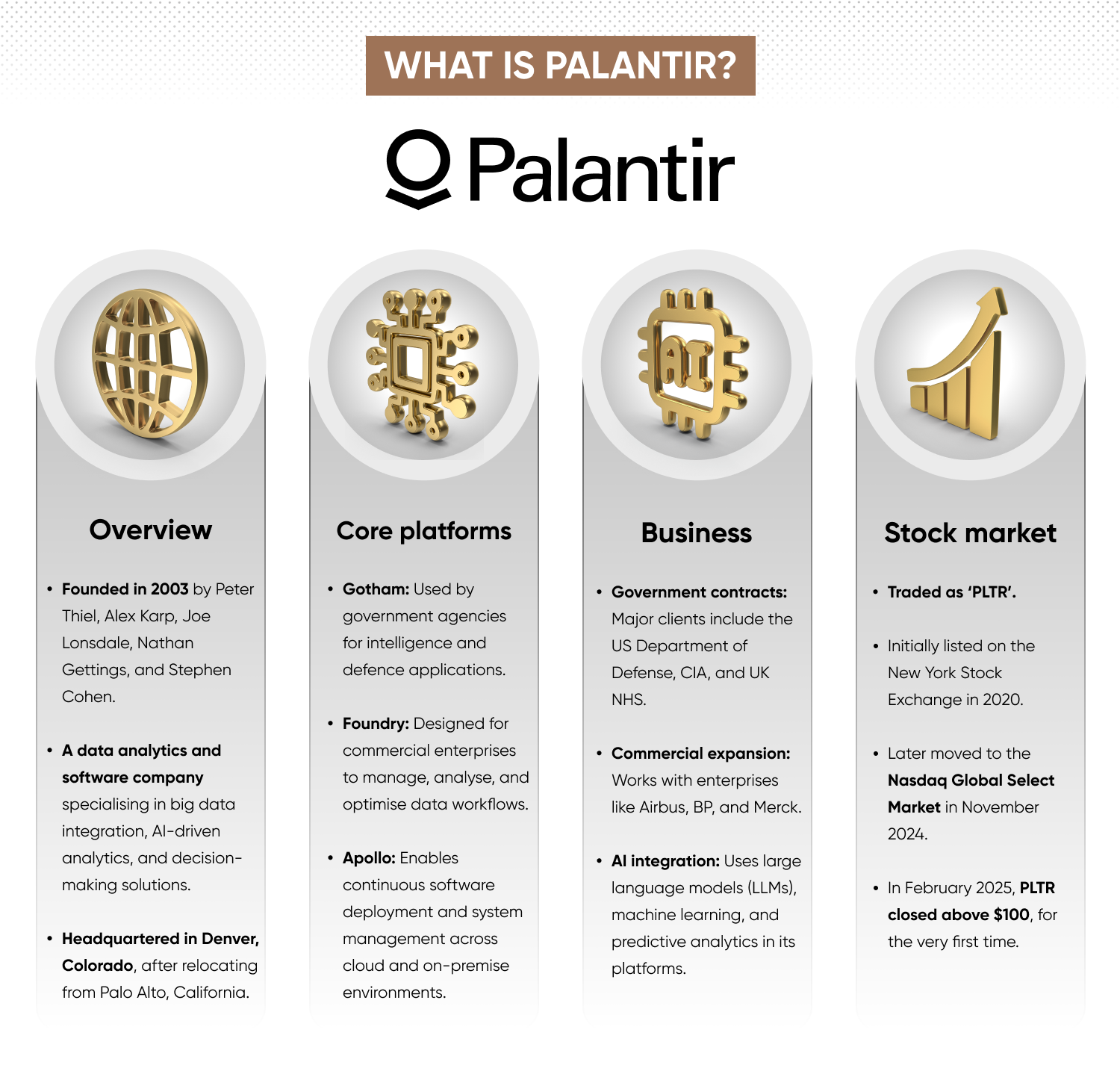
The Architecture of Intelligence: Gotham, Foundry, and Apollo
To understand how Palantir functions, one must examine its three primary software platforms. Each is designed for a specific environment, but all share a common philosophy: data is only useful when it is contextualized and accessible to the people who need it most.
Palantir Gotham: The Intelligence Specialist
Originally designed for the United States Department of Defense and the intelligence community, Palantir Gotham is built to find “needles in haystacks.” It excels at integrating disparate, unstructured data sources—such as satellite imagery, signal intelligence, and financial records—to identify hidden patterns and relationships.
Gotham’s power lies in its ability to facilitate “human-in-the-loop” analytics. It does not replace the analyst; rather, it empowers them by surfacing connections that would be impossible for a human to find manually. In a defense context, this might mean mapping out an insurgent network by connecting various data points across multiple theaters of operation.
Palantir Foundry: Bridging the Enterprise Gap
While Gotham was built for the battlefield, Palantir Foundry was built for the boardroom and the factory floor. Foundry is an end-to-end data integration and operations platform used by some of the world’s largest commercial entities, from Airbus to BP.
The challenge most corporations face is “data silos”—departments that use different software and storage methods that don’t communicate with each other. Foundry breaks these silos down by creating a “Data Ontology.” This ontology translates raw data into real-world concepts (like “Aircraft,” “Part,” or “Customer”) that business users can understand and manipulate without needing to write complex code. By providing a unified version of the truth, Foundry allows companies to optimize everything from inventory management to predictive maintenance.
Palantir Apollo: The Continuous Delivery Engine
Palantir Apollo is the often-invisible backbone that powers the other two platforms. In technical terms, Apollo is a continuous delivery and infrastructure management platform. It allows Palantir to deploy its software across diverse environments—whether that is a secure cloud, an on-premise server, or a “disconnected” edge device like a submarine or a satellite.
Apollo ensures that the software is always updated, secure, and functional, regardless of where it is running. This capability is what allows Palantir to operate in the most demanding and restricted environments on Earth, providing a level of reliability that traditional SaaS (Software as a Service) models often struggle to match.
Artificial Intelligence and the AIP Revolution
As the world enters the era of Generative AI and Large Language Models (LLMs), Palantir has positioned itself as a leader in operationalizing these technologies through its Artificial Intelligence Platform (AIP). While many companies are experimenting with AI in a sandbox, Palantir’s focus is on bringing AI into the “real world” where mistakes have high stakes.
Integrating Large Language Models (LLMs)
The primary challenge for enterprises using AI today is accuracy and security. A public LLM like ChatGPT might “hallucinate” or leak sensitive data. Palantir AIP solves this by allowing organizations to deploy LLMs within their own secure environment.
AIP connects these models directly to the organization’s private data via the Foundry or Gotham ontology. This means the AI isn’t just generating text based on the internet; it is analyzing the company’s specific live data to answer questions like, “Which of my suppliers are affected by the current hurricane, and what are my alternative shipping routes?”
Operationalizing AI in Real-World Environments
Palantir’s approach to AI is strictly focused on “Action.” It’s not enough for an AI to provide an insight; that insight must be translated into a decision. AIP allows users to build “Logic Blocks” and “Functions” that the AI can trigger.

For instance, in a medical logistics scenario, the AI could identify a shortage of critical supplies and automatically draft a procurement request or redirect a shipment. By keeping a human in the loop to approve these actions, Palantir provides a framework where AI can be used safely in mission-critical operations without surrendering total control to an algorithm.
Data Security, Privacy, and Ethical Guardrails
Given the sensitive nature of the work Palantir performs for governments and massive corporations, digital security and data privacy are not just features—they are the foundation of the technology. Palantir has long been at the center of the debate regarding data privacy, but its technical approach is often more rigorous than that of its peers.
Granular Access Controls and Audit Trails
One of the core tenets of Palantir’s tech stack is the concept of “Purpose-Based Access Control.” Unlike systems where an admin has access to everything, Palantir allows organizations to restrict data access at a granular level. A user can only see the specific data points required for their specific task.
Furthermore, every single action taken within a Palantir platform—every search, every click, and every data modification—is recorded in a permanent, immutable audit trail. This ensures total accountability. If data is misused, the system provides a clear record of who did what and when, making it an essential tool for compliance in highly regulated industries like finance and healthcare.
The Philosophy of Privacy-Preserving Technology
Palantir’s engineers have pioneered “Privacy-Preserving Analytics.” This involves techniques like data tagging and de-identification, which allow analysts to derive insights from a dataset without ever seeing the personally identifiable information (PII) of individuals.
The company argues that its software actually protects civil liberties by ensuring that government agencies are held to strict digital boundaries. By codifying laws and regulations directly into the data environment, Palantir ensures that the software itself prevents unauthorized or illegal data usage, moving beyond the “honor system” that often exists in traditional data management.
Industry Use Cases: From Defense to Global Logistics
The true value of Palantir is best understood through its applications. The software’s versatility allows it to solve problems that are vastly different in nature but identical in their underlying data complexity.
Transforming Military Operations and Strategy
In modern warfare, information is as important as ammunition. Palantir Gotham is used by defense forces to integrate data from the “edge”—sensors on drones, ground troops, and satellites. During the conflict in Ukraine, Palantir’s technology has been cited as a “game-changer,” enabling rapid targeting and situational awareness.
The software aggregates diverse streams of intelligence to provide commanders with a common operating picture. This allows for faster decision-making cycles, reducing the time it takes to identify a threat and respond to it, which is the cornerstone of modern electronic and algorithmic warfare.
Optimizing Supply Chains and Manufacturing
In the commercial sector, Palantir Foundry has become a staple for companies with massive, complex supply chains. During the COVID-19 pandemic, the UK’s National Health Service (NHS) used Palantir to manage the distribution of vaccines, ensuring that doses were sent where they were most needed based on real-time infection rates and hospital capacity.
Similarly, in the aerospace industry, Airbus uses Palantir to power “Skywise,” a data platform that connects thousands of aircraft around the world. By analyzing sensor data from planes in flight, Skywise can predict when a part is likely to fail before it actually does. This shift from reactive to predictive maintenance saves airlines millions of dollars in grounded flights and ensures higher safety standards for passengers.
Conclusion: The Future of the Data-Driven Era
Palantir is more than a software company; it is a manifestation of the shift toward “Software-Defined Operations.” In an era where the volume of data is exploding, the bottleneck for progress is no longer a lack of information, but a lack of integration and sense-making.
Through Gotham, Foundry, and the new AIP, Palantir provides the technical scaffolding for the world’s most important institutions to function in the 21st century. By focusing on the intersection of human intuition and algorithmic power, and by maintaining a rigorous focus on security and ethics, Palantir has defined a new category of technology. It is not just about knowing what is happening; it is about having the infrastructure to decide what to do next. As AI continues to evolve, Palantir’s role as the “operating system for the modern enterprise” is likely to become even more central to the global technological landscape.
aViewFromTheCave is a participant in the Amazon Services LLC Associates Program, an affiliate advertising program designed to provide a means for sites to earn advertising fees by advertising and linking to Amazon.com. Amazon, the Amazon logo, AmazonSupply, and the AmazonSupply logo are trademarks of Amazon.com, Inc. or its affiliates. As an Amazon Associate we earn affiliate commissions from qualifying purchases.