
Timing is one of the most critical variables in the world of finance. For investors and traders, understanding when the market open and close is not merely a matter of checking a clock; it is about recognizing the windows of peak liquidity, understanding when volatility is likely to spike, and managing the risks associated with global economic events. While the digital age allows for nearly instantaneous transactions, the traditional “ringing of the bell” still dictates the rhythm of the global economy.
This guide explores the intricate schedule of major financial markets, the nuances of extended-hours trading, and the strategic implications of market timing for your personal finance journey.
1. The Core Hours of Major Global Exchanges
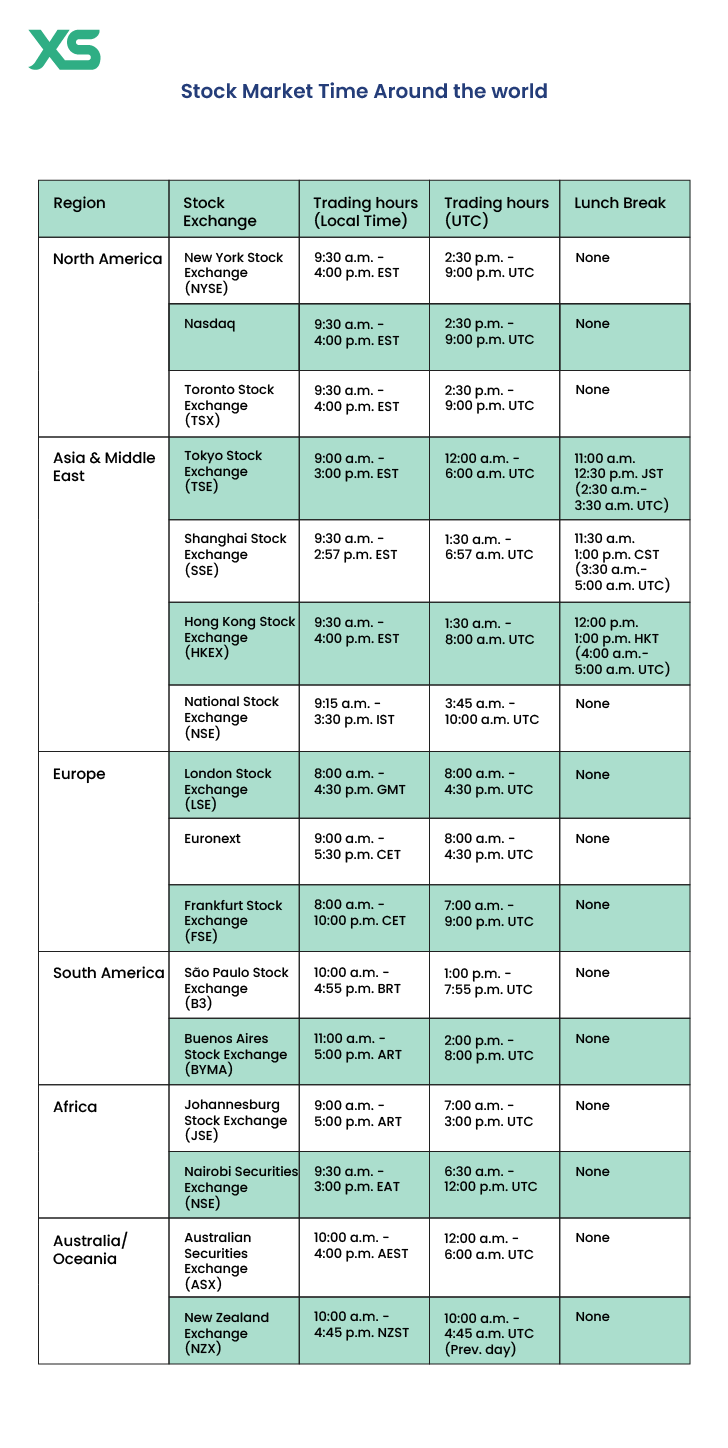
The foundation of the global financial system rests on several key exchanges, each operating within its own specific time zone. For the vast majority of retail investors, these “regular” trading hours are when the highest volume of trading occurs, ensuring that buy and sell orders are filled quickly at competitive prices.
The New York Stock Exchange (NYSE) and NASDAQ
The New York Stock Exchange and the NASDAQ are the two largest stock exchanges in the world. Located in the United States, they operate on Eastern Time (ET). Regular trading hours for both exchanges are Monday through Friday, from 9:30 AM to 4:00 PM ET.
The opening at 9:30 AM is characterized by a “price discovery” phase, where the market absorbs news that occurred overnight. The 4:00 PM close is equally significant, as it marks the moment when “closing prices” are set, which are used to value mutual funds and various institutional portfolios.
European Markets: The London Stock Exchange and Beyond
Europe operates on a different schedule that often overlaps with the U.S. morning session. The London Stock Exchange (LSE), one of the oldest and most influential exchanges, opens at 8:00 AM and closes at 4:30 PM local time (GMT/BST).
Other major European hubs, such as the Euronext Paris or the Deutsche Börse (DAX) in Germany, typically follow a similar schedule, opening at 9:00 AM and closing at 5:30 PM Central European Time (CET). For U.S.-based traders, the overlap between 9:30 AM ET and 11:30 AM ET represents a period of intense global liquidity, as both American and European markets are active simultaneously.
Asian Markets: Tokyo, Hong Kong, and Shanghai
The Asian markets kick off the global trading day. The Tokyo Stock Exchange (TSE) operates from 9:00 AM to 3:00 PM local time, but with a notable distinction: a “lunch break” from 11:30 AM to 12:30 PM.
The Hong Kong Stock Exchange (HKEX) and the Shanghai Stock Exchange also feature mid-day breaks. Understanding these breaks is essential for investors dealing in international equities, as trading halts completely during these intervals, unlike the continuous sessions found in Western markets.
2. Pre-Market and After-Hours Trading
In the modern era, the market never truly “sleeps.” While the physical floor of an exchange might close, electronic systems allow for extended-hours trading. This is often where the most dramatic price movements occur in response to corporate earnings or geopolitical shifts.
Understanding Electronic Communication Networks (ECNs)
Pre-market and after-hours trading are facilitated by Electronic Communication Networks (ECNs). These digital systems match buyers and sellers directly without the need for a traditional exchange floor. In the U.S., pre-market trading can begin as early as 4:00 AM ET, while after-hours trading typically runs from 4:00 PM to 8:00 PM ET.
Risks and Volatility in Extended Trading Sessions
While the ability to trade outside regular hours offers flexibility, it comes with significant risks. The primary concern is liquidity. During regular hours, millions of participants are active; during the “after-market,” there are far fewer. This lower volume leads to wider “bid-ask spreads”—the difference between what a buyer is willing to pay and what a seller is willing to accept. Consequently, an investor might end up paying a much higher price or receiving a lower one than they would during the day.
Furthermore, volatility is heightened. A single large trade can move the price of a stock significantly when there are fewer participants to absorb the impact. Most seasoned investors recommend using “limit orders” during these times to ensure they do not get caught in a disadvantageous price swing.
Why Institutional Investors Dominate the Off-Hours
Most major corporate events, such as quarterly earnings reports or CEO transitions, are announced either before 9:30 AM or after 4:00 PM. This is done to prevent immediate, knee-jerk reactions from disrupting the regular trading day. Institutional investors—hedge funds, pension funds, and large banks—use these hours to reposition their portfolios based on new data. For the retail investor, participating in these sessions requires a high degree of technical knowledge and risk tolerance.
3. Trading Holidays and Weekend Closures
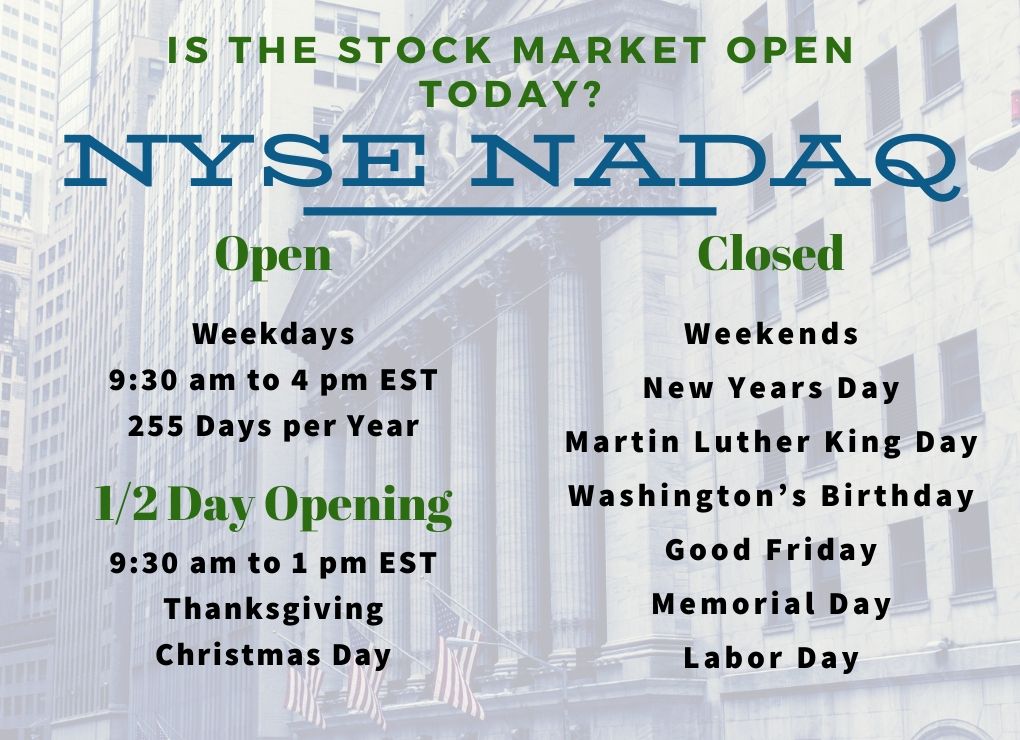
The rhythm of the market is also dictated by the calendar. Markets do not operate 24/7, and recognizing when the doors are closed for holidays is vital for cash flow management and trade planning.
Standard Weekend Policy for Equities
For almost all global stock exchanges, the market is closed on Saturdays and Sundays. This weekend break allows for the settlement of trades from the previous week and gives market participants a reprieve from the constant flow of data. While you can often place “queued” orders via your brokerage app on a Sunday, these orders will not be executed until the opening bell on Monday morning.
U.S. Federal Holidays and Early Closures
In the United States, the markets follow a holiday schedule that largely aligns with federal holidays. This includes:
- New Year’s Day
- Martin Luther King Jr. Day
- Presidents’ Day
- Good Friday
- Memorial Day
- Juneteenth
- Independence Day
- Labor Day
- Thanksgiving Day (with an early close on the following Friday)
- Christmas Day
On days like “Black Friday” (the day after Thanksgiving) or Christmas Eve, the market often has an early close at 1:00 PM ET. Being aware of these shortened sessions is important, as liquidity often dries up early, making it harder to exit large positions.
How Global Holidays Impact Liquidity
Because the financial world is interconnected, a holiday in one major economy can affect others. For instance, if the U.S. market is closed for Labor Day but the London Stock Exchange is open, global trading volume will be significantly lower. This “thin” market can lead to unusual price movements in multinational stocks or commodities, as the “anchor” of U.S. liquidity is absent.
4. Other Financial Markets: Crypto and Forex
If you find the strict hours of the stock market restrictive, you may be looking toward the Forex or Cryptocurrency markets. These sectors operate under entirely different paradigms regarding time.
The 24/7 Nature of Cryptocurrency Markets
Cryptocurrency is the only major asset class that truly never closes. Whether it is 3:00 AM on a Tuesday or mid-afternoon on Christmas Day, Bitcoin, Ethereum, and thousands of other digital assets are tradable. This 24/7/365 accessibility is a hallmark of the decentralized finance (DeFi) movement. However, it also means that “market-moving news” can happen at any time, requiring crypto investors to remain much more vigilant than traditional stock investors.
Foreign Exchange (Forex) Market Sessions
The Forex market is the largest and most liquid financial market in the world. It operates 24 hours a day, five days a week. It follows the sun around the globe, starting with the Sydney session on Sunday evening (U.S. time) and ending with the New York close on Friday evening.
The Forex market is generally divided into four major sessions:
- Sydney Session
- Tokyo Session
- London Session
- New York Session
The most significant movements in Forex usually occur during the “overlaps”—specifically the London/New York overlap—when the volume of currency being exchanged for international trade and investment is at its peak.
5. Strategic Considerations for Market Timing
Understanding when the market opens and closes is not just about logistics; it is a fundamental part of an investment strategy. Different times of the day offer different opportunities and threats.
The “Power Hour”: Why the Last 60 Minutes Matter
In the stock market, the “Power Hour” refers to the final hour of trading, from 3:00 PM to 4:00 PM ET. This is often the most volatile and high-volume period of the day. Day traders look to close out their positions, while institutional investors “rebalance” their holdings to match index changes. For many, the price action during this hour provides a signal for how the market will open the following day.
Market Open Dynamics and Price Discovery
The first 30 to 60 minutes after the 9:30 AM opening bell are often referred to as “amateur hour” by professional traders. This is because the market is reacting to all the news, rumors, and emotions that built up while the exchange was closed. Prices can swing wildly as the market works through a backlog of orders. For long-term investors, it is often wise to wait until this initial volatility subsides before entering or exiting a position.

The Impact of Time Zones on Your Portfolio
In our globalized economy, what happens at the Tokyo open can directly impact your portfolio in Chicago. For example, if a major Japanese tech company misses its earnings, it might cause a sell-off in U.S. tech futures long before the NYSE opens. Successful modern investors don’t just watch their local clock; they maintain a global perspective, recognizing that the “close” of one market is often just the “pre-game” for another.
By mastering the schedule of the global markets, you position yourself to make more informed, calculated decisions. Whether you are a long-term retirement saver or an active trader, knowing when the doors are open—and more importantly, what happens when they are closed—is a cornerstone of financial literacy.
aViewFromTheCave is a participant in the Amazon Services LLC Associates Program, an affiliate advertising program designed to provide a means for sites to earn advertising fees by advertising and linking to Amazon.com. Amazon, the Amazon logo, AmazonSupply, and the AmazonSupply logo are trademarks of Amazon.com, Inc. or its affiliates. As an Amazon Associate we earn affiliate commissions from qualifying purchases.