
For many individual investors, the world of high finance feels like a labyrinth of complex terminology and fluctuating numbers. However, one term stands out as the ultimate benchmark for financial health: the S&P 500. Often cited on nightly news broadcasts and analyzed by the world’s most successful hedge fund managers, the S&P 500 is more than just a list of companies; it is the pulse of the American economy and the primary vehicle through which millions of people build long-term wealth.
Decoding the S&P 500: What It Is and How It Works
The Standard & Poor’s 500, commonly known as the S&P 500, is a stock market index that tracks the performance of 500 of the largest companies listed on stock exchanges in the United States. While there are thousands of publicly traded companies, the S&P 500 represents approximately 80% of the total value of the U.S. equity market. Understanding its mechanics is the first step for anyone looking to master their personal finances.
The Definition of the Standard & Poor’s 500
Launched in its modern form in 1957 by the credit rating agency Standard & Poor’s, the index was designed to be a more comprehensive alternative to the Dow Jones Industrial Average (DJIA). Unlike the Dow, which only tracks 30 companies, the S&P 500 offers a broader view of the marketplace. It is a “float-adjusted market-capitalization-weighted” index. This means that the companies with the highest market values have the greatest impact on the index’s movements.
Market Capitalization Weighting Explained
In a market-cap-weighted index, size matters. To calculate a company’s market capitalization, you multiply its current share price by the number of outstanding shares. In the S&P 500, a 1% move in a trillion-dollar company like Apple or Microsoft will change the index’s value far more than a 1% move in a smaller constituent like a regional utility company. This structure ensures that the index reflects where the majority of investor capital is actually flowing, making it a realistic representation of the dominant forces in the business world.
The Selection Criteria: Who Makes the Cut?
Not just any company can join the S&P 500. Components are selected by a committee at S&P Dow Jones Indices. To be eligible, a company must be a U.S. corporation, have a market cap of at least several billion dollars, and maintain high liquidity. Crucially, a company must also demonstrate financial viability, defined as having positive earnings over the most recent quarter and the sum of the previous four quarters. This “quality filter” ensures that the index represents the elite tier of American enterprise.
Why the S&P 500 Matters to Your Personal Finances
For the average person, the S&P 500 isn’t just an abstract number; it is a critical tool for retirement planning and wealth accumulation. It serves as both a performance benchmark and a direct investment strategy.
A Barometer for the U.S. Economy
When people ask, “How is the market doing today?” they are usually referring to the S&P 500. Because the index spans all major sectors of the economy—from healthcare and energy to consumer staples and technology—it acts as a real-time thermometer for economic health. If the index is rising, it generally indicates investor confidence in corporate profitability and broader economic growth.
Historical Performance and Long-Term Wealth Building
Historically, the S&P 500 has provided an average annual return of approximately 10% before inflation. While the market does experience “bear markets” (periods of decline), the long-term trajectory of the S&P 500 has been consistently upward. For a personal finance enthusiast, this represents the power of compounding. An investment of $10,000 in an S&P 500 index fund, left untouched for 30 years with an average 10% return, would grow to over $174,000. This reliable growth is why financial experts often recommend it as the “core” of a diversified portfolio.
Dividends and Total Return
An often-overlooked aspect of the S&P 500 is its dividend yield. Many of the 500 constituent companies pay out a portion of their profits to shareholders. When investors talk about “total return,” they are combining the increase in share price (capital appreciation) with these dividend payments. For long-term investors, reinvesting these dividends can significantly accelerate the growth of their portfolio, turning a steady index into a powerhouse of passive income.
Diversification and Sector Allocation within the Index
One of the greatest benefits of the S&P 500 is “instant diversification.” Rather than betting your entire savings on a single company that could fail, the index spreads your risk across 500 different entities.

The Dominance of Information Technology
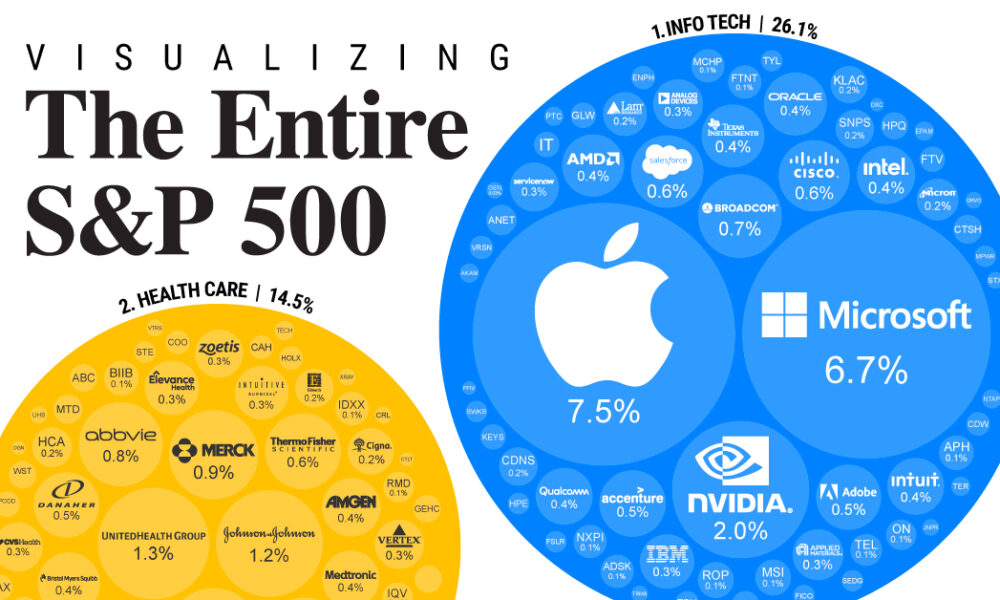
In recent decades, the composition of the S&P 500 has shifted dramatically. While industrial and manufacturing firms once ruled the index, the Information Technology sector now carries the heaviest weight. Companies that lead in software, hardware, and semiconductor production often dictate the daily swings of the index. This reflects the modern reality that the U.S. economy is increasingly driven by digital innovation.
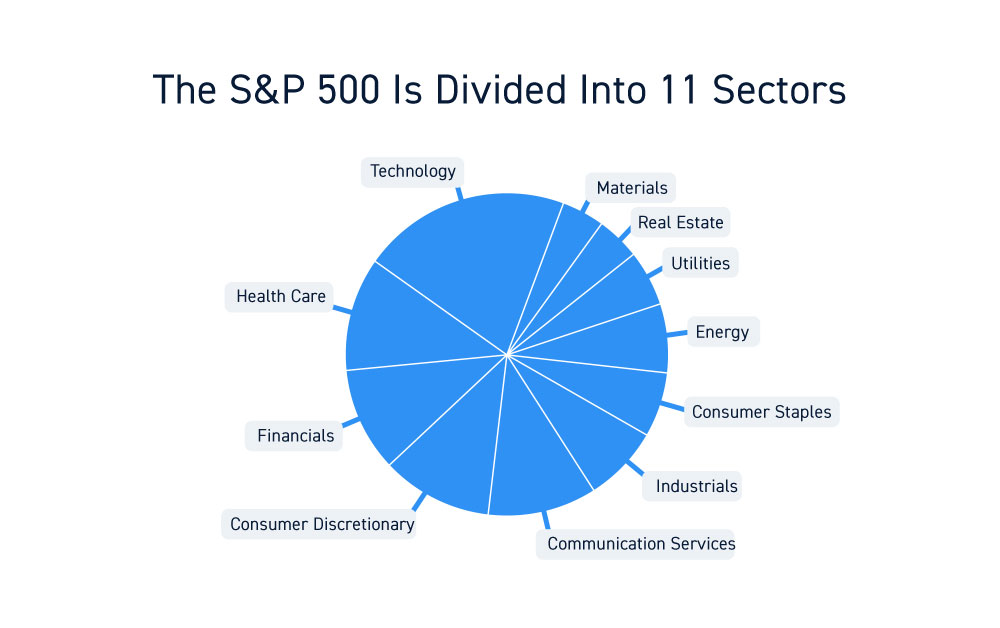
Balancing Risk Across 11 GICS Sectors
The S&P 500 is organized into 11 sectors based on the Global Industry Classification Standard (GICS). These include:
- Information Technology
- Health Care
- Financials
- Consumer Discretionary
- Communication Services
- Industrials
- Consumer Staples
- Energy
- Utilities
- Real Estate
- Materials
By holding all these sectors, an investor is protected. If the Energy sector suffers due to falling oil prices, the gains in the Technology or Healthcare sectors may offset those losses, providing a smoother ride for the investor’s capital.
Top Holdings: The Engines of the Index
To understand the S&P 500 today, one must look at its “top ten” holdings. These usually include household names like Amazon, Alphabet (Google), NVIDIA, and Berkshire Hathaway. Because these companies represent such a large portion of the index’s weight, their corporate earnings reports are the most anticipated events on the financial calendar. When these giants thrive, the “Money” category of the news cycle is usually filled with green arrows.
How to Invest in the S&P 500
Knowing what the S&P 500 is is only half the battle; the real value lies in knowing how to put your money into it. Fortunately, it is one of the most accessible investment vehicles in the world.
Index Funds vs. Exchange-Traded Funds (ETFs)
You cannot “buy” the S&P 500 directly because it is an index (a list). Instead, you buy a fund that mimics the index. There are two primary ways to do this:
- Index Mutual Funds: These are priced once at the end of the day and are often used in 401(k) plans.
- ETFs: These trade like stocks throughout the day. Popular examples include the SPDR S&P 500 ETF Trust (SPY) and the Vanguard S&P 500 ETF (VOO). ETFs are highly popular for their liquidity and ease of use in brokerage accounts.
The Role of Passive Investing
The S&P 500 is the poster child for “passive investing.” Instead of trying to “beat the market” by picking individual stocks—a feat that even professional fund managers struggle to achieve—passive investors simply aim to match the market. By buying the S&P 500, you are essentially betting on the continued success and innovation of the American corporate system as a whole.
Cost Considerations: Expense Ratios and Fees
One of the main reasons the S&P 500 is a favorite in the personal finance community is its low cost. Because a computer can manage the index by simply buying the 500 companies in their correct proportions, there is no need for expensive human stock-pickers. Many S&P 500 ETFs have “expense ratios” as low as 0.03%. This means for every $10,000 you invest, you only pay $3 a year in fees. Keeping costs low is one of the most effective ways to maximize your long-term returns.
Common Misconceptions and Risks to Consider
While the S&P 500 is a cornerstone of modern investing, it is not without its nuances and risks. A savvy investor must look beyond the surface level.
The S&P 500 is Not the Entire Market
A common mistake is assuming that the S&P 500 represents the entire stock market. It does not. It excludes small-cap and mid-cap companies, which often have higher growth potential (albeit with higher risk). Furthermore, it is strictly focused on U.S.-based companies. For a truly global “Money” strategy, investors often pair their S&P 500 holdings with international funds to capture growth in emerging markets and Europe.
Market Volatility and Drawdowns
Investing in the S&P 500 is not a “guaranteed” way to make money in the short term. The index can be volatile. In years like 2008 or 2020, the index saw significant drops in value. Personal finance success requires a “buy and hold” mentality. Those who panic-sell during a downturn often miss the subsequent recovery, which is where the real wealth is generated.
Concentration Risk in the Modern Era
In recent years, critics have pointed out that the S&P 500 is becoming “top-heavy.” Because the largest tech companies have grown so significantly, the top 7 to 10 companies now account for a record percentage of the index’s total value. This means that if the tech sector faces a specific regulatory or economic hurdle, the entire S&P 500 could suffer, even if the other 490 companies are doing well. This concentration risk is something every modern investor should monitor when building their portfolio.
Ultimately, the S&P 500 remains the most efficient and time-tested vehicle for participating in the growth of the world’s largest economy. Whether you are a novice starting your first side hustle or a seasoned professional managing a corporate budget, understanding this index is fundamental to achieving financial independence.
aViewFromTheCave is a participant in the Amazon Services LLC Associates Program, an affiliate advertising program designed to provide a means for sites to earn advertising fees by advertising and linking to Amazon.com. Amazon, the Amazon logo, AmazonSupply, and the AmazonSupply logo are trademarks of Amazon.com, Inc. or its affiliates. As an Amazon Associate we earn affiliate commissions from qualifying purchases.