
When investors, economists, and news anchors discuss “the market,” they are most often referring to the S&P 500. For decades, this index has served as the definitive barometer for the health of the United States economy and the primary vehicle for long-term wealth creation for millions of individuals. But what exactly are S&P 500 companies, and why does this specific collection of businesses carry so much weight in the world of finance?
The Standard & Poor’s 500, commonly known as the S&P 500, is a stock market index that tracks the performance of 500 of the largest companies listed on stock exchanges in the United States. It is not merely a list; it is a carefully curated representation of the American corporate landscape. Understanding the mechanics, the selection process, and the investment implications of the S&P 500 is fundamental for anyone looking to navigate the world of money and personal finance.

Defining the S&P 500: More Than Just a List of Companies
At its core, the S&P 500 is a float-adjusted, market-capitalization-weighted index. This means that the influence each company has on the index’s performance is proportional to its market value. While there are technically 503 components (due to some companies having multiple classes of shares), the index remains the primary gateway for investors to gain exposure to the U.S. equity market.
The Power of Market Capitalization Weighting
Unlike the Dow Jones Industrial Average, which is price-weighted (meaning a stock with a higher price has more influence regardless of the company’s size), the S&P 500 uses market capitalization. To calculate a company’s market cap, you multiply the current share price by the number of outstanding shares.
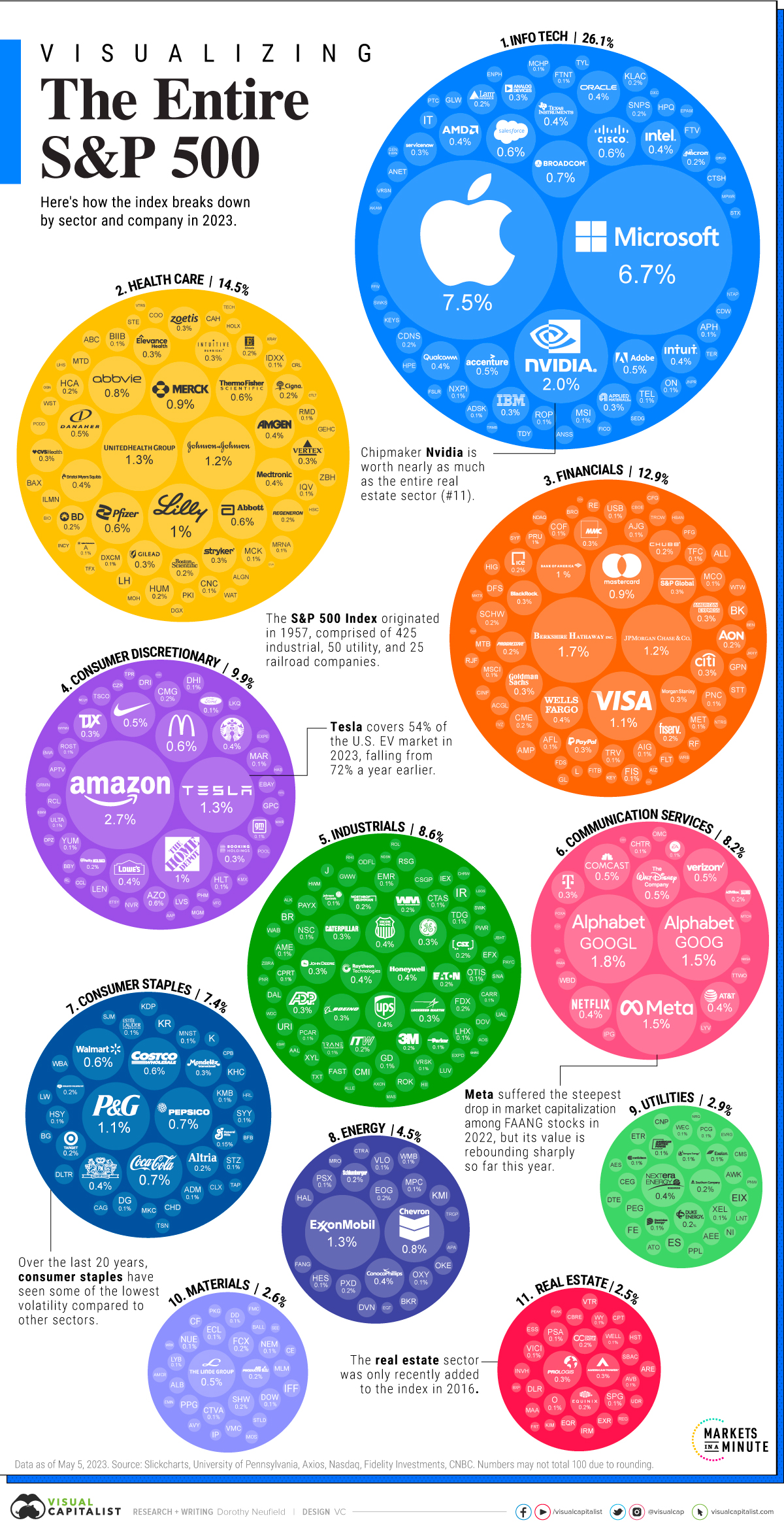
In a market-cap-weighted system, the “heavyweights”—such as Apple, Microsoft, Amazon, and Nvidia—exert a significant impact on the index’s daily movements. If these tech giants see a surge in value, the entire S&P 500 will likely rise, even if dozens of smaller companies in the index are stagnant. This structure ensures that the index reflects the actual economic footprint of the companies within it.
A Historical Perspective on Performance
Launched in its current form in 1957, the S&P 500 has weathered recessions, wars, and technological revolutions. Historically, it has provided an average annual return of approximately 10% before inflation. This consistent growth has made it the “gold standard” for measuring investment success. For most professional fund managers, the primary goal is to “beat the S&P 500,” a feat that is surprisingly difficult to achieve consistently over long periods.
Eligibility and Selection: How Companies Join the Elite 500
Entry into the S&P 500 is not automatic. A company does not simply become large enough and get a “participation trophy” entry. Instead, a committee at S&P Dow Jones Indices meets regularly to determine which companies are fit to represent the U.S. economy. This adds a layer of quality control that sets the S&P 500 apart from other broad market indices.
Strict Quantitative Requirements
To be considered for inclusion, a company must meet several rigorous financial hurdles. As of 2024, the primary criteria include:
- Market Capitalization: The company must have an unadjusted market cap of at least $15.8 billion (this threshold is adjusted periodically).
- Liquidity: The stock must be highly liquid, meaning it is easy to buy and sell in large volumes without drastically affecting the price.
- Public Float: At least 50% of the company’s shares must be available for public trading, ensuring that the index reflects the shares available to everyday investors rather than just those held by founders or insiders.
The Profitability and Sector Balance Factor
One of the most important rules for S&P 500 inclusion is the “earnings rule.” A company must report positive as-reported earnings over the most recent quarter, as well as the sum of the most recent four consecutive quarters. This rule protects the index from “speculative bubbles” or companies that have high valuations but no actual profits.
Furthermore, the committee seeks to maintain sector balance. They want the index to look like the U.S. economy. If the technology sector is growing, it will take up a larger portion of the index, but the committee also ensures representation in healthcare, consumer staples, energy, and industrials to provide a comprehensive view of national productivity.
Why the S&P 500 Matters to Every Investor
Whether you are a seasoned trader or someone with a modest 401(k), the S&P 500 affects your financial future. It serves two primary roles: a diagnostic tool for the economy and a foundation for investment portfolios.
A Barometer for the U.S. Economy
The S&P 500 covers approximately 80% of the available market capitalization in the United States. Because of this massive coverage, the movement of the index is often used as a proxy for the health of the “American Dream.” When the S&P 500 is in a “Bull Market” (rising prices), it typically signals corporate confidence, high consumer spending, and low unemployment. Conversely, a “Bear Market” (a drop of 20% or more) often precedes or accompanies economic contractions.
Diversification and Risk Management
For the individual investor, the S&P 500 offers “instant diversification.” Instead of betting your life savings on a single company that might go bankrupt, you are spreading your capital across 500 different businesses in 11 different sectors. While the index can still go down during market panics, the likelihood of all 500 of America’s strongest companies going to zero simultaneously is virtually non-existent. This makes it a cornerstone of modern portfolio theory.
Strategies for Investing in the S&P 500
The beauty of the S&P 500 is that you do not need to be a billionaire to own a piece of it. In the past, you would have had to buy shares of all 500 companies individually—a logistical and financial nightmare. Today, financial innovation has made it accessible to everyone.
Index Funds and ETFs
The most common way to invest in S&P 500 companies is through an Index Fund or an Exchange-Traded Fund (ETF). These funds are designed to mirror the performance of the index exactly.
- VOO (Vanguard S&P 500 ETF) and SPY (SPDR S&P 500 ETF Trust) are two of the most popular options.
- Low Expense Ratios: Because these funds are “passively managed” by computers rather than highly paid stock pickers, the fees (expense ratios) are incredibly low—often less than 0.05% per year. This ensures that more of the market’s gains stay in your pocket.
The Power of Long-term Compounding
The S&P 500 is best utilized as a long-term wealth-building tool. Through the power of compounding—where you earn returns on your previous returns—a steady monthly investment into an S&P 500 fund can grow exponentially over 20 or 30 years. When dividends are reinvested, the growth becomes even more aggressive, turning the S&P 500 into a passive income engine for retirement.
The Limitations and Risks of Index Investing
While the S&P 500 is a powerhouse, no investment is without risk. Relying solely on these 500 companies requires an understanding of the potential pitfalls inherent in the index’s design.
Concentration Risk in Mega-Cap Tech
Because the index is market-cap weighted, it has become increasingly “top-heavy.” In recent years, a handful of companies known as the “Magnificent Seven” (including Alphabet, Meta, and Tesla) have accounted for a disproportionate share of the index’s gains. If the tech sector faces a regulatory crackdown or a cyclical downturn, the entire S&P 500 can suffer, even if the other 490 companies are performing well. This is known as concentration risk.
The Vulnerability to Market Volatility
The S&P 500 is an equity index, which means it is subject to the whims of market sentiment. In years like 2008 or 2022, the index saw significant double-digit declines. For investors who are close to retirement and need to withdraw their money immediately, a sudden drop in the S&P 500 can be devastating. This highlights the importance of asset allocation—balancing S&P 500 stocks with bonds or cash to mitigate short-term volatility.

Conclusion: The S&P 500 as a Financial Foundation
The companies that make up the S&P 500 represent the pinnacle of corporate achievement. From the technology that powers our smartphones to the healthcare systems that save lives, these 500 entities are the driving force behind the modern economy.
For the person focused on “Money”—whether that means saving for a first home, building a college fund, or securing a comfortable retirement—the S&P 500 provides a transparent, low-cost, and historically proven path to success. By understanding how these companies are selected and how the index functions, you move from being a passive observer of the news to an active participant in the global economy. Investing in the S&P 500 is essentially a bet on human ingenuity and the long-term growth of the American business spirit—a bet that, over the long haul, has paid off for generations.
aViewFromTheCave is a participant in the Amazon Services LLC Associates Program, an affiliate advertising program designed to provide a means for sites to earn advertising fees by advertising and linking to Amazon.com. Amazon, the Amazon logo, AmazonSupply, and the AmazonSupply logo are trademarks of Amazon.com, Inc. or its affiliates. As an Amazon Associate we earn affiliate commissions from qualifying purchases.