
In the landscape of global commerce, few names carry as much weight as Amazon. What started as an ambitious online bookstore in a garage has evolved into a multi-trillion-dollar ecosystem that influences everything from cloud computing to grocery delivery. For investors, entrepreneurs, and financial analysts, the question “How much does Amazon make a year?” is more than just a curiosity—it is a study in business scaling, capital allocation, and market dominance.
As of the most recent fiscal year-end, Amazon’s financial performance continues to defy the laws of gravity for a company of its size. In 2023, Amazon reported a staggering total net sales revenue of approximately $574.8 billion, a 12% increase compared to the previous year. To put that in perspective, if Amazon were a country, its annual revenue would place it among the top 25 largest economies in the world. However, the true story of Amazon’s wealth lies not just in the top-line revenue, but in the diversified engines that drive its bottom-line profit.

1. Deconstructing the Revenue Streams: Where the Billions Come From
Amazon’s financial strength is built on a “flywheel” model where various business segments feed into one another. While most consumers interact with the front-end retail site, the company’s income is actually derived from several distinct, high-performing sectors.
Online Stores and Third-Party Seller Services
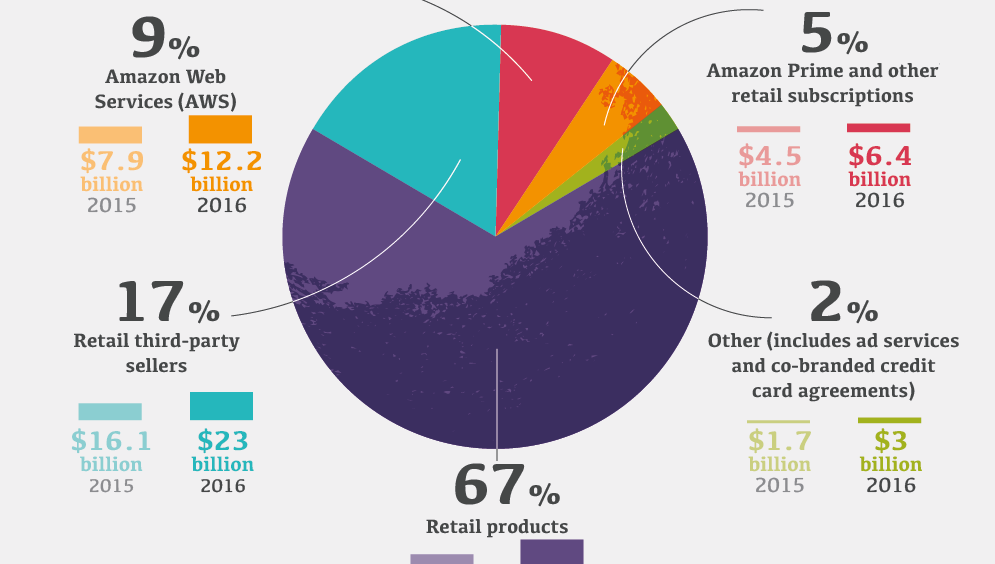
The core of Amazon’s identity remains its e-commerce platform. Direct sales (first-party) account for a massive portion of revenue, but the real growth engine in the retail space is Third-Party Seller Services. This includes commissions, shipping fees, and fulfillment fees charged to independent sellers. In recent years, third-party services have frequently outperformed Amazon’s own retail sales growth, highlighting the company’s transition from a merchant to a marketplace infrastructure.
Amazon Web Services (AWS): The Profit Engine
While the retail side generates the most volume, Amazon Web Services (AWS) is the undisputed champion of profitability. As the world’s leading cloud service provider, AWS offers computing power, database storage, and content delivery to millions of businesses. Financially, AWS is a marvel; despite contributing only about 14–16% of Amazon’s total revenue, it often accounts for over 60% of the company’s total operating income. The high margins associated with cloud infrastructure allow Amazon to reinvest billions back into its logistics and experimental projects.
Subscription Services and Advertising
Amazon Prime is a pillar of the company’s financial stability. With over 200 million members globally, the recurring revenue from Prime subscriptions provides a consistent cash flow that is less susceptible to seasonal shopping fluctuations. Furthermore, Amazon has quietly become an advertising titan. By leveraging its vast consumer data, Amazon’s advertising services now generate more annual revenue than the entire global newspaper industry, providing a high-margin stream that bolsters the company’s overall net income.
2. Profitability vs. Revenue: Understanding the Bottom Line
In the world of finance, revenue is vanity, and profit is sanity. For many years, Amazon was famous for reporting little to no profit because it chose to reinvest every cent into infrastructure, warehouses, and technology. Today, that strategy has shifted toward a more balanced approach to net income.
Net Income and Operating Margins
In 2023, Amazon’s net income saw a massive recovery, reaching $30.4 billion, a stark contrast to the net loss reported in 2022 (which was largely due to a valuation loss from its investment in Rivian). This swing illustrates the volatility that can occur when a company holds large stakes in other public entities. However, the operating margin—the profit a company makes on a dollar of sales after paying for variable costs of production—has been steadily improving as Amazon optimizes its fulfillment network and leans into its high-margin AWS and advertising sectors.
The Cost of Innovation and Logistics
To maintain its “Earth’s most customer-centric company” status, Amazon spends an astronomical amount on fulfillment and technology. Shipping costs alone run into the tens of billions annually. Furthermore, Amazon’s Research and Development (R&D) budget is consistently the highest of any corporation in the world. From AI development and robotics in warehouses to satellite internet (Project Kuiper), the company’s “spending” is better viewed as capital expenditure (CapEx) designed to secure future market share.
3. The Investor’s Perspective: Valuation and Market Performance
For those looking at Amazon through the lens of personal finance and investing, the company’s annual earnings are the primary driver of its stock price (AMZN). Understanding how to read these financial results is key to evaluating whether the stock belongs in a diversified portfolio.
Price-to-Earnings (P/E) and Growth Expectations
Amazon has historically traded at a high P/E ratio compared to traditional retail stocks like Walmart or Target. This is because investors are not just buying a retail company; they are buying a high-growth tech firm. When Amazon reports its yearly earnings, Wall Street looks closely at “Free Cash Flow.” This metric represents the cash a company generates after accounting for cash outflows to support operations and maintain its capital assets. For Amazon, a positive and growing free cash flow is often a more accurate indicator of financial health than simple net income.
The Impact of Macroeconomics on Earnings
Amazon’s annual earnings are a bellwether for the global economy. Rising interest rates and inflation can impact consumer spending habits, which in turn affects Amazon’s retail margins. Conversely, the “digital transformation” of businesses continues to provide a tailwind for AWS. Investors must weigh these macroeconomic factors against Amazon’s internal efficiency gains, such as its recent move to regionalize its shipping network, which significantly reduced the “cost to serve” each customer.
4. Future Financial Outlook: The Next Half-Trillion
Where will Amazon’s growth come from in the next decade? As the company approaches $1 trillion in annual revenue—a milestone once thought impossible—it is looking toward new sectors to maintain its momentum.
Artificial Intelligence and Machine Learning
Generative AI is the current frontier. Amazon is integrating AI across its entire business, from improving Alexa’s capabilities to optimizing logistics routes and offering “Bedrock” through AWS—a service that helps other companies build their own AI applications. The financial implication here is twofold: increased internal efficiency and a new, high-demand revenue stream for AWS.
Healthcare and Physical Stores
Amazon’s acquisition of One Medical and its expansion into Amazon Pharmacy signal a serious move into the multi-trillion-dollar healthcare industry. While healthcare currently represents a small fraction of Amazon’s annual take, the company is applying its “low cost, high efficiency” playbook to disrupt traditional medical models. Additionally, while Whole Foods and Amazon Fresh provide a physical footprint, the company continues to experiment with “Just Walk Out” technology to license to other retailers, turning a cost center into a potential software-as-a-service (SaaS) revenue stream.
Summary: A Financial Fortress
When we ask how much Amazon makes a year, the answer is a moving target that currently sits north of $570 billion. However, the true financial story is one of diversification. Amazon has successfully transitioned from a company that sells products to a company that provides the essential infrastructure for the modern economy.
For the student of business finance, Amazon serves as the ultimate case study in long-term thinking. By prioritizing customer experience and reinvesting in high-margin sectors like cloud computing and advertising, Amazon has built a financial fortress that generates massive liquidity. Whether you are an individual investor looking at AMZN stock or a business owner analyzing their marketplace model, the scale of Amazon’s annual earnings is a testament to the power of a well-executed, data-driven business strategy. As the company continues to evolve, its ability to turn massive revenue into sustainable profit will dictate its path toward becoming the most valuable company in history.
aViewFromTheCave is a participant in the Amazon Services LLC Associates Program, an affiliate advertising program designed to provide a means for sites to earn advertising fees by advertising and linking to Amazon.com. Amazon, the Amazon logo, AmazonSupply, and the AmazonSupply logo are trademarks of Amazon.com, Inc. or its affiliates. As an Amazon Associate we earn affiliate commissions from qualifying purchases.