
Navigating the landscape of used car financing can be a complex journey, especially with interest rates in constant flux. For many, a used car represents a practical and financially sensible transportation solution, but the actual cost extends far beyond the sticker price. The interest rate you secure on your used car loan significantly impacts your monthly payments, the total amount you repay over the life of the loan, and ultimately, your financial well-being. Understanding current market conditions, the factors influencing these rates, and strategies to secure the most favorable terms is paramount for any savvy car buyer.

This comprehensive guide delves into the current state of used car interest rates, offering insights into what drives them, how they affect your purchase, and actionable advice to help you make an informed decision in today’s dynamic economic environment. Whether you’re a first-time buyer or looking to upgrade, grasping the nuances of used car financing is your first step towards a financially sound purchase.
Understanding Used Car Interest Rates
Interest rates are not static; they fluctuate based on a multitude of economic indicators and individual borrower profiles. For used cars, these rates often carry a slightly higher premium compared to new car loans, reflecting a perceived higher risk for lenders due to factors like vehicle age, mileage, and depreciation. However, even within the used car market, there’s a wide spectrum of rates available.
The Macroeconomic Factors Driving Interest Rates
At a foundational level, used car interest rates are heavily influenced by broader macroeconomic conditions, primarily the monetary policy set by central banks like the Federal Reserve in the United States. When the Fed raises its benchmark interest rate (the federal funds rate), it becomes more expensive for banks to borrow money, a cost that is then passed on to consumers in the form of higher interest rates for various loans, including auto loans.
- Federal Reserve Policy: The Fed’s decisions to raise or lower interest rates in response to inflation, employment figures, and overall economic health directly impact lending costs across the board. In periods of high inflation, the Fed often increases rates to cool down the economy, leading to higher auto loan rates.
- Inflation: High inflation erodes the purchasing power of money, prompting lenders to demand higher interest rates to compensate for the reduced value of future repayments. This is a critical factor in the current economic climate.
- Economic Outlook: The general health and stability of the economy also play a role. During periods of economic uncertainty or recession, lenders may become more cautious, potentially tightening lending standards and increasing rates for riskier borrowers.
How Lenders Determine Your Individual Rate
While macroeconomic factors set the baseline, your personal financial profile is the most significant determinant of the specific interest rate you’ll be offered. Lenders assess risk based on several key metrics, aiming to predict your ability and likelihood to repay the loan.
- Credit Score: This is arguably the most crucial factor. A higher credit score (typically FICO scores above 700) signals to lenders that you are a responsible borrower with a history of on-time payments, leading to lower interest rates. Conversely, a lower credit score indicates higher risk and will result in a higher interest rate.
- Loan Term: The length of your loan, often expressed in months (e.g., 36, 48, 60, 72 months), impacts your rate. Shorter loan terms typically come with lower interest rates because the lender’s money is tied up for a shorter period, reducing their risk exposure. However, shorter terms mean higher monthly payments.
- Down Payment Amount: A substantial down payment reduces the loan amount, thereby lowering the lender’s risk. This often translates into a lower interest rate offer, as you have more equity in the vehicle from the outset.
- Vehicle Age and Mileage: Lenders also consider the specifics of the used car itself. Older vehicles with higher mileage are perceived as having a greater risk of mechanical issues and faster depreciation, which can lead to higher interest rates compared to newer used cars.
- Debt-to-Income (DTI) Ratio: This ratio compares your total monthly debt payments to your gross monthly income. A lower DTI indicates that you have more disposable income to cover your loan payments, making you a more attractive borrower.
Navigating the Current Market Landscape
The auto loan market is currently experiencing significant shifts, largely driven by persistent inflation and the Federal Reserve’s response to it. Understanding these current conditions is essential for setting realistic expectations.
Average Rates Today: What to Expect
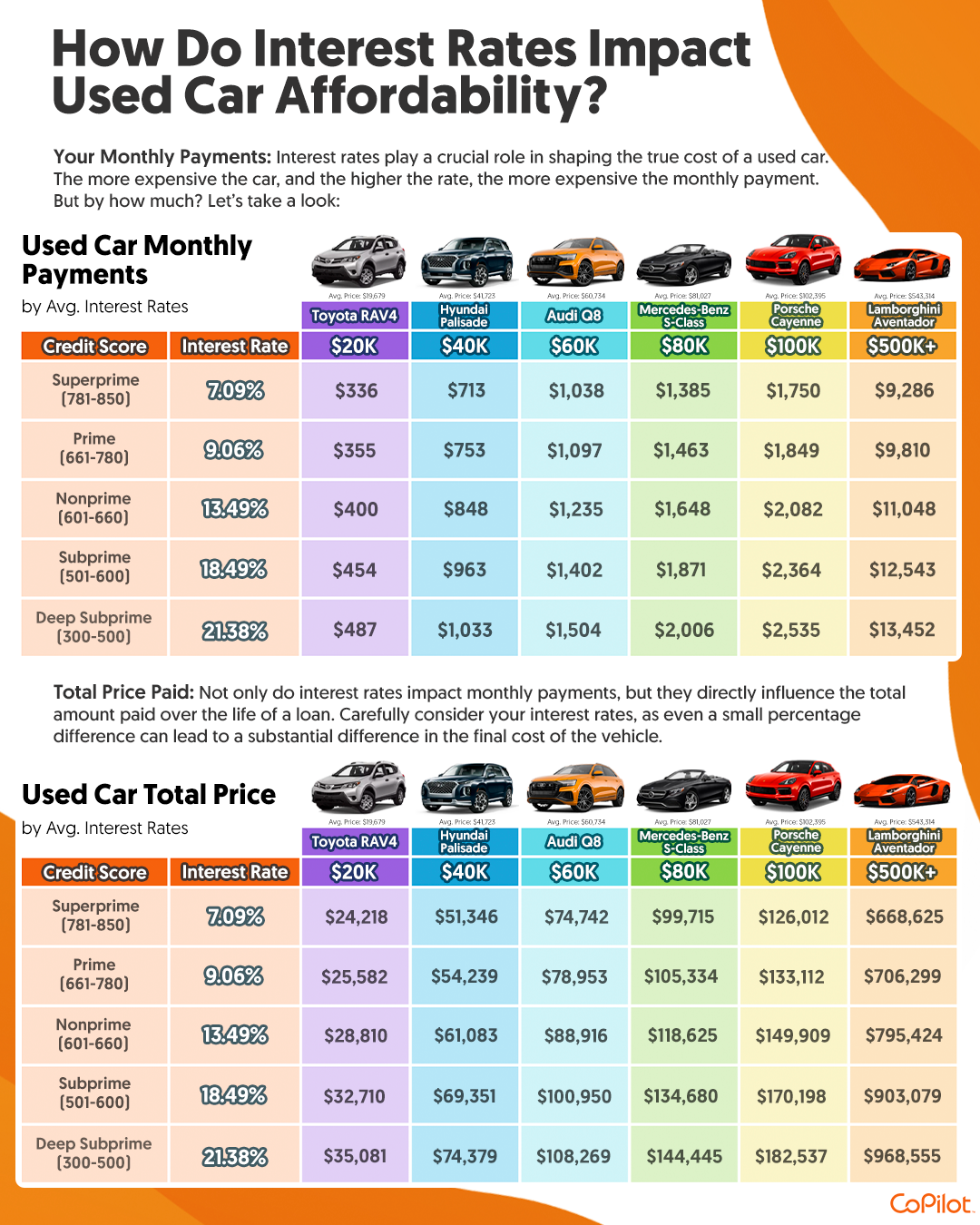
As of late 2023 and early 2024, used car interest rates have generally seen an upward trend compared to previous years. While exact rates vary wildly based on the factors discussed above, buyers with excellent credit (FICO score 720+) might expect rates anywhere from 6% to 9% for a used car loan. For those with good credit (660-719), rates could range from 9% to 13%. Borrowers with fair or poor credit (below 660) might encounter rates significantly higher, potentially reaching 15% to 25% or even more, if they qualify at all.
It’s important to remember these are broad averages. Specific rates can depend on the lender (banks, credit unions, dealership financing), the state, and the precise details of the vehicle and loan term.
The Impact of Inflation and Economic Uncertainty
High inflation has been a dominant theme in recent years, prompting central banks to aggressively raise interest rates. This direct correlation means that auto loan rates have climbed significantly. This economic environment also introduces a degree of uncertainty. Consumers might be more cautious about taking on new debt, and lenders might tighten their approval criteria, especially for longer loan terms or less creditworthy borrowers.
- Increased Borrowing Costs: The most immediate impact is the higher cost of borrowing. A higher interest rate means a larger portion of your monthly payment goes towards interest, not principal, increasing the total cost of the car.
- Affordability Challenges: For many, elevated interest rates, combined with still-high used car prices (though they are moderating), make car ownership less affordable. This might push some buyers towards older models, smaller loans, or delaying their purchase.
- Loan Term Extension: To keep monthly payments manageable in the face of higher rates, some buyers might be tempted to extend their loan terms to 72 or even 84 months. While this lowers the monthly burden, it dramatically increases the total interest paid over the life of the loan and increases the risk of being “upside down” (owing more than the car is worth).
Strategies for Securing a Favorable Rate
Even in a high-interest-rate environment, there are proactive steps you can take to improve your chances of securing the best possible used car loan rate. Financial preparation is key to minimizing your borrowing costs.
Boosting Your Credit Score
Your credit score is your financial report card. Improving it can shave significant percentage points off your interest rate.
- Review Your Credit Report: Obtain free copies of your credit report from the three major bureaus (Experian, Equifax, TransUnion) via annualcreditreport.com. Correct any errors or inaccuracies.
- Pay Bills on Time: Payment history is the biggest factor in your credit score. Make all payments on time, every time.
- Reduce Existing Debt: Lowering your credit utilization ratio (the amount of credit you’re using versus your total available credit) can quickly boost your score. Pay down credit card balances.
- Avoid New Credit Inquiries: Don’t open new credit accounts or apply for multiple loans in the months leading up to your car purchase, as this can temporarily lower your score.
The Power of a Substantial Down Payment
A larger down payment is a win-win. It reduces the amount you need to borrow and signals to lenders that you’re a lower risk.
- Lower Loan Amount: Less borrowed money means less interest accrued, even if the rate remains the same.
- Reduced Risk for Lender: When you have more equity in the car from day one, lenders are more confident in your commitment and ability to repay. This often translates to a better rate.
- Avoid Being Upside Down: A significant down payment helps prevent you from owing more than the car is worth, especially given the rapid depreciation of used cars. Aim for at least 10-20% if possible.
Shopping Around for Lenders
Never accept the first loan offer you receive, especially from a dealership. Comparison shopping is crucial.
- Pre-Approval from Multiple Sources: Apply for pre-approval from several different financial institutions – banks, credit unions, and online lenders – before you even step onto a dealership lot. This allows you to compare offers objectively without sales pressure.
- Credit Unions Often Offer Better Rates: Credit unions are member-owned and often have lower overheads, allowing them to offer more competitive rates than traditional banks.
- Online Lenders: Fintech companies and online lenders can also be competitive, offering streamlined application processes and potentially unique loan products.
- Negotiate with the Dealership: Once you have pre-approval offers in hand, you can use them as leverage to negotiate a better rate with the dealership’s finance department. They may be able to match or beat external offers to secure your business.
Consider Shorter Loan Terms
While longer loan terms (60-84 months) offer lower monthly payments, they come at the cost of significantly more interest paid over time and higher interest rates.
- Save on Total Interest: A 36- or 48-month loan term, if affordable, will drastically reduce the total interest you pay.
- Lower Interest Rate: Lenders typically offer lower interest rates for shorter terms because their risk exposure is reduced.
- Faster Equity Build-up: You’ll build equity in your car much faster, reducing the risk of being upside down on your loan.
The Long-Term Impact of Your Interest Rate
The interest rate you secure on your used car loan doesn’t just affect your monthly budget; it has profound long-term implications for your financial health and the true cost of vehicle ownership.
Calculating Your Total Cost of Ownership
It’s easy to focus solely on the monthly payment, but the total amount you will repay over the loan’s lifetime provides a clearer picture of the car’s real cost. Even a seemingly small difference in interest rate can add up to hundreds or thousands of dollars over several years.
- Example Scenario: Consider a $20,000 used car loan over 60 months.
- At an 8% interest rate, your monthly payment might be around $405, and you’d pay approximately $4,286 in total interest.
- At a 12% interest rate, your monthly payment jumps to roughly $445, and your total interest paid skyrockets to about $6,677.
- This $40 difference in monthly payment translates to nearly $2,400 more in interest over the life of the loan.
Understanding this calculation empowers you to make decisions that protect your finances. Utilize online auto loan calculators to model different scenarios with varying rates and terms.
Refinancing Options
The good news is that your initial interest rate isn’t necessarily set in stone forever. If interest rates drop, your credit score improves, or you simply find a more favorable offer, refinancing your used car loan can be a strategic move.
- Lower Monthly Payments: Refinancing to a lower interest rate can reduce your monthly outlay, freeing up cash for other financial goals.
- Reduce Total Interest Paid: A lower rate directly translates to less interest paid over the remaining term of the loan.
- Adjust Loan Term: You might also refinance to a shorter or longer term, depending on your current financial situation and goals (e.g., shorten the term to pay off faster, or lengthen it to reduce high monthly payments if absolutely necessary).
- When to Consider Refinancing: Keep an eye on market interest rates and your credit score. If rates have fallen significantly since you bought your car, or if your credit score has improved substantially, exploring refinancing options could save you a considerable amount of money.
Future Outlook and Expert Advice
The used car market and its associated financing rates are dynamic. Staying informed and prepared is the best approach.
What to Watch For
- Federal Reserve Announcements: Pay attention to news regarding the Federal Reserve’s monetary policy meetings and announcements about future interest rate hikes or cuts. These are strong indicators of where auto loan rates are headed.
- Inflation Reports: Regular inflation reports (like the Consumer Price Index, CPI) provide insights into the economic pressures that influence the Fed’s decisions and, by extension, auto loan rates.
- Used Car Market Trends: While interest rates are key, keep an eye on used car prices themselves. As inventory levels improve and demand moderates, prices may continue to stabilize or even fall, further impacting affordability.

Key Takeaways for Buyers
- Prioritize Your Credit: Focus on building and maintaining a strong credit score as your primary lever for securing the best rates.
- Save for a Down Payment: The more you put down, the less you borrow, and the better your chances for a favorable interest rate.
- Shop Smart for Lenders: Never rely on a single loan offer. Get pre-approved from multiple financial institutions to compare terms effectively.
- Understand Total Cost: Look beyond the monthly payment to the total interest you’ll pay over the life of the loan.
- Don’t Rush: Take your time to research both the car and the financing options. A well-planned purchase is a financially sound purchase.
In conclusion, current used car interest rates reflect a complex interplay of macroeconomic forces and individual financial profiles. While rates have been elevated, informed buyers who prioritize their financial preparation and engage in thorough comparison shopping can still navigate the market effectively to secure a loan that aligns with their budget and financial goals.
aViewFromTheCave is a participant in the Amazon Services LLC Associates Program, an affiliate advertising program designed to provide a means for sites to earn advertising fees by advertising and linking to Amazon.com. Amazon, the Amazon logo, AmazonSupply, and the AmazonSupply logo are trademarks of Amazon.com, Inc. or its affiliates. As an Amazon Associate we earn affiliate commissions from qualifying purchases.