
The world of cryptocurrency can seem daunting, a complex landscape of digital assets, blockchain technology, and volatile markets. For many, the question “how do I buy XRP?” is more than a simple transaction query; it’s an entry point into understanding a significant player in the digital finance ecosystem. XRP, a cryptocurrency created by Ripple Labs, is designed to facilitate fast, low-cost international payments, positioning itself as a challenger to traditional banking infrastructure. Its unique utility and turbulent regulatory journey have made it a focal point for investors seeking diversification in their digital portfolios. This guide will meticulously walk you through the process of acquiring XRP, from understanding its fundamentals to navigating the practical steps of purchase and secure storage, all while grounding your decisions in sound financial principles.

Understanding XRP: More Than Just a Cryptocurrency
Before diving into the mechanics of purchase, it’s crucial to understand what XRP is, its purpose, and its distinct characteristics within the broader cryptocurrency market. This foundational knowledge empowers you to make informed investment decisions, rather than merely following a trend.
What is XRP and Why Was it Created?
XRP is the native digital asset of the XRP Ledger, an open-source, permissionless, and decentralized blockchain technology. It was created by Ripple Labs Inc. (formerly OpenCoin) in 2012 with a specific mission: to revolutionize global payments. Unlike Bitcoin, which aims to be a decentralized digital currency, or Ethereum, which powers smart contracts and dApps, XRP’s primary utility is to serve as a bridge currency for international transactions. Its design allows for near-instant settlements and extremely low transaction fees, making it an attractive alternative for financial institutions, payment providers, and individuals looking to move value across borders efficiently. The underlying vision is to provide a real-time global settlement system that is faster, cheaper, and more reliable than traditional banking rails like SWIFT.
Key Characteristics and Use Cases
XRP possesses several distinctive features that set it apart. Firstly, its transaction speed is remarkable, with payments typically settling in 3-5 seconds, a stark contrast to the days or even weeks required by conventional cross-border transfers. Secondly, transaction fees are negligible, often fractions of a cent, making micro-payments economically viable. Thirdly, XRP is pre-mined; all 100 billion XRP tokens were created at inception, with Ripple controlling a significant portion held in escrow. This pre-mined nature means no new XRP can be generated through mining, differentiating it from proof-of-work cryptocurrencies.
Its main use case, as mentioned, is facilitating international remittances and liquidity for financial institutions. For example, a bank in country A wanting to send money to a bank in country B can convert its fiat currency into XRP, send the XRP across the ledger, and then the receiving bank converts the XRP into its local fiat currency. This bypasses the need for costly nostro/vostro accounts and pre-funded liquidity, significantly streamlining the process. Beyond institutional use, individuals can also use XRP for fast, inexpensive transfers, and it is sometimes accepted as payment by a growing number of merchants.
XRP’s Market Position and Volatility
Over the years, XRP has consistently ranked among the top cryptocurrencies by market capitalization. Its value is influenced by a myriad of factors, including broader cryptocurrency market trends, macroeconomic conditions, technological developments on the XRP Ledger, adoption by financial institutions, and, critically, regulatory news. Like most cryptocurrencies, XRP is subject to significant price volatility. Investors must be prepared for potential rapid price swings, both upward and downward. Understanding this inherent volatility is paramount for anyone considering an investment, aligning with the principle that high potential returns often come with high risks.
Navigating the Regulatory Landscape: The SEC vs. Ripple Lawsuit
Perhaps no other factor has shaped XRP’s journey and investor sentiment as profoundly as the ongoing legal battle between Ripple Labs and the U.S. Securities and Exchange Commission (SEC). This lawsuit has had far-reaching implications, impacting XRP’s availability, price, and the overall regulatory clarity for the cryptocurrency market.
The Core of the Legal Challenge
In December 2020, the SEC filed a lawsuit against Ripple Labs and two of its executives, alleging that they conducted an unregistered securities offering by selling XRP to retail investors. The SEC contended that XRP itself is an investment contract and thus a security, falling under its jurisdiction. Ripple Labs vehemently denied these allegations, arguing that XRP is not a security but rather a utility token used for payments, and that the SEC’s actions have caused significant harm to XRP holders and market participants. The core of the dispute revolves around the application of the Howey Test, a legal precedent used to determine whether a transaction qualifies as an “investment contract.”
Impact on XRP’s Availability and Price
The immediate aftermath of the SEC lawsuit was tumultuous for XRP. Major cryptocurrency exchanges based in the U.S., including Coinbase, Kraken, and Binance.US, delisted XRP or suspended its trading for their U.S. customers to avoid potential legal repercussions. This significantly restricted U.S. investors’ ability to buy or sell XRP, leading to a sharp decline in its price and market liquidity. However, outside the U.S., trading continued largely unimpeded on global exchanges.
As the lawsuit progressed, particularly with favorable rulings for Ripple in mid-2023, many exchanges began to relist XRP for U.S. customers, leading to a substantial price recovery and renewed investor interest. This legal saga underscored the profound impact that regulatory uncertainty can have on digital assets and demonstrated the market’s sensitivity to legal outcomes. The case is still ongoing (as of early 2024 for a complete resolution, though key summary judgment decisions have been rendered), and its final outcome will undoubtedly set precedents for how other cryptocurrencies are classified and regulated in the United States.
Implications for Investors
For current and prospective XRP investors, the lawsuit highlights the critical importance of understanding regulatory risk. While the recent rulings have brought some clarity and optimism, the regulatory environment for cryptocurrencies remains dynamic and fragmented globally. Investors must stay informed about legal developments, not just for XRP but for the broader crypto market. The legal uncertainty emphasizes that investing in cryptocurrency involves not only market risk but also significant regulatory risk, which can directly affect access to markets, liquidity, and asset value. It is prudent to consider the potential for future regulatory shifts and their impact on your investment strategy.
Step-by-Step Guide to Acquiring XRP
With a foundational understanding of XRP and its regulatory context, you’re ready to explore the practical steps involved in purchasing this digital asset. This process is generally straightforward but requires attention to detail regarding security and regulatory compliance.
Choosing a Reputable Cryptocurrency Exchange
The first and most crucial step is selecting a reliable cryptocurrency exchange. These platforms act as intermediaries, allowing you to buy, sell, and trade various digital assets. For XRP, especially in the U.S., availability has fluctuated due to the SEC lawsuit, making careful selection even more important.
When choosing an exchange, consider the following factors:
- Regulation and Compliance: Prioritize exchanges that adhere to strict regulatory standards in their operating jurisdictions. This often means they comply with KYC (Know Your Customer) and AML (Anti-Money Laundering) procedures, offering a layer of consumer protection.
- XRP Availability: Double-check if the exchange explicitly supports XRP trading in your region, particularly if you are in the U.S. Post-SEC lawsuit, many exchanges like Coinbase, Kraken, Uphold, and eToro have relisted XRP, but it’s always best to verify.
- Security Measures: Look for exchanges with robust security protocols, including two-factor authentication (2FA), cold storage for a significant portion of assets, insurance policies, and a strong track record of protecting user funds.
- Fees: Compare trading fees (taker/maker fees), deposit fees, and withdrawal fees. These can vary significantly between platforms and impact your overall cost.
- User Interface and Support: An intuitive interface and responsive customer support can greatly enhance your trading experience, especially for beginners.
- Payment Methods: Ensure the exchange supports your preferred method for funding your account (bank transfer, debit/credit card, etc.).
Popular choices that have historically supported or relisted XRP include Coinbase, Kraken, Uphold, and eToro. Research each thoroughly to find the best fit for your needs.
Account Creation and Verification
Once you’ve selected an exchange, you’ll need to create an account. This typically involves:
- Signing Up: Providing an email address and creating a strong password.
- Email Verification: Confirming your email address through a link sent to your inbox.
- Two-Factor Authentication (2FA): Setting up 2FA using an authenticator app (like Google Authenticator or Authy) or SMS. This is a critical security step and should never be skipped.
- Identity Verification (KYC/AML): To comply with financial regulations and prevent fraud, exchanges require you to verify your identity. This usually involves:
- Submitting personal details (full name, date of birth, address).
- Uploading government-issued ID (passport, driver’s license).
- Often, a “selfie” or live video verification to confirm you are the person on the ID.
This KYC process can take anywhere from a few minutes to several days, depending on the exchange and the volume of applications. It is a necessary step to unlock full trading capabilities.
Funding Your Account
After your account is verified, you’ll need to deposit funds to purchase XRP. Exchanges offer various deposit methods:
- Bank Transfer (ACH/SEPA/Wire): This is often the most cost-effective method, though it can take a few business days for funds to clear.
- Debit/Credit Card: Offers instant deposits but typically comes with higher fees due to processing costs.
- Peer-to-Peer (P2P): Some exchanges offer P2P options where you can buy crypto directly from other users using various payment methods.
- Cryptocurrency Deposit: If you already own other cryptocurrencies, you can often deposit them into the exchange and then trade them for XRP.
Choose the method that balances speed, cost, and convenience for your situation.
Placing Your XRP Buy Order
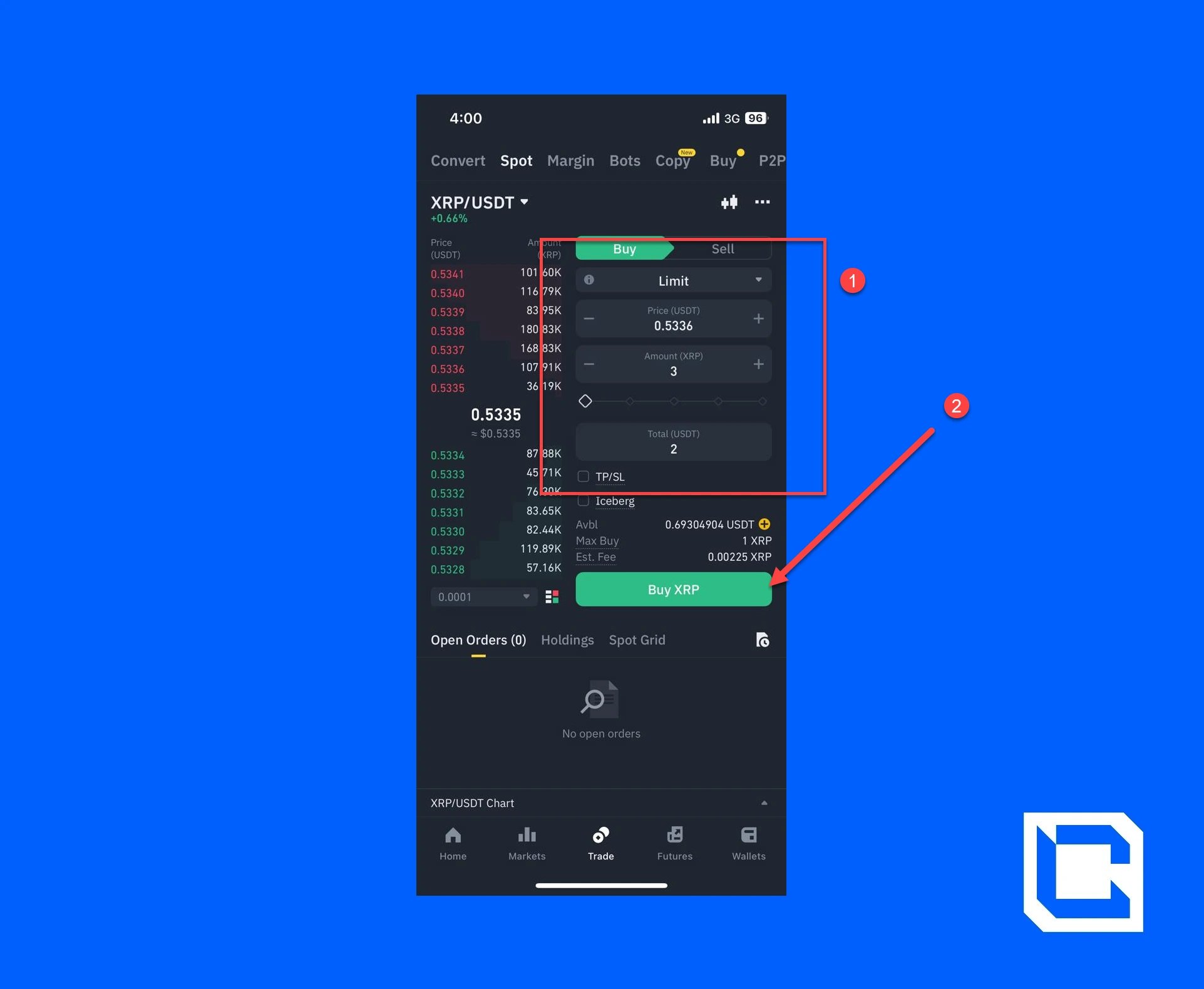
With funds in your account, you are ready to buy XRP. Navigate to the trading section of the exchange and search for the XRP trading pair you wish to use (e.g., XRP/USD, XRP/EUR, XRP/BTC).
You’ll generally have two primary order types:
- Market Order: This is the simplest way to buy XRP. You specify the amount of fiat currency (e.g., $100) or the quantity of XRP you want, and the exchange executes the order immediately at the best available market price. While quick, the final price might slightly differ from what you saw due to market fluctuations and the “spread” (difference between bid and ask prices).
- Limit Order: This gives you more control over the price. You specify the maximum price you are willing to pay per XRP. The order will only execute if and when the market price reaches your specified limit or a better price. Limit orders are useful for precision but may not execute immediately if your desired price isn’t met.
For beginners, a market order is generally sufficient to get started. Review your order details carefully before confirming the purchase. Once confirmed, your XRP will appear in your exchange wallet.
Securely Storing Your XRP After Purchase
Acquiring XRP is only half the battle; securely storing your assets is equally, if not more, critical. “Not your keys, not your crypto” is a fundamental mantra in the digital asset space, emphasizing the importance of holding your private keys.
Why Secure Storage Matters
Storing your cryptocurrency securely protects it from various threats, including exchange hacks, phishing scams, malware, and even simple loss or theft. While exchanges offer custodial wallets, entrusting a third party with your assets introduces a layer of risk. True ownership in crypto means having control over your private keys.
Exchange Wallets
When you buy XRP on an exchange, it’s typically held in an “exchange wallet” or “hot wallet” controlled by the exchange.
- Pros: Convenient for active trading, easy to access.
- Cons: You don’t own the private keys; the exchange does. If the exchange is hacked, goes bankrupt, or freezes your account, your funds could be at risk. This custodial arrangement runs contrary to the decentralized ethos of cryptocurrency. For significant amounts, it’s generally not recommended for long-term storage.
Software Wallets (Hot Wallets)
Software wallets are applications that you install on your desktop computer or mobile device. They are “hot” because they are connected to the internet.
- Examples: Exodus, Trust Wallet, Atomic Wallet.
- Pros: You control your private keys (seed phrase). Generally user-friendly and convenient for sending/receiving transactions.
- Cons: Still susceptible to online vulnerabilities. If your device is compromised by malware or viruses, your funds could be stolen. A lost or damaged device could also lead to loss of funds if the seed phrase isn’t backed up securely.
When using a software wallet, always download it from the official website or app store to avoid fraudulent versions.
Hardware Wallets (Cold Storage)
Hardware wallets are physical devices that store your private keys offline. They are considered the “gold standard” for cryptocurrency security, especially for larger holdings, because they remove the private keys from internet-connected environments.
- Examples: Ledger Nano S/X, Trezor Model One/T.
- Pros: Highest level of security as private keys are never exposed to the internet. Resistant to online hacks and malware.
- Cons: Can be more expensive, require careful handling to prevent physical loss or damage, and involve a slight learning curve.
Even with a hardware wallet, you’ll still interact with software interfaces to manage your crypto, but the critical signing of transactions happens securely on the device itself.
Best Practices for Wallet Security
Regardless of the wallet type, adhere to these fundamental security practices:
- Secure Your Seed Phrase: This is a series of 12-24 words that acts as your master key. Write it down offline on paper, store it in multiple secure, discreet locations, and never share it with anyone or store it digitally (e.g., in cloud storage, email, or a screenshot).
- Enable 2FA Everywhere: Use two-factor authentication on all your exchange accounts and any other platforms related to your crypto.
- Use Strong, Unique Passwords: For every account, use complex passwords that combine letters, numbers, and symbols, and never reuse passwords. Consider using a reputable password manager.
- Beware of Phishing and Scams: Be vigilant against suspicious emails, messages, or websites impersonating exchanges or wallet providers. Always verify URLs and source legitimacy.
- Regular Software Updates: Keep your wallet software, operating system, and antivirus programs up to date.
- Physical Security: If using a hardware wallet, protect it physically from loss, theft, or damage.
Strategic Considerations for XRP Investors
Acquiring XRP is a transactional step, but successful investing requires a strategic mindset, encompassing risk management, continuous learning, and an understanding of the broader financial implications.
Diversification and Risk Management
Investing solely in one cryptocurrency, or any single asset for that matter, exposes you to concentrated risk. Diversification is a cornerstone of sound investment strategy. While XRP offers unique utility and growth potential, it’s prudent to allocate only a portion of your investment capital to it, alongside other cryptocurrencies, traditional stocks, bonds, or real estate, depending on your overall financial plan. Understand your personal risk tolerance, and never invest more than you can comfortably afford to lose. The cryptocurrency market is inherently volatile, and prices can fluctuate wildly and unpredictably.
Research and Due Diligence
The crypto market evolves rapidly. Staying informed about Ripple Labs’ developments, XRP Ledger updates, adoption rates by financial institutions, and, critically, regulatory news (especially regarding the SEC lawsuit’s final outcome) is essential. Follow reputable crypto news sources, analyze market trends, and understand the technological underpinnings of your investment. A well-informed investor is a more confident and resilient investor. Blindly following hype or social media trends without your own research is a recipe for potential losses.
Long-Term vs. Short-Term Investment Horizons
Consider your investment horizon. Are you “HODLing” (holding on for dear life) XRP for its long-term potential as a global payment infrastructure, weathering market volatility? Or are you looking for short-term trading opportunities based on price swings? Your horizon will influence your approach to market timing, risk exposure, and emotional resilience during price dips. Long-term investors typically focus less on daily fluctuations and more on fundamental growth drivers, while short-term traders require deeper market analysis and risk management tools.
Tax Implications of Cryptocurrency Investments
A frequently overlooked but critical aspect of cryptocurrency investing is taxation. In many jurisdictions, including the U.S., buying and holding cryptocurrency is not a taxable event. However, selling crypto for fiat currency, trading one crypto for another (e.g., XRP for Bitcoin), or using crypto to purchase goods and services are generally considered taxable events. These typically fall under capital gains tax rules.
It is crucial to keep meticulous records of all your cryptocurrency transactions, including purchase dates, acquisition costs, sale dates, and sale prices. Consult with a tax professional who specializes in cryptocurrency to understand your obligations and ensure compliance with local tax laws. Failure to report crypto gains can lead to significant penalties.
Conclusion: Empowering Your XRP Investment Journey
The journey to acquire XRP, from initial research to secure storage and strategic planning, is an illuminating path into the world of digital finance. XRP stands out with its explicit focus on revolutionizing global payments, a mission that has garnered significant attention and investment. However, its path has been uniquely shaped by regulatory challenges, which underscore the need for vigilance and informed decision-making.
By meticulously following the steps outlined – understanding XRP’s core utility, navigating the regulatory landscape, choosing a reputable exchange, executing your purchase, and committing to robust security practices for storage – you empower yourself to participate responsibly in this exciting asset class. Remember that investing in cryptocurrency, while offering substantial potential, carries inherent risks. A disciplined approach, characterized by thorough research, diversification, and an awareness of tax implications, is your best guide on the journey of investing in XRP and the broader digital asset economy. As you delve deeper, continuous learning and adaptation will be your most valuable assets.
aViewFromTheCave is a participant in the Amazon Services LLC Associates Program, an affiliate advertising program designed to provide a means for sites to earn advertising fees by advertising and linking to Amazon.com. Amazon, the Amazon logo, AmazonSupply, and the AmazonSupply logo are trademarks of Amazon.com, Inc. or its affiliates. As an Amazon Associate we earn affiliate commissions from qualifying purchases.