
In the world of high-performance sports equipment, few advancements have sparked as much technical debate and mechanical intrigue as the emergence of the “zero torque” putter. For decades, golf club design relied on traditional aesthetics and incremental weight shifts. However, as the integration of physics-based modeling and precision engineering has moved from aerospace to the fairway, a new category of hardware has emerged. To understand a zero torque putter is to understand the intersection of mechanical equilibrium, center-of-gravity optimization, and the elimination of rotational force during a dynamic stroke.

Traditionally, putters were categorized by their “toe hang” or “face balance.” A zero torque putter—often referred to in the industry as a “Lie Angle Balance” (L.A.B.) putter—represents a fundamental shift in how engineers approach the stability of a golf club. It is a piece of technology designed to solve a problem that most golfers didn’t realize they were fighting: the physical tendency of a clubhead to rotate during the arc of a swing.
The Physics of Putting: Understanding Torque and Twist
At its core, “torque” is a measure of the force that can cause an object to rotate about an axis. In the context of a golf stroke, torque occurs because the center of gravity of the putter head is typically not aligned with the axis of the shaft. When a golfer moves the club, the laws of physics exert a rotational force on the head, causing it to want to open or close relative to the target line.
Defining Torque in Golf Club Mechanics
In a standard putter, the shaft enters the head at a specific point, but the weight is distributed in a way that creates a “lever arm” between the shaft’s axis and the club’s center of mass. As the club moves through space, centrifugal force and gravity act upon that offset mass. This creates a twisting motion. For the golfer, this means their hands and forearms must subconsciously apply counter-torque to keep the face square. A zero torque putter is engineered to eliminate this lever arm, ensuring that the force of the stroke does not result in any rotational movement of the face.
The Center of Gravity (CG) and the Axis of Rotation
The engineering breakthrough of zero torque technology lies in the precise alignment of the Center of Gravity (CG) with the shaft’s axis at the specific lie angle of the club. Using computer-aided design (CAD) and high-precision weighting, manufacturers can locate the CG so that it remains perfectly neutral throughout the stroke. This creates a state of mechanical equilibrium. When the club is held at its designated lie angle, it does not want to flop open or shut; it remains “dead” in the hands, effectively removing the variable of face rotation from the putting equation.
The Evolution of Putter Technology: From Blades to Lie Angle Balance
To appreciate the “Tech” niche of zero torque putters, one must look at the historical trajectory of clubhead design. For over a century, the industry moved from the “Calf-Shed” blades to peripheral-weighted mallets, yet the underlying physics of rotation remained largely unaddressed.
Traditional Putters and the “Toe Hang” Problem
Classic blade putters, such as the iconic Anser style, are designed with “toe hang.” Because the weight is concentrated toward the toe and the shaft is attached toward the heel, the toe naturally hangs toward the ground when the club is balanced on a finger. This design requires a “gate-style” stroke where the golfer actively opens and closes the face. While this feels “natural” to some, it is mathematically inefficient because it relies on perfect timing to return the face to square at the millisecond of impact.
Face-Balanced Putters: An Incomplete Solution
In the 1990s and 2000s, the “face-balanced” mallet became the technological standard for golfers seeking stability. By extending the shaft or using a long hosel, engineers aligned the shaft axis with the center of the face. While this prevented the club from twisting when held horizontally, it did not account for the club’s behavior at a 70-degree lie angle (the angle at which most golfers actually putt). Once the club is tilted into a playing position, even a face-balanced putter experiences torque. Zero torque technology is the final step in this evolution, providing balance not just in a static laboratory setting, but in the actual geometry of the golf stroke.
Engineering the Zero Torque Design: Mechanical Solutions for Stability
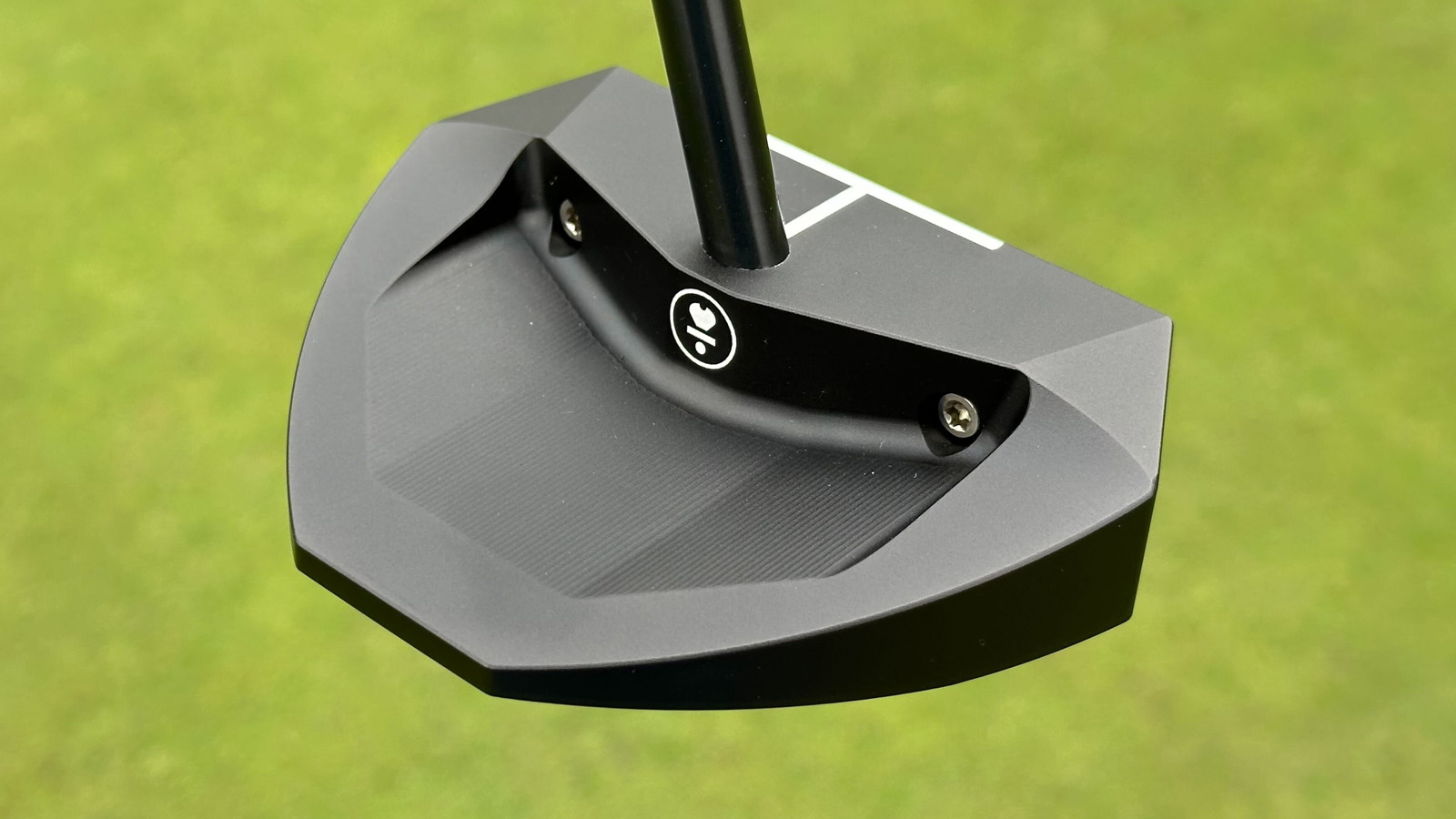
The construction of a zero torque putter is a feat of mechanical engineering that requires tighter tolerances than standard club manufacturing. It isn’t just about where the shaft goes; it is about how the entire mass of the head is managed through three-dimensional space.
Weight Distribution and Internal Weighting Systems
Creating a zero torque head often involves a complex system of internal weights. Engineers use materials of varying densities—such as lightweight aluminum for the body and heavy tungsten for the weights—to “tune” the head. In many high-end zero torque models, you will see multiple weight ports on the sole. These are not just for total head weight; they are strategically placed to pull the CG into alignment with the shaft axis. This requires CNC (Computer Numerical Control) milling to ensure that every gram of material is exactly where the physics model dictates it should be.
The Role of the Shaft-to-Head Connection
A critical technological component of zero torque putters is the hosel and shaft integration. Unlike traditional putters where the shaft might be bent or offset to provide a certain “look” at address, zero torque putters utilize specific geometry to ensure the shaft points directly at the CG. This often results in a “center-shafted” look, though many modern designs use clever industrial design to hide the center-axis connection, providing the golfer with a clean sightline while maintaining the mechanical benefits of the technology.
Data-Driven Performance: How Zero Torque Impacts the Stroke
The shift toward zero torque equipment is heavily supported by data from launch monitors and motion-capture systems like Quintic and SAM PuttLab. These tools have allowed researchers to see exactly how much energy is wasted by golfers trying to stabilize a twisting putter head.
Reducing Compensatory Movements
When a putter wants to twist, the human brain detects the instability and sends signals to the small muscles in the hands and wrists to compensate. This is known as a “compensatory movement.” In the world of biomechanics, these movements are the primary cause of inconsistency. By using a zero torque putter, the “noise” in the nervous system is reduced. Because the machine (the putter) is inherently stable, the human operator can focus purely on the pendulum motion of the shoulders.
Consistency Metrics and Launch Monitor Data
High-speed cameras show that zero torque putters result in more consistent “face angle at impact” metrics. Even a 1-degree error in face angle can cause a 10-foot putt to miss the hole. Data indicates that by removing the torque-induced twist, golfers see a tighter dispersion pattern. This isn’t just a “feel” improvement; it is a measurable increase in the efficiency of the human-machine interface. The technology essentially lowers the “input cost” for the golfer, allowing for a more repeatable and mechanically sound motion.
The Future of Golf Hardware: AI and Materials Science
As we look forward, the technology behind zero torque putters is likely to become the baseline for all high-performance golf equipment. The marriage of AI-driven design and advanced materials is pushing the boundaries of what is possible on the green.
AI-Optimized MOI and Topology Optimization
Engineers are now using topology optimization software—the same tech used to design lightweight components for spacecraft—to determine the most efficient shape for a putter head. By inputting the requirement for “zero torque” into an AI algorithm, designers can create organic, complex shapes that maximize Moment of Inertia (MOI) while maintaining perfect lie-angle balance. This results in putters that are not only twist-free but also incredibly forgiving on off-center hits.

The Integration of Smart Materials
We are also seeing the introduction of carbon fiber composites and 3D-printed titanium in zero torque designs. These materials allow for even more extreme weight displacement, pushing the CG further back and deeper while maintaining the zero torque requirement. As 3D printing technology becomes more accessible, we may soon see “bespoke zero torque” putters, where a golfer’s unique lie angle and stroke tempo are scanned, and a perfectly balanced head is printed specifically for their biometric data.
In conclusion, a zero torque putter is far more than a marketing gimmick; it is a sophisticated mechanical solution to a complex physics problem. By aligning the center of gravity with the axis of rotation, this technology eliminates the rotational forces that have plagued golfers for centuries. As the golf industry continues to embrace a “tech-first” mentality, the zero torque putter stands as a testament to how engineering can simplify a game by mastering the laws of motion.
aViewFromTheCave is a participant in the Amazon Services LLC Associates Program, an affiliate advertising program designed to provide a means for sites to earn advertising fees by advertising and linking to Amazon.com. Amazon, the Amazon logo, AmazonSupply, and the AmazonSupply logo are trademarks of Amazon.com, Inc. or its affiliates. As an Amazon Associate we earn affiliate commissions from qualifying purchases.