
When you encounter the field labeled “Employer” on a job application, it’s more than just a simple request for a name. Understanding the nuances of what an employer signifies in this context is crucial for presenting your professional history accurately and effectively. This term, in the realm of job applications, encapsulates the entity that has provided you with employment, whether through direct hiring, contracting, or even as a volunteer placement. It represents a formal relationship where your skills and time were exchanged for compensation, experience, or other benefits. Navigating this section correctly can significantly impact how a hiring manager perceives your past roles, the duration of your commitments, and the nature of your work experience.

Understanding the Employer in a Professional Context
The term “employer” on a job application serves as a cornerstone for verifying your employment history. It’s the primary point of reference for recruiters and hiring managers to understand where you’ve previously contributed your talents. This information allows them to gauge your career progression, the types of environments you’ve thrived in, and the responsibilities you’ve held. The accuracy and completeness of the employer information you provide are paramount, as it forms the basis for background checks, reference verification, and ultimately, your suitability for a new role.
Defining the Scope of “Employer”
For the purposes of a job application, “employer” typically refers to any organization, company, or individual that has formally engaged your services. This includes:
- Full-time and Part-time Employees: Traditional employment relationships where you receive a regular salary, benefits, and are on the company’s payroll.
- Contractors and Freelancers: While you might be self-employed or work for an agency, the client or company for whom you performed the work can be considered an employer for the duration of that contract. It’s important to clarify how to represent these roles.
- Interns and Volunteers: Even if unpaid, these positions often involve a structured engagement with an organization, where you gained experience and contributed to their operations. Many applications will ask for these roles separately or require you to denote them as such.
- Temporary Staffing Agencies: If you were employed through a staffing agency, the agency is technically your employer. However, for the application, you will typically list the company where you performed the work as the “employer,” and then note the agency as the staffing provider in a secondary field or under specific instructions.
The Importance of Accurate Employer Details
Providing precise employer information is not just about filling out a form; it’s about building trust and demonstrating attention to detail. Inaccurate or misleading information can lead to:
- Red Flags: Gaps in employment history, discrepancies in dates, or misrepresentation of employer names can raise suspicions with recruiters.
- Failed Background Checks: Many employers conduct thorough background checks, which include verifying past employment. Inaccuracies can halt the hiring process.
- Damaged Credibility: A history of misrepresentation, however minor, can erode a hiring manager’s confidence in your integrity.
Therefore, meticulousness in recalling and documenting past employers is a non-negotiable aspect of a successful job application.
Navigating Employer Information on Different Application Formats
The way you present employer information can vary depending on the format of the job application. Whether it’s an online portal, a downloadable PDF, or a paper form, each has its own conventions and requirements. Understanding these differences ensures you provide the most relevant and impactful details.
Online Application Portals
Many modern job applications are submitted through online Applicant Tracking Systems (ATS). These systems are designed to efficiently process large volumes of applications. When filling out these forms, pay close attention to the specific fields related to employment history.
- Chronological Order: Most portals will ask you to list your employment history in reverse chronological order, starting with your most recent position.
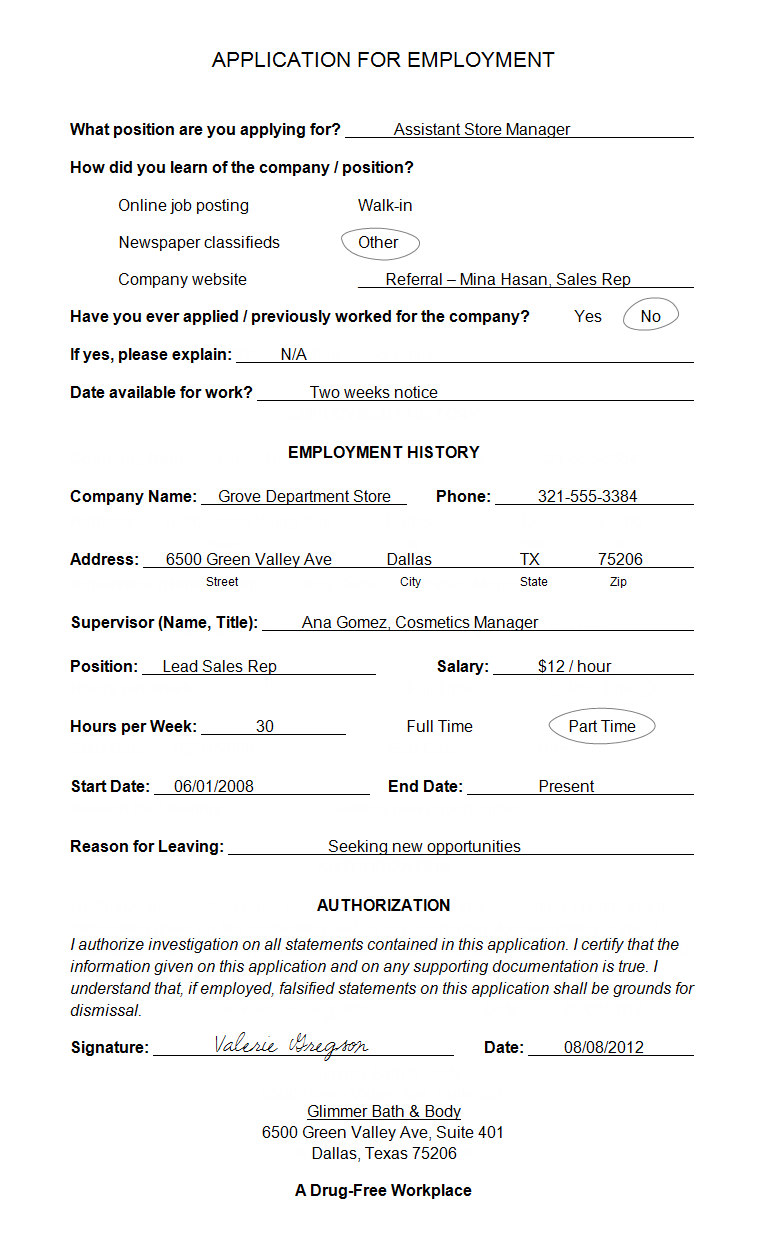
- Required Fields: Typically, you’ll need to provide the employer’s name, location, your job title, dates of employment (start and end), and often a brief description of your responsibilities.
- “Company Name” vs. “Employer Name”: Some systems use “Company Name,” which is straightforward. Others might use “Employer Name,” which can encompass the scenarios mentioned earlier (agencies, contract clients). Always err on the side of clarity; if in doubt, list the primary entity for whom you performed the work.
- “Reason for Leaving”: This is often a required field. Be concise and professional. Phrases like “seeking new opportunities,” “career advancement,” or “completion of contract” are generally accepted. Avoid negative comments about past employers.
- “Supervisor Name” and “Contact Information”: Some applications will ask for your direct supervisor’s name and contact details. This is for reference checking purposes. Always ensure you have the correct information and, ideally, have informed your former supervisor that they might be contacted.
PDF and Paper Application Forms

While less common now, some organizations still use downloadable PDF or paper application forms. These often require more manual input and can sometimes offer more space for detail.
- Handwritten vs. Typed: If it’s a paper form, ensure your handwriting is legible. Typed forms are generally preferred for clarity and professionalism.
- Structured Sections: These forms usually have clearly delineated sections for each past employer.
- Space for Details: If there’s ample space, you can elaborate slightly more on your responsibilities and achievements within each role, which can be an advantage if you can’t do so in an online form.
- Consistency: Even on paper, maintain consistency in the information you provide, matching details to your resume where applicable.
The “Other” Employer Scenarios
Sometimes, your employment history might not fit neatly into a standard employer category. This is where careful consideration is needed.
- Agency Hires: As mentioned, if you worked through a temp agency, you might need to list the agency as the employer, or the client company, depending on the application’s instructions. Often, there’s a field to specify “staffing agency” or “contracting firm.” If not, in the employer name field, you could write “[Client Company Name] (via [Staffing Agency Name])”.
- Franchise Locations: If you worked for a franchise, like a fast-food chain, you’ll need to list the specific franchise owner’s name or the franchise entity, rather than just the brand name (e.g., “XYZ Foods Inc., d.b.a. McDonald’s,” instead of just “McDonald’s”).
- Internships and Volunteer Work: Explicitly label these roles as “Intern” or “Volunteer” in your job title. For the employer, list the organization’s name. Be prepared to explain the nature of the role and what you gained from it, as these are often evaluated differently from paid employment.
Demonstrating Your Professional Trajectory Through Employer History
Your employer history is a narrative of your professional development. Each entry on a job application tells a part of that story. Hiring managers analyze this section not just for names and dates, but for patterns, growth, and alignment with the position they are trying to fill.
The Significance of Job Titles and Responsibilities
Beyond the employer’s name, your job title and the description of your responsibilities are critical.
- Job Titles: A progression of job titles from junior to senior roles clearly indicates career advancement. If your titles have been similar, focus on the increasing scope and complexity of your responsibilities within those roles.
- Description of Duties: This is your opportunity to showcase your skills and accomplishments. Quantify your achievements whenever possible (e.g., “Managed a team of 5,” “Increased sales by 15%,” “Reduced project completion time by 20%”). Tailor these descriptions to highlight experiences relevant to the job you’re applying for.
- Keywords: Incorporate keywords from the job description into your responsibilities. ATS systems often scan for these terms to match candidates to open roles.
Explaining Employment Gaps
Gaps in employment history are common and not necessarily detrimental. However, how you address them on an application is important.
- Be Honest and Concise: If there’s a gap, you’ll often have the option to provide a brief explanation. Be truthful without oversharing.
- Legitimate Reasons: Common reasons for gaps include further education, caregiving responsibilities, personal health issues, extensive travel, or a period of intentional career re-evaluation.
- Framing Positively: If you took time off for personal development, highlight any skills acquired or courses completed during that period. For example, “2020-2021: Career Break for Professional Development, including completion of [relevant certification].”
- Avoid Negative Language: Never blame previous employers or speak negatively about why you left a job.
The Employer as a Reference Point for Skills and Experience
Ultimately, the employer section of a job application serves as a concrete validation of your skills and experience. When a hiring manager reviews your application, they are cross-referencing the stated employer with your resume and, eventually, with the references you provide.
- Verifiability: The employer’s name and contact information allow for verification of your tenure and roles.
- Contextualizing Skills: Knowing the type of company and industry you worked in provides context for the skills you claim to possess. For instance, “project management” means something different in a software development firm compared to a non-profit organization.
- Cultural Fit: The reputation and culture of your previous employers can sometimes offer subtle clues about your ability to fit into a new organizational environment.
By thoroughly understanding and accurately completing the “employer” section of any job application, you lay a solid foundation for a successful job search, demonstrating professionalism, honesty, and a clear understanding of your own career journey.
aViewFromTheCave is a participant in the Amazon Services LLC Associates Program, an affiliate advertising program designed to provide a means for sites to earn advertising fees by advertising and linking to Amazon.com. Amazon, the Amazon logo, AmazonSupply, and the AmazonSupply logo are trademarks of Amazon.com, Inc. or its affiliates. As an Amazon Associate we earn affiliate commissions from qualifying purchases.