
While seemingly a relic of the 1970s, the humble mood ring, with its shifting colors, has a surprisingly sophisticated technological undercurrent. Far from mere whimsy, the science behind its color changes is a fascinating intersection of chemistry, physics, and materials science, offering a glimpse into the evolution of display technologies and the human desire to understand our internal states. When a mood ring turns blue, it’s not just a pretty pigment; it’s a calibrated response to our body’s thermal output, interpreted through the lens of thermochromic technology.
The Thermochromic Heart of the Mood Ring
At its core, a mood ring’s magic lies in its thermochromic liquid crystal. These aren’t your typical liquid crystals found in digital displays, but rather a specialized formulation designed to change color in response to minute shifts in temperature. Understanding this fundamental component is key to deciphering the meaning behind each hue.
Liquid Crystals: A State of Matter in Motion
Liquid crystals occupy a unique phase of matter, exhibiting properties of both conventional liquids and solid crystals. In their crystalline state, molecules are arranged in a highly ordered, repeating pattern. In their liquid state, these molecules are disordered and can flow. Liquid crystals, however, possess an intermediate phase where their molecules exhibit some degree of orientational order while still maintaining the fluidity of a liquid. This ordered arrangement allows them to interact with light in predictable ways.
The specific type of liquid crystals used in mood rings are chiral nematic liquid crystals. These molecules are inherently asymmetrical, or chiral, causing them to arrange themselves in a helical structure. This helical arrangement is crucial because it selectively reflects certain wavelengths of light. The pitch of this helix – essentially, how tightly wound it is – determines which color of light is reflected.
Temperature’s Tango with Molecular Structure
The real genius of thermochromic liquid crystals lies in their sensitivity to temperature. As the temperature of the liquid crystal changes, so does the pitch of its helical structure. When the temperature rises, the molecules gain kinetic energy and move further apart, increasing the pitch of the helix. Conversely, when the temperature drops, the molecules draw closer together, decreasing the pitch.
This subtle alteration in helical pitch directly impacts the wavelengths of light that are reflected. A tighter helix will reflect shorter wavelengths (blues and violets), while a looser helix will reflect longer wavelengths (reds and oranges). The liquid crystal mixture is carefully formulated to encompass a spectrum of colors within a typical human body temperature range. This allows for a gradual transition between colors as body temperature fluctuates.
The Encapsulation: Protecting the Thermochromic Magic
The delicate liquid crystals are typically encapsulated within a sealed glass or plastic dome. This encapsulation serves two primary purposes: it protects the liquid crystals from environmental contaminants that could degrade their performance, and it ensures the even distribution of heat from the wearer’s skin to the thermochromic material. Without this protective layer, the liquid crystals would be exposed to air, moisture, and potential damage, rendering them ineffective. The transparency of the dome is also vital, allowing the reflected light to be seen by the observer.
The Science Behind the Blue Hue
When a mood ring displays blue, it signifies a specific temperature range, which, according to the ring’s purported interpretations, correlates with certain emotional states. From a purely scientific standpoint, blue indicates that the thermochromic liquid crystals are reflecting light in the blue portion of the visible spectrum.
Reflecting the Blue Spectrum
The visible light spectrum, as perceived by humans, ranges from violet (shortest wavelength) to red (longest wavelength). Blue light falls within the shorter wavelength range. For a mood ring to appear blue, the helical structure of the thermochromic liquid crystals must be at a pitch that selectively reflects these shorter wavelengths. This typically corresponds to a cooler temperature within the range the mood ring is designed to interpret.
Correlating Temperature with Emotion: A Technological Interpretation
The connection between the color blue and specific emotions on a mood ring is a product of technological interpretation rather than direct biological measurement. The creators of mood rings, likely drawing on popular associations and perhaps early, rudimentary understandings of physiological responses to emotions, assigned emotional states to different color ranges.
Blue has historically been associated with calmness, serenity, peace, and a sense of tranquility. In the context of a mood ring, this often translates to the wearer being in a relaxed, stable, or contented state. The technology itself is simply registering a cooler body temperature and the assigned meaning is a layer of interpretation applied to that measurement. It’s a fascinating example of how we imbue technological outputs with human meaning.
Calibration and Variability: Understanding the Nuances

It’s important to acknowledge that the exact temperature at which a mood ring will turn blue can vary between different rings and even between different batches of thermochromic material. Manufacturers calibrate these rings to specific temperature ranges, but these calibrations are not always precise or standardized.
Furthermore, external factors can influence the perceived color. Ambient temperature plays a significant role; if the environment is cold, your body temperature might naturally be lower, leading to a blue hue regardless of your emotional state. Conversely, a warm environment might push the ring towards warmer colors. Skin conductivity and individual metabolic rates can also contribute to slight variations in body temperature, and thus, in the color displayed. This inherent variability means that while blue might generally indicate a cooler, potentially calmer state, it’s not an infallible biometric indicator.
Beyond Blue: The Full Spectrum of Thermochromic Expression
While blue is a prominent and often sought-after color on a mood ring, understanding the entire spectrum provides a more complete picture of the thermochromic technology at play and the symbolic meanings assigned to it. Each color represents a different temperature point within the liquid crystal’s operational range.
The Warm Spectrum: Red, Orange, and Yellow
As body temperature increases, the helical pitch of the thermochromic liquid crystals lengthens, leading to the reflection of longer wavelengths.
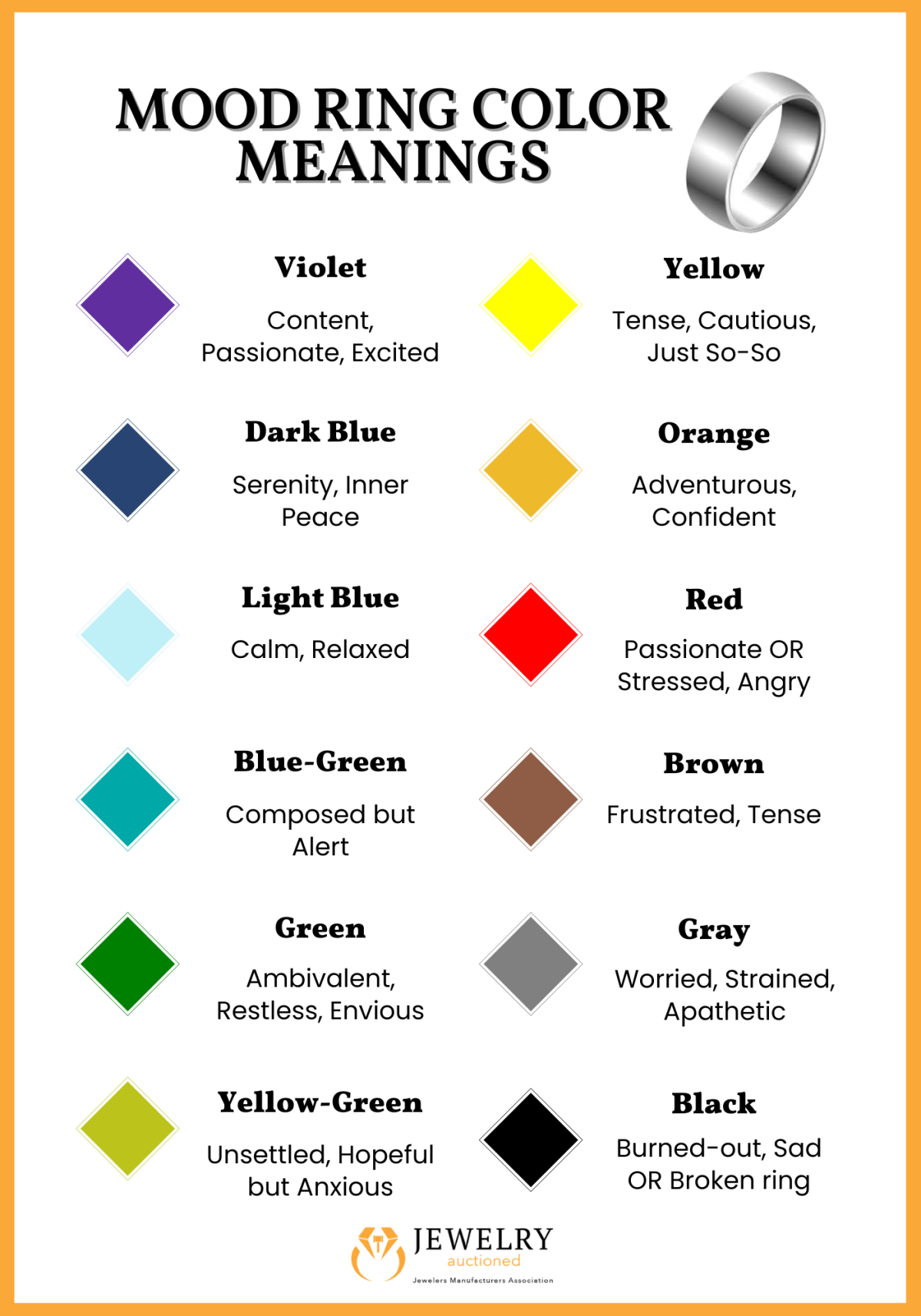
- Red: Often associated with passion, energy, excitement, and sometimes anger or stress. This color typically indicates a higher body temperature.
- Orange: Frequently interpreted as enthusiasm, creativity, happiness, or a general feeling of well-being. It sits between red and yellow in terms of temperature indication.
- Yellow: Can signify optimism, cheerfulness, and a lively disposition. This color generally represents a moderately elevated body temperature.
The Cool Spectrum: Green and Other Hues
The colors in the middle of the spectrum, like green, represent a more neutral or balanced temperature.
- Green: Often symbolizes balance, calmness, contentment, and stability. It sits between the warmer colors and the cooler blues.
- Violet/Purple: Sometimes seen on mood rings, violet is typically associated with more intense emotions, such as passion, romance, or sometimes anxiety. It generally indicates a temperature slightly warmer than blue but cooler than green.
Black and Other Non-Responsive Colors
Some mood rings might also display black, or may appear black when the thermochromic material is outside its responsive temperature range. This can occur if the ring is too cold or too hot for the liquid crystals to exhibit a visible color. In some cases, black might be interpreted as a lack of significant emotional response or a neutral state, though it’s primarily a technical indicator of temperature outside the designed spectrum.
The Enduring Appeal: Tech, Nostalgia, and Personal Insight
The mood ring, despite its seemingly simple appearance, represents a fascinating piece of wearable technology. Its enduring appeal lies in a confluence of factors: the ingenuity of thermochromic science, a touch of nostalgic charm, and the universal human desire for self-understanding.
A Primitive Form of Wearable Tech
In the broader context of technology, the mood ring can be seen as an early, albeit rudimentary, form of wearable technology. It leveraged a specific scientific principle – thermochromism – to provide real-time feedback about a physiological parameter. While it didn’t offer the complex data streams or connectivity of modern smartwatches, it was one of the first widely accessible devices that attempted to bridge the gap between our internal state and external observation through technological means. It paved the way for the sophisticated biometric sensors we see today in fitness trackers and smartwatches, which monitor heart rate, sleep patterns, and more.
The Nostalgia Factor and Cultural Significance
The mood ring holds a significant place in popular culture, particularly as a symbol of the 1970s. Its resurgence in popularity, often seen in novelty stores and as a retro accessory, taps into a powerful sense of nostalgia. For many, it evokes memories of childhood, simpler times, and a playful approach to self-expression. This cultural resonance ensures its continued existence and appeal, even as more advanced technologies emerge. It’s a tangible link to a past era, a colorful reminder of trends and aesthetics that have come and gone.

A Gateway to Self-Reflection
Ultimately, the meaning derived from a mood ring’s colors, including the coveted blue, is a matter of personal interpretation. The technology provides a visual cue, a prompt for introspection. When the ring turns blue, it encourages the wearer to consider what state of being might correspond to that hue – perhaps a moment of quiet contemplation, a period of calm focus, or a general sense of peace. While not a scientific diagnostic tool, the mood ring serves as a playful catalyst for self-awareness, reminding us that even simple technologies can spark deeper engagement with our own internal worlds. It encourages a mindful pause, inviting us to reflect on our present state, whether that state is associated with the serene blue of tranquility.
aViewFromTheCave is a participant in the Amazon Services LLC Associates Program, an affiliate advertising program designed to provide a means for sites to earn advertising fees by advertising and linking to Amazon.com. Amazon, the Amazon logo, AmazonSupply, and the AmazonSupply logo are trademarks of Amazon.com, Inc. or its affiliates. As an Amazon Associate we earn affiliate commissions from qualifying purchases.