
The quest for the “most accurate” Bible translation is a deeply personal and intellectually engaging journey for many. It’s not simply about finding a book, but about seeking a profound connection to ancient texts that have shaped civilizations and guided countless lives. Accuracy in translation, however, is a multifaceted concept, especially when dealing with a document as historically rich and linguistically complex as the Bible. This article delves into the nuances of Bible translation, exploring the methodologies, inherent challenges, and the leading translations often cited for their fidelity to the original languages. We will examine the technical considerations that translators face and how these impact the final text, ultimately empowering you to make an informed choice about which translation best suits your needs.
The Labyrinth of Original Languages: Hebrew, Aramaic, and Greek
At the heart of any discussion about Bible translation lies the foundational challenge: bridging the gap between ancient languages and modern understanding. The Old Testament was primarily written in Hebrew, with some portions in Aramaic. The New Testament was penned in Koine Greek, the common Greek spoken throughout the Hellenistic world. Each of these languages possesses unique grammatical structures, idiomatic expressions, and cultural contexts that are not always easily transferable into English.
Decoding Hebrew: A Window into the Old Testament
Hebrew, the language of the ancient Israelites, is characterized by its consonantal alphabet, where vowels were historically indicated by diacritical marks added later. This can lead to ambiguities in pronunciation and meaning if not handled with care. Furthermore, Hebrew literature is rich in poetic parallelism, wordplay, and symbolic language, all of which require a deep understanding of the cultural and historical milieu in which it was produced. Translators must grapple with Hebrew verb forms, which can convey nuances of aspect (completed, ongoing, habitual) that don’t have direct one-to-one equivalents in English. The tetragrammaton, the four-letter personal name of God (YHWH), presents another significant translation challenge, with various approaches to rendering it, from “LORD” to “Jehovah.”
The Nuances of Koine Greek: The Language of the New Testament
Koine Greek, the lingua franca of the Roman Empire during the time of Jesus and the apostles, offers its own set of translation hurdles. While more widely spoken than classical Greek, it still had its own distinct grammar and vocabulary. The Greek New Testament is replete with participial clauses, prepositional phrases, and a sophisticated case system that can convey relationships between words in ways that require careful rendering into English. The meaning of certain Greek words can also shift depending on their context, necessitating meticulous lexical work and an understanding of the specific theological and philosophical currents of the era. For instance, understanding the precise meaning of agape (love) or logos (word) requires more than a simple dictionary definition; it demands an immersion into the semantic range and cultural connotations of these terms.
Aramaic Influences and Other Ancient Tongues
While Hebrew and Greek are the primary languages of the Bible, Aramaic plays a role, particularly in books like Daniel and Ezra. Aramaic, closely related to Hebrew, shares some of its linguistic characteristics but also has distinct features. Translating passages that shift between Hebrew and Aramaic requires a translator to be proficient in both and to understand the reasons for the linguistic switch, which can sometimes be stylistic or thematic. Occasionally, other ancient languages and their textual traditions may also inform translation decisions, especially when dealing with debated passages or alternative manuscript readings.
Methodologies of Translation: Balancing Fidelity and Readability
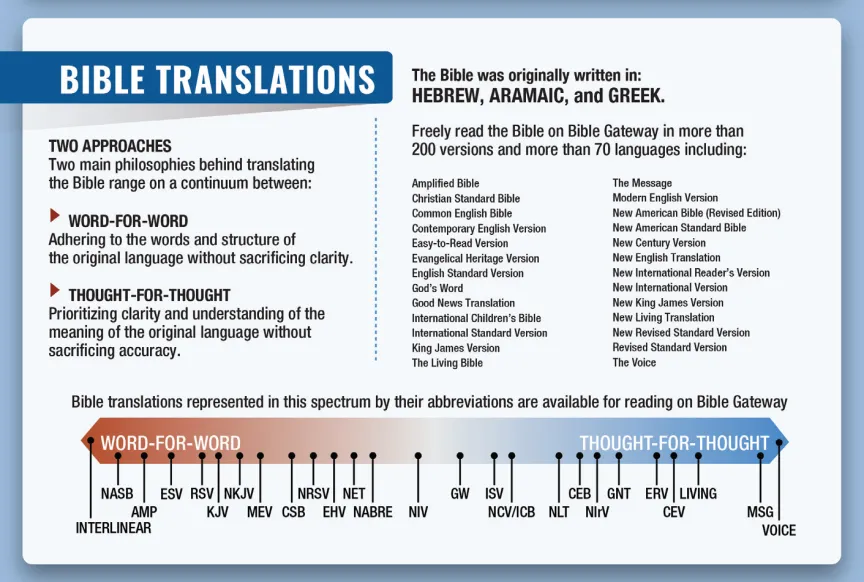
The process of translating the Bible is not a monolithic endeavor. Various translation philosophies and methodologies have been developed over centuries, each aiming to strike a different balance between literal accuracy and modern readability. Understanding these approaches is crucial to appreciating why different translations sound and read so differently.
Formal Equivalence: Word-for-Word Precision
Translations employing a formal equivalence approach strive to replicate the grammatical structure and vocabulary of the original languages as closely as possible in the target language. The goal is to be as literal as the source text allows, preserving the nuances of the original wording and sentence construction. This method is favored by those who want to study the biblical text with a high degree of precision, allowing them to see how the translators have handled specific Greek or Hebrew words. However, a strict adherence to this approach can sometimes result in awkward phrasing or even obscure meanings in English, as direct word-for-word translations often don’t sound natural or convey the intended sense. Examples of translations that lean heavily towards formal equivalence include the New American Standard Bible (NASB) and the King James Version (KJV), though the latter also reflects the English of its era.
Dynamic Equivalence: Meaning-for-Meaning Clarity
In contrast, dynamic equivalence (also known as thought-for-thought) prioritizes conveying the meaning of the original text in natural, idiomatic English. Translators using this approach aim to produce a text that communicates the same message and impact on the modern reader as the original text did on its first audience. This often involves rephrasing sentences, substituting contemporary idioms for ancient ones, and adapting cultural references. The advantage is a text that is generally easier to read and understand for a broad audience. However, some critics argue that this method can introduce translator bias or obscure subtle meanings present in the original wording. Prominent examples of dynamic equivalence translations include the New International Version (NIV) and the Good News Translation (GNT).
A Balanced Approach: Blending Literalness and Readability

Many modern translations adopt a hybrid approach, seeking to blend the strengths of both formal and dynamic equivalence. These translations aim for a high degree of fidelity to the original languages while also ensuring that the English is clear, accessible, and engaging. Translators in this category meticulously study the original texts and make informed decisions about when to opt for a more literal rendering and when a more interpretive, thought-for-thought approach is necessary for clarity. The English Standard Version (ESV) and the New Living Translation (NLT) are often cited as examples of translations that strike a commendable balance, offering both scholarly accuracy and readability.
The Role of Manuscript Evidence and Textual Criticism
The accuracy of any Bible translation is fundamentally tied to the quality and reliability of the ancient manuscripts upon which it is based. Translators do not have direct access to the original autographs (the very first writings of the biblical authors). Instead, they work with thousands of ancient copies of these texts, which have been passed down through generations. Textual criticism is the scholarly discipline of comparing these manuscripts to identify the most likely original wording.
Navigating the Manuscript Maze: Early Copies and Variations
The vast number of ancient manuscripts available for the Hebrew Old Testament and the Greek New Testament is a strength, allowing scholars to cross-reference and identify variations. However, these variations, known as textual variants, are a reality. They can range from minor spelling differences and scribal errors to more significant omissions or additions. Textual critics use a variety of criteria, such as the age of the manuscript, the geographical location of its discovery, and the consistency of its readings across different manuscript families, to determine which reading is most likely to reflect the original text. For the New Testament, the work of scholars like Brooke Foss Westcott and Fenton John Anthony Hort, whose critical text formed the basis for many early translations, remains influential, as do more contemporary critical editions like the Nestle-Aland (NA) and the United Bible Societies (UBS) Greek New Testament.
Addressing Discrepancies: Translator Decisions and Scholarly Consensus
When textual variants exist, translators must make informed decisions about which reading to include in their translation. This often involves consulting the consensus of leading textual critics and considering the theological implications of different readings. Some translations may choose to footnote disputed readings, allowing readers to see the variations and the translator’s rationale. The process is complex, requiring a deep understanding of ancient languages, historical context, and the principles of textual criticism. While no translation can claim absolute, perfect accuracy, the most respected translations are transparent about their methodologies and grounded in robust scholarly work.
Identifying “Accurate” Translations for Your Study
Given the complexities of translation, how does one identify a translation that is considered “accurate”? Accuracy, in this context, typically refers to a translation that is faithful to the original languages, relies on sound manuscript evidence, and employs a clear and understandable methodology. While “most accurate” is subjective and depends on one’s purpose, certain translations consistently rank high in scholarly assessments for their fidelity.
The Pillars of Scholarly Accuracy: ESV, NASB, and NRSV
The English Standard Version (ESV) is widely regarded as a highly accurate and reliable translation. It aims for a balance between formal equivalence and readability, prioritizing word-for-word accuracy where possible while maintaining clear English prose. It is a revision of the Revised Standard Version (RSV) and is favored by many scholars and pastors for its fidelity to the original Hebrew and Greek.
The New American Standard Bible (NASB) is known for its extremely literal, word-for-word approach. It is a favorite for in-depth study, as it seeks to preserve the grammatical structures and vocabulary of the original languages as closely as English allows. While its literalness can sometimes make it less fluid for casual reading, its precision is unparalleled for those who want to scrutinize every word.
The New Revised Standard Version (NRSV), a successor to the RSV, is another translation highly respected for its scholarly rigor and faithfulness to the original languages. It is known for its inclusive language, which reflects contemporary English usage and sensitivities while remaining committed to accurate translation of the original texts. The NRSV is often used in academic and ecumenical settings.

Other Notable Translations and Their Strengths
Beyond these, other translations are frequently cited for their accuracy and strengths:
- The New King James Version (NKJV) aims to update the KJV while retaining its traditional wording and theological emphasis. It is more literal than many modern translations but less so than the NASB.
- The Christian Standard Bible (CSB) seeks a balance between word-for-word and thought-for-thought translation, aiming for both accuracy and readability. It is a relatively newer translation that has gained significant traction.
Ultimately, the “most accurate” translation is the one that best serves your understanding and spiritual growth. Engaging with multiple translations, understanding their distinct approaches, and consulting scholarly resources can significantly enhance your journey into the rich tapestry of biblical texts. The pursuit of accuracy is a continuous process, one that enriches our engagement with the timeless wisdom of Scripture.
aViewFromTheCave is a participant in the Amazon Services LLC Associates Program, an affiliate advertising program designed to provide a means for sites to earn advertising fees by advertising and linking to Amazon.com. Amazon, the Amazon logo, AmazonSupply, and the AmazonSupply logo are trademarks of Amazon.com, Inc. or its affiliates. As an Amazon Associate we earn affiliate commissions from qualifying purchases.