
In the realm of digital communication and content creation, clarity and precision are paramount. Whether you’re crafting a compelling marketing email, drafting an insightful blog post for a tech publication, or building a personal brand that resonates with your audience, the way you construct your sentences directly impacts how effectively your message is received. One grammatical pitfall that can significantly undermine this clarity is the dangling participle. While it might sound like an esoteric linguistic concept, understanding dangling participles is crucial for anyone aiming to produce polished, professional, and impactful content, especially within the fast-paced and detail-oriented world of Tech.
The Perils of Poorly Placed Modifiers in Tech Content
In the technology sector, where innovation moves at lightning speed and complex ideas need to be communicated concisely, grammatical errors can be particularly detrimental. A dangling participle, when it appears in a tech article, a software review, or even a company’s mission statement, can lead to misinterpretations, confusion, and a general erosion of credibility. This is especially true when discussing intricate technical processes, user interfaces, or the benefits of a new gadget. Imagine a tutorial for a new AI tool: if the instructions are unclear due to a misplaced modifier, users might waste time, get frustrated, and abandon the tool, reflecting poorly on the software and the brand. Similarly, a company’s marketing collateral that suffers from such errors might inadvertently convey a lack of attention to detail, a trait that is antithetical to the precision expected in the tech industry.
Understanding the Core Concept: The Participle Phrase
At its heart, a dangling participle arises from a misunderstanding of how participle phrases function. A participle is a word that is derived from a verb but functions as an adjective or part of a verb phrase. Present participles end in “-ing” (e.g., running, coding, developing), while past participles often end in “-ed” or “-en” (e.g., developed, coded, built). A participle phrase is a group of words containing a participle and its modifiers, objects, or complements, and it functions like an adjective, describing a noun or pronoun.
For instance, in the sentence, “Running at full speed, the server processed the data,” the participle phrase “Running at full speed” describes the noun “server.” The action of running is clearly attributed to the server, making the sentence grammatically sound and logically coherent. The phrase modifies the noun that immediately follows it.
When Modifiers Go Astray: The Dangling Participle Explained
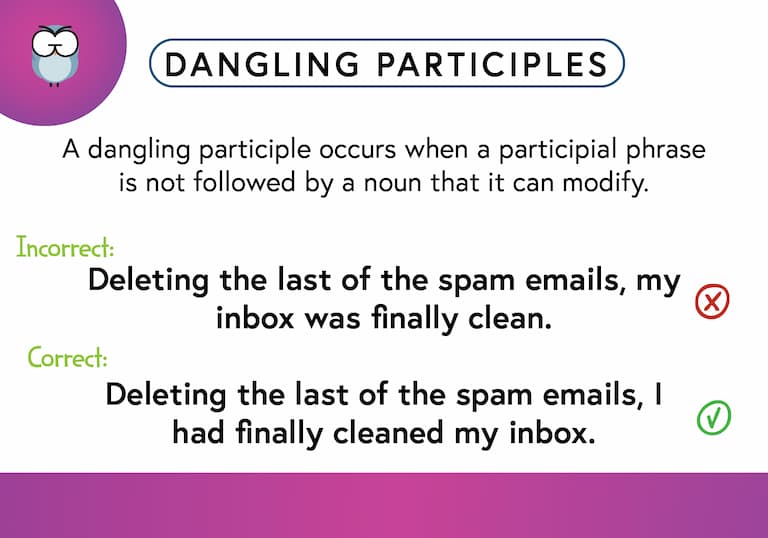
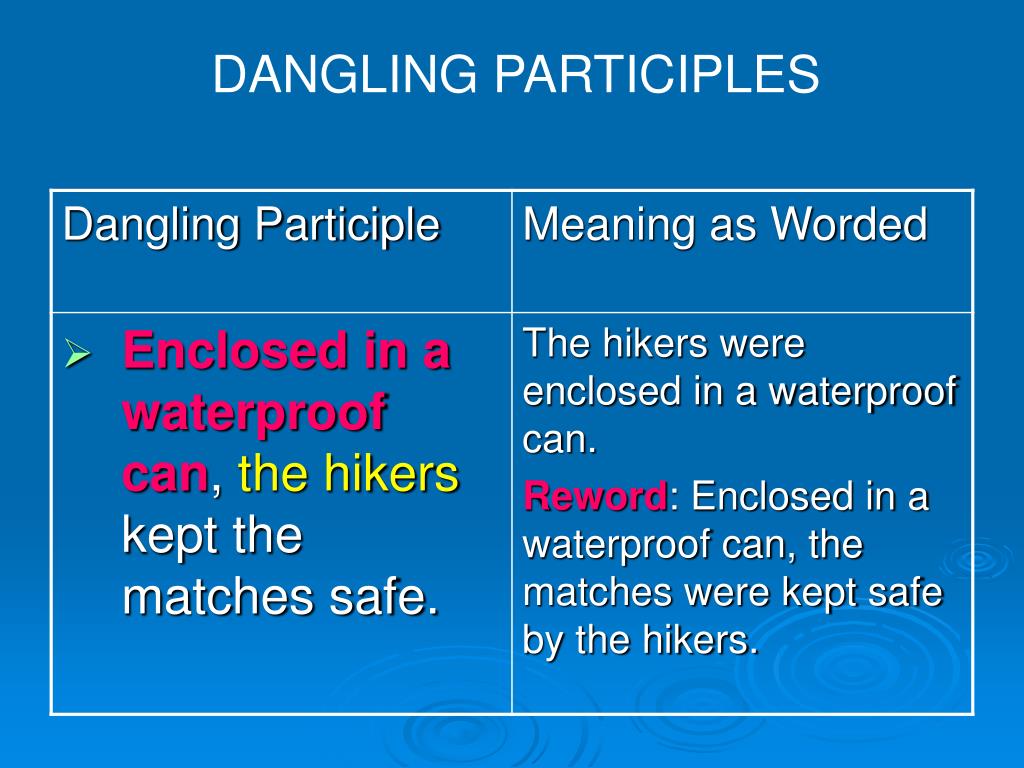
A dangling participle occurs when a participle phrase is placed in a sentence in such a way that it appears to modify a word other than the one it’s intended to describe. More often than not, the word it should modify is missing entirely from the sentence, or it’s simply in the wrong place. This creates an illogical or nonsensical statement, as the action of the participle is attributed to the wrong subject.
The “What” and “Why” of the Grammatical Slip-Up
The “what” of a dangling participle is a modifier that lacks a clear, logical subject to which it can attach. The “why” often stems from a desire for conciseness or an attempt to create a more sophisticated sentence structure, which can, ironically, lead to less clarity. In tech writing, where a premium is placed on efficiency and accuracy, this grammatical misstep can have significant consequences.
For example, consider the sentence: “Having finished the beta testing, the new software was released to the public.”
Here, the participle phrase “Having finished the beta testing” seems to imply that the software finished the beta testing. This is illogical. The software cannot perform the action of testing itself. The intended meaning is likely that the development team or the company finished the beta testing.
Common Scenarios Leading to Dangling Participles
Several common sentence structures and writing habits can lead to dangling participles, particularly when writers are focused on conveying technical information quickly.
- Starting sentences with “-ing” phrases: This is a very common structure for introducing context or an action. If the subject of that action isn’t immediately following the phrase, problems can arise.
- Incorrect: “Exploring the new API, the features were overwhelming.” (The features didn’t explore the API; someone explored the API and found the features overwhelming.)
- Correct: “Exploring the new API, the developers found the features overwhelming.”
- Using past participles without a clear antecedent: Similar to present participles, past participles used in introductory phrases can dangle if the noun they are meant to describe isn’t present or is misplaced.
- Incorrect: “Developed with cutting-edge algorithms, the AI chatbot impressed users.” (While the AI chatbot is indeed developed, this sentence structure implies the AI chatbot itself did the developing. It’s a subtle but important distinction.)
- Correct: “Developed with cutting-edge algorithms, the AI chatbot impressed users.” (This is actually a correct usage if the intention is that the chatbot itself is the subject being described. The problem arises when the subject performing the action of developing is implied but missing.) A clearer version to avoid any ambiguity could be: “After being developed with cutting-edge algorithms, the AI chatbot impressed users.” or “The AI chatbot, developed with cutting-edge algorithms, impressed users.”
- Passive voice constructions: While not always the culprit, the passive voice can sometimes obscure the actor, making it easier for participial phrases to lose their intended subject.
- Incorrect: “Looking at the complex code, the bug was hard to find.” (The bug didn’t look at the code; someone looking at the code found the bug hard to find.)
- Correct: “Looking at the complex code, the programmer found the bug hard to find.”

Recognizing and Correcting Dangling Participles in Technical Writing
The ability to identify and correct dangling participles is a hallmark of professional and effective communication in the tech industry. A clear understanding of grammar ensures that your technical documentation, marketing copy, and internal communications are not only informative but also readily accessible and trustworthy.
Strategies for Identification
The first step to fixing a dangling participle is recognizing it. Here are some key indicators:
- Examine the beginning of your sentences: If a sentence starts with a word ending in “-ing” or a past participle (often with “-ed” or “-en”), pause and ask: “Who or what is performing this action?”
- Check for a clear subject: Ensure that the noun or pronoun immediately following the participial phrase is the one that logically performs the action described by the participle.
- Read aloud: Sometimes, reading your sentences aloud can help you catch awkward phrasing or illogical connections. If a sentence sounds strange or funny when spoken, it might be a sign of a grammatical error.
- Look for implied actors: Dangling participles often occur when the writer has an actor in mind but forgets to include them in the sentence.
Effective Correction Techniques
Once a dangling participle is identified, there are several straightforward methods to correct it:
- Add the missing subject: The most direct solution is to insert the noun or pronoun that the participle phrase is intended to modify.
- Original Dangling: “Walking through the server room, the humming of the machines was deafening.”
- Corrected: “Walking through the server room, the technician found the humming of the machines deafening.”
- Make the participial phrase a clause: You can transform the participial phrase into a full clause by adding a subject and a verb.
- Original Dangling: “Having reviewed the user feedback, the feature roadmap was updated.”
- Corrected: “After the team had reviewed the user feedback, the feature roadmap was updated.”
- Rearrange the sentence: Sometimes, moving the participial phrase to a different part of the sentence or rephrasing can resolve the issue.
- Original Dangling: “Built with advanced security protocols, users can trust the new platform.”
- Corrected: “Users can trust the new platform, which was built with advanced security protocols.”
- Use a relative clause: Introduce a relative pronoun (who, which, that) to create a subordinate clause.
- Original Dangling: “Considering the current market trends, the launch strategy was revised.”
- Corrected: “The launch strategy was revised, which was considered in light of the current market trends.”
The Impact on Brand Perception and Credibility in Tech
In the technology sector, where credibility and trust are the bedrock of success, grammatical precision is not merely about following rules; it’s about cultivating a professional image and ensuring that your message is understood without ambiguity.
Elevating Professionalism and Authority
When tech companies, developers, or technical writers produce content that is free from grammatical errors like dangling participles, it signals attention to detail. This meticulousness translates into a perception of expertise and authority. Whether it’s a white paper detailing a new algorithm, a user manual for a complex piece of hardware, or a press release announcing a groundbreaking software update, error-free content instills confidence in the reader. It tells them that the creators are thorough, competent, and serious about their work. Conversely, a sentence containing a dangling participle can inadvertently suggest sloppiness, a lack of oversight, or even a fundamental misunderstanding of the subject matter being discussed.
Enhancing User Experience and Comprehension
For a tech product or service to succeed, users must be able to understand how it works and how to use it effectively. This relies heavily on clear and unambiguous instructions, tutorials, and product descriptions. Dangling participles can create confusion, leading to user frustration and potentially hindering adoption.
Consider a scenario where a software update description reads: “Implementing new security features, the system is now more protected.” A user might pause, wondering if the system itself is implementing the features. While a minor point, such small ambiguities can accumulate, making the overall user experience less intuitive. A clearer version, such as “Implementing new security features, we have made the system more protected,” or “With new security features implemented, the system is now more protected,” ensures the intended meaning is immediately grasped. This clarity is vital for customer support, onboarding, and overall customer satisfaction.
Building a Stronger Digital Brand Identity
In the digital landscape, your content is a direct reflection of your brand. Every blog post, every social media update, every website page contributes to your brand identity. In the tech industry, brands are often built on innovation, reliability, and a forward-thinking approach. Grammatical errors, especially persistent ones, can undermine these very qualities. A brand that consistently publishes well-written, grammatically sound content positions itself as knowledgeable, professional, and trustworthy. This strengthens its digital presence, attracts a more discerning audience, and ultimately contributes to a stronger, more reputable brand in the competitive tech market. Mastering the nuances of grammar, including the proper use and avoidance of dangling participles, is an investment in the clarity, credibility, and overall success of your tech-related endeavors.
aViewFromTheCave is a participant in the Amazon Services LLC Associates Program, an affiliate advertising program designed to provide a means for sites to earn advertising fees by advertising and linking to Amazon.com. Amazon, the Amazon logo, AmazonSupply, and the AmazonSupply logo are trademarks of Amazon.com, Inc. or its affiliates. As an Amazon Associate we earn affiliate commissions from qualifying purchases.