
The RMS Titanic, a monument to opulent engineering and a stark reminder of the unforgiving power of nature, met its tragic end on its maiden voyage in 1912. For decades, its final resting place remained a tantalizing mystery, a subject of fervent speculation and a dream for treasure hunters and historians alike. The quest to locate this legendary vessel was not merely a matter of geographic probability; it was a profound technological challenge, a testament to human ingenuity in pushing the boundaries of exploration into the planet’s deepest realms. The answer to “what year did they find the Titanic” is not just a date, but a milestone in the evolution of underwater search and retrieval technologies.

The discovery of the Titanic in 1985 was not a sudden, serendipitous event. It was the culmination of years of dedicated research, evolving scientific understanding of the ocean floor, and, crucially, the development and refinement of cutting-edge technologies that allowed humans to “see” and explore in environments previously beyond our reach. This endeavor represents a significant chapter in the history of applied technology, showcasing how innovation can unlock secrets hidden by immense pressure, crushing darkness, and vast expanses of water.
The Pre-Discovery Landscape: Early Attempts and Technological Hurdles
Before the successful expedition, numerous attempts were made to locate the Titanic, each facing an almost insurmountable wall of technological limitations. The sheer depth of the North Atlantic, coupled with the vastness of the search area, presented challenges that existing technology of the mid-20th century could not adequately address.
The Ocean Depths: An Unforgiving Frontier
The Titanic rests at a depth of approximately 12,500 feet (3,800 meters) in the North Atlantic Ocean. At this depth, the pressure is immense, exceeding 600 times that at sea level. This extreme environment poses significant engineering challenges for any vessel or equipment intended for submersion. Early attempts were often hampered by the inability of submersibles to withstand such pressures or by the limitations of acoustic equipment to penetrate the murky depths with sufficient clarity.
Early Search Methodologies: Limitations of Sonar and Visual Reconnaissance
In the decades following the sinking, initial search efforts often relied on rudimentary sonar technologies, which were still in their nascent stages of development. These systems had limited resolution, a narrow acoustic beam, and were prone to interference from oceanic noise. The vastness of the ocean meant that covering the search area effectively with such imprecise tools was akin to searching for a needle in an infinite haystack. Visual reconnaissance, even with early remotely operated vehicles (ROVs) or manned submersibles, was severely restricted by the lack of deep-sea lighting and the limited operational time and maneuverability of these early machines. The hope was often for a lucky visual sighting rather than a systematic, technologically driven search.
The Role of Oceanography and Marine Geology
Simultaneously, advancements in oceanography and marine geology were laying the groundwork for more effective exploration. Scientists began to develop a better understanding of deep-sea currents, seafloor topography, and the complex processes that govern the distribution of debris in the ocean. This scientific knowledge, when combined with emerging technologies, started to paint a clearer picture of where and how the wreck might be found. However, the actual “finding” still required technological leaps forward.
The Technological Breakthrough: The Woods Hole Oceanographic Institution Expedition
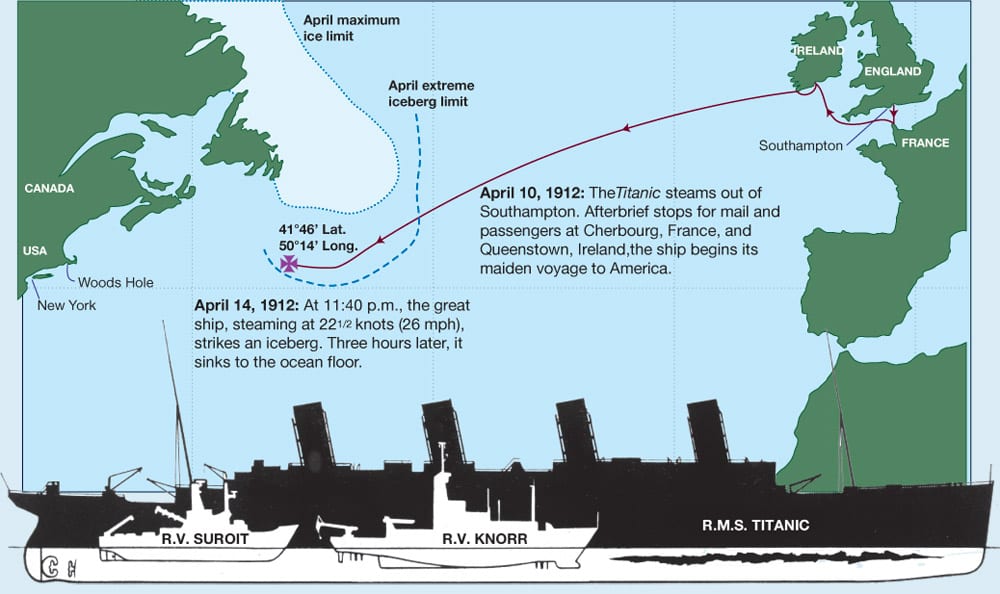
The pivotal moment in the discovery of the Titanic came in 1985, spearheaded by a joint expedition from the Woods Hole Oceanographic Institution (WHOI) and the French research institute IFREMER. This expedition was not simply another search; it was a sophisticated application of then-state-of-the-art underwater technology, meticulously planned and executed.
Advanced Sonar and Imaging Technologies: Seeing the Unseen
The success of the 1985 expedition was heavily reliant on advanced sonar and imaging systems. The research vessel Atlantis II was equipped with advanced side-scan sonar, a technology that uses sound pulses to create detailed images of the seafloor. Unlike traditional sonar, side-scan sonar emits sound waves to the sides of the vessel, effectively “painting” a picture of the seabed as the ship traverses the area. This allowed the team to survey large swathes of the ocean floor with unprecedented detail, identifying anomalies that might indicate wreckage. Crucially, the expedition also utilized the SeaMARV (Submersible/Experimental/Advanced Research Vehicle), an unmanned deep-submergence vehicle equipped with powerful cameras and lights. This vehicle was instrumental in providing visual confirmation of the sonar readings.
The Deep-Submergence Vehicle ARGUS and the ROV NAUTILE
While not the first deep-submergence vehicles, the capabilities of those employed in the Titanic search were significant for their time. The French submersible NAUTILE, operated by IFREMER, was a key component of the search. This manned submersible, capable of reaching the Titanic’s depth, allowed for direct observation and sample collection. However, the true breakthrough came with the integration of ARGUS, an unmanned remotely operated vehicle (ROV) also developed by WHOI. ARGUS, tethered to the support vessel, was able to explore the seafloor for extended periods, relaying high-definition video and sonar data back to the surface. It was ARGUS that ultimately provided the first visual confirmation of the Titanic’s wreckage. This technological synergy between sonar mapping and detailed ROV exploration was a game-changer for deep-sea archaeology.
Data Integration and Analysis: Piecing Together the Puzzle
The sheer volume of data generated by the sonar and ROV systems required sophisticated methods for analysis. Advanced computer algorithms were employed to process the sonar data, distinguishing between natural seafloor features and potential man-made objects. The video feeds from ARGUS and NAUTILE were meticulously reviewed, allowing the team to identify distinctive features of the Titanic, such as its size, shape, and even specific debris patterns. The ability to integrate and interpret this complex, multi-layered data was as crucial as the hardware itself.
The Discovery and its Technological Legacy
The moment of discovery on September 1, 1985, was a triumph of technological perseverance and scientific collaboration. The Titanic was found not as a single, intact hull, but as two primary pieces – the bow and stern sections – separated by a vast field of debris. This realization itself was a testament to the understanding of the ship’s breakup, informed by the visual and sonar data.
The Scientific and Cultural Impact of Finding the Titanic
The discovery of the Titanic was more than just a scientific achievement; it captured the global imagination. It provided tangible evidence of the tragedy, allowing for a more profound connection to the human stories behind the disaster. This discovery fueled further interest in deep-sea exploration and archaeology, demonstrating the potential of technology to reveal historical secrets. It spurred advancements in ROV technology, deep-sea imaging, and data processing techniques that continue to benefit oceanographic research today.

Post-Discovery Technological Applications
The techniques and technologies honed during the Titanic expedition have had a lasting impact. The development of more robust and maneuverable ROVs, coupled with advanced acoustic and optical sensors, has enabled the exploration and mapping of countless other shipwrecks, underwater geological formations, and marine habitats. The methods for systematic deep-sea search, data analysis, and the integration of multiple sensing technologies have become standard practice in marine archaeology and oceanographic research. The Titanic‘s discovery truly marked a new era in our ability to explore and understand the Earth’s most inaccessible environments, proving that with the right technological tools, even the deepest mysteries can be brought to light.
aViewFromTheCave is a participant in the Amazon Services LLC Associates Program, an affiliate advertising program designed to provide a means for sites to earn advertising fees by advertising and linking to Amazon.com. Amazon, the Amazon logo, AmazonSupply, and the AmazonSupply logo are trademarks of Amazon.com, Inc. or its affiliates. As an Amazon Associate we earn affiliate commissions from qualifying purchases.