
In the realm of institutional finance and organizational management, few historical milestones carry as much weight as the Pendleton Civil Service Reform Act of 1883. While often relegated to the pages of history textbooks as a political turning point, the Pendleton Act was, at its core, one of the most significant “corporate restructurings” in American history. It transformed the federal government from a system of patronage and financial kickbacks into an entity governed by merit, fiscal accountability, and standardized human capital management.
To understand the Pendleton Act is to understand the birth of modern institutional compliance. For professionals in finance, business strategy, and governance, the act serves as the primary case study on how systemic corruption can be mitigated through structural reform. It shifted the “business of government” from a short-term reward system for political donors into a long-term investment in professional expertise.
From the Spoils System to Fiscal Accountability
Before 1883, the United States government operated under the “Spoils System.” This was an era where the financial health of the nation was often secondary to political loyalty. Under the mantra “to the victor belong the spoils,” winning political parties would clear out government offices and fill them with supporters, regardless of their qualifications. This created a massive, systemic drain on public resources.
The High Cost of the “Spoils System”
The economic inefficiency of the spoils system was staggering. Because positions were handed out as rewards for political service, there was no incentive for competence or productivity. In financial terms, the government was experiencing a massive “negative ROI” (Return on Investment) on its payroll. Ghost employees were common, and embezzlement was a frequent byproduct of a system where loyalty was the only metric of success. This lack of oversight led to significant fiscal leakage, as public funds were often diverted to maintain political machines rather than being invested in national infrastructure or debt reduction.
Civil Service Reform as a Financial Safeguard
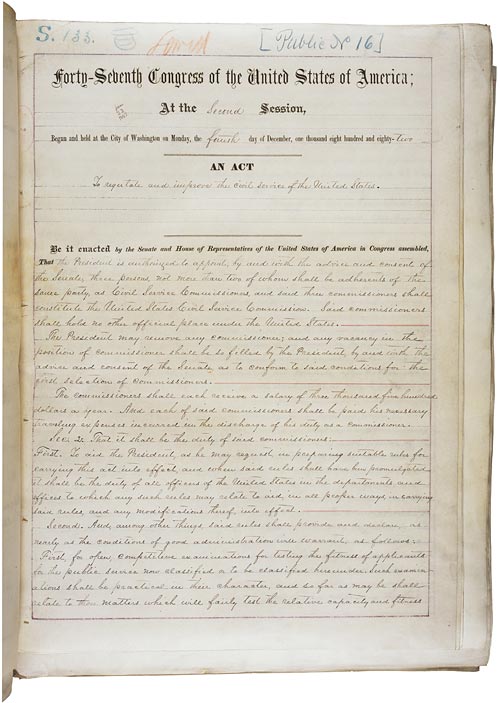
The Pendleton Act was born out of a crisis of confidence. Following the assassination of President James A. Garfield by a disgruntled office-seeker, the public and the financial markets demanded a more stable and predictable administrative state. The resulting legislation established the Civil Service Commission, which mandated that federal positions be awarded based on merit through competitive examinations. From a business finance perspective, this was the first national implementation of a “standardized hiring process,” designed to ensure that the “human assets” of the government were capable of managing the nation’s growing complexity.
Economic Implications of Merit-Based Hiring
The transition to a merit-based system had profound implications for the American economy. By professionalizing the civil service, the Pendleton Act stabilized the regulatory environment in which businesses operated. It created a layer of “career professionals” who maintained continuity even when administrations changed, providing the predictability that investors and markets crave.
Optimizing Human Capital ROI
In any large-scale organization, human capital is the most significant expenditure. Prior to the Pendleton Act, the government’s recruitment strategy was entirely haphazard, leading to high turnover and low institutional knowledge. By introducing competitive exams, the Act ensured that the government was hiring individuals with the requisite skills to manage the treasury, collect customs, and oversee public lands. This optimization of labor led to a more efficient allocation of taxpayer dollars, reducing the “waste” that had characterized the mid-19th century.
Eliminating Mandatory Political Kickbacks

One of the most transformative financial aspects of the Pendleton Act was the prohibition of “political assessments.” Under the spoils system, government employees were often required to “kick back” a percentage of their salary to the political party that had appointed them. This was effectively a private tax on public salaries, used to fund partisan campaigns. By banning this practice, the Pendleton Act not only protected the personal finances of government workers but also disrupted the financial plumbing of corrupt political machines. It decoupled public sector employment from private political financing, a move that remains a cornerstone of modern financial ethics and anti-corruption laws.
The Pendleton Act as a Model for Corporate Compliance
For modern business leaders, the Pendleton Act mirrors the development of internal controls and compliance frameworks. Just as a modern corporation must ensure that its procurement processes are free from bias to protect shareholder value, the Pendleton Act sought to protect the “value” of the American citizenry’s investment in their government.
Standardizing Recruitment for Long-Term Growth
The Act initially covered only about 10% of federal jobs, but it included a provision that allowed the President to expand the “classified service” by executive order. This scalability is a hallmark of successful organizational design. Over the decades, this allowed the government to grow its professional workforce in lockstep with the industrialization of the country. For a business, this represents the importance of building a “scalable culture” where meritocratic principles can be applied to new departments as the company expands. It moved the organization away from “founder-led” (or in this case, “party-led”) whims toward a system-driven approach.
Mitigating the Risk of Financial Corruption
In the world of business finance, risk management is paramount. The spoils system was a breeding ground for “agency risk”—where the agents (government employees) acted in their own interest or the interest of their political patrons rather than the interest of the principal (the American public). The Pendleton Act introduced the first major “Compliance Department” in the form of the Civil Service Commission. By auditing the hiring process and providing a legal framework for removals based on performance rather than politics, the Act mitigated the risk of systemic financial fraud. This laid the groundwork for future financial regulatory bodies, such as the SEC, which operate on similar principles of transparency and professional expertise.
Modern Lessons for Business Finance and Leadership
The legacy of the Pendleton Act extends far beyond the 19th century. Its core tenets—meritocracy, fiscal responsibility, and the elimination of conflicts of interest—remain the bedrock of successful financial management in both the public and private sectors.
Integrity as an Asset Class
In today’s ESG-focused (Environmental, Social, and Governance) investment landscape, the “G” for Governance has never been more critical. Investors are increasingly looking for companies that have robust internal systems to prevent cronyism and financial mismanagement. The Pendleton Act was the first great “Governance” victory in the United States. It demonstrated that integrity is not just a moral virtue but a financial asset. Organizations that hire based on merit and maintain clear boundaries between personal interests and professional duties are consistently more resilient and profitable over the long term.

Building Resilient Systems in the 21st Century
As we look toward the future of work—with the integration of AI in hiring and the rise of remote, decentralized organizations—the lessons of 1883 are surprisingly relevant. The Pendleton Act reminds us that systems are only as good as the metrics they use for success. If a system rewards loyalty over competence, it will eventually face a financial or operational collapse. Whether managing a startup’s budget or a multi-national’s HR department, leaders must ensure that their “meritocratic engines” are protected from the modern-day equivalents of the spoils system: nepotism, biased algorithms, and lack of transparency.
In conclusion, the Pendleton Act was more than a political reform; it was a fundamental shift in the American financial and organizational philosophy. It established the principle that public service is a public trust, and that the efficient management of human and financial resources is the duty of every institutional leader. By replacing a corrupt and wasteful system with one rooted in merit and accountability, the Act paved the way for the United States to become a global economic powerhouse, built on a foundation of professional integrity and fiscal discipline. For anyone interested in the intersection of money, management, and history, the Pendleton Act remains the gold standard for how to rebuild an institution for long-term success.
aViewFromTheCave is a participant in the Amazon Services LLC Associates Program, an affiliate advertising program designed to provide a means for sites to earn advertising fees by advertising and linking to Amazon.com. Amazon, the Amazon logo, AmazonSupply, and the AmazonSupply logo are trademarks of Amazon.com, Inc. or its affiliates. As an Amazon Associate we earn affiliate commissions from qualifying purchases.