
In the realm of mathematics, the orthocenter is a classic concept, often relegated to high school geometry textbooks. However, in the high-stakes world of modern technology—ranging from computer-aided design (CAD) and game engine development to structural engineering software—the orthocenter is far more than a point on a chalkboard. It is a critical geometric primitive that informs how we render 3D environments, how we simulate physical stresses in architecture, and how autonomous systems perceive the world through computer vision.
Understanding what the orthocenter of a triangle is, and more importantly, how it functions within a digital framework, is essential for developers, engineers, and tech enthusiasts who work with spatial data.

Defining the Orthocenter in the Context of Digital Engineering
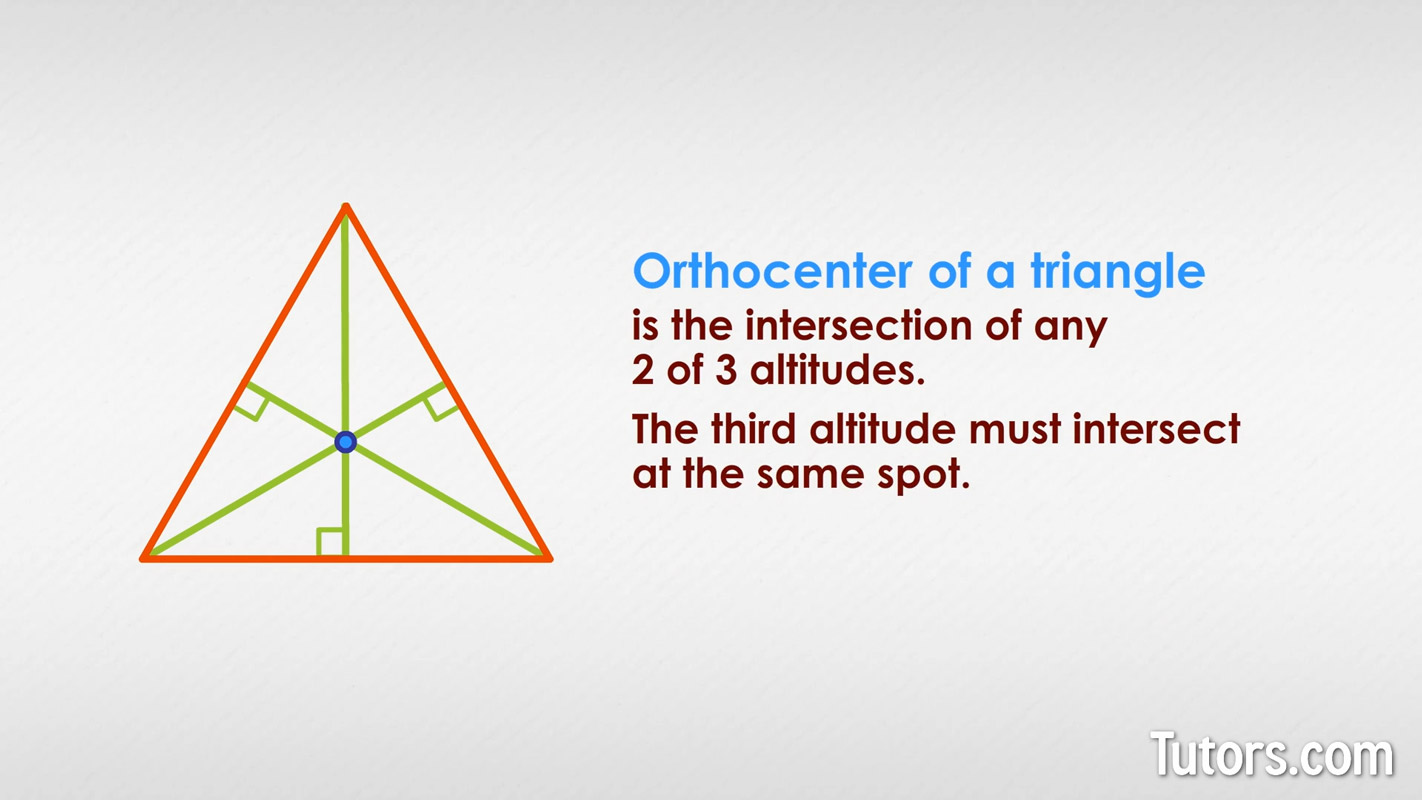
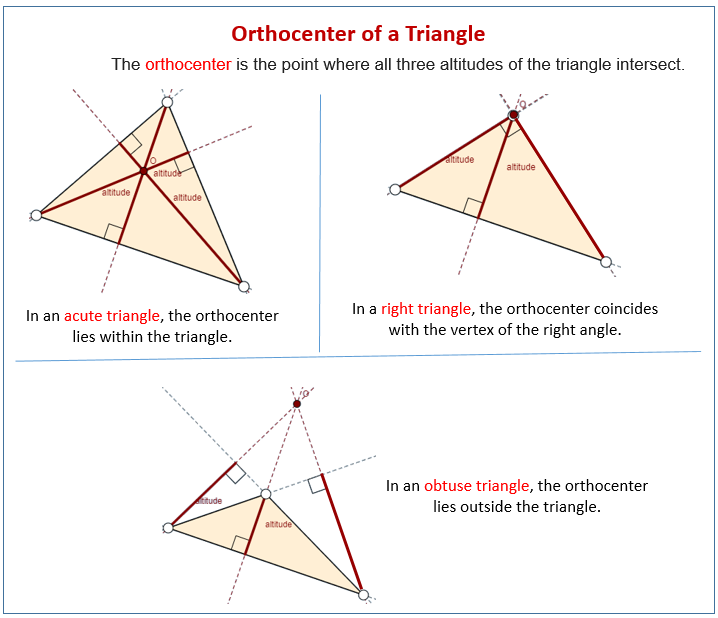
Before diving into the complex tech applications, we must establish a precise technical definition. In any given triangle, the orthocenter is the point where the three altitudes of the triangle intersect. An altitude is defined as a line segment passing through a vertex and perpendicular to the opposite side (or an extension of the opposite side).
The Intersection of Altitudes
From a software engineering perspective, calculating the orthocenter involves solving a system of linear equations. Unlike the centroid (the average of the vertices), which is always located inside the triangle, the orthocenter is dynamic. Its position relative to the triangle’s boundaries depends entirely on the triangle’s internal angles. In an acute triangle, the orthocenter resides inside; in an obtuse triangle, it falls outside; and in a right triangle, it sits exactly on the vertex of the right angle.
This variability is a significant factor in computational geometry. When algorithms are written to process triangular meshes (the foundation of almost all 3D digital models), the “behavior” of the orthocenter provides immediate metadata about the triangle’s properties without requiring heavy trigonometric calculations.
Properties and Computational Logic
In the tech sector, specifically in algorithmic development, the orthocenter is often studied alongside other “centers” like the circumcenter and centroid. Together, they form the Euler Line. For developers working on precision-based software, such as GPS mapping or satellite trajectory modeling, the relationship between these points is used to verify the accuracy of spatial coordinates. If a program’s output places the orthocenter outside the predicted Euler Line, it serves as a digital “red flag” for a calculation error or a data corruption issue.
Applications in Computer Graphics and Game Development
Modern gaming and visual effects rely on the decomposition of complex shapes into millions of tiny triangles, a process known as triangulation. The orthocenter plays a subtle but vital role in how these triangles are processed by the Graphics Processing Unit (GPU).
Collision Detection and Spatial Partitioning
In high-performance game engines like Unreal Engine 5 or Unity, “collision detection” is what prevents a digital character from walking through a wall. When a character’s hitbox interacts with the environment’s geometry, the engine must perform rapid calculations to determine the point of contact.
While the centroid is often used for simple movements, the orthocenter is utilized in more advanced “barycentric coordinate” systems. These systems help determine exactly where a point lies relative to a triangle’s altitudes. If a game engine needs to calculate the precise “bounce” of a projectile off a jagged surface, the orthocenter’s relationship to the surface normal (the perpendicular vector) becomes a key part of the physics engine’s logic.
Rendering Complex Meshes and Shading
Digital shading—the way light hits a surface—is another area where the orthocenter’s properties shine. In Phong shading or Gouraud shading, the computer must interpolate colors and light across a triangle. The altitudes of the triangle, which define the orthocenter, are used to calculate the “height” of various points within the mesh. This allows the GPU to determine the gradient of light intensity, ensuring that a 3D model looks smooth and realistic rather than like a collection of flat, jagged plates.
The Role of the Orthocenter in CAD and Architectural Software
Architecture has transitioned from drafting tables to sophisticated Building Information Modeling (BIM) software. Programs like AutoCAD, Revit, and Rhino 3D use geometric centers to ensure that the digital twin of a building reflects real-world physics.
Structural Integrity and Load Distribution
In structural engineering software, the orthocenter is frequently used during “Finite Element Analysis” (FEA). This is a process where a digital model of a bridge or skyscraper is broken down into a mesh of triangles (elements) to simulate how it will respond to stress, wind, and gravity.
Because the altitudes used to find the orthocenter represent the shortest distance from a vertex to the opposite base, they are inherently linked to the distribution of perpendicular force. If an engineer is calculating how a heavy load will compress a triangular support beam, the orthocenter provides a reference point for analyzing perpendicular stress vectors. Understanding where these altitudes intersect allows software to predict where a structure is most likely to buckle or fail under pressure.
Parametric Design and Generative Algorithms
The rise of “Generative Design” in tech—where AI suggests the most efficient shape for a part based on set constraints—relies heavily on the orthocenter. In parametric modeling, a change in one vertex of a triangle automatically recalculates the entire shape.
The orthocenter is often used as a “constraint point.” For instance, in the design of high-performance automotive parts, an algorithm might be instructed to keep the orthocenter within a specific coordinate range to ensure aerodynamic stability. As the AI iterates through thousands of designs, it uses the orthocenter as a geometric anchor to maintain the desired proportions and physical properties of the component.
Implementing Orthocenter Algorithms in Programming
For software developers, calculating the orthocenter isn’t about using a ruler and compass; it’s about writing clean, optimized code. Whether using Python for data science or C++ for system-level graphics, the implementation follows a standard geometric logic.
Coordinate Geometry in Python and C++
To find the orthocenter $(H)$ of a triangle with vertices $A, B,$ and $C$, a programmer typically uses the slope-intercept form. First, the slopes of the sides are calculated. Then, the slopes of the altitudes (which are the negative reciprocals of the sides) are derived. By creating equations for two of these altitudes, the programmer can find their point of intersection using a simple linear solver.
In Python, libraries like NumPy or SymPy make this process incredibly efficient. A developer can write a function that takes three coordinate pairs as input and returns the $(x, y)$ coordinates of the orthocenter in milliseconds. This is a foundational task in “Computational Geometry,” a subfield of computer science that powers everything from Adobe Illustrator’s vector tools to the pathfinding logic in autonomous vacuum cleaners.
Optimization for Real-Time Processing
In real-time tech applications, such as VR (Virtual Reality), the overhead of calculating geometric centers for millions of triangles can be taxing. Developers use “lazy evaluation” or pre-computed lookup tables for common geometric shapes to save processing power. When the orthocenter must be calculated on the fly, it is often done via SIMD (Single Instruction, Multiple Data) processing, allowing the CPU to handle multiple geometric points simultaneously, ensuring the user experiences a smooth, lag-free digital environment.
The Future of Geometric Computing in AI and Robotics
As we move further into the era of Artificial Intelligence and robotics, the orthocenter remains a relevant piece of the puzzle. The way robots perceive their environment is rooted in “Triangulation” and “Trilateration.”
Computer Vision and Shape Recognition
Computer vision systems—the “eyes” of self-driving cars—work by identifying key points in a 2D image and projecting them into 3D space. When a car’s camera identifies a triangular traffic sign, it uses geometric centers like the orthocenter to determine the sign’s orientation and distance. By analyzing how the orthocenter shifts relative to the camera’s perspective, the AI can calculate the “tilt” or “yaw” of the object, allowing the car to understand its spatial relationship with the sign in real-time.
Pathfinding in Non-Euclidean Spaces
In advanced robotics research, particularly in drones that navigate through dense forests or cluttered urban environments, pathfinding algorithms often create a “mesh” of the navigable space. The orthocenter is used in these contexts to refine the “medial axis” of a path—the safest route that stays as far away from obstacles as possible. By leveraging these ancient geometric principles through modern silicon, we enable machines to move with a level of precision that was once thought to be purely human.
Conclusion: The Silicon Heart of Geometry
While the question “What is the orthocenter of a triangle?” may seem like a relic of high school mathematics, its role in the tech industry is foundational. It is a vital tool for the graphics programmer, a safety parameter for the structural engineer, and a spatial guide for the AI developer. In our increasingly digital world, where everything from the buildings we live in to the games we play is constructed from triangles, the orthocenter serves as a silent, mathematical anchor. As software continues to evolve, our ability to manipulate these geometric points will remain at the core of technological innovation, proving that even the most basic mathematical concepts can power the most advanced machines.
aViewFromTheCave is a participant in the Amazon Services LLC Associates Program, an affiliate advertising program designed to provide a means for sites to earn advertising fees by advertising and linking to Amazon.com. Amazon, the Amazon logo, AmazonSupply, and the AmazonSupply logo are trademarks of Amazon.com, Inc. or its affiliates. As an Amazon Associate we earn affiliate commissions from qualifying purchases.