
Shoegazing music is often described as a “wall of sound”—a dense, ethereal, and overwhelming sonic landscape that blurs the lines between melody and texture. However, beneath the dreamy vocals and layers of distortion lies a sophisticated ecosystem of technology. Shoegaze is, at its core, a genre defined by the innovative use of audio hardware and signal processing. While the term originally referred to musicians staring at their feet (specifically their pedalboards), it has evolved into a masterclass in how technology can be used to push the boundaries of traditional instruments. To understand what shoegazing music is, one must look past the aesthetic and into the gear, software, and engineering techniques that make this expansive sound possible.

The Sonic Foundations: Engineering the Signal Chain
At the heart of any shoegaze composition is the signal chain. Unlike traditional rock, where the guitar signal is kept relatively clean to preserve note clarity, shoegaze relies on the radical transformation of the audio signal through series and parallel processing.
The Pedagogy of Pedals: Distortion and Temporal Effects
In the world of shoegaze, the guitar is less a melodic instrument and more a sound source for a modular synthesizer-like environment. The primary tools are distortion, fuzz, and time-based effects. The “Big Muff” fuzz pedal, for example, is a staple of the genre due to its high sustain and harmonic saturation, which allows a single chord to ring out indefinitely. However, the true technical innovation of shoegaze lies in the unconventional placement of these effects. Traditionally, reverb and delay are placed at the end of a signal chain to provide a sense of space. Shoegaze engineers often place reverb before the distortion. This creates a “washed out” effect where the echoes themselves are distorted, resulting in a thick, textured noise that lacks a clear attack but possesses immense harmonic depth.
Signal Routing and the Architecture of “The Wall”
Creating a “wall of sound” requires more than just high volume; it requires complex signal routing. Professional shoegaze setups often utilize stereo rigs and wet/dry signal splitting. By splitting the guitar signal, a musician can send a “dry” signal to one amplifier to maintain rhythmic definition while sending a “wet” (fully processed) signal to another. This prevents the sound from becoming a muddy mess, ensuring that despite the layers of noise, the structural integrity of the composition remains intact. Modern digital switching systems now allow players to reorder their signal chain on the fly, enabling rapid shifts from crystalline textures to crushing distortion.
Hardware Evolution: From Analog Rigs to Digital Signal Processing (DSP)
The history of shoegaze is intrinsically linked to the evolution of audio hardware. From the vintage rack units of the 1980s to the high-powered DSP chips of today, technology has dictated the genre’s capabilities.
The Rise of Rack-Mounted Units and Early Digital Reverb
In the late 80s and early 90s, the “shoegaze sound” was pioneered using early digital rack gear. The Yamaha FX500 and the Alesis Midiverb II were instrumental. These units featured “Early Reflection” and “Reverse Reverb” algorithms that became the signature of bands like My Bloody Valentine. These algorithms didn’t just simulate a room; they manipulated time, creating a sound that seemed to swell backwards toward the listener. The technical limitation of these early 12-bit and 16-bit processors—specifically their “lo-fi” aliasing and grainy textures—actually contributed to the genre’s unique sonic character, providing a digital warmth that modern high-fidelity units often struggle to replicate.
High-Fidelity DSP and Modern Pedal Integration
Today, the technology has shifted toward high-performance Digital Signal Processing (DSP) housed in compact stompboxes. Manufacturers like Strymon, Eventide, and Meris utilize ARM processors and Sharc chips to run complex mathematical models of space and time. These modern units offer “Shimmer” reverbs—which pitch-shift the reverb trail up an octave—and granular delay, which chops the audio signal into tiny “grains” and reassembles them in real-time. This level of processing power allows modern shoegaze artists to create soundscapes that were previously only possible in a high-end recording studio, bringing cinematic audio quality to the live stage.
The Software Front: VSTs and the Modern Bedroom Producer
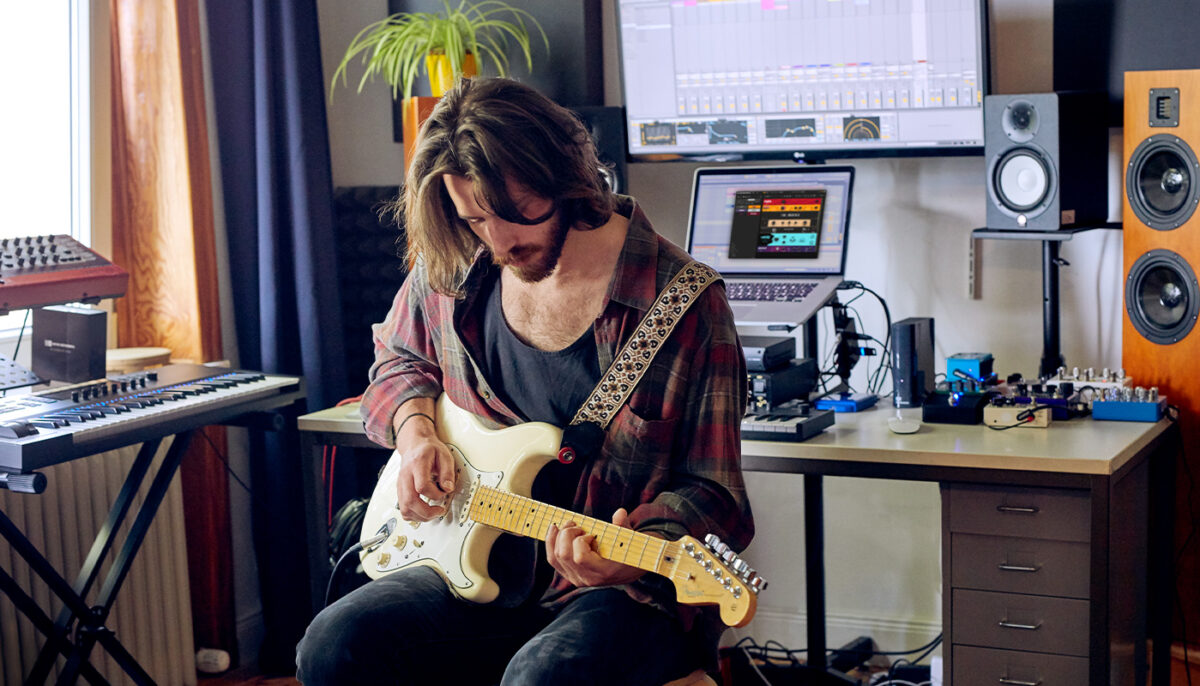
While hardware remains a cornerstone of the genre, the rise of the Digital Audio Workstation (DAW) and Virtual Studio Technology (VST) has democratized the creation of shoegaze. Technology has moved from the floor to the screen.
Emulating Analog Warmth in a Digital Environment
The challenge of digital shoegaze production is avoiding the “clinical” sound of modern software. To combat this, producers utilize saturation plugins and tape emulators. By applying virtual tape hiss, wow and flutter, and tube saturation, artists can give their digital layers the organic, “breathing” quality associated with vintage recordings. Software like Soundtoys or FabFilter allows for microscopic control over these parameters, enabling producers to automate the intensity of the noise throughout a track, creating a dynamic experience that hardware alone sometimes cannot achieve.
Advanced Plugin Suites for Ethereal Soundscapes
Beyond simple emulation, modern plugins offer creative possibilities that hardware cannot match. Granular synthesis plugins (such as Portal or GRM Tools) allow producers to stretch a single note into a ten-minute ambient texture without changing the pitch. Convolution reverbs, which use “Impulse Responses” (IRs) to recreate the acoustics of real-world spaces, allow a producer to make a guitar recorded in a bedroom sound like it was played in a massive cathedral or a metal tank. This technological flexibility is why shoegaze has seen a massive resurgence among independent producers; the barrier to entry is no longer a $5,000 pedalboard, but a laptop and a well-curated library of VSTs.
Engineering the Inaudible: Mixing and Mastering for Dense Audio
Mixing shoegaze is one of the most difficult tasks in audio engineering. When every instrument is competing for the same frequency range, technology must be used to create separation and clarity.
Frequency Management and Surgical EQ
The primary tech tool for a shoegaze mix engineer is the Equalizer (EQ). Because the “wall of sound” usually occupies the low-mid and high-mid frequencies, engineers must use surgical EQ to “carve out” space for the vocals and drums. Techniques like side-chain compression are frequently employed. For example, whenever the kick drum hits, the volume of the distorted guitars might be subtly and instantaneously dipped (ducked) by a few decibels. This is often done using multiband compressors, which allow the engineer to compress only the low frequencies of the guitar, leaving the ethereal highs untouched.
Spatial Processing and Phase Management
With so many layers of effects, phase cancellation is a constant threat. If two guitar tracks are out of phase, they can cancel each other out, making the mix sound thin. Modern mixing software includes phase-alignment tools and correlation meters that allow engineers to visualize the stereo image. To increase the “width” of a shoegaze track, engineers use spatial imaging tech to push certain frequencies to the extreme left and right of the stereo field, while keeping the core elements (vocals, snare, bass) in the center. This creates a 3D listening experience that immerses the listener in the sound.
The Future of Shoegaze: AI and Generative Audio Synthesis
As we look toward the future, the intersection of shoegaze and technology is entering the realm of Artificial Intelligence and generative synthesis.
AI-Driven Texture Generation
New AI tools are beginning to emerge that can analyze a melody and generate a “shoegaze texture” based on that input. By training neural networks on the discographies of genre pioneers, developers are creating tools that can automatically layer distortion, reverb, and modulation in ways that mimic human intuition. While some purists argue this removes the soul of the genre, it provides a new palette for sound designers to explore, allowing for the creation of textures that are mathematically complex and physically impossible to play on a traditional guitar.

The Immersive Audio Horizon: Dolby Atmos and Spatial Audio
The ultimate technological frontier for shoegaze is spatial audio, such as Dolby Atmos. Because the genre is so focused on “immersion,” the transition from stereo to a 360-degree sound field is a natural evolution. With spatial audio technology, an engineer can place a shimmering reverb trail behind the listener’s head while a wall of fuzz rotates around the room. This moves shoegaze from a “wall of sound” to a “sphere of sound,” utilizing object-based audio technology to fulfill the genre’s original promise of total sonic envelopment.
In conclusion, shoegazing music is far more than a stylistic choice; it is a celebration of audio technology. From the strategic abuse of analog circuits to the precision of modern DSP and the infinite possibilities of software, the genre continues to evolve alongside the tools used to create it. Whether through a vintage pedalboard or a high-end DAW, the “tech” of shoegaze remains its most vital component.
aViewFromTheCave is a participant in the Amazon Services LLC Associates Program, an affiliate advertising program designed to provide a means for sites to earn advertising fees by advertising and linking to Amazon.com. Amazon, the Amazon logo, AmazonSupply, and the AmazonSupply logo are trademarks of Amazon.com, Inc. or its affiliates. As an Amazon Associate we earn affiliate commissions from qualifying purchases.