
In the world of personal finance and wealth management, the adage “it’s not about how much you make, but how much you keep” holds profound significance. Asset protection is a strategic component of financial planning designed to safeguard one’s wealth from legal claims, creditors, and unforeseen financial catastrophes. While often associated with the ultra-wealthy, asset protection is a vital discipline for anyone with a positive net worth, a business, or investments that they wish to preserve for future generations.
Protecting assets involves the use of legal techniques and financial instruments to place a “barrier” between a creditor and the debtor’s assets. It is a proactive endeavor, intended to discourage litigation and provide a safety net in an increasingly litigious society. This guide explores the multifaceted world of asset protection, focusing on the legal structures, insurance policies, and strategic planning necessary to ensure long-term financial resilience.

1. The Foundation of Asset Protection: Understanding Risks and Asset Classes
Before implementing a protection strategy, one must understand what is being protected and from whom. Asset protection is not about hiding money or evading taxes; rather, it is about utilizing legal frameworks to minimize vulnerability.
Defining Personal and Business Assets
Assets generally fall into two categories: liquid and illiquid. Liquid assets include cash, savings accounts, and stocks, which are easily accessible but also easily seized in a legal judgment. Illiquid assets include real estate, equipment, and private business interests.
In the eyes of the law, assets are further categorized as “exempt” or “non-exempt.” Exempt assets are those protected by state or federal law from creditors, such as primary residences (in some jurisdictions) and qualified retirement accounts. Non-exempt assets are “fair game” for creditors. Effective asset protection seeks to convert non-exempt assets into protected forms or house them within protective legal shells.
Identifying the Risks: Creditors, Lawsuits, and Market Volatility
The modern financial landscape is fraught with risks. These include “inside” risks (liabilities arising from the asset itself, like a slip-and-fall at a rental property) and “outside” risks (liabilities arising from the owner’s actions, such as a car accident or a professional malpractice suit).
Beyond litigation, asset protection also accounts for market volatility and systemic economic shifts. While a trust might protect cash from a lawsuit, a diversified investment portfolio protects that same cash from inflation and market downturns. True protection is a dual-layered approach: protecting the legal title to the money and protecting the purchasing power of the money.
2. Legal Structures for Wealth Preservation
The cornerstone of any robust asset protection plan is the separation of the individual from their wealth. By shifting legal ownership from a natural person to a legal entity, one can create significant hurdles for potential claimants.
The Role of Limited Liability Companies (LLCs)
The LLC is perhaps the most versatile tool in the asset protection arsenal. By placing assets—such as a rental property or a side business—inside an LLC, the owner limits their personal liability. If the business is sued, the creditor can typically only pursue the assets held within the LLC, not the owner’s personal bank account or home.
Furthermore, many jurisdictions offer “charging order” protection. This means that if an owner is sued personally, the creditor cannot force the LLC to liquidate its assets. Instead, the creditor is only entitled to distributions made from the LLC, which the manager can choose to withhold, effectively trapping the creditor in a stalemate.
Using Trusts: Revocable vs. Irrevocable
Trusts are powerful fiduciary arrangements where a third party (the trustee) holds assets on behalf of a beneficiary.
- Revocable Living Trusts: While excellent for avoiding probate and managing estate affairs, these offer virtually no asset protection. Because the grantor retains control and the power to revoke the trust, the law views the assets as the grantor’s personal property.
- Irrevocable Trusts: To achieve true asset protection, one must often relinquish some degree of control through an irrevocable trust. Once assets are moved into an irrevocable trust, they are no longer legally owned by the individual. Specialized “Asset Protection Trusts” (APTs), available in certain U.S. states and offshore jurisdictions, allow the grantor to be a discretionary beneficiary while shielding the principal from future creditors.
Family Limited Partnerships (FLPs)
An FLP is a strategic tool often used by families to consolidate wealth and transfer it to the next generation while maintaining centralized management. By gifting “limited” interests to children while the parents remain “general” partners, the family can move wealth out of the parents’ taxable estate. Because limited partners have no control over the partnership, their creditors cannot easily reach the underlying assets, making the FLP a favorite for high-net-worth families.

3. Insurance as the First Line of Defense
While legal structures provide the “walls” of a financial fortress, insurance acts as the “moat.” It is the most accessible and cost-effective method of transferring risk from an individual to a corporation.
Liability Coverage and Umbrella Policies
Most individuals have basic homeowners and auto insurance. However, these policies often have low liability limits—sometimes as low as $300,000. In a serious legal dispute, these limits can be exhausted quickly.
An “Umbrella Policy” provides an extra layer of liability protection that kicks in after your primary policies are exhausted. For a relatively small annual premium, a million-dollar umbrella policy can protect your savings and future earnings from being garnished in the event of a catastrophic accident. It is arguably the highest-return investment in the realm of asset protection.
Professional Indemnity and Business Insurance
For professionals such as doctors, lawyers, and architects, malpractice or professional indemnity insurance is non-negotiable. Similarly, business owners require General Liability, Errors and Omissions (E&O), and Directors and Officers (D&O) insurance. These policies ensure that if a professional error occurs, the financial impact is absorbed by the insurer rather than the business’s balance sheet or the owner’s personal wealth.
4. Strategic Financial Planning and Statutory Exemptions
Asset protection isn’t just about high-tech legal maneuvers; it’s also about maximizing the protections already afforded to you by the government.
Homestead Exemptions and Retirement Accounts
Many people overlook the “built-in” protections provided by state and federal laws.
- The Homestead Exemption: Some states, like Florida and Texas, offer unlimited protection for a primary residence against most creditors. In these states, your home is essentially a “safe harbor” for your equity.
- Qualified Retirement Plans: Under the Employee Retirement Income Security Act (ERISA), assets held in 401(k) plans are generally shielded from creditors. Similarly, IRAs are protected up to a certain dollar amount under federal bankruptcy law, and many states offer additional protections. Prioritizing contributions to these accounts is a savvy move for both tax efficiency and asset protection.
Offshore Asset Protection: Benefits and Compliance
For those with significant wealth, moving assets to offshore jurisdictions (like the Cook Islands or Nevis) can provide the ultimate level of protection. These jurisdictions do not recognize foreign court orders, meaning a creditor would have to refile their lawsuit in a foreign court—an expensive and daunting prospect.
However, offshore protection comes with rigorous reporting requirements, such as the FBAR (Foreign Bank Account Report) and FATCA. Engaging in offshore protection requires meticulous compliance to avoid “tax evasion” labels, as the goal is legal protection, not hiding income from the IRS.
5. Implementing a Long-Term Asset Protection Strategy
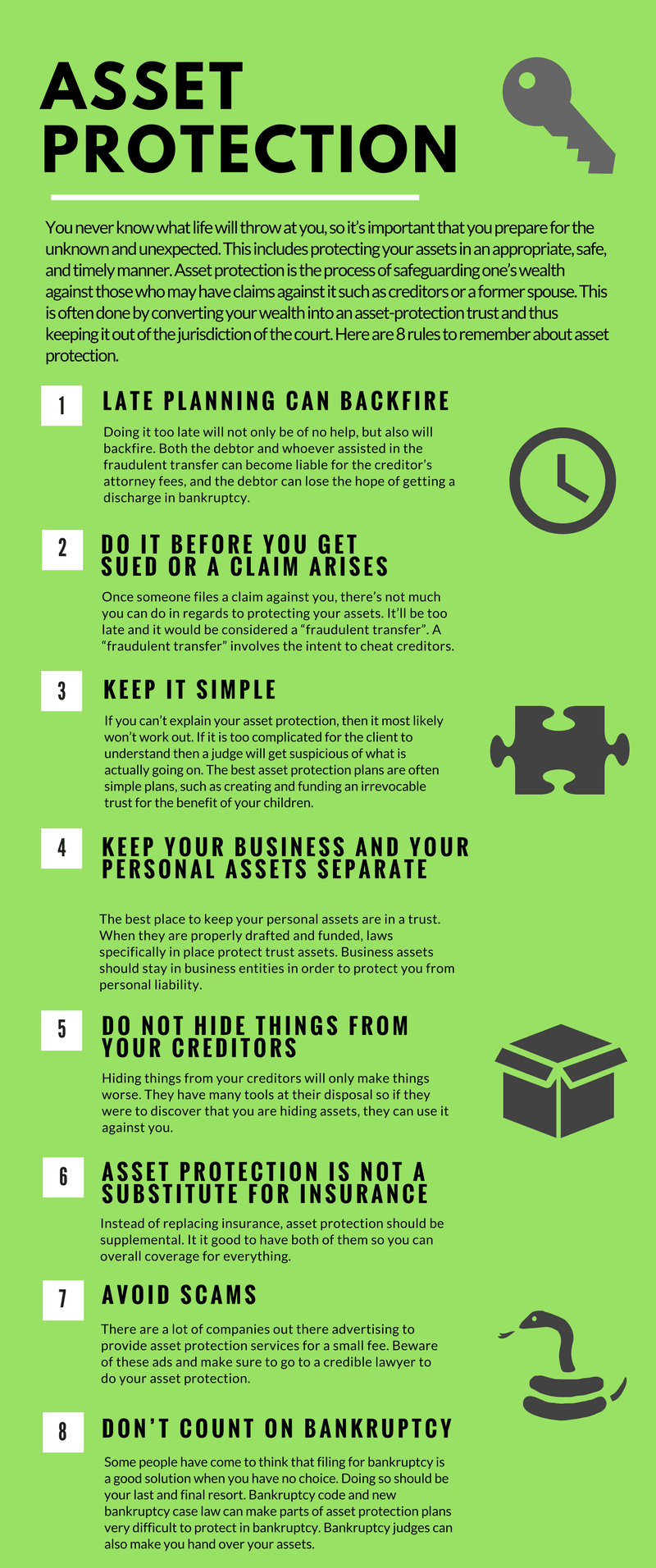
The most critical aspect of asset protection is timing. A plan implemented after a claim has been made or a lawsuit has been filed is often useless due to “Fraudulent Transfer” laws.
The Importance of Timing and the “Fraudulent Transfer” Trap
Courts have the power to “undo” the transfer of assets if they believe the transfer was made with the intent to hinder, delay, or defraud a known creditor. If you move your money into a trust the day after you are served with a lawsuit, a judge will likely void that transfer. Asset protection must be “sunny day” planning—established when the horizon is clear and no specific threats are looming.
Regular Audits and Maintenance
Asset protection is not a “set it and forget it” endeavor. Laws change, family dynamics shift, and wealth grows. An LLC that has its corporate veil pierced because the owner commingled personal and business funds offers no protection. Regular audits with financial advisors and legal counsel are necessary to ensure that entities are properly maintained, minutes are recorded, and assets are correctly titled.
Conclusion
Protecting assets is a disciplined approach to financial stewardship. It requires a blend of legal foresight, adequate insurance, and the strategic use of statutory exemptions. By separating personal identity from wealth ownership and building a multi-layered defense system, individuals can ensure that their hard-earned capital remains a source of security for themselves and a legacy for their heirs. In the world of finance, being proactive is the only way to ensure that your “assets” remain exactly that—yours.
aViewFromTheCave is a participant in the Amazon Services LLC Associates Program, an affiliate advertising program designed to provide a means for sites to earn advertising fees by advertising and linking to Amazon.com. Amazon, the Amazon logo, AmazonSupply, and the AmazonSupply logo are trademarks of Amazon.com, Inc. or its affiliates. As an Amazon Associate we earn affiliate commissions from qualifying purchases.