
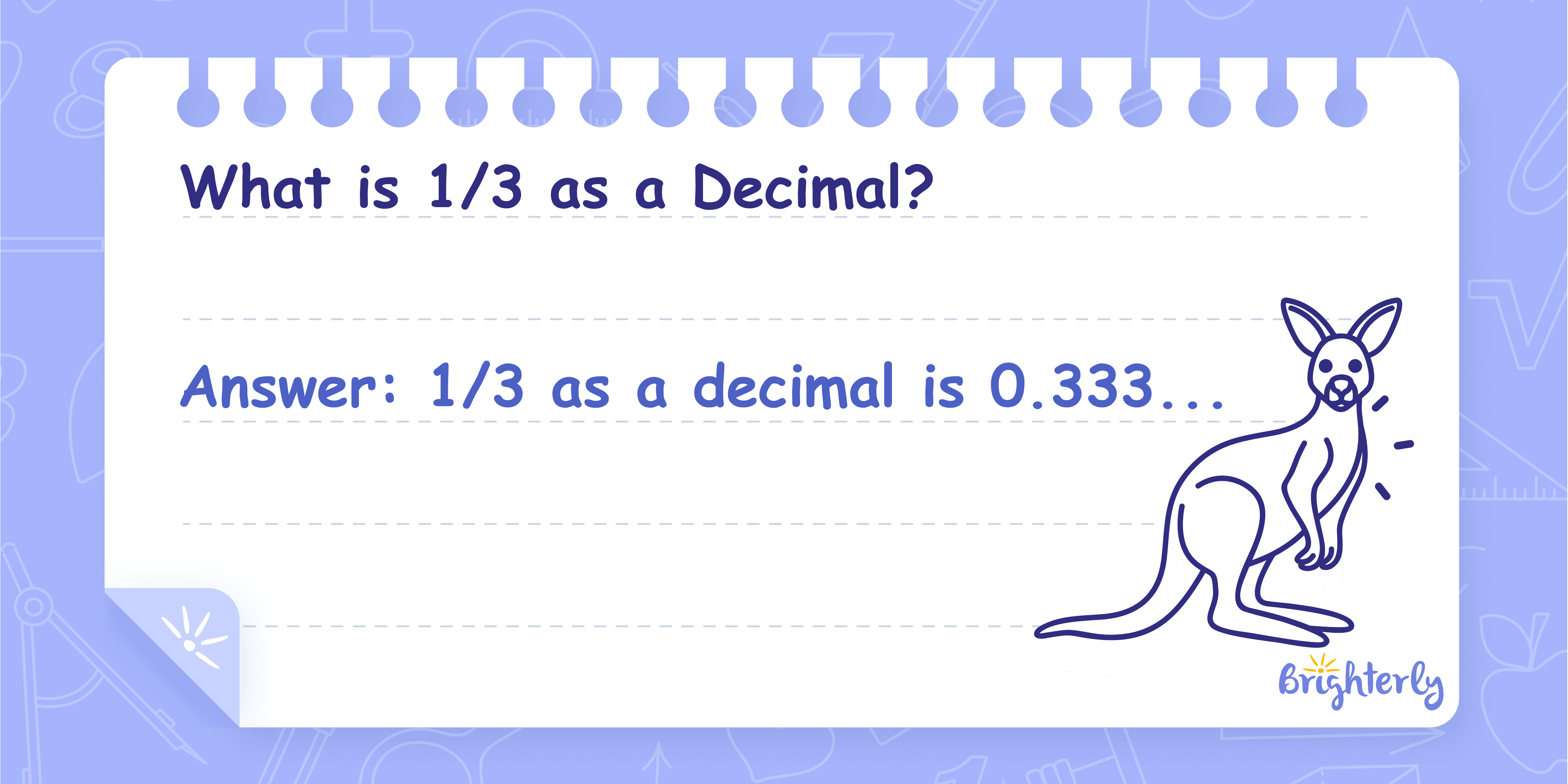
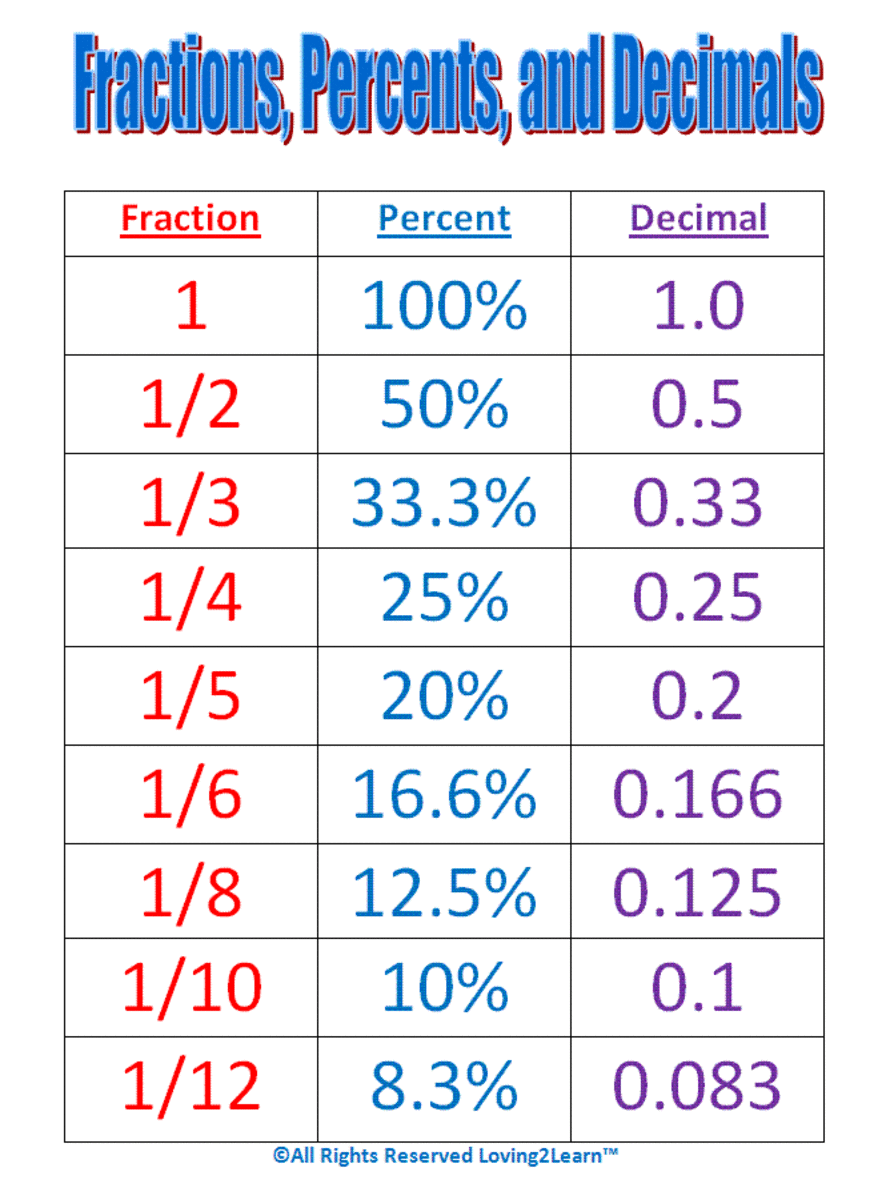
In the realm of elementary mathematics, the question “what is the decimal of 1/3?” yields a straightforward, albeit infinite, answer: 0.333… repeating. To a human with a pencil and paper, the ellipsis represents a simple concept of infinity. However, in the world of technology, software engineering, and digital architecture, the decimal representation of 1/3 is anything but simple. It represents a fundamental challenge in how hardware and software interpret the physical world through the lens of binary logic.
As we move toward an era dominated by Artificial Intelligence (AI) and high-frequency data processing, the way our tools handle “unclean” fractions like 1/3 defines the boundaries of digital precision. This article explores the technical nuances of representing periodic decimals, the architectural constraints of modern processors, and the software solutions that ensure our digital world doesn’t crumble under the weight of rounding errors.

The Paradox of Periodic Decimals in Binary Systems
To understand why 1/3 is a significant figure in technology, one must first understand the fundamental disconnect between human base-10 (decimal) counting and computer base-2 (binary) logic. Humans use ten digits, allowing us to represent 1/3 as a repeating sequence of threes. Computers, however, rely on transistors that are either “on” or “off”—0 or 1.
Why 1/3 is a Challenge for Silicon
In the decimal system, a fraction can be represented as a terminating decimal only if its denominator’s prime factors are limited to 2 and 5 (the factors of 10). Because the denominator of 1/3 is 3, it becomes a non-terminating, repeating decimal.
When a computer attempts to store 1/3, it faces a similar, yet more complex, problem. In binary, a fraction terminates only if its denominator is a power of 2. Since 3 is not a power of 2, 1/3 becomes a repeating sequence in binary as well: 0.01010101… infinitely. Because digital memory—whether it be RAM or a CPU register—is finite, the computer cannot store an infinite string of bits. It must eventually cut the number off. This “cutoff” is the birth of the floating-point error, a ghost in the machine that software developers have been battling since the dawn of the ENIAC.
The IEEE 754 Floating-Point Standard
To standardize how computers handle these messy decimals, the Institute of Electrical and Electronics Engineers (IEEE) established the IEEE 754 standard for floating-point arithmetic. This is the technical blueprint used by almost every modern processor, from the Apple M3 chip to Intel Core i9s.
Under this standard, a number like 1/3 is stored in “single precision” (32-bit) or “double precision” (64-bit). In 64-bit precision, a computer allocates 1 bit for the sign, 11 bits for the exponent, and 52 bits for the fraction (mantissa). Even with 52 bits of space, the computer can only approximate 1/3. It rounds the final bit, resulting in a value that is almost 1/3, but technically 0.333333333333333314829616256247… This tiny discrepancy is the foundation of numerical instability in complex algorithms.
Software Engineering Challenges: When 0.333 Isn’t Enough
In software development, the decimal of 1/3 is a classic “gotcha” that separates junior coders from senior architects. The inability of binary systems to perfectly represent 1/3 leads to cascading logic failures if not handled with technical rigor.
Round-off Errors and Their Cascading Effects
The danger of the 1/3 decimal isn’t the first calculation; it’s the thousandth. In iterative algorithms—such as those used in weather forecasting or physical simulations—a tiny rounding error in 1/3 is compounded every time the variable is reused.
Consider a graphics engine calculating the lighting for a 3D environment. If a surface is divided into three equal segments and the engine uses a standard float to represent 1/3, the sum of those three segments might equal 0.9999999999999999 instead of 1.0. This can result in “pixel gaps,” where light leaks through solid objects because the math literally does not add up. In digital security, these precision mismatches can even be exploited in “rounding attacks,” where hackers manipulate the way a system handles infinitesimal remainders to bypass authentication or alter transaction logs.
Lessons from History: The Legacy of Precision Failures
The tech world is full of cautionary tales regarding decimal precision. While the most famous example is the Pentium FDIV bug—where a flaw in the processor’s lookup table caused errors in floating-point division—more modern examples exist in software.
In high-performance computing (HPC), failing to account for the “tail” of the 1/3 decimal has led to catastrophic system failures. For instance, in missile defense systems or orbital mechanics software, a precision error at the 15th decimal place can result in a trajectory drift of several kilometers over long distances. For developers, the mantra is clear: never compare two floating-point numbers for equality. Writing if (x == 0.333333) is a cardinal sin; instead, engineers use an “epsilon”—a tiny threshold of acceptable error—to determine if a value is “close enough” to 1/3.
Modern Solutions for Mathematical Accuracy in AI and Data Science
As we transition into an era where AI tools and Big Data drive decision-making, the tech industry has developed sophisticated methods to bypass the limitations of standard floating-point decimals.
Libraries for Arbitrary Precision: Beyond the Float
When absolute accuracy is required, developers abandon the native CPU floating-point logic in favor of “Arbitrary-Precision Arithmetic” libraries. Tools like Python’s decimal module or Java’s BigDecimal class allow the computer to treat numbers as strings of digits rather than binary approximations.
By using these tools, a developer can define exactly how many decimal places of 1/3 they wish to maintain—whether it’s 50 or 5,000. These libraries simulate “human-style” math, ensuring that 1/3 + 1/3 + 1/3 equals exactly 1. While this comes at a cost of higher CPU overhead and slower execution speeds, it is the gold standard for software where numerical integrity is non-negotiable, such as in scientific research apps and high-end CAD (Computer-Aided Design) tools.
Quantization in Neural Networks
Interestingly, in the niche of AI and Machine Learning, the industry is moving in the opposite direction. Training large language models (LLMs) requires massive computational power. To speed up these AI tools, engineers use a process called “quantization.”
Instead of using 64-bit double precision to represent values like 1/3, they might downscale to 8-bit or even 4-bit integers. This purposefully sacrifices the precision of the decimal of 1/3 to gain speed and reduce energy consumption. The “insight” here is that neural networks are often robust enough to handle the “noise” created by these approximations. It turns out that for an AI to recognize a cat or generate a sentence, it doesn’t need to know that 1/3 is 0.333… to the fiftieth decimal place; 0.33 is often sufficient.
Best Practices for Developers Handling Non-Terminating Decimals
For those building the next generation of apps and digital tools, managing the decimal representation of 1/3 is a matter of choosing the right tool for the specific architectural requirement.
Unit Testing for Numerical Stability
In professional software environments, testing for “floating-point drift” is a standard part of the CI/CD (Continuous Integration/Continuous Deployment) pipeline. Developers use specialized testing frameworks to ensure that calculations involving 1/3 do not deviate beyond an acceptable margin over time. This involves “stress-testing” the math by running millions of iterations and checking for “divergence,” where the calculated value begins to drift away from the theoretical value.
Choosing the Right Data Type for the Task
The most critical decision a developer makes is the selection of the data type.
- Float (32-bit): Used in mobile apps and games where speed is prioritized over extreme accuracy.
- Double (64-bit): The industry standard for most general-purpose software and data analysis.
- Decimal/Fixed-Point: The mandatory choice for any software that handles sensitive measurements or coordinates.
- Rational Types: Some modern languages (like Clojure or Haskell) offer “Ratio” types that store 1/3 as two integers (1 and 3) rather than a decimal. This allows for perfect precision throughout the calculation, only converting to a decimal at the very last moment for human display.
By understanding the technical DNA of a number as simple as 1/3, we gain a deeper appreciation for the complex layers of logic that keep our digital world functioning. Whether it is the microscopic rounding of a 64-bit float or the high-level abstraction of a rational data type, the “decimal of 1/3” remains a powerful reminder that in technology, the bridge between infinite math and finite silicon is built on a foundation of brilliant engineering compromises.
aViewFromTheCave is a participant in the Amazon Services LLC Associates Program, an affiliate advertising program designed to provide a means for sites to earn advertising fees by advertising and linking to Amazon.com. Amazon, the Amazon logo, AmazonSupply, and the AmazonSupply logo are trademarks of Amazon.com, Inc. or its affiliates. As an Amazon Associate we earn affiliate commissions from qualifying purchases.