
In the traditional sense, the cardinal directions—North, South, East, and West—serve as the foundational pillars of geographic orientation. For centuries, humanity relied on the physical properties of the Earth, such as its magnetic field and the position of celestial bodies, to navigate the unknown. However, in the modern era, the definition and application of these directions have undergone a radical transformation. No longer confined to paper maps and magnetized needles, cardinal directions are now the backbone of complex algorithms, satellite constellations, and the burgeoning field of spatial computing.
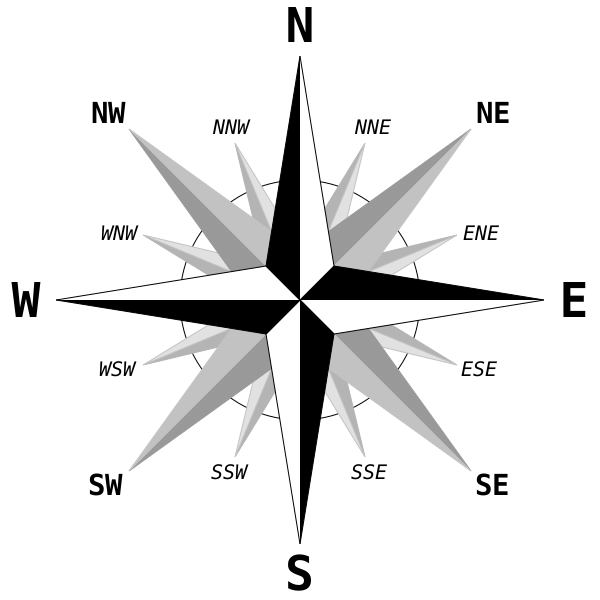
As we transition deeper into a digitally-mediated reality, understanding “what are the cardinal directions” requires looking through the lens of technology. This exploration examines how digital sensors, global positioning systems, and artificial intelligence have redefined our sense of place, turning ancient navigational concepts into high-precision data points that drive the global tech economy.
From Magnetism to Microchips: The Evolution of Directional Data
The journey from the physical compass to the digital orientation systems found in modern smartphones is a testament to the miniaturization of physics. In the tech sector, directionality is no longer a matter of looking at the stars; it is a matter of interpreting electrical signals from Micro-Electro-Mechanical Systems (MEMS).
The Transition from Analog to Digital Sensors
The shift began with the integration of the magnetometer into consumer electronics. Unlike the floating needle of a traditional compass, a digital magnetometer measures the strength and direction of magnetic fields using the Hall Effect or magneto-resistive materials. In the context of hardware engineering, this allows devices to determine their orientation relative to the Earth’s magnetic north with incredible precision. This sensor data is the primary layer of “direction” in the tech world, enabling everything from rotating map displays on mobile apps to the stabilization of drone flight paths.
How MEMS Accelerometers and Magnetometers Work Together
In advanced hardware design, a magnetometer rarely works alone. To provide a truly accurate sense of cardinal direction, tech developers utilize “sensor fusion.” This involves combining data from magnetometers, accelerometers (which measure tilt and motion), and gyroscopes (which measure rotation). By synthesizing these inputs, software can correct for electromagnetic interference caused by other electronic devices—a common hurdle in digital navigation—ensuring that “North” remains North even in a signal-heavy urban environment.
The Role of Cardinal Directions in Global Positioning Systems (GPS) and GIS
While a magnetometer tells a device which way it is facing, Global Positioning Systems (GPS) and Geographic Information Systems (GIS) tell the device where it is on the global grid. In this niche, cardinal directions are translated into a mathematical coordinate system (Latitude and Longitude), forming the digital skeleton of our modern world.
Triangulation and Coordinate Systems
The tech infrastructure behind GPS relies on a constellation of at least 24 satellites orbiting the Earth. These satellites transmit precise signals that allow receivers on the ground to calculate their location through trilateration. For developers and software engineers, cardinal directions are represented as vectors. North and South are defined by the Y-axis of the WGS84 (World Geodetic System) coordinate frame, while East and West occupy the X-axis. This mathematical abstraction allows software—from Uber’s routing algorithms to Amazon’s logistics trackers—to navigate the physical world with centimeter-level accuracy.
Geospatial Data and the Internet of Things (IoT)
As we enter the era of the Internet of Things (IoT), the “cardinal directions” of objects are becoming part of a massive data web. Smart cities use geospatial data to manage traffic flow, where sensors at intersections must understand the directional vector of approaching vehicles. In this tech-driven ecosystem, directionality is a vital data point used for predictive analytics. If a smart car is heading North at 60 mph, the network can anticipate its location minutes in advance, optimizing signal timing and reducing congestion through real-time data processing.
Navigating the Virtual Frontier: Directionality in UI/UX Design

In the realm of Software and App development, cardinal directions have moved beyond geography and into the world of User Interface (UI) and User Experience (UX) design. Here, “direction” refers to how a user navigates a digital environment, whether it is a 2D website or a 3D virtual reality (VR) space.
Spatial Computing and Augmented Reality (AR)
The rise of spatial computing—pioneered by devices like the Apple Vision Pro and Meta Quest—has forced a re-evaluation of cardinal directions within digital interfaces. In an Augmented Reality (AR) environment, the software must “pin” digital objects to specific physical directions. If a user places a virtual calendar on their “North” wall, the device’s SLAM (Simultaneous Localization and Mapping) algorithms must ensure that the object stays there regardless of how the user moves. This requires a sophisticated understanding of 3D space, where cardinal directions serve as the anchors for a persistent digital reality.
Intuitive Interface Navigation
In traditional web and app design, directional metaphors guide user behavior. We talk about “scrolling down” (South) or “navigating back” (West). Modern UI/UX designers use directional cues to reduce cognitive load. For instance, swiping right (East) might signify progression, while swiping left (West) signifies deletion or reversal. These digital “cardinal directions” create an intuitive language that allows users to navigate complex software ecosystems without needing a manual.
Autonomous Systems and the Robotics of Orientation
Perhaps the most significant application of cardinal directions in modern tech is in the field of robotics and autonomous vehicles. For a machine to move independently, it must possess a flawless internal map of the four cardinal directions and the ability to react to them in real-time.
LiDAR and Computer Vision: Seeing the Four Corners
Autonomous vehicles use a combination of LiDAR (Light Detection and Ranging) and computer vision to perceive their surroundings. LiDAR sensors pulse laser light to create a 360-degree 3D map of the environment. In this context, cardinal directions are the reference points used to align this local map with a global map. A self-driving car doesn’t just “see” an obstacle; it identifies the obstacle’s position relative to its own directional heading, calculating whether a turn toward the “East” is safe and compliant with traffic laws.
Machine Learning in Pathfinding Algorithms
At the heart of autonomous navigation are pathfinding algorithms like A* (A-Star) or Dijkstra’s algorithm. These pieces of software treat the world as a grid where movements are restricted to specific directions. Machine learning models are trained to optimize these paths, taking into account the “cost” of moving in different cardinal directions based on terrain, traffic, and fuel efficiency. This is the pinnacle of directional tech: a system that not only knows where North is but can intelligently decide whether North is the best way to go.
The Future of Spatial Awareness in Tech
As we look toward the future of technology, our reliance on traditional cardinal directions may evolve further into the realm of quantum mechanics and hyper-precise digital twins. The “directions” of the future will be more than just points on a compass; they will be high-fidelity streams of data that merge our physical and digital lives.
Quantum Sensing and Beyond
Current GPS technology can be hindered by “urban canyons” (tall buildings) or solar flares. The next frontier in tech is quantum sensing. Quantum compasses, which use the properties of subatomic particles to measure movement and orientation, promise to provide navigation that is 1,000 times more accurate than current systems. These devices will not need satellites; they will determine cardinal directions by measuring the “quantum interference” of atoms, allowing for perfect navigation in deep space, underwater, or deep underground.

Ethical Implications of Precise Location Tracking
The ability of technology to pinpoint our orientation and direction brings significant questions regarding digital security and privacy. If a tech company knows exactly which cardinal direction you are facing at every second of the day, they can infer what you are looking at, who you are talking to, and what products you are interested in. As directional tech becomes more pervasive, the industry must balance the benefits of precise navigation with the necessity of protecting user data.
In conclusion, the question “what are the cardinal directions” has moved far beyond the simple orientation of North, South, East, and West. In the tech industry, these directions represent a sophisticated interplay of hardware sensors, satellite networks, software UI, and autonomous intelligence. By digitizing the compass, we have not only mastered the ability to find our way—we have created a world where the very concept of direction is a fundamental component of the digital experience.
aViewFromTheCave is a participant in the Amazon Services LLC Associates Program, an affiliate advertising program designed to provide a means for sites to earn advertising fees by advertising and linking to Amazon.com. Amazon, the Amazon logo, AmazonSupply, and the AmazonSupply logo are trademarks of Amazon.com, Inc. or its affiliates. As an Amazon Associate we earn affiliate commissions from qualifying purchases.