
The quest for comfortable indoor temperatures, especially during sweltering heatwaves, has led humanity to explore a myriad of cooling technologies. While air conditioners have long dominated the market, a more energy-efficient and environmentally conscious alternative has been steadily gaining traction: the evaporative air cooler. Often misunderstood and sometimes conflated with traditional air conditioning, evaporative coolers operate on a fundamentally different principle, offering a unique set of advantages and disadvantages that cater to specific climate needs and user preferences. This article delves into the intricate workings of evaporative air coolers, exploring their technological underpinnings, their applications, and their position within the broader landscape of climate control solutions.
The Science of Evaporative Cooling: Harnessing the Power of Water
At its core, an evaporative air cooler is a device that utilizes the natural process of water evaporation to lower air temperature. This phenomenon, often observed when water evaporates from our skin, leaving us feeling cooler, is the driving force behind these cooling systems. The technology itself is elegantly simple, yet remarkably effective in the right environmental conditions.
The Evaporation Process Explained
The principle of evaporative cooling hinges on the concept of latent heat of vaporization. When water transitions from a liquid state to a gaseous state (water vapor), it absorbs a significant amount of energy from its surroundings. In an evaporative cooler, this energy absorption is harnessed to cool the air passing through the device.
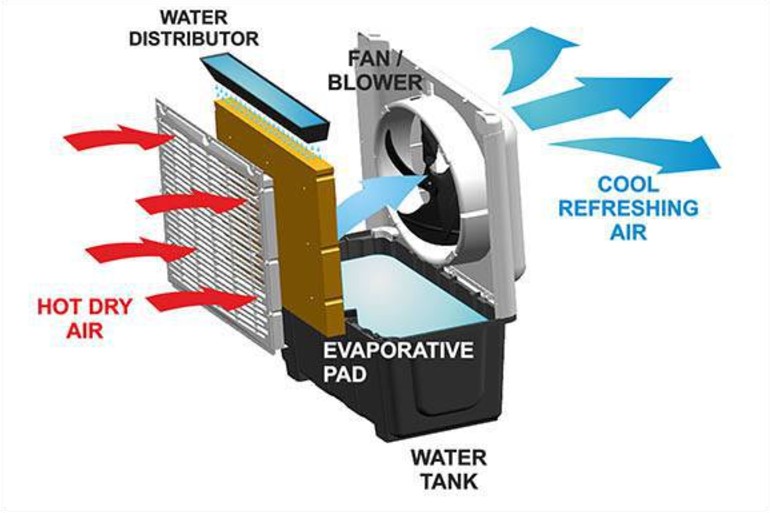
The process typically begins with a fan drawing warm, dry air into the cooler. This air then passes through a water-saturated porous medium, often made of materials like wood fibers, cellulose, or specialized synthetic pads. As the warm air makes contact with the moist surface of the medium, water molecules on the surface begin to evaporate. This evaporation requires energy, which is drawn from the air itself, thus lowering the air’s temperature. The cooled, humidified air is then expelled back into the environment.
Key Components of an Evaporative Air Cooler
While the underlying science is straightforward, the design of an evaporative air cooler incorporates several key components working in concert to achieve efficient cooling:
- Water Reservoir: This is the tank that holds the water supply for the evaporation process. The size of the reservoir dictates how long the cooler can operate before needing a refill.
- Water Pump: A small pump circulates water from the reservoir to the cooling pads, ensuring they remain saturated and ready to facilitate evaporation.
- Cooling Pads: These are the heart of the evaporative cooler. They are designed to have a large surface area and excellent absorbency to maximize water-air contact. The material and design of the pads are critical for efficiency.
- Fan: The fan is responsible for drawing warm air into the unit and then expelling the cooled air. The speed and power of the fan directly influence the volume of air cooled and the rate of airflow.
- Motor: Powers the fan and the water pump.
- Housing: The external casing that encloses all the components and directs airflow.
The interplay of these components, driven by the physical principle of evaporation, transforms warm, dry air into a cooler, more comfortable breeze.
Advantages and Disadvantages: A Balanced Perspective
Evaporative air coolers offer a distinct set of benefits and drawbacks compared to other cooling technologies, making them a niche solution that excels in specific scenarios. Understanding these trade-offs is crucial for determining their suitability.
The Upside: Energy Efficiency and Environmental Friendliness
One of the most compelling advantages of evaporative coolers is their remarkable energy efficiency. Unlike refrigerated air conditioners that rely on energy-intensive compressors and refrigerants, evaporative coolers consume significantly less electricity. This translates to lower utility bills and a reduced carbon footprint.
- Lower Energy Consumption: Typically, an evaporative cooler uses a fraction of the electricity of a comparable air conditioner. The primary energy consumers are the fan and the water pump, both of which are relatively low-power components.
- No Refrigerants: Traditional air conditioners use chemical refrigerants that can have an environmental impact. Evaporative coolers, on the other hand, rely solely on water, making them a more eco-friendly option.
- Improved Air Quality: As warm air is drawn in and passed through the water-saturated pads, dust and other airborne particles are trapped. This can lead to a noticeable improvement in indoor air quality. Additionally, the process of evaporation adds moisture to the air, which can be beneficial in dry climates, alleviating issues like dry skin and irritated respiratory passages.
- Portability and Ease of Use: Many evaporative coolers are designed to be portable, with wheels for easy movement between rooms. They require no complex installation, often just needing to be plugged into a standard electrical outlet and filled with water.
The Downside: Climate Dependency and Humidity Concerns
The effectiveness of evaporative coolers is heavily influenced by the ambient humidity levels. This climate dependency is their most significant limitation.
- Ineffective in High Humidity: Evaporative cooling works by adding moisture to the air. In humid environments, the air is already saturated with water vapor, meaning less evaporation can occur. Consequently, the cooling effect is significantly diminished, and the cooler can even make the air feel damp and uncomfortable.
- Requires Ventilation: To maintain optimal cooling performance and prevent excessive humidity buildup, evaporative coolers require adequate ventilation. This means windows or doors should be partially open to allow moist air to escape and fresh, drier air to enter. This is in direct contrast to air conditioners, which are designed to create a sealed environment.
- Regular Maintenance: The water reservoir and cooling pads require regular cleaning and maintenance. The pads can develop mineral deposits or mold if not properly cared for, which can reduce efficiency and create unpleasant odors. Regular water refilling is also necessary.
- Limited Cooling Capacity: While effective in suitable climates, evaporative coolers typically do not achieve the same dramatic temperature drops as air conditioners. They offer a more gentle cooling effect, bringing the temperature down by a noticeable but often less extreme margin.
Applications and Suitability: Where Do Evaporative Coolers Shine?
The unique operating principles and environmental dependencies of evaporative air coolers make them ideal for specific applications and geographical regions. Their strengths lie in arid and semi-arid climates where the natural cooling effect of evaporation can be maximized.
Ideal Environments and Use Cases
- Dry Climates: The Southwestern United States, many parts of Australia, the Middle East, and arid regions across the globe are prime candidates for evaporative coolers. In these areas, the low humidity allows for significant and effective cooling.
- Outdoor Cooling: Patios, workshops, garages, and other outdoor or semi-outdoor spaces can benefit greatly from evaporative coolers. The need for ventilation is less of a concern in these areas, and the added humidity is often welcome.
- Energy-Conscious Homes: For individuals or households prioritizing energy savings and environmental impact, evaporative coolers offer a compelling alternative to traditional air conditioning, especially in suitable climates.
- Personal Cooling: Smaller, portable evaporative coolers can be used for personal cooling in a localized area, providing a comfortable breeze without cooling an entire room. This is a more targeted and energy-efficient approach.
- Industrial and Agricultural Settings: Evaporative cooling is widely used in industrial processes, greenhouses, and agricultural settings to regulate temperature and humidity for optimal conditions.
When to Reconsider: High Humidity Dilemmas
Conversely, there are situations where an evaporative air cooler is simply not the optimal choice:
- Humid Coastal Regions: Areas with naturally high humidity, such as tropical or subtropical coastal cities, will find evaporative coolers largely ineffective and potentially counterproductive.
- Sealed Indoor Environments: If the intention is to create a completely sealed and dehumidified indoor environment, an evaporative cooler will not achieve this. Air conditioners are the technology designed for such purposes.
- Individuals Sensitive to Humidity: Some individuals may find even the slight increase in humidity caused by evaporative coolers to be uncomfortable, especially if they have respiratory sensitivities exacerbated by moisture.
Comparing Evaporative Coolers to Air Conditioners: A Technological Divide
Understanding the fundamental differences between evaporative air coolers and refrigerated air conditioners is essential for making an informed decision about climate control. While both aim to make indoor spaces more comfortable, their mechanisms, efficiency, and ideal applications are distinct.
Mechanism and Energy Consumption
- Evaporative Coolers: Utilize the natural process of water evaporation. They draw in warm air, pass it through a water-saturated pad, and expel cooler, more humidified air. Energy consumption is low, primarily for a fan and a water pump.
- Air Conditioners: Employ a refrigeration cycle. They use a compressor and refrigerants to remove heat and moisture from the indoor air, expelling it outdoors. This process is energy-intensive, requiring significantly more electricity.
Cooling Performance and Humidity Control
- Evaporative Coolers: Best suited for dry climates. They offer a noticeable but often moderate temperature drop. They increase humidity, which can be beneficial in dry regions but detrimental in humid ones. Requires ventilation.
- Air Conditioners: Effective in a wide range of climates, including humid ones. They can achieve significant temperature drops and actively dehumidify the air, creating a dry, cool environment. Designed for sealed spaces.
Installation and Maintenance
- Evaporative Coolers: Generally portable, requiring no professional installation. Maintenance involves regular cleaning of pads and refilling the water reservoir.
- Air Conditioners: Typically require professional installation (window units, central systems). Maintenance can involve cleaning filters and professional servicing of the refrigerant system.
Cost and Environmental Impact
- Evaporative Coolers: Lower purchase price and significantly lower operating costs due to reduced energy consumption. Environmentally friendly due to lack of refrigerants.
- Air Conditioners: Higher purchase price and higher operating costs. Refrigerants can have an environmental impact, although modern refrigerants are less harmful.
The Future of Cooling: Sustainability and Innovation
As concerns about climate change and energy consumption continue to grow, the demand for sustainable and efficient cooling solutions is on the rise. Evaporative air coolers, with their inherent energy efficiency and minimal environmental impact, are well-positioned to play an increasingly important role in the future of climate control.
Innovations and Emerging Technologies
The field of evaporative cooling is not static. Ongoing research and development are focused on enhancing their efficiency, expanding their applicability, and improving user experience:
- Advanced Pad Materials: Researchers are developing new pad materials that offer better water retention, increased surface area, and improved durability, leading to more efficient heat exchange.
- Hybrid Systems: Concepts for hybrid cooling systems that combine evaporative cooling with other technologies, such as small refrigeration units, are being explored to offer a broader range of performance and overcome humidity limitations.
- Smart Controls and Integration: The integration of smart sensors and control systems can optimize the operation of evaporative coolers, adjusting fan speeds and water flow based on real-time ambient conditions and user preferences, further enhancing efficiency.
- Renewable Energy Integration: Pairing evaporative coolers with solar power or other renewable energy sources presents a significant opportunity for truly off-grid and sustainable cooling solutions.

The Role of Evaporative Coolers in a Greener Future
The shift towards a more sustainable future necessitates a re-evaluation of our energy consumption patterns, particularly in areas like cooling. Evaporative air coolers offer a tangible solution for reducing reliance on energy-intensive air conditioning, especially in regions where they are most effective. By harnessing a natural, simple, and low-impact process, they provide a pathway towards more responsible climate control. While not a universal replacement for all cooling needs, their growing popularity and ongoing technological advancements underscore their importance as a vital component of a more sustainable and comfortable future.
aViewFromTheCave is a participant in the Amazon Services LLC Associates Program, an affiliate advertising program designed to provide a means for sites to earn advertising fees by advertising and linking to Amazon.com. Amazon, the Amazon logo, AmazonSupply, and the AmazonSupply logo are trademarks of Amazon.com, Inc. or its affiliates. As an Amazon Associate we earn affiliate commissions from qualifying purchases.