
In the rapidly evolving landscape of Natural Language Processing (NLP) and Artificial Intelligence, the nuances of human language are no longer just the concern of linguists and English professors. For developers, SEO specialists, and AI prompt engineers, understanding the granular building blocks of syntax is essential for creating coherent, high-ranking, and logically sound content. One of the most critical, yet often overlooked, components of this linguistic framework is the conjunctive adverb.
A conjunctive adverb is a part of speech that serves a dual purpose: it acts as an adverb by modifying a clause, and it acts as a conjunction by connecting two independent ideas. While simple conjunctions like “and” or “but” provide basic connectivity, conjunctive adverbs like “however,” “furthermore,” and “consequently” provide the logical connective tissue that allows both humans and machines to navigate complex arguments. In the context of tech and digital infrastructure, these words are the “logical operators” of human prose.
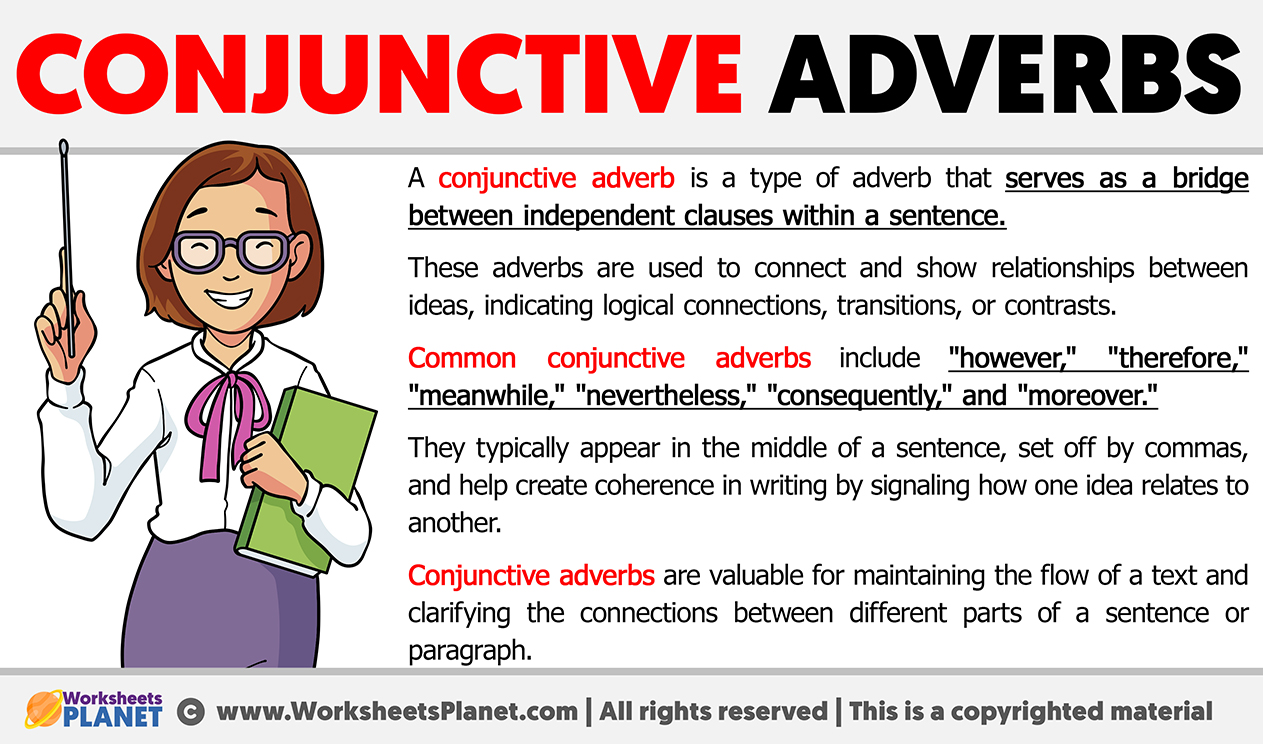
The Mechanics of Logic: Defining Conjunctive Adverbs in Natural Language Processing
To understand a conjunctive adverb from a technical perspective, we must look at how Natural Language Processing (NLP) models categorize and utilize them. In traditional grammar, these words transition the reader from one complete thought to another. In the world of data science, they are markers of transition and relationship.
The Syntax of Connectivity
Unlike coordinating conjunctions (the “FANBOYS”—for, and, nor, but, or, yet, so), conjunctive adverbs require specific punctuation to maintain the structural integrity of a digital document. Typically, they follow a semicolon and are followed by a comma. For example: “The server migration was successful; however, the latency issues persisted.”
From a coding standpoint, this structure mimics a conditional statement. The semicolon acts as a break in the “code” of the sentence, while the conjunctive adverb sets the “logical state” of the following clause. If the adverb is “therefore,” the machine (and the reader) expects a result. If it is “nevertheless,” they expect a contradiction.
Semantic Mapping and Relationship Types
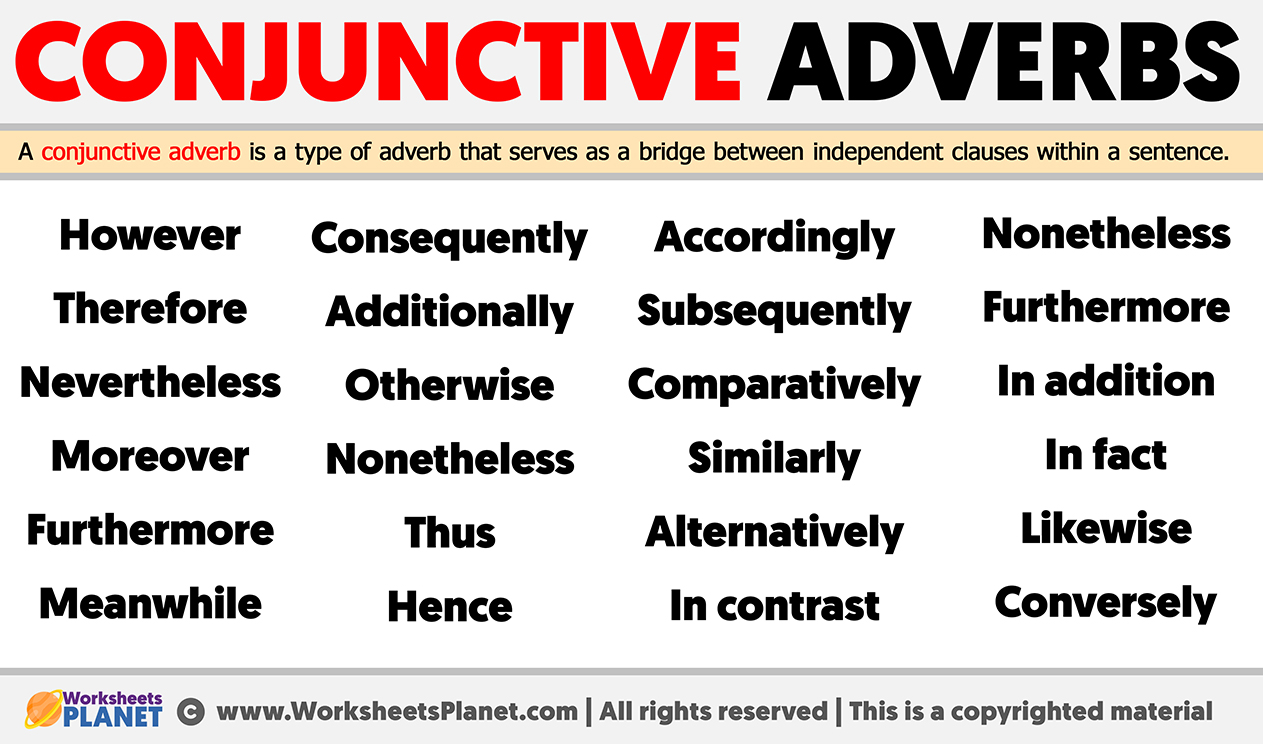
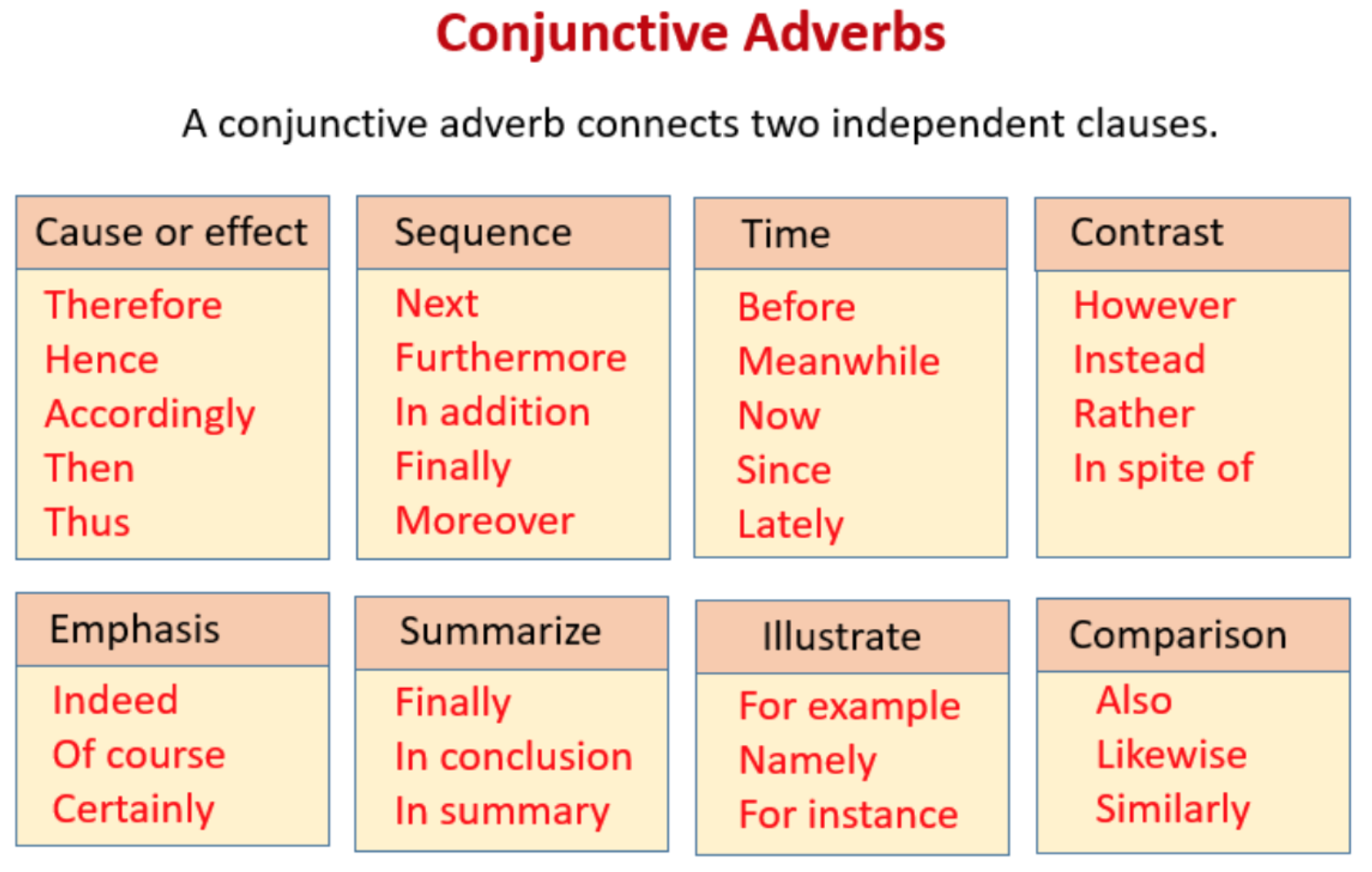
In NLP, conjunctive adverbs are categorized by the logical relationship they establish. Tech professionals working with sentiment analysis or text summarization tools prioritize these categories to understand the “flow” of data:
- Addition: Moreover, furthermore, additionally. (Logic: A + B)
- Contrast: However, nonetheless, conversely. (Logic: A vs. B)
- Cause and Effect: Consequently, therefore, accordingly. (Logic: A → B)
- Time/Sequence: Meanwhile, subsequently, finally. (Logic: A then B)
By identifying these tokens, AI models can map the hierarchy of information in a technical manual or a software documentation file, ensuring that the most critical instructions are understood in their proper context.
Bridging the Gap: Why Conjunctive Adverbs Matter for Large Language Models (LLMs)
The rise of Large Language Models, such as GPT-4 and Claude, has turned the spotlight onto “Prompt Engineering.” The effectiveness of an AI’s output is directly proportional to the clarity of the logical transitions within the prompt. Conjunctive adverbs are the tools that refine this clarity.
Enhancing Prompt Engineering Precision
When a developer interacts with an LLM, the goal is often to simulate a specific reasoning process. By utilizing conjunctive adverbs within a prompt, the user can force the model to weigh information differently.
For instance, compare these two prompts:
- “Analyze the code for bugs. Suggest optimizations.”
- “Analyze the code for bugs; subsequently, suggest optimizations that prioritize memory efficiency over execution speed.”
In the second example, the conjunctive adverb “subsequently” creates a temporal and logical sequence that the AI follows more strictly. It establishes a clear order of operations, reducing the likelihood of the model hallucinating or blending two distinct tasks into a muddled response.
Sentiment Analysis and Contextual Flow
For tech companies developing customer feedback tools, conjunctive adverbs are vital for sentiment analysis. A customer might write: “The software UI is beautiful; however, the API documentation is abysmal.”
A basic sentiment algorithm might see the word “beautiful” and “abysmal” and cancel them out, resulting in a “neutral” rating. However, a sophisticated NLP tool recognizes “however” as a pivotal conjunctive adverb that shifts the weight of the sentence to the second clause. In tech reviews and user experience (UX) research, the clause following the conjunctive adverb often contains the most actionable data.
SEO and Readability Algorithms: The Role of Transitional Phrases in Digital Ranking
In the world of digital marketing and search engine technology, “readability” is a core metric. Google’s search algorithms, influenced by the E-E-A-T (Experience, Expertise, Authoritativeness, and Trustworthiness) framework, prioritize content that provides a seamless user experience. Conjunctive adverbs are a primary signal of high-quality, authoritative writing.
Google’s Understanding of Semantic Relationships
Modern SEO has moved beyond mere keyword stuffing. Google now uses “semantic search” to understand the intent and meaning behind queries. Conjunctive adverbs help Google’s “spiders” understand the relationship between different sections of a technical article.
When a blog post uses words like “consequently” or “in contrast,” it signals to the search engine that the content is deeply researched and provides a comprehensive exploration of the topic. This improves the “Flow Score” of the page, which is a significant factor in reducing bounce rates. If a reader can easily follow the logic of a 2,000-word tutorial on “Setting up a Kubernetes Cluster,” they are more likely to stay on the page, signaling to the algorithm that the content is valuable.
Technical Implementation in Markdown and HTML
For technical writers, the placement of conjunctive adverbs also intersects with document structure. When writing in Markdown for GitHub or a documentation site, these transitions help break up “wall of text” syndrome.
- Accessibility (A11y): Screen readers use natural pauses at semicolons and commas. Proper use of conjunctive adverbs ensures that visually impaired developers can follow the logical transitions of a technical guide without confusion.
- Schema Markup: While conjunctive adverbs aren’t part of schema code, the clarity they provide allows for better auto-generation of “How-To” and “FAQ” rich snippets in search results.
Programming Logic and Linguistic Transitions: A Comparative Study
There is a fascinating parallel between the grammar of conjunctive adverbs and the syntax of modern programming languages. Both systems rely on specific tokens to manage the flow of logic.
Boolean Logic vs. Linguistic Flow
In programming, we use operators like IF, THEN, ELSE, and AND. In human language, the conjunctive adverb serves as the “Else-If” of the sentence.
- Code:
if (systemUpdate == true) { restartServer(); } else { continueOperations(); } - Prose: “The system update is complete; otherwise, the server will remain in standby mode.”
The word “otherwise” functions exactly like an else statement in JavaScript or Python. By viewing language through this lens, technical writers can create documentation that mirrors the logical structure of the software they are describing, making it more intuitive for developers to read.
Automation of Stylistic Editing
The tech industry is currently seeing a surge in AI-powered editing tools like Grammarly, Hemingway, and specialized code-commenting bots. These tools are programmed to identify “weak” transitions. A common critique in technical documentation is the overuse of “and” to connect complex ideas.
Automated linters for English text often suggest replacing a simple “and” with a conjunctive adverb like “moreover” or “accordingly” to elevate the technical precision of the document. This automation of style ensures that corporate white papers and technical specifications meet a global standard of professional communication, which is crucial for cross-border tech collaborations.
The Future of Linguistic Precision in the Tech Niche
As we move deeper into the age of Generative AI and automated content systems, the “human touch” in writing will increasingly be defined by sophisticated logical structures. The conjunctive adverb is not merely a relic of 19th-century grammar; it is a vital tool for the 21st-century technologist.
By mastering these terms, tech professionals can:
- Improve AI outputs through more structured and logical prompting.
- Enhance SEO performance by signaling depth and authority to search algorithms.
- Refine Technical Documentation to better serve the needs of a global developer community.
- Optimize NLP Models to better recognize and process human intent and sentiment.
Ultimately, whether you are writing a line of Python or a paragraph of a software review, the goal remains the same: the clear, efficient transmission of logic. The conjunctive adverb is the bridge that makes this transmission possible, ensuring that in the vast sea of digital data, our ideas remain connected, coherent, and impactful.
aViewFromTheCave is a participant in the Amazon Services LLC Associates Program, an affiliate advertising program designed to provide a means for sites to earn advertising fees by advertising and linking to Amazon.com. Amazon, the Amazon logo, AmazonSupply, and the AmazonSupply logo are trademarks of Amazon.com, Inc. or its affiliates. As an Amazon Associate we earn affiliate commissions from qualifying purchases.