
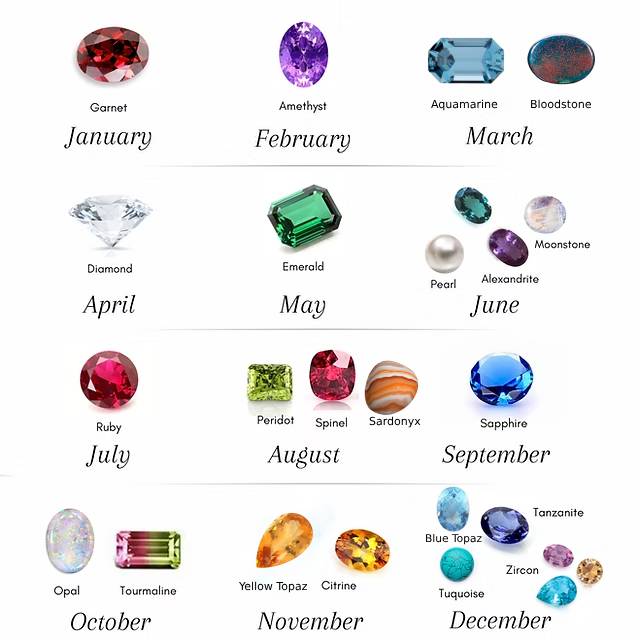
For centuries, the concept of monthly birthstones has been rooted in folklore, tradition, and personal sentiment. However, in the modern financial landscape, these twelve specific gemstones have transcended their status as mere birthday gifts to become a sophisticated class of alternative assets. As traditional markets face volatility, high-net-worth individuals and savvy retail investors are increasingly looking toward “portable wealth”—assets that hold intrinsic value regardless of currency fluctuations.
Understanding what the monthly birthstones are through the lens of investment requires a shift in perspective. It is no longer about the zodiac or personal affinity; it is about market scarcity, historical appreciation, and the “Big Three” of the colored stone world. This guide explores the financial viability of birthstones, analyzing which months offer the highest potential for capital gains and how to navigate the complex gemstone market.

The Economics of Rarity: Why Birthstones are More Than Just Jewelry
Before diving into the specific stones assigned to each month, it is essential to understand why these minerals hold financial weight. Unlike fiat currency, which can be printed, or digital assets, which rely on network effects, gemstones are a finite resource.
The Shift from Sentimental Value to Investment Grade
Historically, the list of birthstones was standardized by the American National Association of Jewelers in 1912. While this was a marketing masterstroke, it also inadvertently created a roadmap for demand. Because every person born in a specific month is a potential consumer for a specific stone, a baseline of global demand is permanently “baked into” the economy.
Investment-grade birthstones—those of exceptional color, clarity, and size—behave differently than commercial-grade stones found in mall kiosks. While a standard Amethyst (February) might retail for $20, a “Russian” Siberian Amethyst of top quality serves as a store of value. The key for the investor is identifying the threshold where a birthstone stops being a consumable and starts being a hedge against inflation.
Supply Constraints and Global Market Demand
The “money” side of birthstones is dictated by geological scarcity. Many of the most valuable birthstones are mined in geopolitically sensitive regions or from mines that are nearing exhaustion. For example, the scarcity of high-quality Rubies (July) from Myanmar or Emeralds (May) from Colombia has led to a consistent upward price trajectory over the last two decades. As an investor, the monthly birthstone list serves as a diversified portfolio of commodities, each with its own supply-chain dynamics and regional risk factors.
A Monthly Breakdown: Evaluating the Financial Potential of Each Stone
Not all birthstones are created equal in the eyes of a financial advisor. While every month has its stone, the market liquidity and appreciation rates vary significantly.
The “Big Three” and the Diamond Standard: April, May, July, and September
If you are approaching birthstones as an investment, these four months represent the “Blue Chip” stocks of the jewelry world.
- April (Diamond): The most liquid of all gemstones. Natural diamonds, particularly those with high GIA grades, have a robust secondary market. However, investors must now distinguish between natural and lab-grown stones; for wealth preservation, only rare, natural, and ideally “fancy colored” diamonds retain significant resale value.
- May (Emerald): These stones are notoriously included (containing internal flaws), which makes a “clean” Emerald extremely rare and valuable. Colombian Emeralds have shown 10-15% annual appreciation in some premium sectors.
- July (Ruby): Often called the “King of Gemstones,” the Ruby frequently outperforms diamonds per carat at auction. Unheated, “Pigeon’s Blood” rubies are among the most concentrated forms of wealth on the planet.
- September (Sapphire): Known for its durability and classic appeal, the Blue Sapphire (specifically from Kashmir or Ceylon) remains a staple for diversified asset portfolios.
The Growth Candidates: January, March, and November
While these stones—Garnet (January), Aquamarine (March), and Topaz (November)—were traditionally considered “semi-precious,” certain varieties are seeing a surge in “alternative asset” interest. For instance, the Tsavorite Garnet is rarer than the Emerald and is increasingly sought after by investors looking for undervalued entry points in the gemstone market. These stones offer a lower barrier to entry but require a keen eye for specific varieties that have high “collector demand.”
Key Performance Indicators (KPIs) for Gemstone Investment
Investing in birthstones is not as simple as buying a gold bar. The value is subjective and depends on a specific set of metrics that determine the “Quality of Asset.”
The Four Cs (and Beyond) in a Financial Context
In the world of personal finance, we look at P/E ratios; in birthstones, we look at the Four Cs: Color, Cut, Clarity, and Carat weight.
- Color: This is the primary driver of value for colored birthstones. Even a slight shift in hue can result in a 50% difference in market price.
- Carat Weight: The “price-per-carat” increases exponentially, not linearly. A two-carat Ruby is not twice as expensive as a one-carat Ruby; it might be four or five times the price due to the scarcity of larger crystals.
Origin and Provenance: The Premium of Place
In the “Money” niche of gemology, origin is everything. A birthstone’s value is heavily tied to its “pedigree.” A September Sapphire from Kashmir carries a massive premium over one from Australia, simply due to the historical significance and the exhausted nature of the Kashmir mines. When building a birthstone portfolio, securing a “Certificate of Origin” from a reputable laboratory like GIA, SSEF, or Gübelin is as vital as an audit for a public company. Without it, the liquidity of the asset drops significantly.
Building a Diversified Gemstone Portfolio
How does an investor actually integrate monthly birthstones into their financial strategy? It requires a blend of passion for the aesthetic and cold, hard data.
Liquidity Challenges and Exit Strategies
The biggest risk in gemstone investment is liquidity. Unlike a stock that can be sold with a click, a high-value Emerald or Ruby may take months to sell at the desired price. Investors should view birthstones as long-term holds (5–10 years).
The primary exit strategies include:
- Auction Houses: For stones valued at $50,000 and above (Sotheby’s, Christie’s).
- Private Treaty Sales: Selling to collectors or specialized dealers.
- Consignment: Placing the stone with a high-end jeweler.
Because of the “spread” between wholesale and retail prices, an investor must buy as close to the source as possible to ensure that the eventual appreciation covers the initial transaction costs.
Risk Mitigation and Authentication Protocols
The rise of synthetic (lab-grown) stones and sophisticated treatments (like heat or fracture filling) has made the market a minefield for the uninitiated. To protect your capital, never purchase an investment-grade birthstone without independent verification.
Furthermore, insurance is a non-negotiable expense. A birthstone portfolio must be appraised annually to reflect current market replacement values, ensuring that your tangible wealth is protected against theft or loss.

Conclusion: The Future of Birthstone Investing
The question of “what are the monthly birthstones” is no longer just a trivia point for jewelry enthusiasts; it is a fundamental question for those looking to diversify their wealth in a tangible, portable, and historically proven way. While April, July, and September remain the heavy hitters in terms of market capitalization, the increasing rarity of all natural gemstones ensures that this niche will continue to attract “smart money.”
By focusing on quality over quantity, insisting on world-class certification, and understanding the supply-demand cycles of specific months, an investor can transform a traditional list of birthstones into a resilient and beautiful financial legacy. In an era of digital dominance, there is a profound financial security in holding a piece of the earth that is both rare, beautiful, and globally recognized as a store of value.
aViewFromTheCave is a participant in the Amazon Services LLC Associates Program, an affiliate advertising program designed to provide a means for sites to earn advertising fees by advertising and linking to Amazon.com. Amazon, the Amazon logo, AmazonSupply, and the AmazonSupply logo are trademarks of Amazon.com, Inc. or its affiliates. As an Amazon Associate we earn affiliate commissions from qualifying purchases.