
In an era of hyper-connectivity, the query “what time is it in Dubai right now” is more than a simple request for a numerical value. For the global tech industry, Dubai’s time zone (GST – Gulf Standard Time, UTC+4) represents a critical bridge between the Eastern and Western hemispheres. However, beneath the surface of a simple Google search or a glance at a smartphone lies a sophisticated web of technological infrastructure designed to ensure that time is not just accurate, but synchronized across billions of devices, servers, and automated systems.
Dubai has positioned itself as a global technology hub, a “Smart City” that operates on the cutting edge of innovation. In this environment, time is a digital commodity. Whether it is for high-frequency trading, autonomous vehicle coordination, or decentralized blockchain ledgers, the technology required to maintain and communicate the precise time in Dubai is a feat of modern engineering.
The Digital Backbone of Universal Time in the UAE
When a user asks for the time in Dubai, they are interacting with a global network of time distribution. This process begins far away from the user’s screen, rooted in the physics of atomic clocks and the protocols of the internet.
Network Time Protocol (NTP) and the Global Sync
The primary technology responsible for telling you what time it is in Dubai is the Network Time Protocol (NTP). NTP is one of the oldest internet protocols still in use, designed to synchronize the clocks of computers over variable-latency data networks. In Dubai, local servers hosted in massive data centers—such as those operated by Equinix or Moro Hub—act as “stratum” servers. These servers receive time signals from reference clocks (like GPS satellites or atomic clocks) and distribute them across the UAE’s digital infrastructure.
Without the precise calibration of NTP, the digital ecosystem in Dubai would collapse. Financial transactions would lack accurate timestamps, leading to security vulnerabilities, and software updates would fail due to certificate mismatches. The tech stack ensuring “Dubai time” is accurate to the millisecond is the invisible foundation of the city’s digital economy.
How Dubai’s Data Centers Maintain Microsecond Precision
Dubai’s push toward becoming a global data hub has led to the construction of some of the world’s most advanced Tier III and Tier IV data centers. These facilities do not merely store data; they manage “temporal integrity.” For high-tech sectors like fintech and cloud computing, being “off” by even a fraction of a second can result in catastrophic data collisions.
The integration of PTP (Precision Time Protocol) in these data centers allows for synchronization at the microsecond level. Unlike NTP, which is sufficient for general internet use, PTP is utilized in Dubai’s industrial and financial sectors to ensure that every automated process—from a robotic arm in a smart factory to a trade on a digital exchange—occurs in the exact sequence intended by the software.
The Role of Time in Dubai’s Smart City Ecosystem
Dubai’s “Smart City” initiative is perhaps the most ambitious tech project in the Middle East. At its core, the initiative relies on the seamless integration of time-sensitive data. When we consider “what time it is in Dubai,” we must also consider how that time is utilized by the city’s Internet of Things (IoT) infrastructure.
IoT and Real-Time Logistics
In the logistics sector, particularly within DP World’s automated port operations, time synchronization is a critical safety and efficiency requirement. Thousands of sensors and automated cranes move containers based on real-time data feeds. These systems operate on a synchronized clock to prevent collisions and optimize the flow of goods.
The tech behind this involves “Edge Computing,” where time-sensitive processing happens locally on the device rather than in a distant cloud. This reduces latency, ensuring that the “time” perceived by a drone or an automated truck in Jebel Ali is identical to the central command center’s clock, down to the nanosecond.
Automated Transport and Time-Sensitive Algorithms
Dubai has set a goal for 25% of all transportation to be autonomous by 2030. Achieving this requires a level of temporal precision that goes beyond traditional GPS. Autonomous vehicles (AVs) in Dubai use a combination of LiDAR, radar, and V2X (Vehicle-to-Everything) communication.
For an AV to safely navigate a busy intersection in Downtown Dubai, it must know the exact time relative to other vehicles and the smart traffic lights. If the “time” signal is delayed or desynchronized by even a tenth of a second, the predictive algorithms governing the vehicle’s braking and acceleration could fail. The technology ensuring that every “smart” component in the city agrees on the time is a masterclass in distributed systems engineering.
Remote Work and the Tech of Global Collaboration
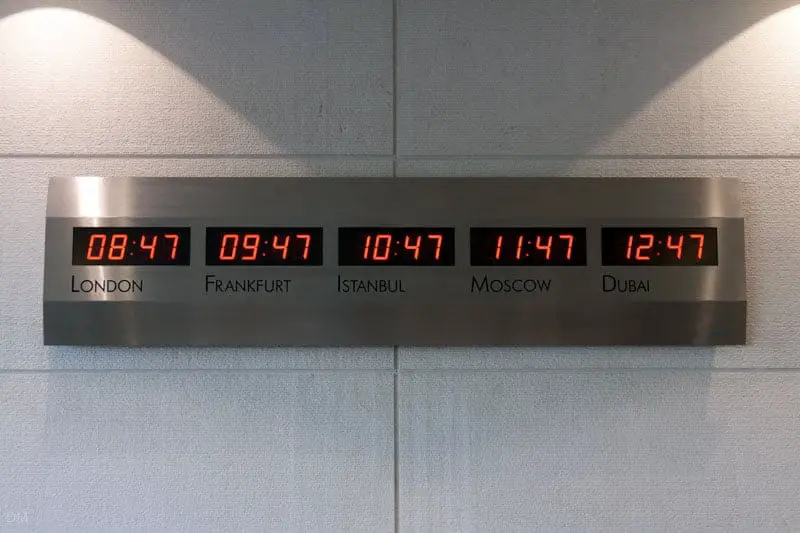
Dubai’s UTC+4 time zone is strategically significant for the global tech workforce. It allows for “follow-the-sun” development models, where teams in Asia hand off work to Dubai, which then hands off to Europe and eventually North America. This 24/7 development cycle is powered by a specific suite of collaboration technologies.
Time Zone Optimization Tools for the Modern Developer
Software developers and project managers in Dubai rely on sophisticated tools to manage the temporal gap. Beyond basic calendar apps, tech teams use integrated environment tools like Slack, Jira, and GitHub, which automatically adjust timestamps based on the user’s localized time.
Furthermore, specialized SaaS (Software as a Service) platforms like “World Time Buddy” or “Moro Hub’s Cloud Services” provide API integrations for enterprises. These APIs allow companies to build time-awareness directly into their internal apps, ensuring that a “deadline” set in a New York office is accurately reflected for a developer in Dubai Internet City without manual calculation errors.
Virtual Presence and Latency: Why Every Millisecond Counts
As Dubai becomes a hub for the “metaverse” and virtual reality (VR) collaboration, the technology of time becomes even more complex. In a virtual meeting room where participants from across the globe interact in real-time, “Network Jitter” and latency can break the illusion of presence.
Dubai’s investment in 5G and 6G research is aimed at reducing the “round-trip time” of data. When a user in Dubai interacts with a server in London, the speed of light dictates a minimum delay, but the tech stack—routers, switches, and fiber optics—must work to keep that delay consistent. In the tech world, knowing “what time it is” is less important than ensuring that everyone experiences that time simultaneously in a shared digital space.
Future-Proofing Time: Blockchain and AI Integration
Looking forward, the concept of time in Dubai is being redefined by two major tech pillars: Blockchain and Artificial Intelligence. These technologies do not just track time; they use it as a foundational element of security and prediction.
Decentralized Time-Stamping in Smart Contracts
Dubai’s “Blockchain Strategy” aims to move all government transactions to a ledger. In a decentralized system, there is no central “clock.” Instead, blockchain technology uses “Proof of History” or “Timestamping” to reach a consensus on when a transaction occurred.
This is vital for Dubai’s digital economy. When a property is sold in the metaverse or a supply chain shipment is verified on a ledger, the “time” recorded is immutable. Tech-wise, this involves cryptographic hashing where the time of a block is linked to the previous one, creating a permanent, unchangeable record of “what time it was” when the event took place. This eliminates fraud and provides a level of digital security that traditional timekeeping cannot match.
Predictive AI and the “Future-Time” Economy
Finally, Dubai is leveraging AI to move from “real-time” to “predictive-time.” Using vast datasets, AI models in Dubai’s Command and Control Centers can predict traffic congestion, energy demand, and even potential hardware failures before they happen.
These AI tools analyze historical “time” data to forecast future states. For a tech professional, “what time is it in Dubai” is increasingly becoming a question of “what will the system state be ten minutes from now?” This shift from reactive to proactive tech is what defines Dubai’s status as a futuristic city. The algorithms require perfectly synchronized historical data to train effectively, proving once again that the technology of time is the silent engine of the future.
Conclusion
The simple query “what time dubai right now” opens a door into a complex world of high-speed data transfer, atomic precision, and global synchronization. From the NTP protocols that keep our smartphones accurate to the PTP systems powering Dubai’s financial district, time is the invisible thread that holds the city’s tech ecosystem together.
As Dubai continues to innovate in the realms of Smart City infrastructure, blockchain, and AI, its relationship with time will only become more sophisticated. In the digital age, time is no longer just a measurement on a clock; it is a synchronized, secured, and highly optimized layer of the global technology stack. Whether you are a developer, an investor, or a casual traveler, the “time in Dubai” is a testament to the incredible digital infrastructure that powers our modern world.
aViewFromTheCave is a participant in the Amazon Services LLC Associates Program, an affiliate advertising program designed to provide a means for sites to earn advertising fees by advertising and linking to Amazon.com. Amazon, the Amazon logo, AmazonSupply, and the AmazonSupply logo are trademarks of Amazon.com, Inc. or its affiliates. As an Amazon Associate we earn affiliate commissions from qualifying purchases.