
In the world of finance, numbers are the language of success. Whether you are tracking the performance of a stock portfolio, evaluating the growth of a startup, or managing your personal household budget, understanding the “how” and “why” behind your financial shifts is critical. One of the most essential metrics in this analytical toolkit is the percentage increase.
Calculating percentage increase allows investors and business owners to strip away the raw dollar amounts—which can often be misleading—and look at the relative growth of an asset or revenue stream. It provides a standardized way to compare different investments, regardless of their size. In this comprehensive guide, we will explore the mathematical foundations of percentage increase and its vital applications across personal finance, investing, and business strategy.
Understanding the Core Formula in Financial Analysis
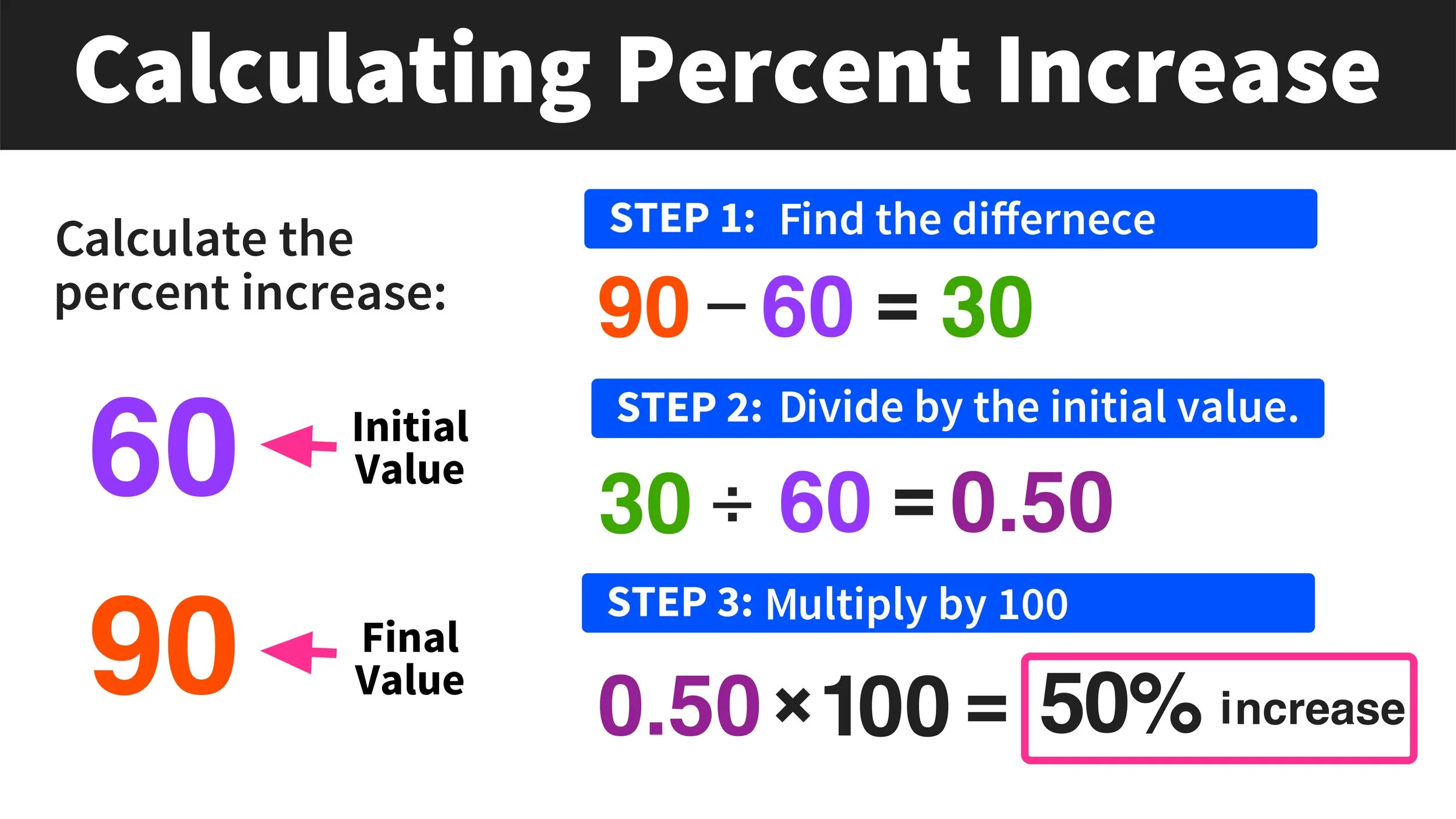
Before diving into complex market trends, one must master the fundamental arithmetic that drives financial reporting. Percentage increase measures the difference between a final value and an initial value, expressed as a proportion of the initial value.
The Basic Mathematical Equation
The formula for calculating percentage increase is straightforward yet powerful:
Percentage Increase = [(New Value – Original Value) / Original Value] × 100
To arrive at the correct figure, follow these three steps:
- Subtract the original value from the new value to find the “absolute increase.”
- Divide that absolute increase by the original value.
- Multiply the resulting decimal by 100 to convert it into a percentage.
For example, if you invested $1,000 in a mutual fund and its value grew to $1,250 over a year, the calculation would be: ($1,250 – $1,000) / $1,000 = 0.25. Multiplying by 100 gives you a 25% increase.
Real-World Financial Application
In a professional financial context, this calculation is rarely just a homework exercise. It is the basis for “Horizontal Analysis” in corporate accounting. By comparing line items on balance sheets or income statements over different periods, analysts can identify trends. For instance, if a company’s debt increases by 5% but its revenue increases by 20%, the percentage increase tells a story of healthy scaling. Conversely, if expenses increase at a higher percentage than income, it signals a need for immediate operational adjustment.
Measuring Investment Performance and Portfolio Growth
For the individual investor, the percentage increase is the ultimate yardstick for performance. Raw gains can be deceptive; a $500 profit on a $1,000 investment is a monumental success (50%), whereas a $500 profit on a $100,000 investment is a negligible fluctuation (0.5%).
Stock Market Gains and Asset Appreciation
When evaluating stocks, real estate, or cryptocurrencies, the percentage increase allows for an “apples-to-apples” comparison. If you are choosing between two assets—one a high-dividend stock and the other a growth stock—you must calculate the total return percentage increase (including dividends) to see which truly optimized your capital.
In real estate, calculating the percentage increase in property value over a decade helps homeowners understand their equity growth relative to the local market average. If your home value increased by 30% while the city average was 50%, the percentage calculation reveals that your specific investment is underperforming the market, prompting a re-evaluation of your real estate strategy.
The Role of Compounded Annual Growth Rate (CAGR)
While a simple percentage increase tells you how much you gained over a total period, it doesn’t account for the element of time. This is where the Compounded Annual Growth Rate (CAGR) becomes essential. CAGR is a specialized version of percentage increase that provides a smoothed annual rate of return.
If an investment grows by 100% over five years, it didn’t simply grow by 20% each year due to the effects of compounding. Serious investors use percentage increase as the starting point to determine if their “yield” is outpacing alternative “risk-free” investments, like Treasury bonds.
Business Finance: Tracking Revenue and Profitability Trends
For entrepreneurs and CFOs, percentage increase is the primary metric used to communicate health to stakeholders. It is used to measure everything from market share expansion to the efficiency of a new marketing campaign.
Analyzing Quarter-over-Quarter (QoQ) and YoY Growth
Businesses typically track growth in two ways: Quarter-over-Quarter (QoQ) and Year-over-Year (YoY).
- QoQ Growth: This measures the percentage increase from the previous quarter. It is useful for tracking short-term momentum and the immediate impact of strategic shifts.
- YoY Growth: This is often more valuable because it accounts for seasonality. For a retail business, comparing December sales to November sales (QoQ) might show a massive percentage increase, but it’s expected due to the holidays. Comparing this December to last December (YoY) provides a much more accurate picture of whether the business is actually expanding.
Evaluating Marketing ROI and Customer Acquisition
In the digital economy, marketing spend is scrutinized through the lens of percentage increase. If a company increases its ad spend by 10% and sees a 25% increase in lead generation, the “percentage increase in efficiency” justifies the extra cost. This data-driven approach allows businesses to scale their operations with confidence, ensuring that every dollar spent results in a disproportionately higher percentage of revenue.
Personal Finance: Managing Salary Increases and Inflation
On an individual level, understanding percentage increase is vital for maintaining purchasing power and negotiating one’s worth in the labor market.
Negotiating Raises and Cost of Living Adjustments (COLA)
When discussing a salary increase with an employer, the focus should always be on the percentage. A $3,000 raise might sound significant, but if your salary is $100,000, that is only a 3% increase. In many economic climates, a 3% increase barely covers the rising cost of goods.
By calculating the percentage increase of your output or the value you bring to a company, you can provide a quantitative argument for a corresponding percentage increase in your compensation. If you increased your department’s efficiency by 15%, requesting a 10% raise becomes a logical, math-based conversation rather than an emotional plea.
Understanding the Impact of Inflation on Purchasing Power
Inflation is essentially a percentage increase in the average price of goods and services. To remain financially healthy, your net worth and income must grow at a percentage higher than the inflation rate.
For example, if the Consumer Price Index (CPI) shows an inflation rate of 5%, and your savings account only offers a 1% interest rate (percentage increase), you are effectively losing 4% of your wealth’s value annually. Understanding this relationship allows individuals to move their money from stagnant savings accounts into investment vehicles that offer a higher percentage increase, thereby protecting their financial future.
Advanced Financial Tools and Automation for Calculation
While the manual formula is essential for conceptual understanding, modern finance relies on speed and accuracy through automation.
Using Excel and Google Sheets for Financial Modeling
In a professional setting, percentage increases are rarely calculated on a handheld calculator. Spreadsheets are the standard. In Excel, the formula is usually written as =(New_Cell - Old_Cell)/Old_Cell.
By setting up dynamic spreadsheets, investors can track their entire portfolio in real-time. A “Price” column can be linked to live market data, and a “Percentage Change” column can automatically update, highlighting which assets are “in the green” and which are “in the red.” This automation is the backbone of modern financial modeling, allowing for “what-if” scenarios—such as calculating how a 10% increase in interest rates would affect a loan’s total cost.
Leveraging Financial Calculators for Long-Term Planning
Many online financial tools specifically designed for “Online Income” or “Side Hustles” integrate percentage increase calculators to help users project future earnings. Whether you are calculating the “Churn Rate” (the percentage increase in lost customers) for a subscription service or the “Conversion Rate” (the percentage increase in visitors becoming buyers) for an e-commerce site, these tools provide the granular data needed to pivot and grow in a competitive digital landscape.

Conclusion: The Strategic Importance of Percentages
The ability to calculate and interpret percentage increase is more than a mathematical skill; it is a financial superpower. It allows you to see past the noise of raw numbers and understand the underlying velocity of your money. By applying this metric to your investments, your business operations, and your personal income, you gain a clearer perspective on your path to wealth.
In a world where the economy is constantly shifting, the percentage increase remains the most reliable indicator of progress. Whether you are aiming for a 7% annual return on your 401(k) or a 20% year-over-year growth in your side business, mastering this calculation ensures that you are not just working for money, but making your money work—at an increasing rate—for you.
aViewFromTheCave is a participant in the Amazon Services LLC Associates Program, an affiliate advertising program designed to provide a means for sites to earn advertising fees by advertising and linking to Amazon.com. Amazon, the Amazon logo, AmazonSupply, and the AmazonSupply logo are trademarks of Amazon.com, Inc. or its affiliates. As an Amazon Associate we earn affiliate commissions from qualifying purchases.